One of my colleagues, a cradle Catholic and a Diocesan priest, challenged me recently to say what exactly is this Anglican Patrimony which we in the Ordinariate are supposed to bring with us as a gift to the whole Church. He had been to an Ordinariate Funeral concelebrated by a group of priests wearing black latin chasubles reciting ‘our’ Eucharistic Prayer (as my colleague put it) but put into ‘tudor’ English. Anyone who has read some of my posts will not be surprised to learn that I tried to steer him away from thinking that this was indeed the ‘Anglican Patrimony’. But that still leaves me to answer the question, ‘If it’s not birettas, latin vestments and the maniple, what is it.
Can I give you a couple of examples which came my way recently – the first really quite trivial, the other not at all trivial?
The first is that custom we had of singing the Benediction hymns to seasonal tunes. Tomorrow at Adoration, therefore, I shall try Tantum ergo to the tune of Once in royal.
The second is much more serious. I’ve been looking again at the writings of Michael Ramsey who was Archbishop of Canterbury in the ’60’s and ’70’s. His stuff on priesthood just would not make sense if it were written and preached for today’s Church of England. But reading it now as a Catholic it has a richness and resonance which is deeply impressive. Could it be that the theology of Ramsey (and others) now find their place in a bigger and fuller communion that he ever imagined?
If you want a simple way to sing the ‘O antiphons’ for the days of Advent from 17th to 23rd December, read on. Of course, you could go to Evensong at King’s Cambridge or find them on YouTube. Fifty years ago we students at the Theological College at Kelham though nothing of singing them each day before and after the Magnificat, but I suppose they would be too ‘difficult’ nowadays.
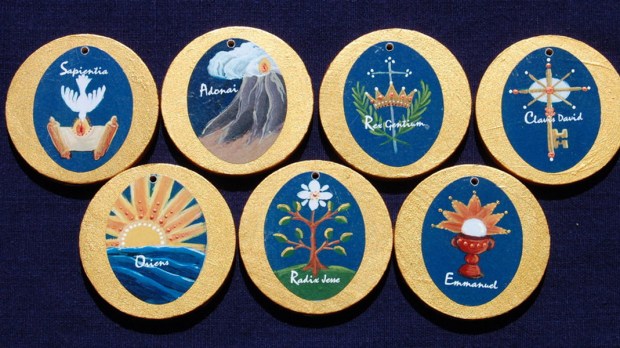
Here are the antiphons for each day. They date from around the 6th century, and address the Lord Jesus by a series of titles from the Old Testament of the long-awaited Messiah.
17 December: O Sapientia – O Wisdom
18 December: O Adonai
19 December: O Radix Jesse (O Root of Jesse)
20 December: O Clavis David (O Key of David)
21 December: O Oriens (O Dawn of the East)
22 December: O Rex Gentium (O King of the Nations)
23 December: OEmmanuel
The Roman lectionary uses the O Antiphons as the Gospel Acclamations at the Mass for each of these days. And in most parishes the Acclamation would be said (which is almost as bad as saying the Alleluia – a word which should only ever be sung in the Christian liturgy). But here is a simple way of singing the ‘O’s.
The hymn ‘O come, O come, Emmanuel’ is a metrical version of the Advent antiphons. Most hymn books do not have all seven antiphons, but the full version is to be found at n° 14 in the Revised English Hymnal . Print a sheet for the people with one verse for each day between 17th and 23rd. For the correct order, begin with verse 2, and finish with verse 1.
For the chorus sing Alleluia four times instead of Rejoice, rejoice, Emmanuel etc. This fits perfectly well, but you will need two notes on the -le of the second and fourth alleluia. And there you have your Great O Gospel Acclamations for the latter part of Advent.
Some ten years ago Dr Antonia Lynn and I put together a little booklet for the Novena of Prayer under the title ‘Called to be holy’. We composed the prayers using the Collect form. Archbishop Cranmer was very skilful in using this form and adapting it to the vernacular in his English Prayer Book. Neither the 1970 Missal nor its more recent translation into English have used this form particularly well.
Here is a prayer, composed by the two of us, which I used at the American War Memorial in Weymouth last Sunday.
O Almighty God / King of kings and Lord of lords : when the darkness of war engulfed the nations of the old world / you sent forth fresh light and hope from the new world / through the courage of brave men and women / Hear us as we pray in gratitude for those who gave their lives / that we might enjoy peace and freedom in our day / Welcome them, we pray, into the eternal light of your presence / through Jesus Christ our Lord: / Amen;
To conclude this series some observations on matters related to the celebration and presentation of the liturgy.
Reservation of the Blessed Sacrament
In mediaeval England the Blessed Sacrament was reserved in a pyx, suspended over the High Altar of the parish church. The practice of reserving the Sacrament for the sick and as the centre for devotion to Jesus Christ present in the Eucharist, was lost by the Church of England (though not in Scotland) at the Reformation. Little by little it was restored towards the end of the 19th century. The Anglican Bishops were cautious and tried to insist that Reservation should be in a wall aumbry in a side-chapel. (Oddly, and embarrassingly for the Anglican bishops, Dom Gregory Dix showed that Reservation in the aumbry had been developed in Germany during the late Middle Ages where the aumbry was placed against a pillar at the head of the nave, and given a transparent door, to enable the laity to have more direct access for adoration.) The use of the hanging pyx for Reservation continued in France until the Revolution, but by the 19th century Rome’s insisted on the use of a veiled and lockable tabernacle, firmly fixed to the altar. In parish churches this was normally the main altar, but in Cathedrals and monastic churches a suitable side chapel was prescribed. (Westminster Cathedral, and of course, St Peter’s Rome are examples.)
With the post-Council reforms to the liturgy came the requirement that the altar be arranged so that the Celebrant might position himself facing the people or facing east. This clearly made reservation in the fixed tabernacle on the main altar impossible. Various solutions were adopted, with the Blessed Sacrament being placed in a chapel off the main sanctuary, on a plinth within the sanctuary itself, or where the original High Altar remained intact, upon that altar. Mass should not to be celebrated on the altar where the Blessed Sacrament is reserved to avoid confusion. In many Catholic churches, especially during the week the priest will consecrate only one host (unfortunately still often called the ‘priest’s host’) with communion being given to the people from the tabernacle. While this may be understandable where the number of communicants varies wildly it is contrary to the rubrics which state that communion should be given from the sacred elements consecrated at that Mass. This is usually possible with a little forethought and planning.
Permission for Reservation in the pyx suspended over the altar would discourage this practice, as well as making the Reserved Sacrament central without impeding the altar of celebration. If the pyx is suspended above the altar it makes it almost impossible to violate or steal, and the provision of an electric lift, controlled by a key from close to (or even at) the altar, makes the raising and lowering of the pyx at Mass or Adoration comparatively simple. This method of Reservation is undoubtedly true to the Patrimony though it was realised in only a small number of Anglican churches.
Vestments
The restoration of the traditional vestments in the C of E was seen as one of the great achievements of the Oxford Movement. The move was fought against by those who realised, quite correctly, that such vesture emphasised the centrality of the Eucharist and proclaimed the sacrificial nature of the celebration – thus seeming to link the worship of the C of E with the earliest years of Christianity, rather than the outworn controversies of the Reformation. (It is worth noting that even today a minority of C of E churches have given up almost entirely the use of ‘robes’ in worship, although attempts to legalise this through the General Synod have so far failed.
The Ordinariate brings with it that strand of Anglicanism which has a high regard for the Eucharist, fighting to retain the surplice for the priest (the ‘rag of Popery’ according to the Puritans of the 17th century) and rejoicing to see the chasuble and other vestments so clearly ordered by the Prayer Book restored in the 19th century. A late mediaeval shape, often heavily embroidered, became the norm. This shape (which we might call ‘Gothic Revival’) represented a halfway-house in the gradual abbreviation of the chasuble, which happened as a result of the elaboration of manual gestures performed by the Celebrant. This process culminated in the so-called ‘Latin’ or ‘Spanish’ shape, where the vestment is reduced to two strips which hang front and back of the Celebrant (hence the nickname ‘sandwich boards’ or ‘fiddle-back’). With the dramatic simplification of ceremonial in the latter half of the 20th century there is no need to continue with this abbreviated form of vestment, and so a return to something which resembles the chasuble of the first thousand years of Catholic worship may be achieved. Curiously, as the chasuble diminished in size from the 17th to the 19th century the stole and maniple (a vestment worn over the left arm by the priest) became larger and more exaggerated, until they resembled a lady’s handbag or reticule The use of canvas interlining to stiffen the vestments destroyed the graceful folds of the older pattern. The sleeves disappeared from the deacon’s dalmatic to be replaced by flaps hanging from the shoulders.
We might note that the linen under-vestment, the alb (and its associated vestments the surplice, rochet and cotta) were similarly abbreviated and decorated with lace, losing dignity and simplicity. What might well be pretty on a night-gown in the privacy of a bedroom looks fussy in public worship.
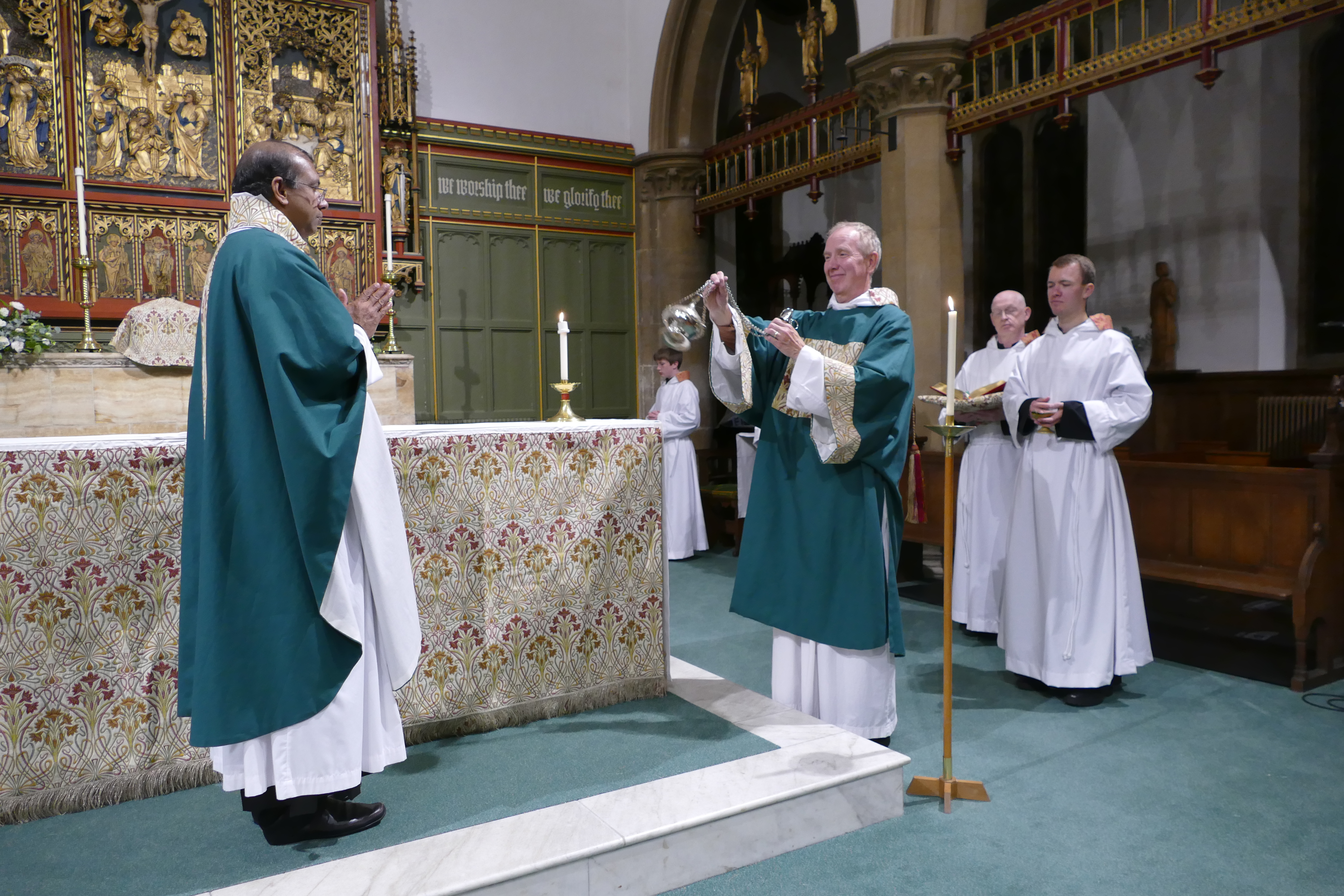
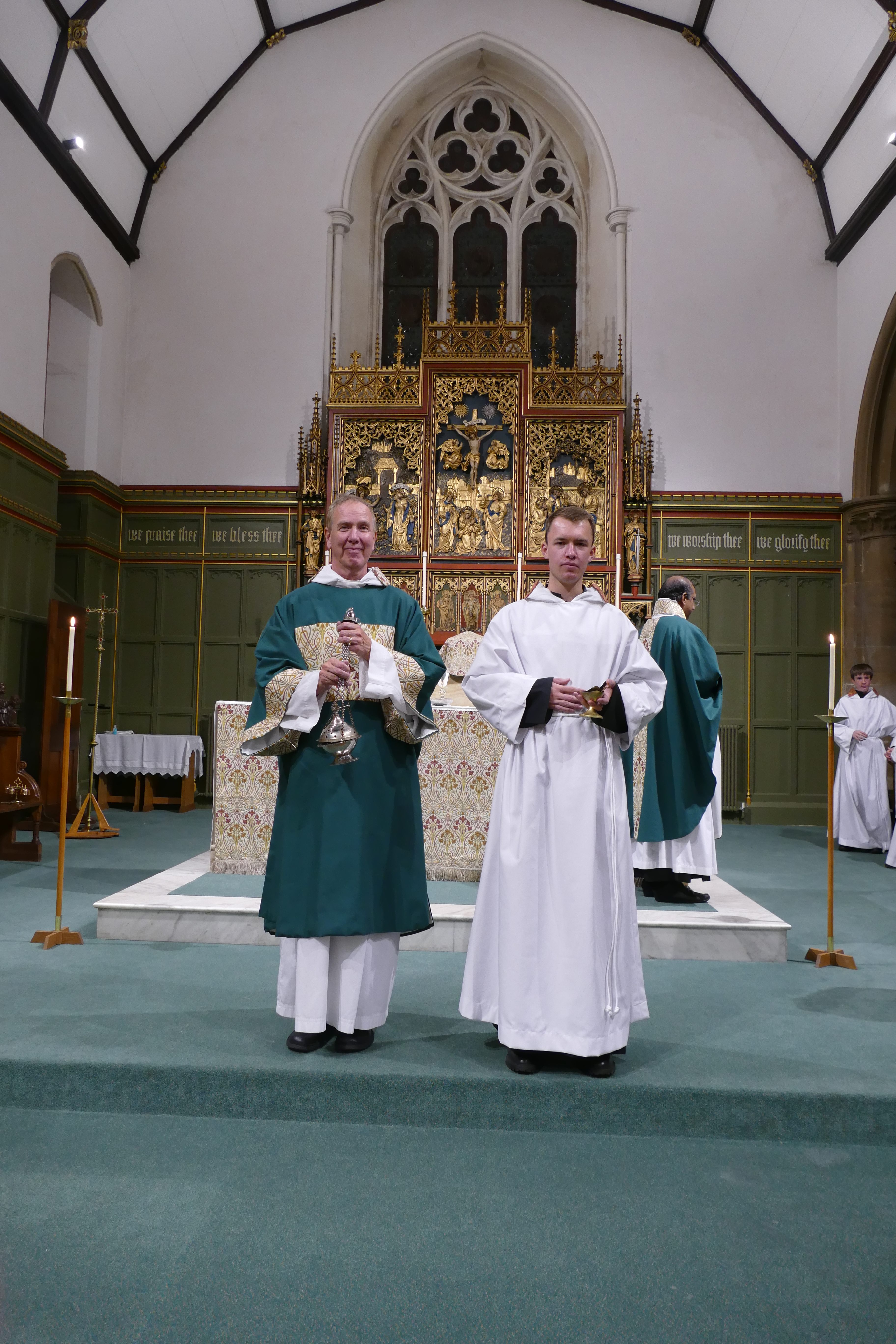
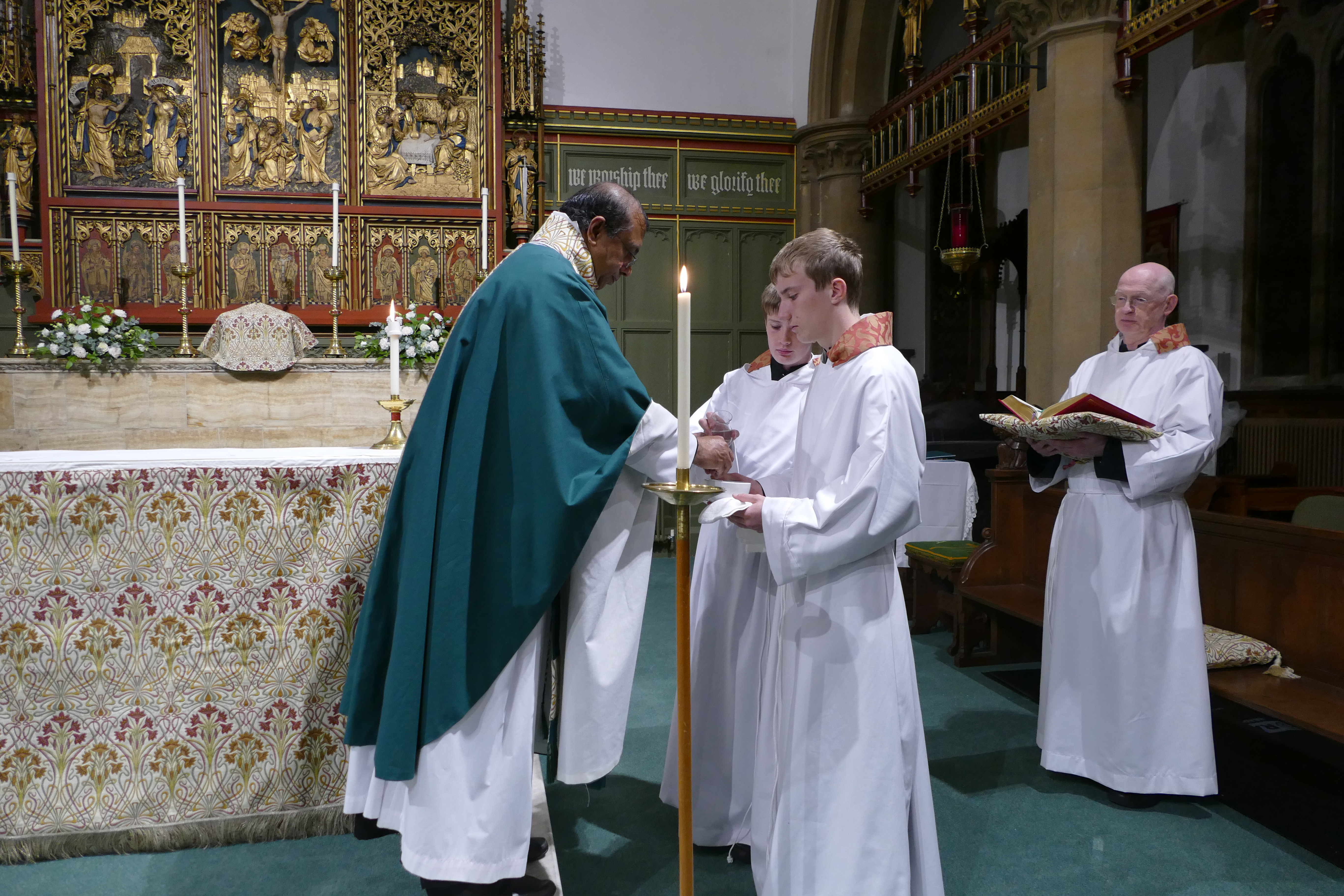
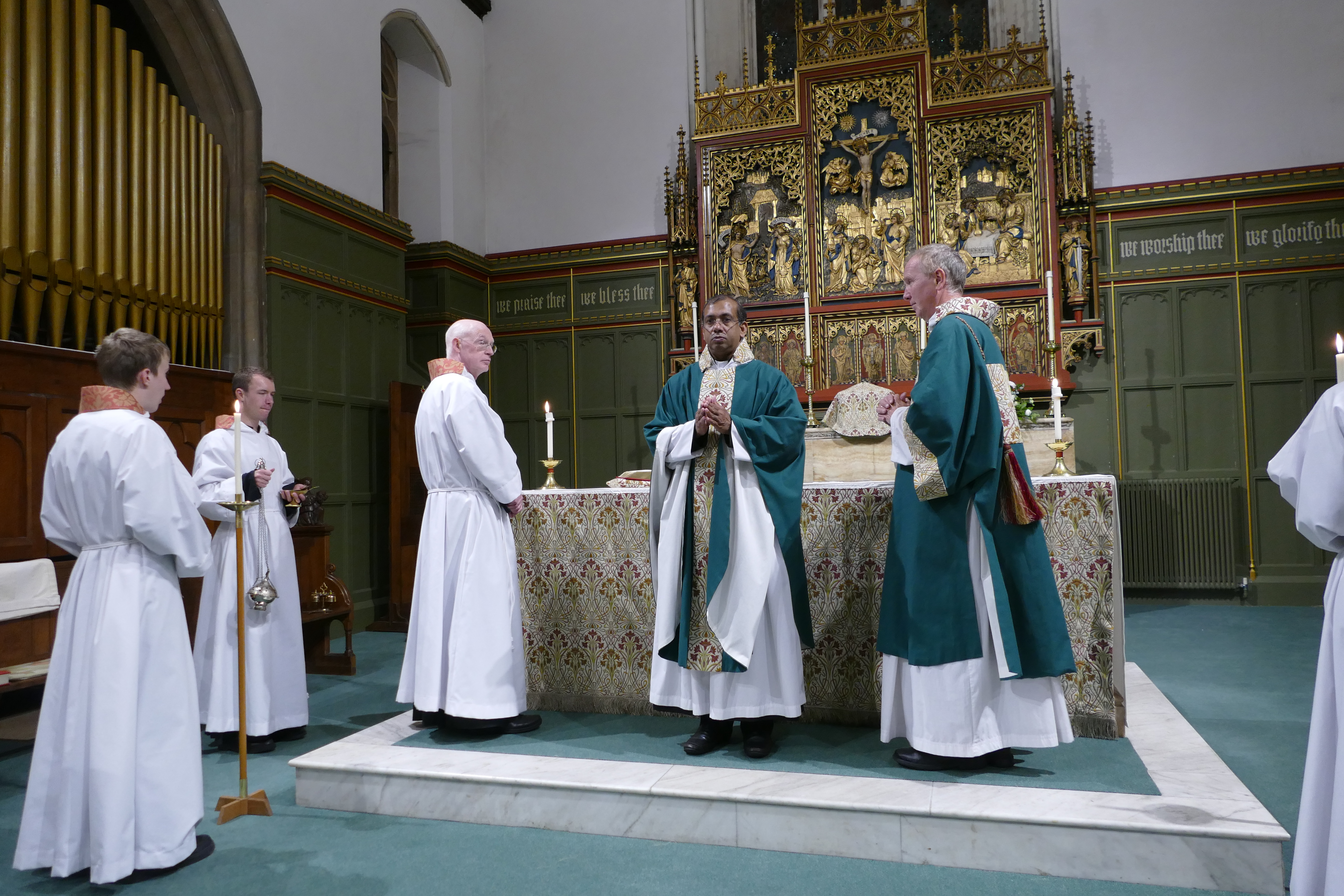
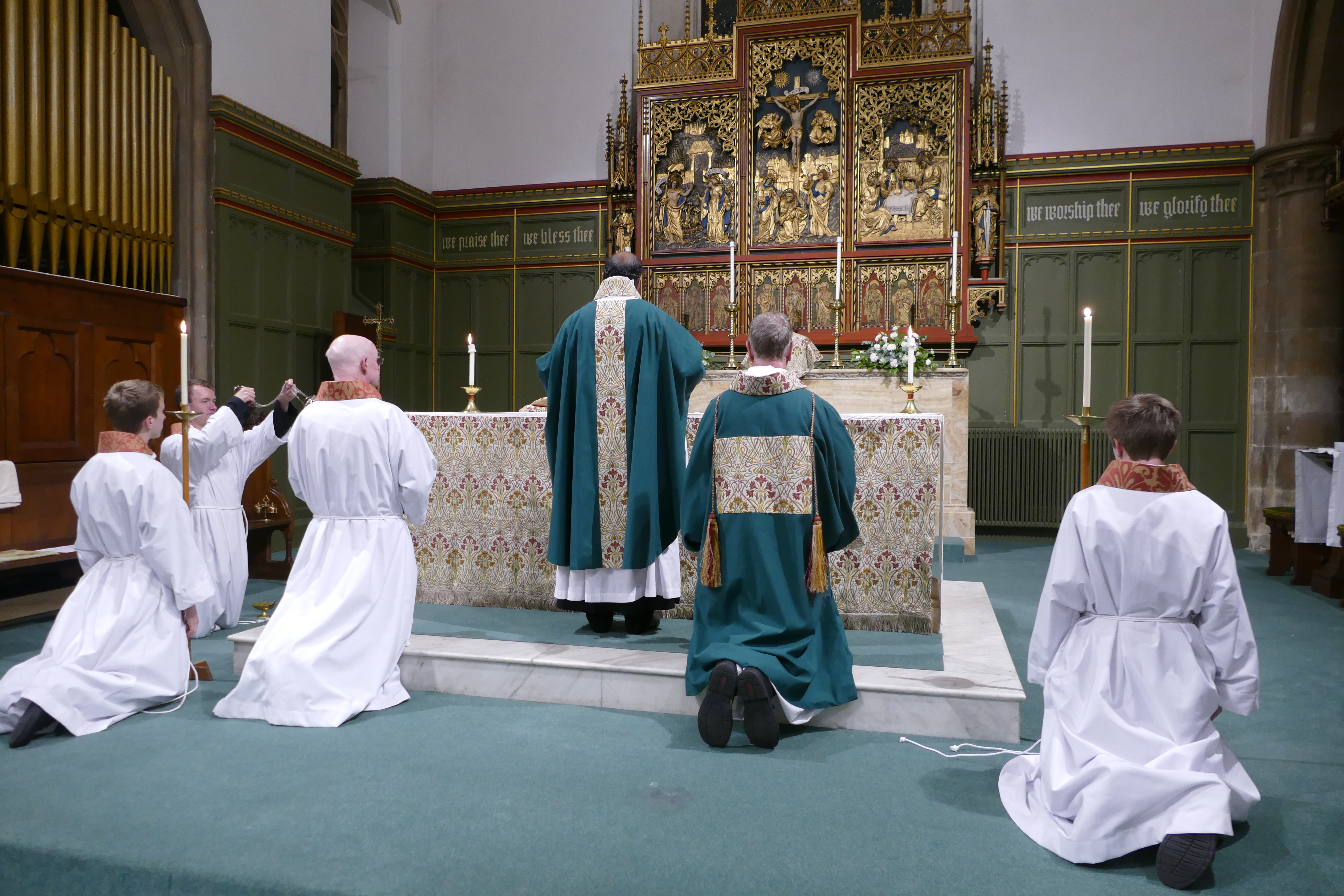
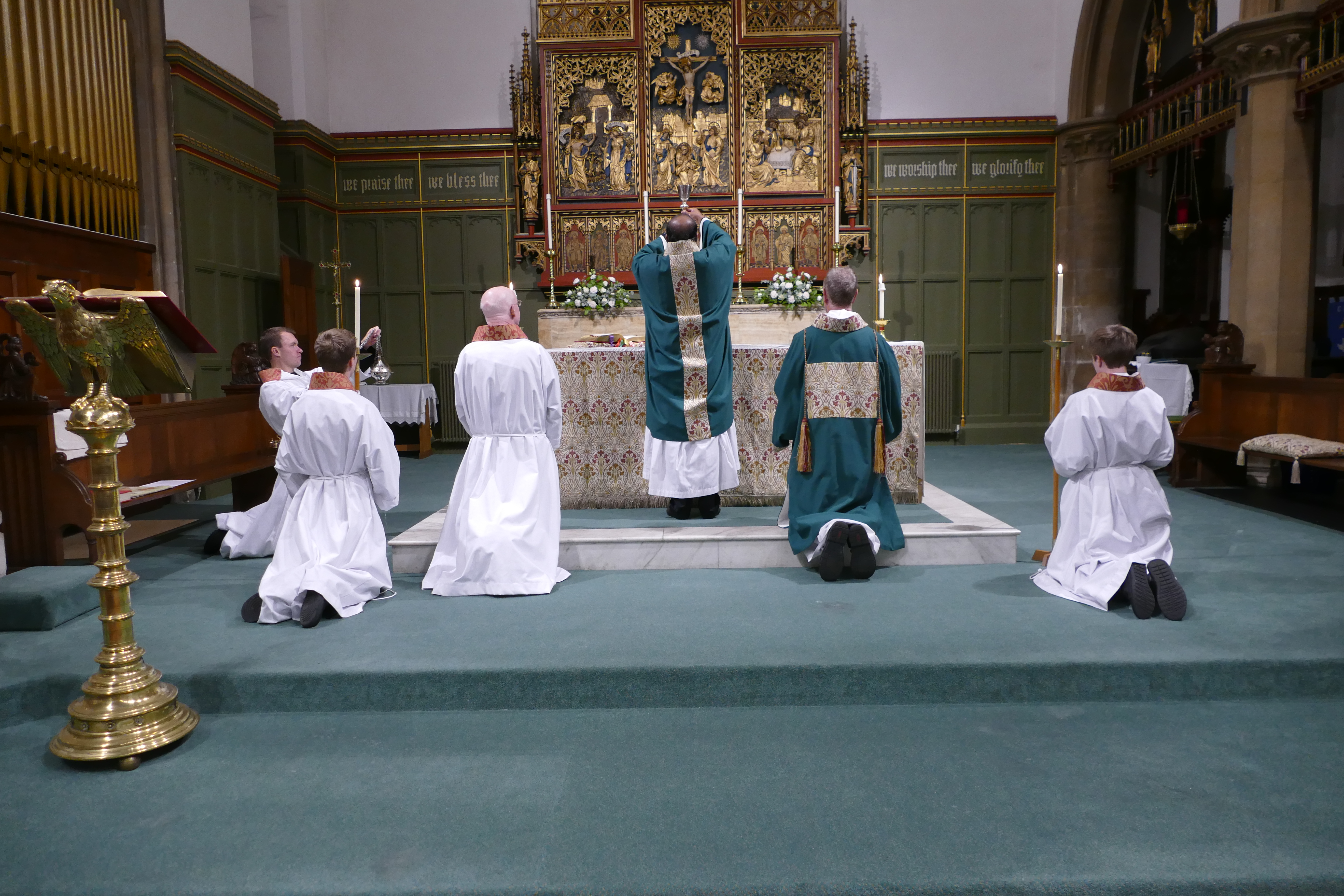
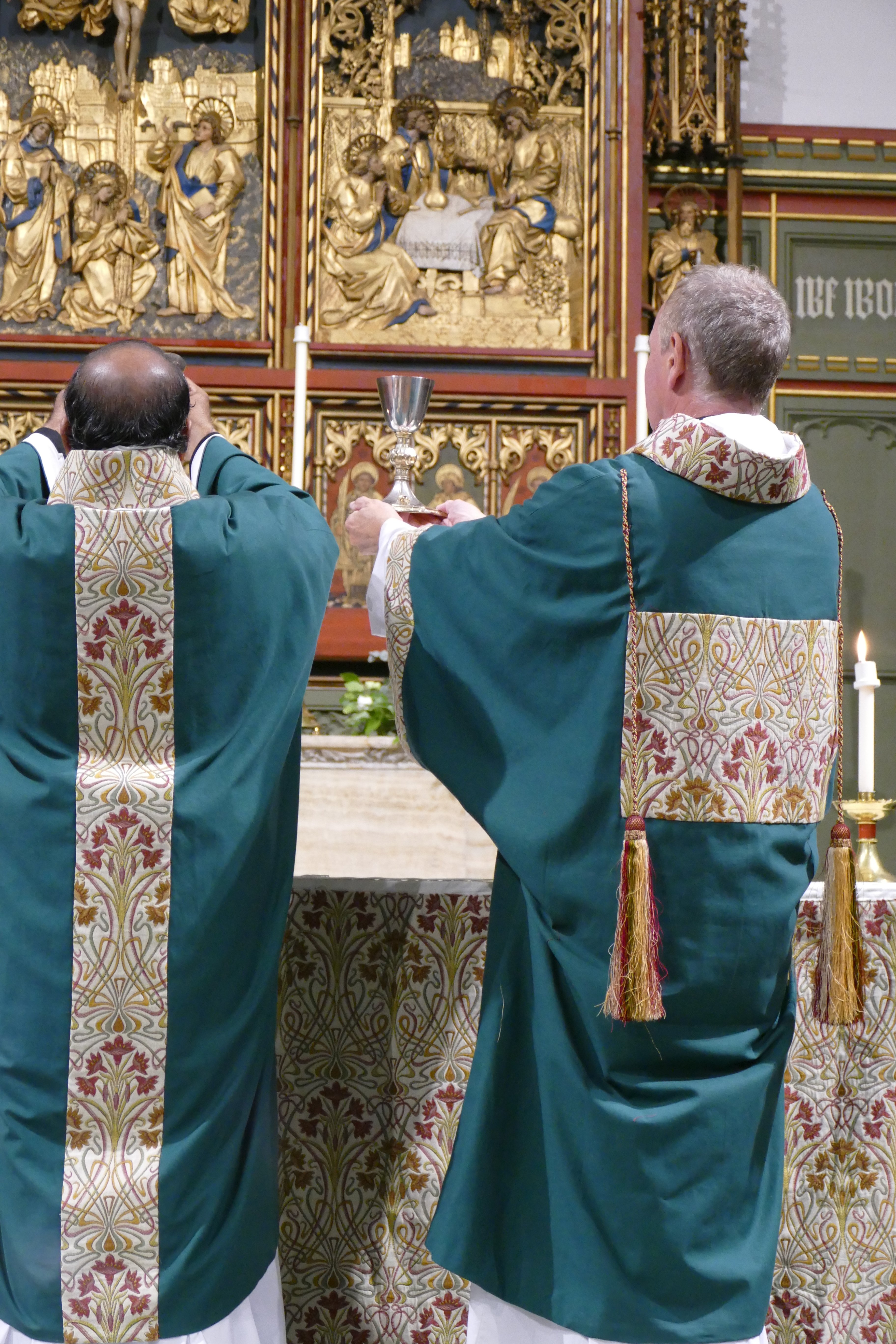
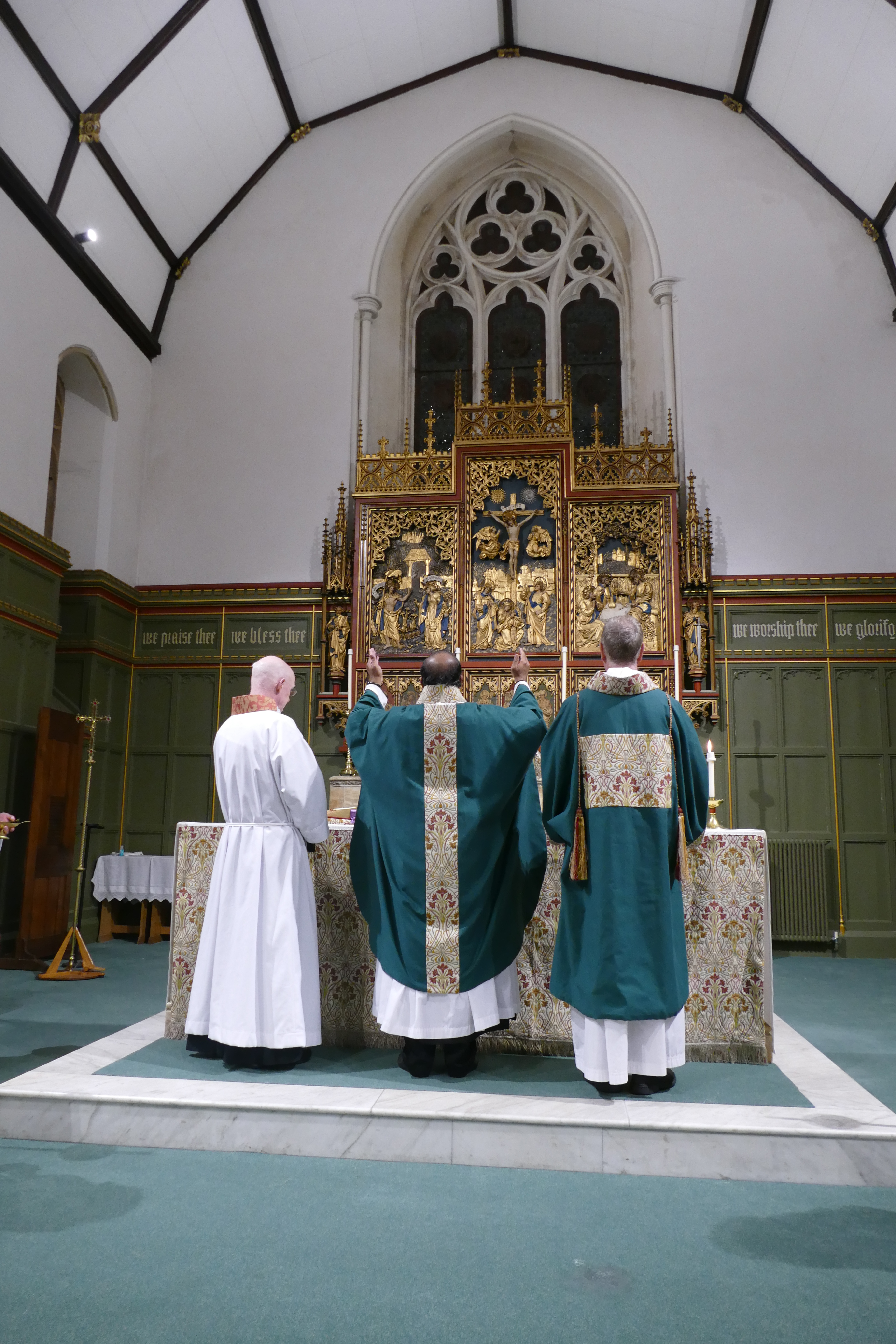
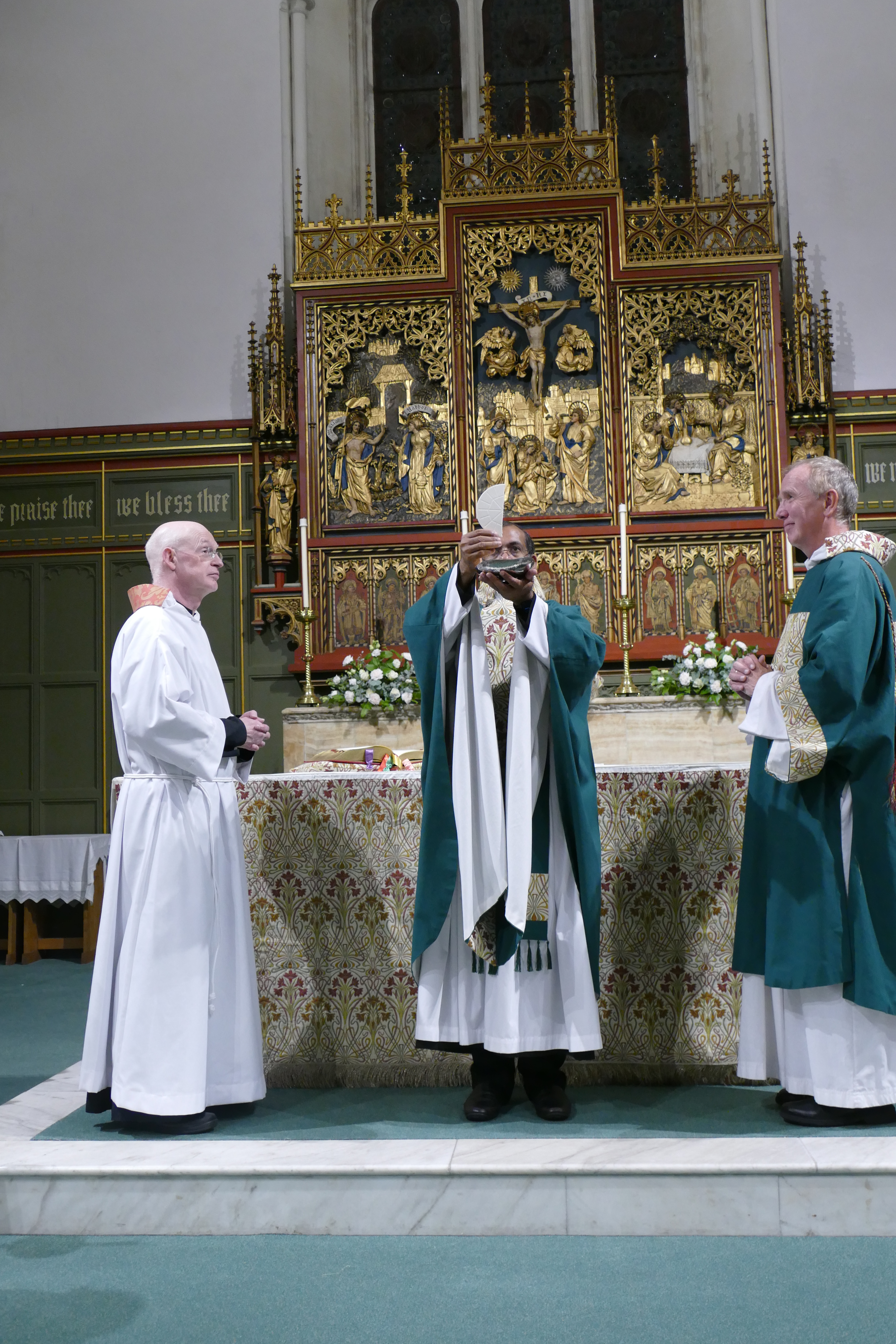
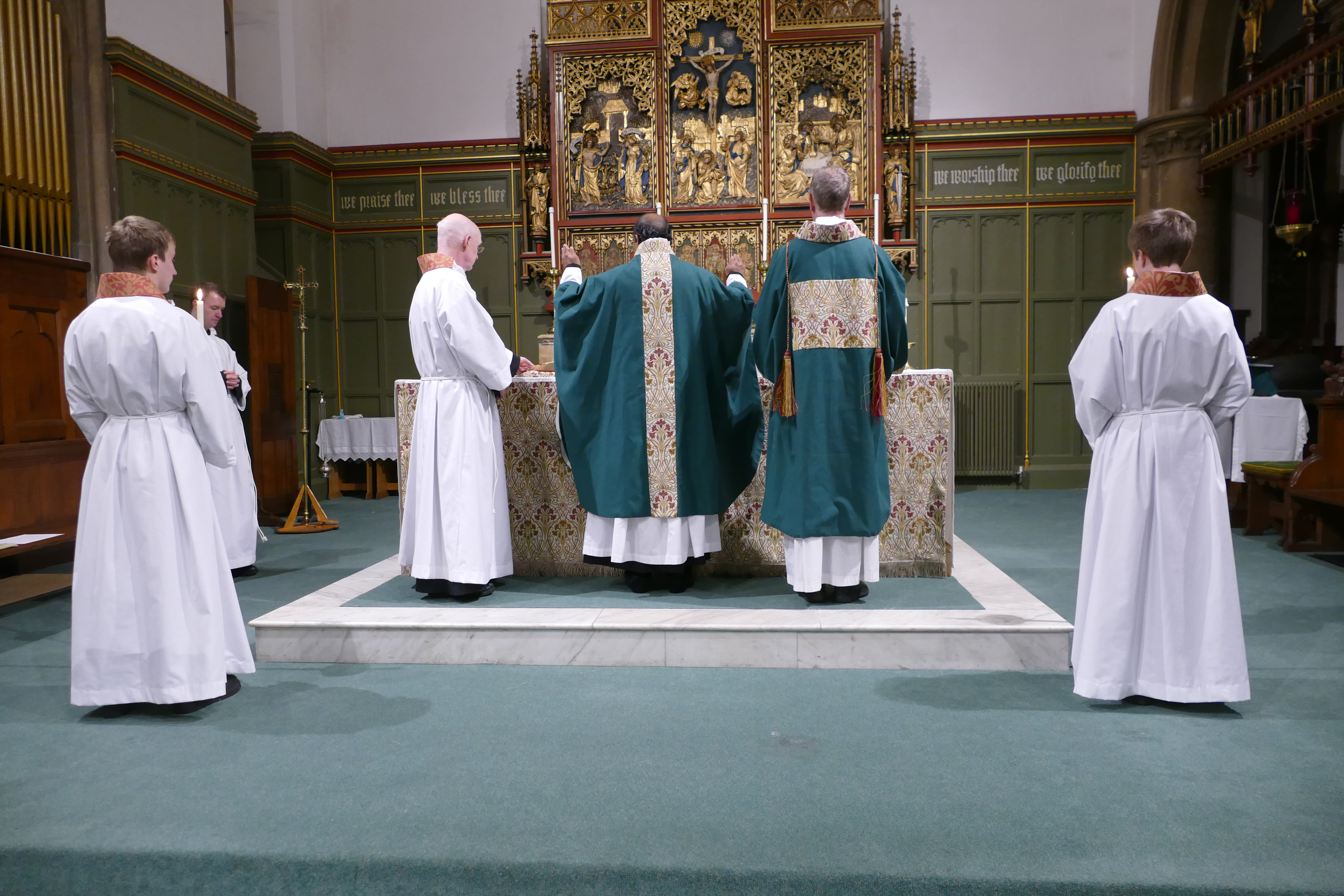
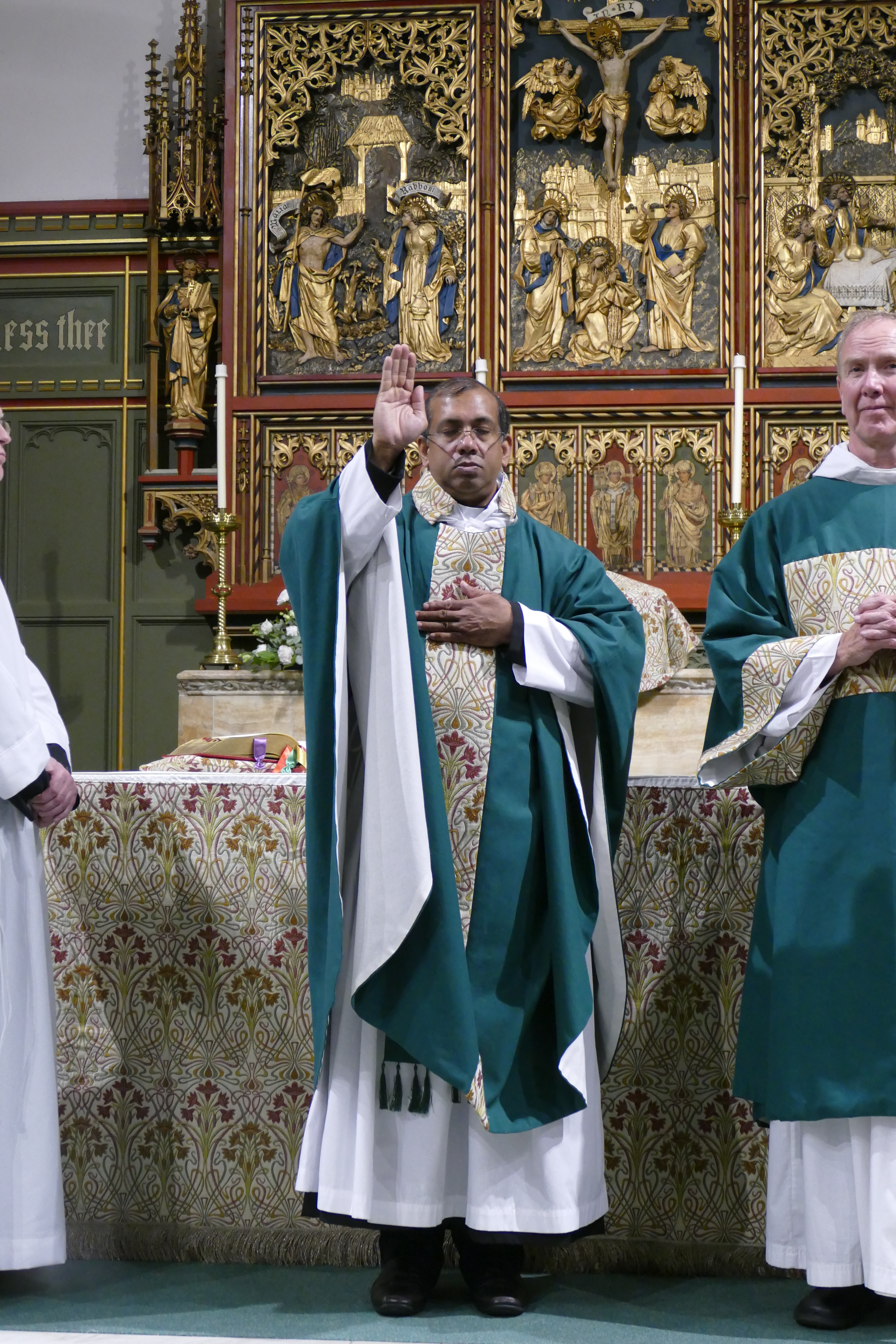
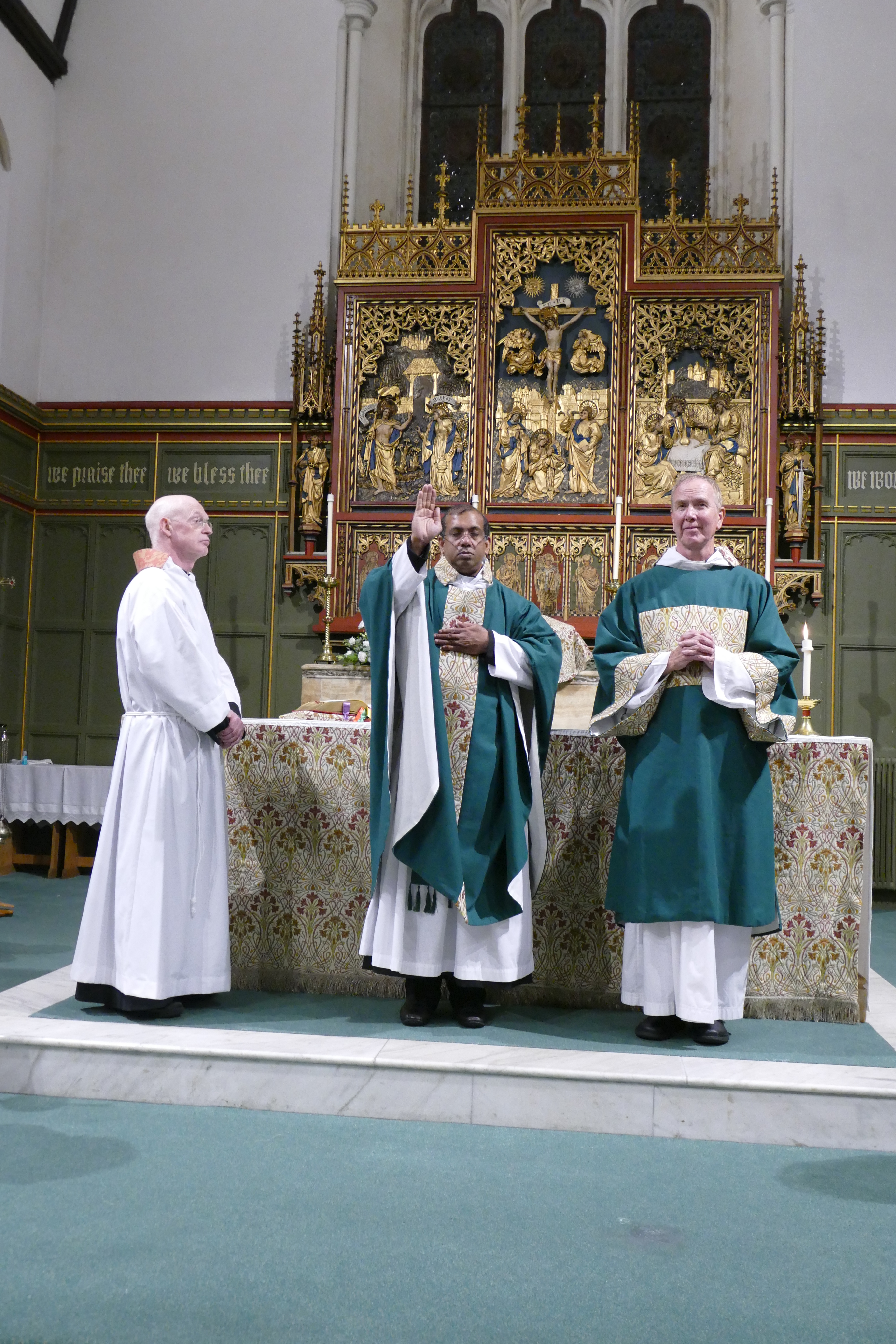
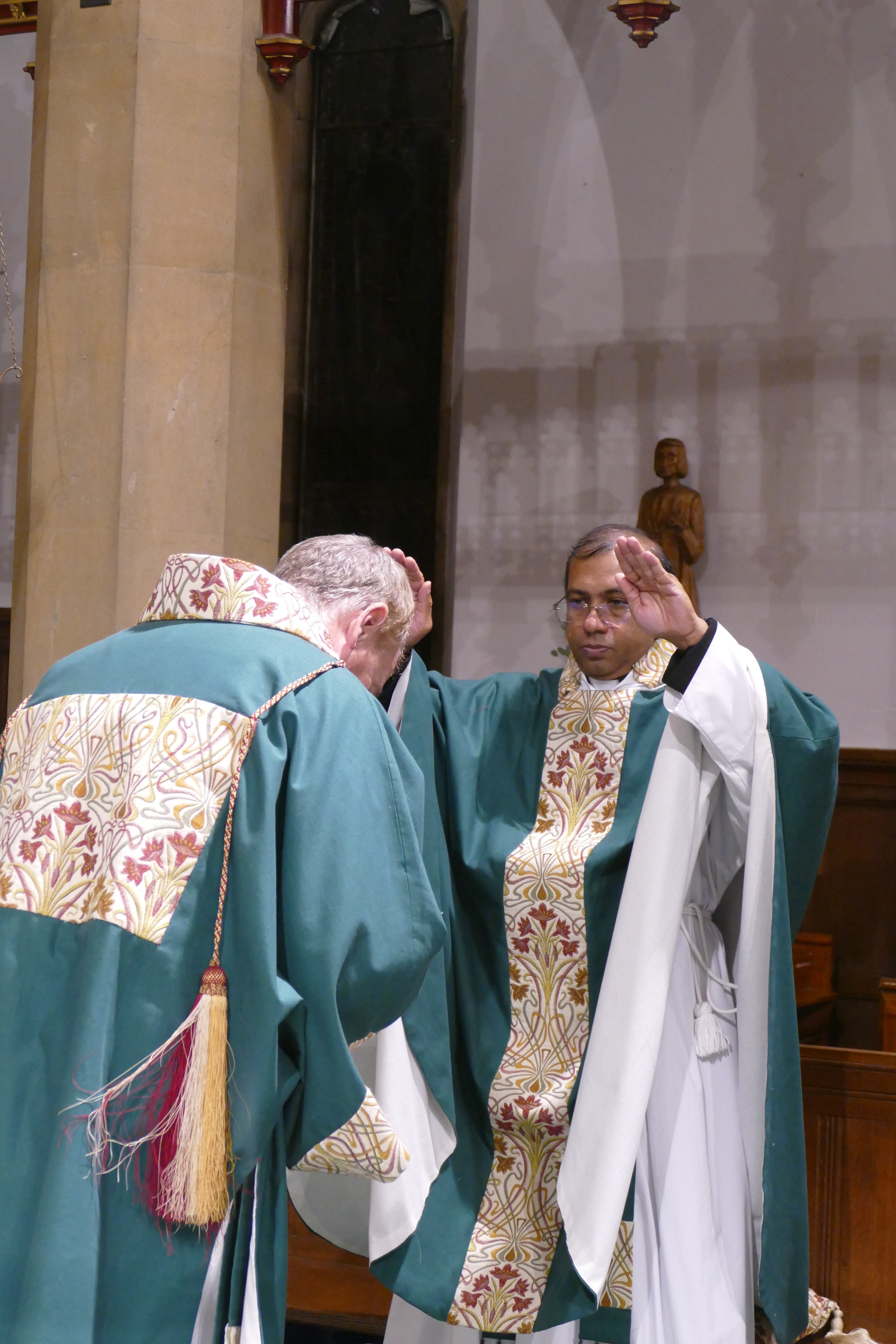
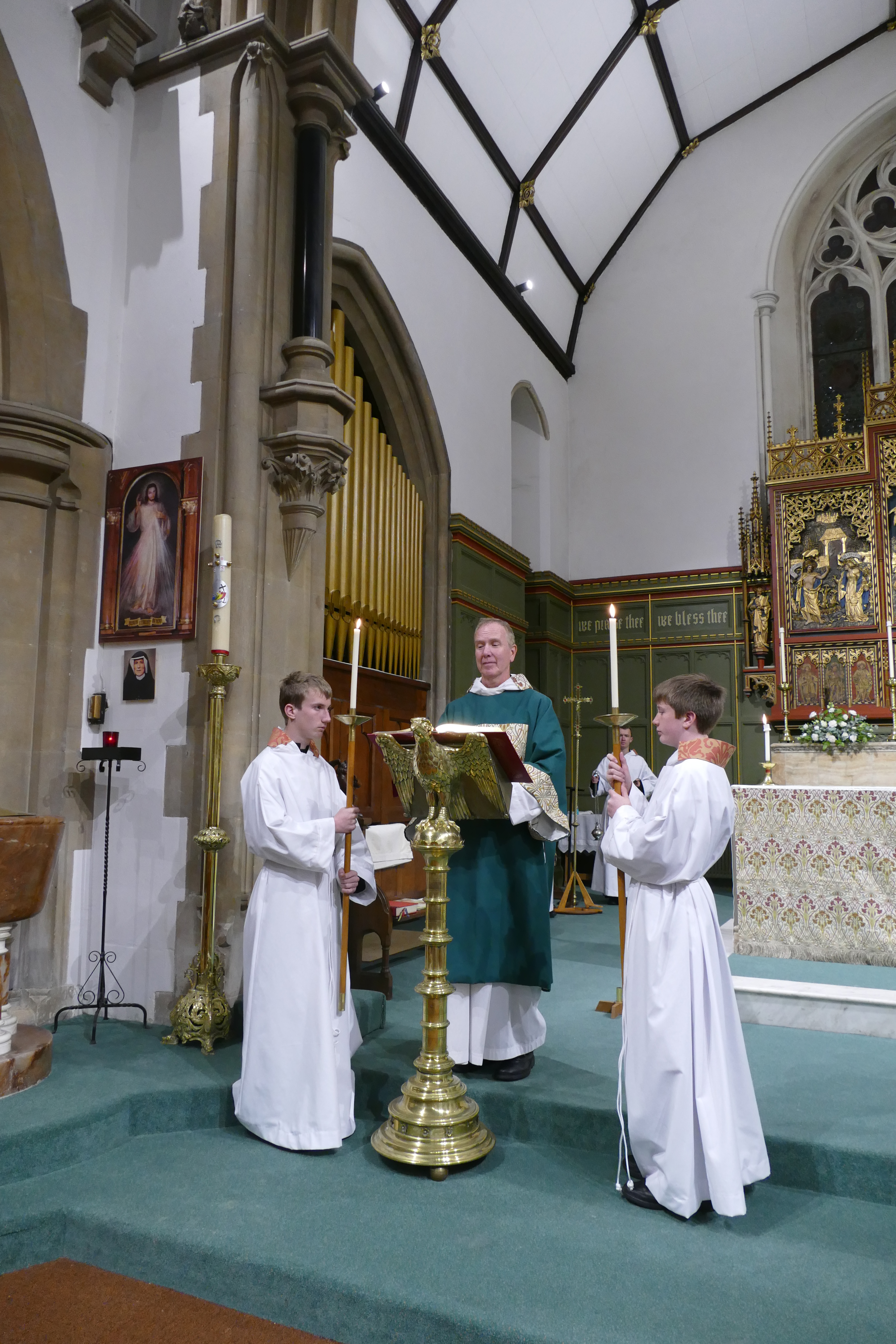
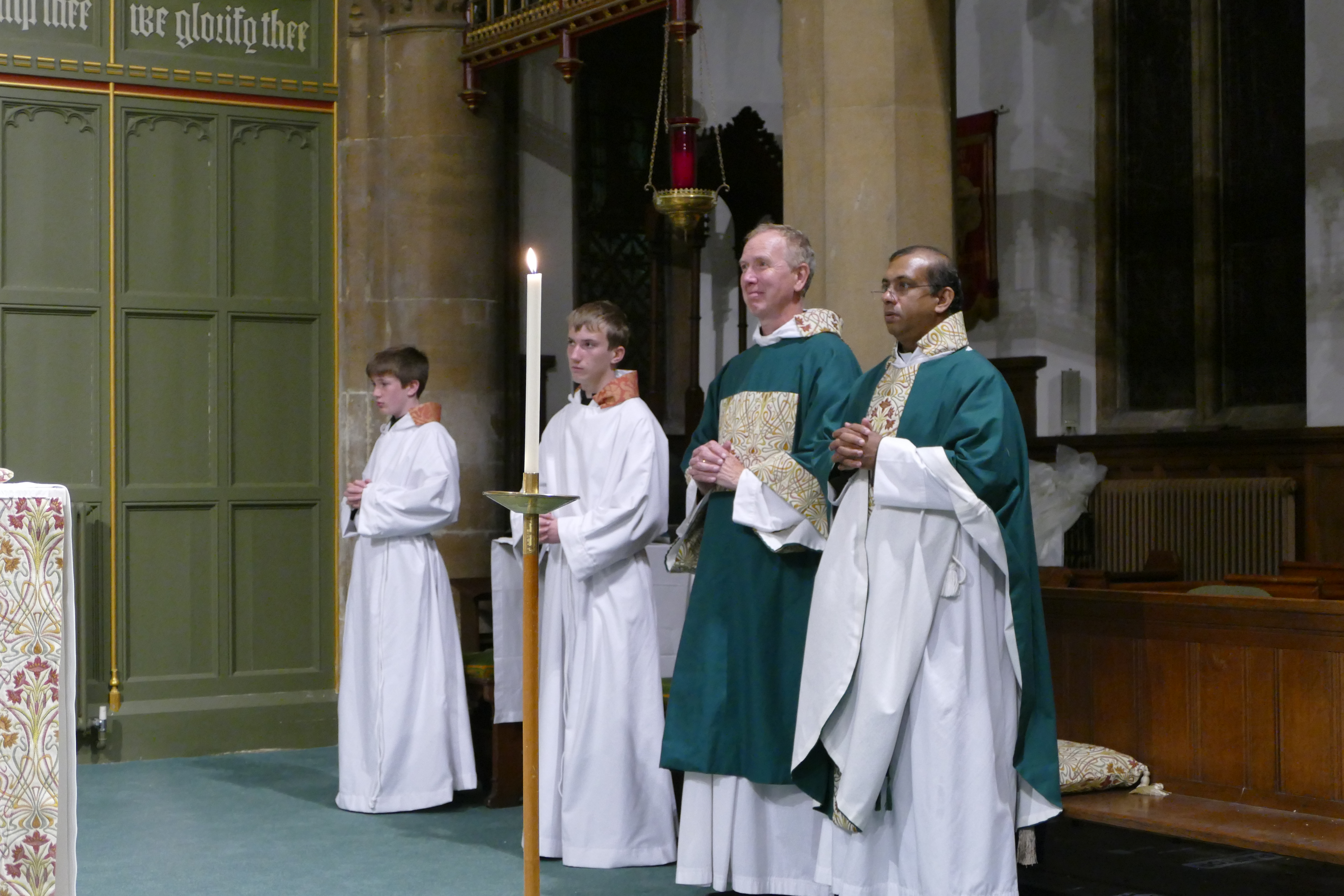
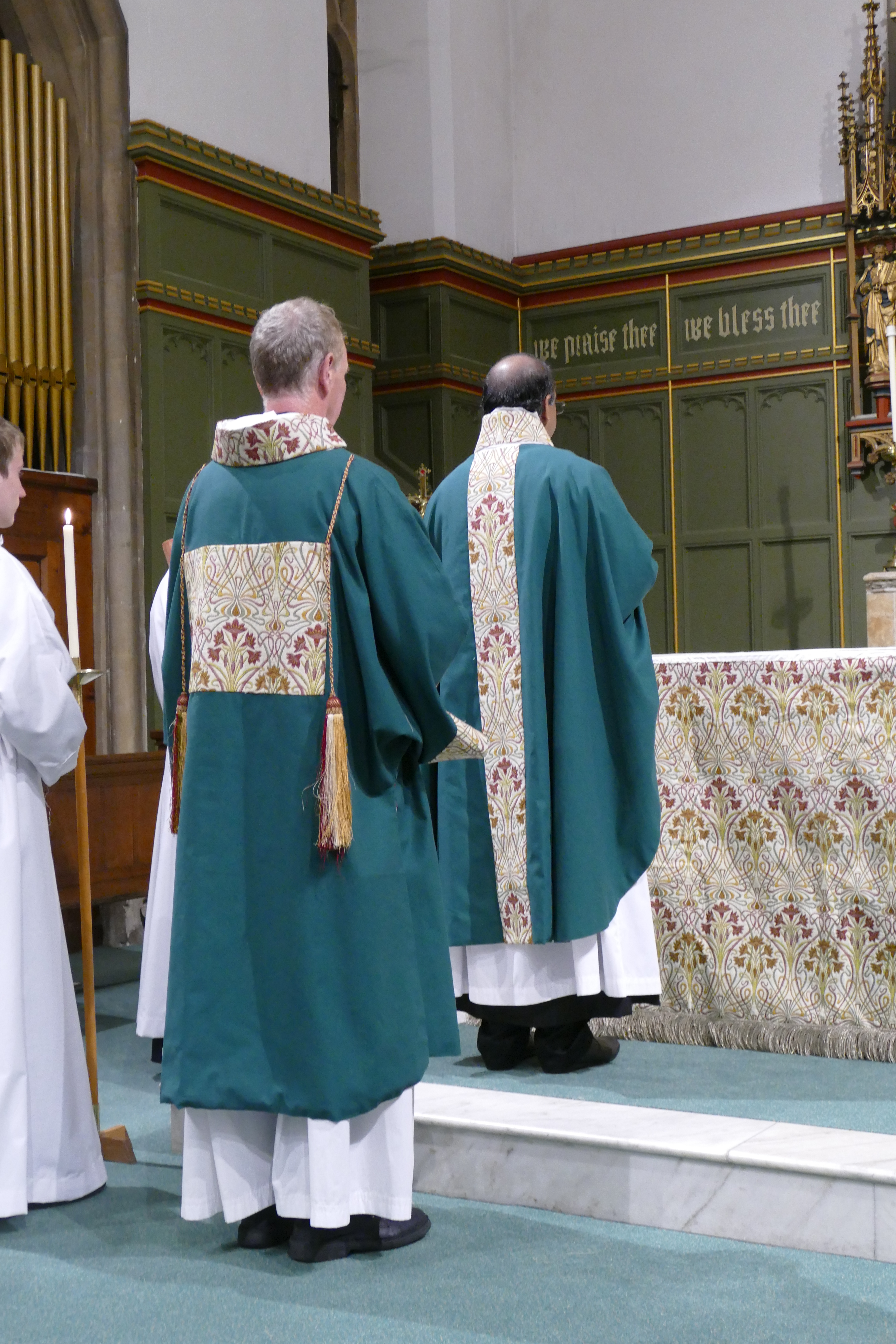
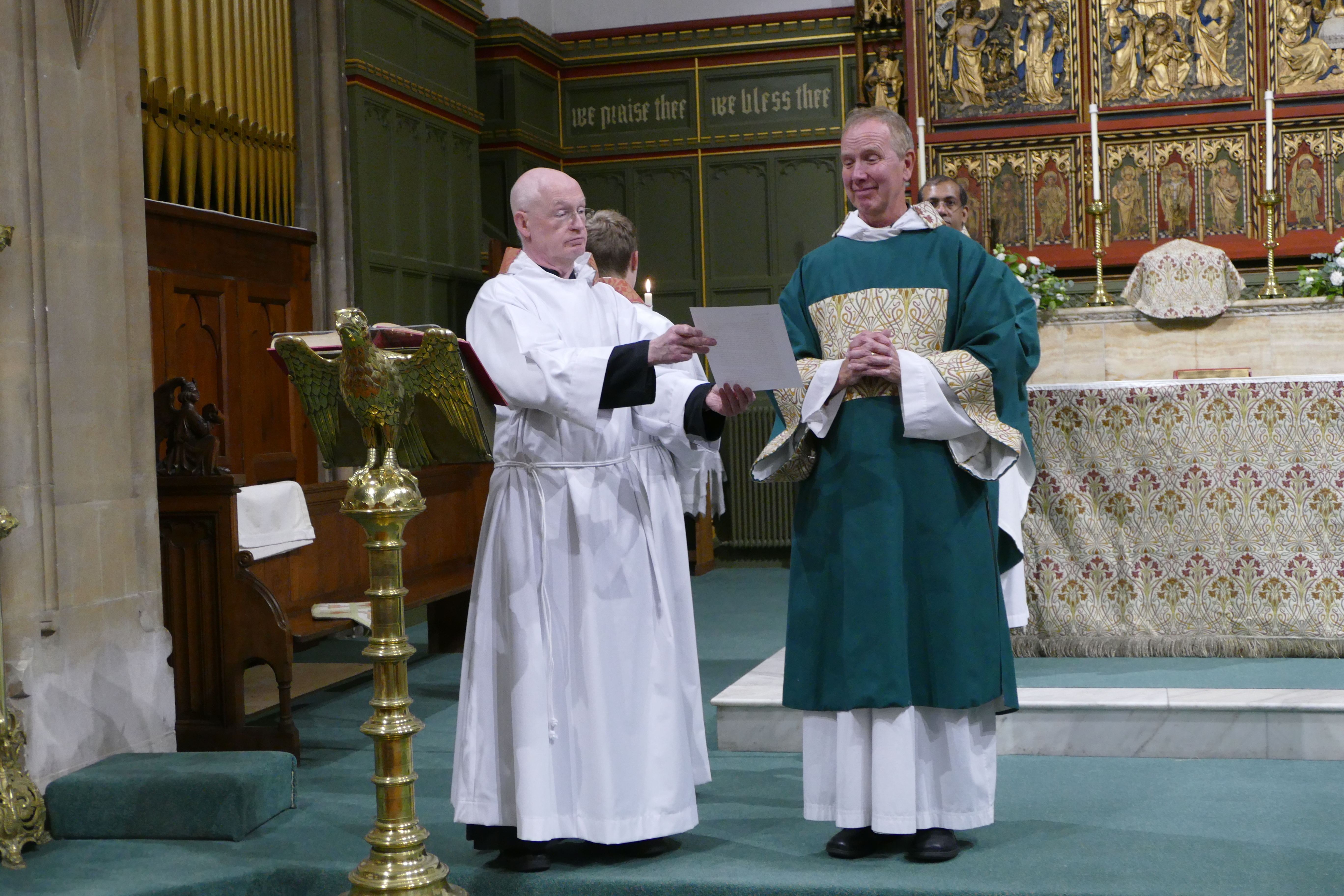
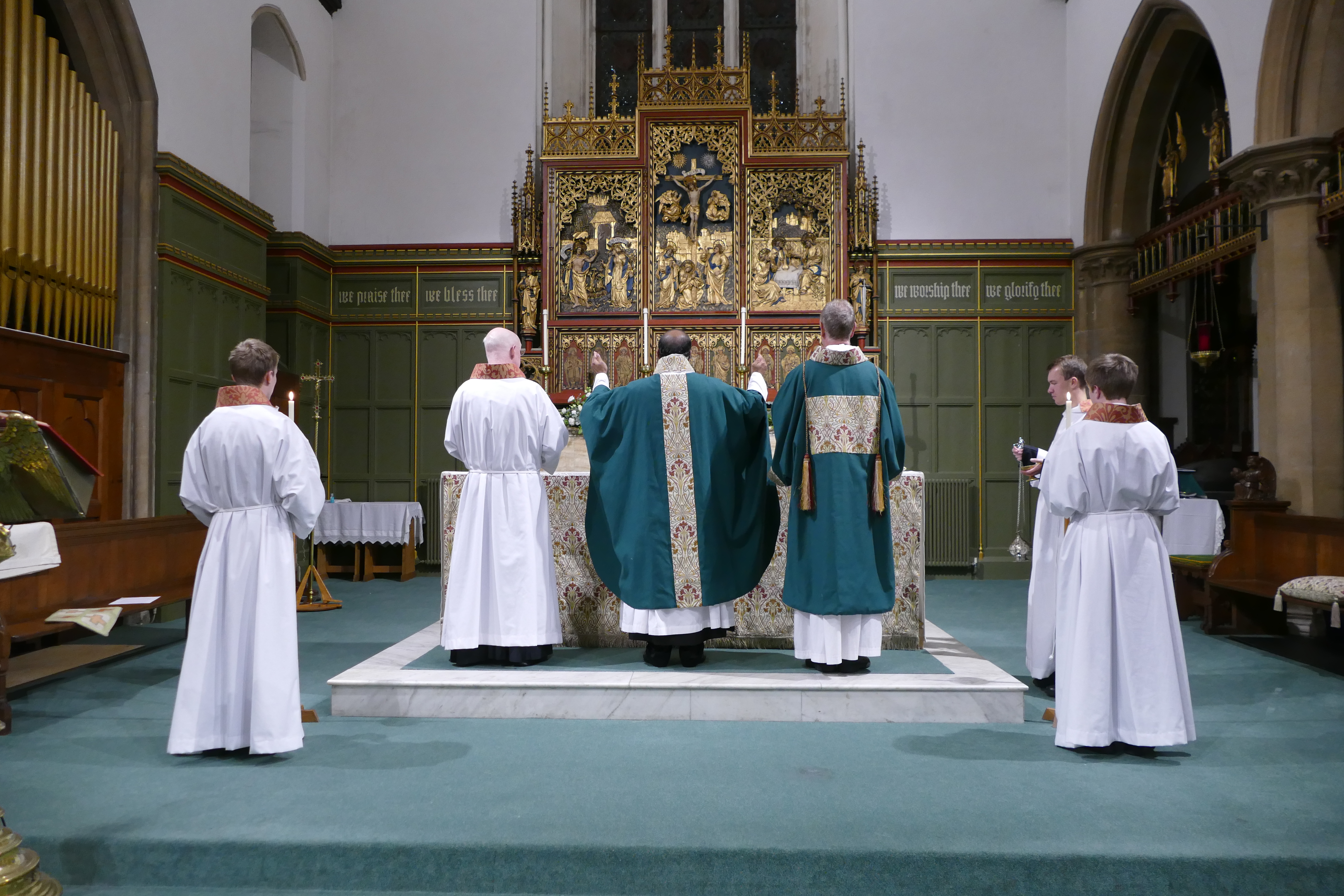
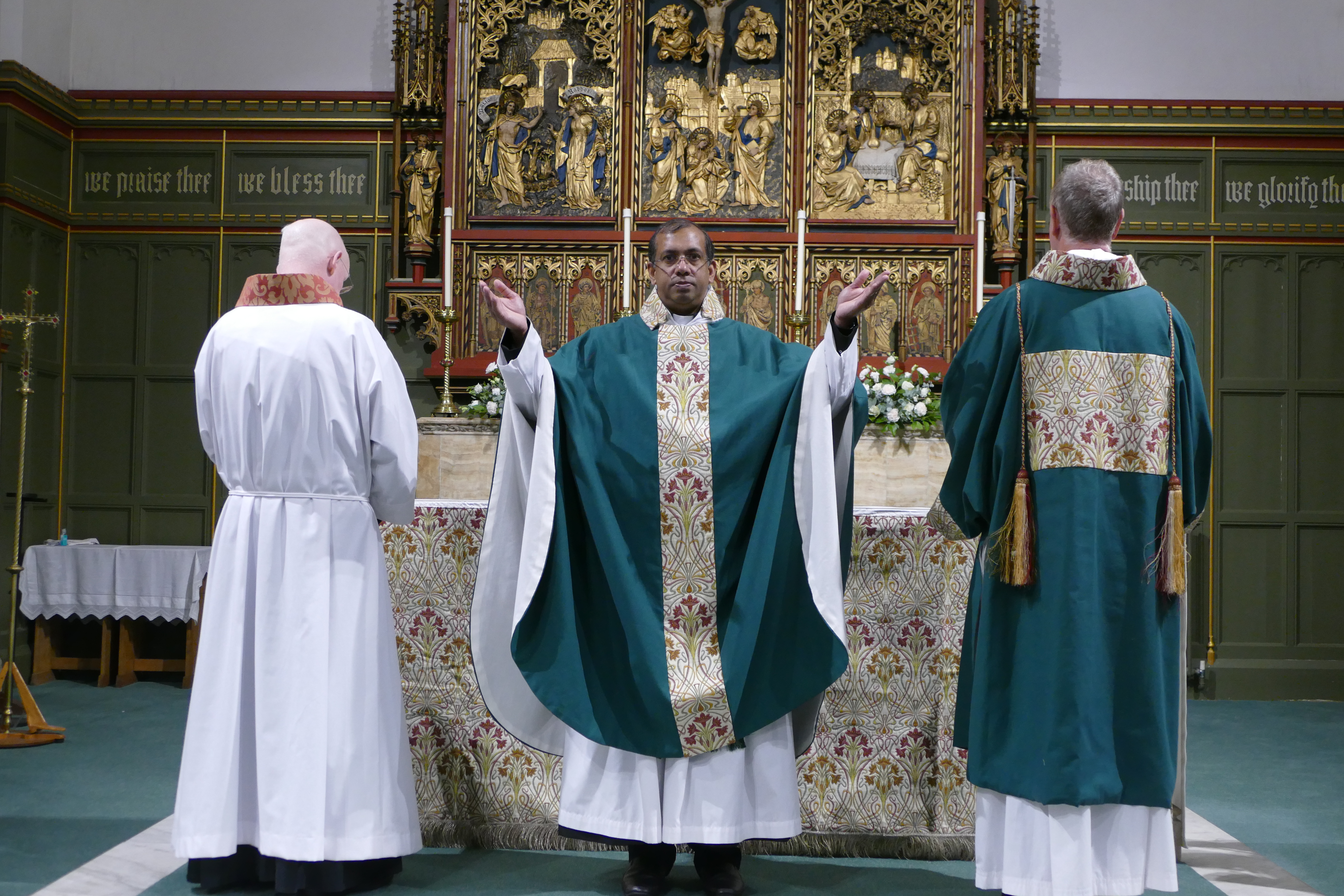
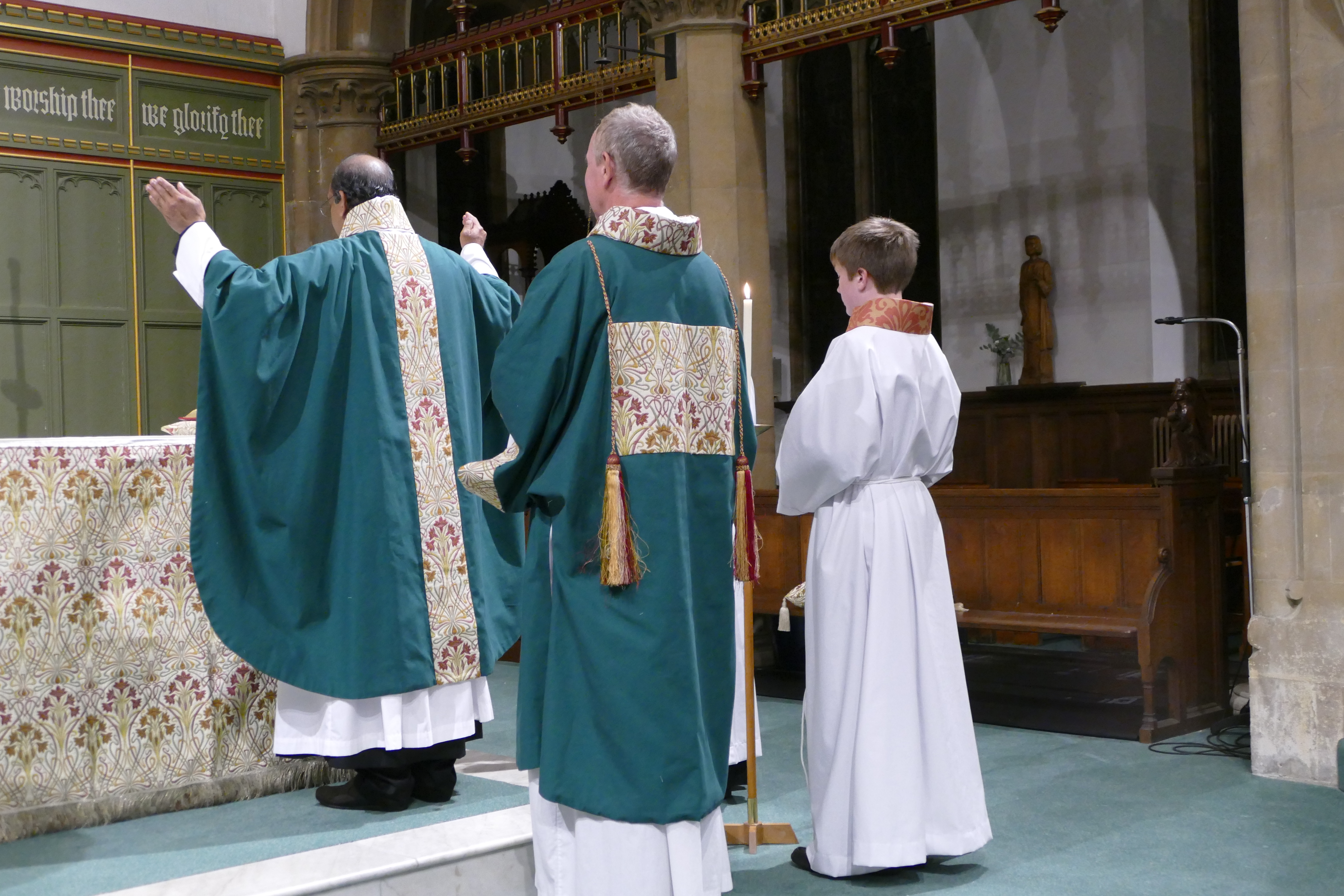
The vestments worn by the priest and deacon in the photographs of this presentation are long and ample. The plain fabric hangs in heavy folds, and a note of richness is added by the use of decorative strips or orphreys of elaborate woven tapestry. The undecorated albs (worn by the servers as well as the ministers) are enlivened by apparels (which form collars) – a particular feature of English vesture. The shape of the chasuble is a compromise. Well into the mediaeval period this vestment was cut as a semicircle joined to form a cone (hence the description ‘conical chasuble’ ) with an opening for the priest’s head at the apex. (If you are not familiar with the chasuble shaped like this, imagine wearing a cope with the front edges joined. To handle anything, you will need to pull the sides up over your arms, thus creating the crescent-shaped folds front and back which are such a beautiful feature of this shape of chasuble.) The ‘conical’ chasuble requires time and care putting on, and unhurried movement in celebrating the liturgy. Incensing the altar or elevating host, for example, the Celebrant may need the help of the deacon and servers. (Ironically, such ‘assistance’ may be seen in the celebration of the ‘Extraordinary Form’ where it is quite unnecessary, as the Celebrant will be wearing a chasuble of the abbreviated ‘latin’ shape!) The albs fall right to the ground, thus covering trouser legs and doing at least something to ameliorate the effect of the oversized (and hideous) ‘trainers’ worn by the younger servers, in spite of pleas by parents and priests. The clergy should wear the cassock under the alb, though the ugly custom of cutting the alb short, thus exposing inches of cassock, should be avoided. Albs are never trimmed with lace, though sometimes apparels are tacked to the skirt and cuffs of the alb.
The stole is made of a strip of material some 3 inches wide and 8 – 9 feet long, usually of the same fabric of the vestments, (but sometimes of the fabric of any decorative orphrey) and lined and perhaps interlined. The ends may be slightly splayed (any exaggeration is to be avoided) and may be finished with fringe or tassels. Both Celebrant and Deacon wear the stole under their respective vestments, the Celebrant wearing his stole around the neck and hanging down the front, (older pictures show the stole crossed over the breast but this is no longer required) to a couple of inches short of the alb hem. The deacon places it over his left shoulder and fastens it at his right side, similar to a sash.
Note on the maniple: This vestment, whose origin and symbolism is uncertain, is now only worn when the 1962 Missal is used. There is no mention of it in either the current Missal or Divine Worship. Especially in its exaggerated form as seen in the 17th and 18th century it required some skill on the part of the Celebrant to avoid knocking over the vessels on the altar!
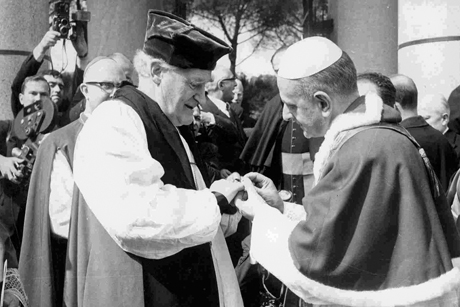
Note on the biretta: The biretta is the later development of clergy head-covering, preceded by the square cap (sometimes called the ‘Canterbury cap’) and by the mortar board now only seen at university graduations. Its obligatory use during the Mass by the priest and other ministers from the 17th century to the middle of the 20th century led to the stiffened form which could be easily managed with one hand. It was widely adopted in the C of E during the 19th century but mainly as out-of-doors headgear, for which it is not well-adapted especially in wet weather. (The cardboard becomes soggy). The older English tradition is for the priest to remain bare headed during Mass. A black skull cap might be used in unheated churches during the recitation of the Office, if the priest feels the cold.
Note on liturgical colours The modern sequence of white, red, violet and green , (with black and rose-pink as extras) was standardised only comparatively recently. Until the 17th century usage of colours varied widely. In the so-called ‘English Use’ adopted by many Anglican Cathedrals in the 20th century dark blue was sometimes used in place of violet. Almost universal before the Reformation and widely revived in the C of E in the 19th and 20th century was the use of the “Lenten Array’. This is not really a colour at all, but a veiling of statues, crosses and altars with unbleached linen. (Modern cotton curtain lining gives a similar impression.) These veils, which covered up much that was coloured and gilded in the church, were put in place for the whole of Lent. Whether the ministers wore vestments of the same unbleached linen, or violet/blue is uncertain; but we do know that crimson or blood-red was worn for the last two weeks of Lent (sometimes called Passiontide) The linen veils were stencilled in black, red or blue, with the symbols of the Passion.
A move in this direction came in the revised Roman Rite which now orders red for Palm Sunday and Good Friday. (There is an option for black for Good Friday in the Divine Worship missal.) In some places a distinction is made between the two penitential seasons with violet (i.e. blue-toned ) being used for Advent, and purple (i.e. red-toned) for Lent.
There is a curious anomaly in the veiling, during the last two weeks of Lent, of realistic crucifixes. This is made more curious where the altar-piece is, say, of a saint in heavenly glory, unveiled for all to see, and in front stands the crucifix with a violet cover over it. (The explanation probably, is that the covering of crucifixes dates from the earlier period when the Lord on the cross was shown in kingly splendour, rather than the agonised suffering figure of the later period.)
The Divine Worship calendar has a period of three weeks before Ash Wednesday which are ordered to be celebrated in violet/purple, although the readings of these Sundays continue the cycle of Ordinary Time with the rest of the Church. The changing seasons would be more clearly marked if violet vestments were worn for the three pre-Lent weeks, with the ‘Lent Array’ coming into use for Ash Wednesday. (Even if it were felt necessary to continue with violet vestments, nonetheless the change in the appearance of the church building would still be very marked.) The last two weeks of Lent (in the old rite called ‘Passiontide’) are more clearly defined in the Ordinariate calendar and suggest the use of red as the liturgical colour a week earlier than in the current Roman Rite. This would accord with the ‘English Use’. But vestments decorated with symbols of the Holy Spirit are clearly inappropriate – plain red with black would be good, and the scarlet/crimson distinction (similar to the violet/purple distinction) might be useful. Veiling, colours – as with all customs – need to be thought through and explained as part of our catechesis. Does what we do show forth, simply and clearly, what we believe, or does it confuse and hide, or at least require doubtful justifications? ‘Vain ceremonies’ (to use an expression from the old Anglican Prayer Book) are best avoided.
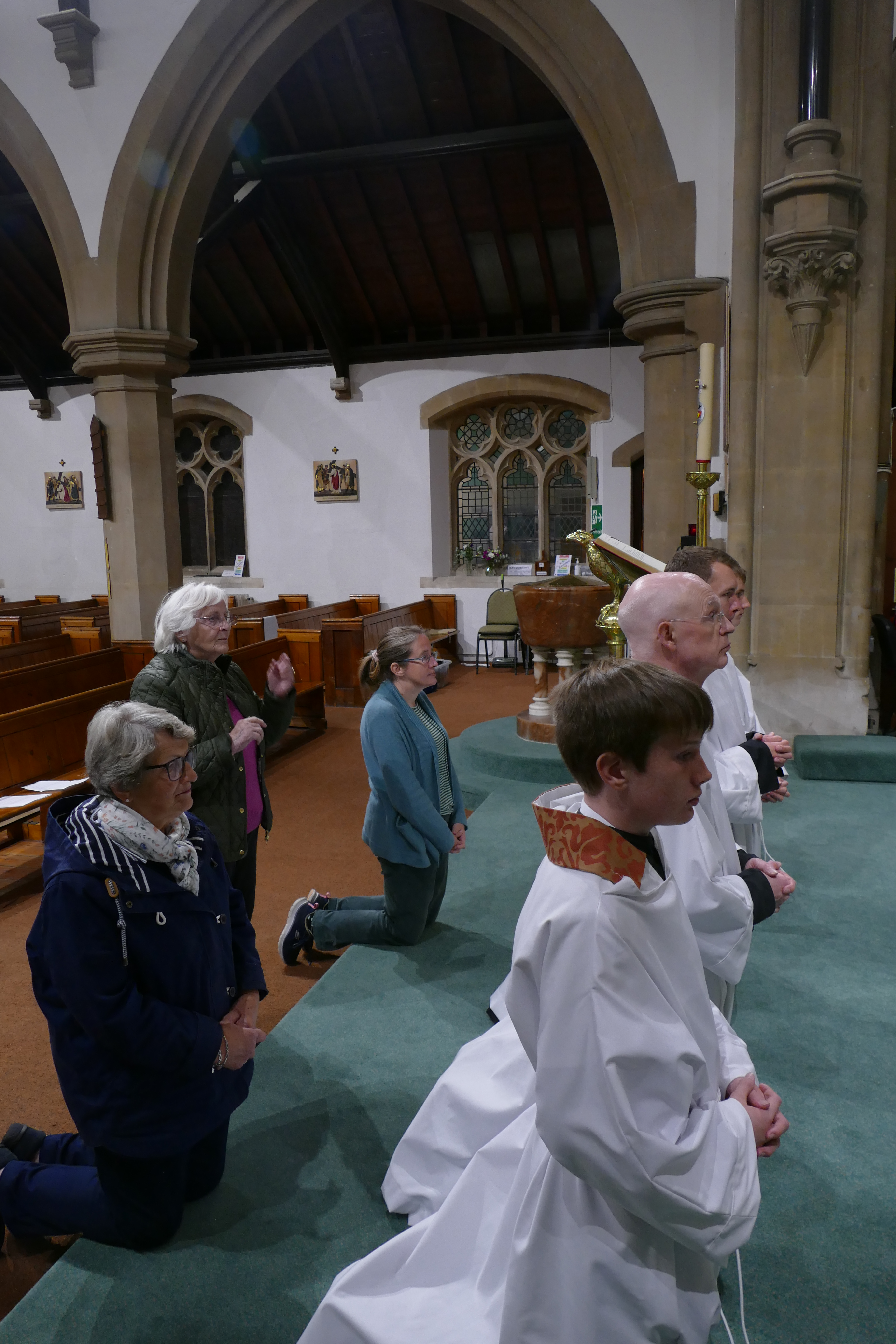
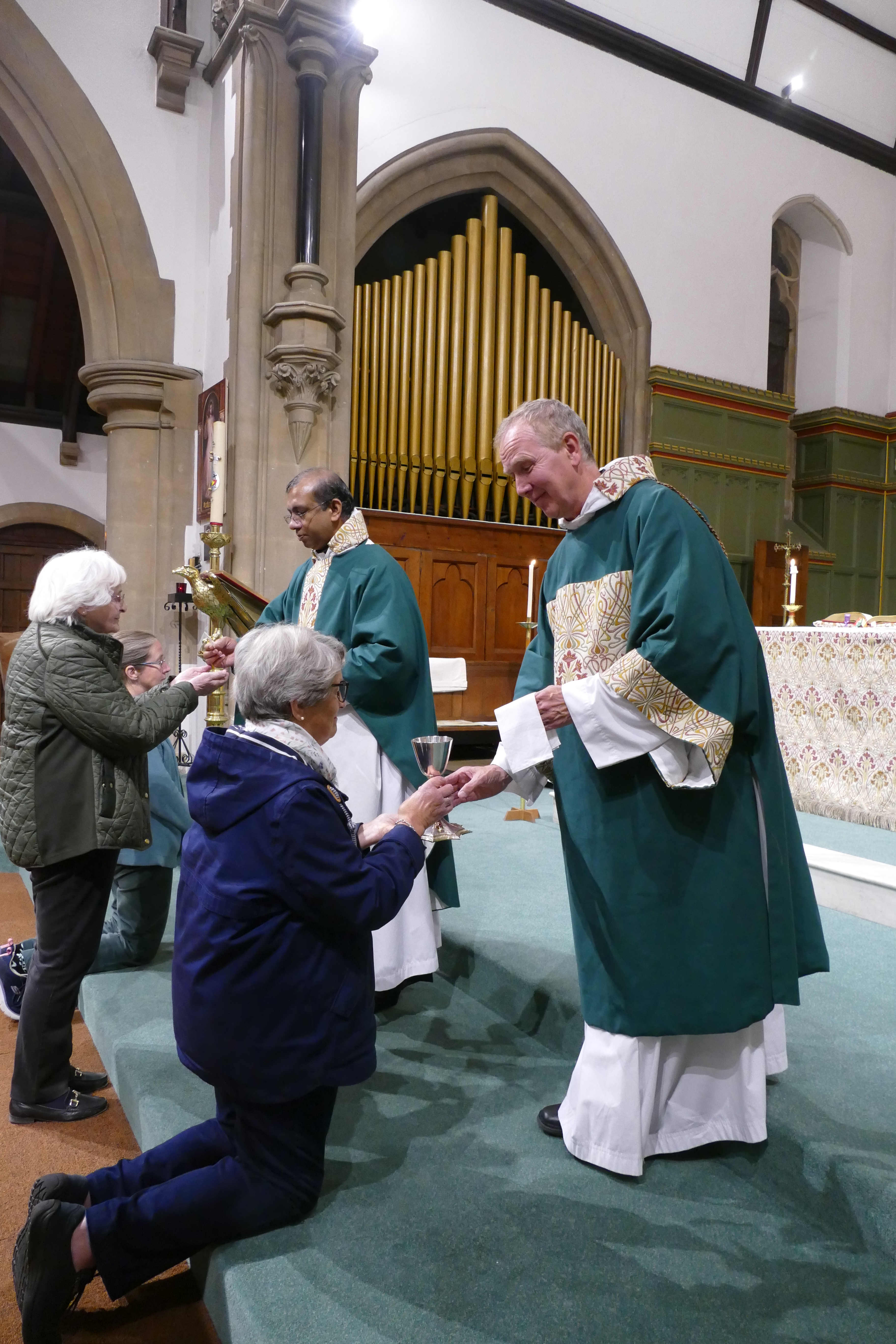
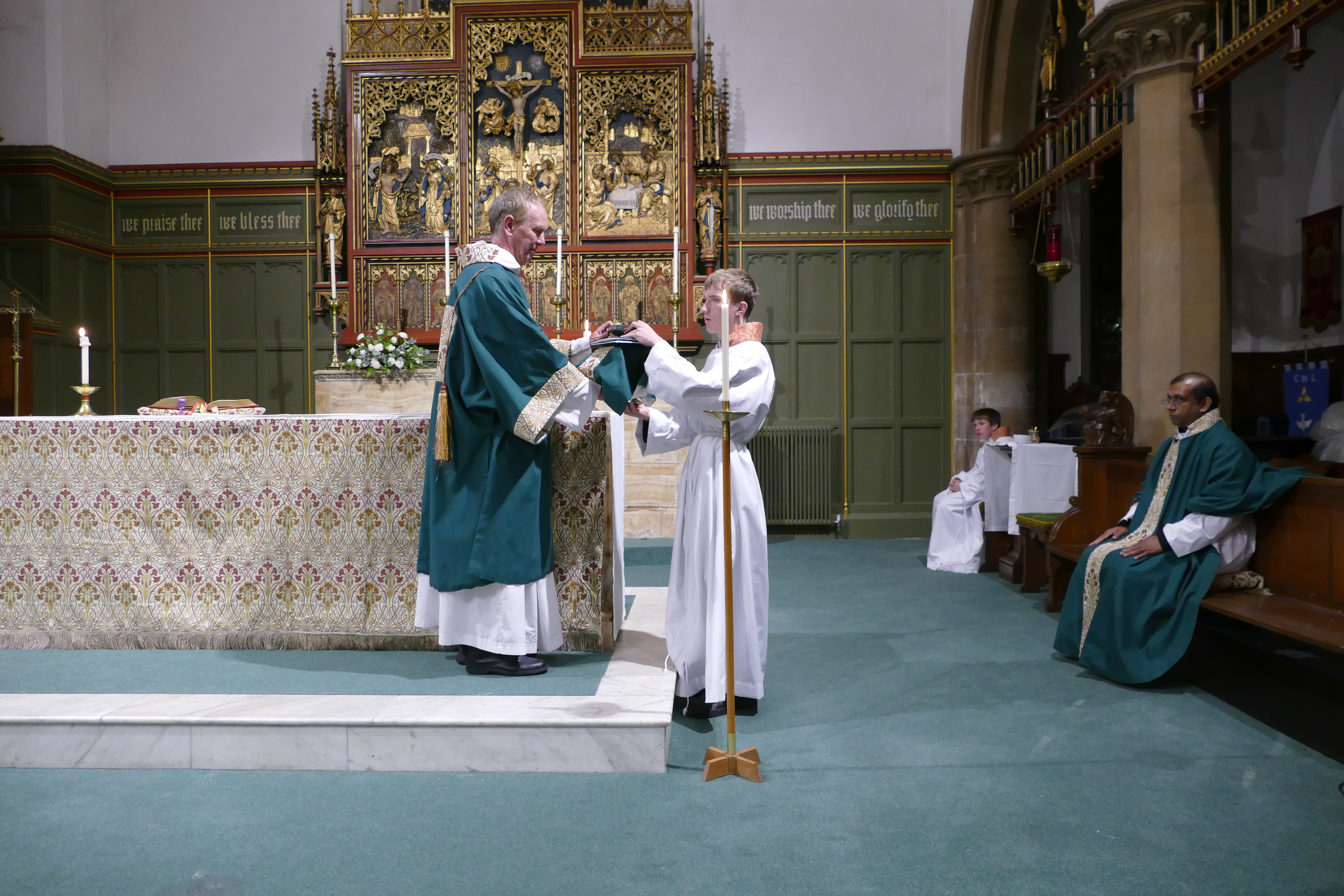
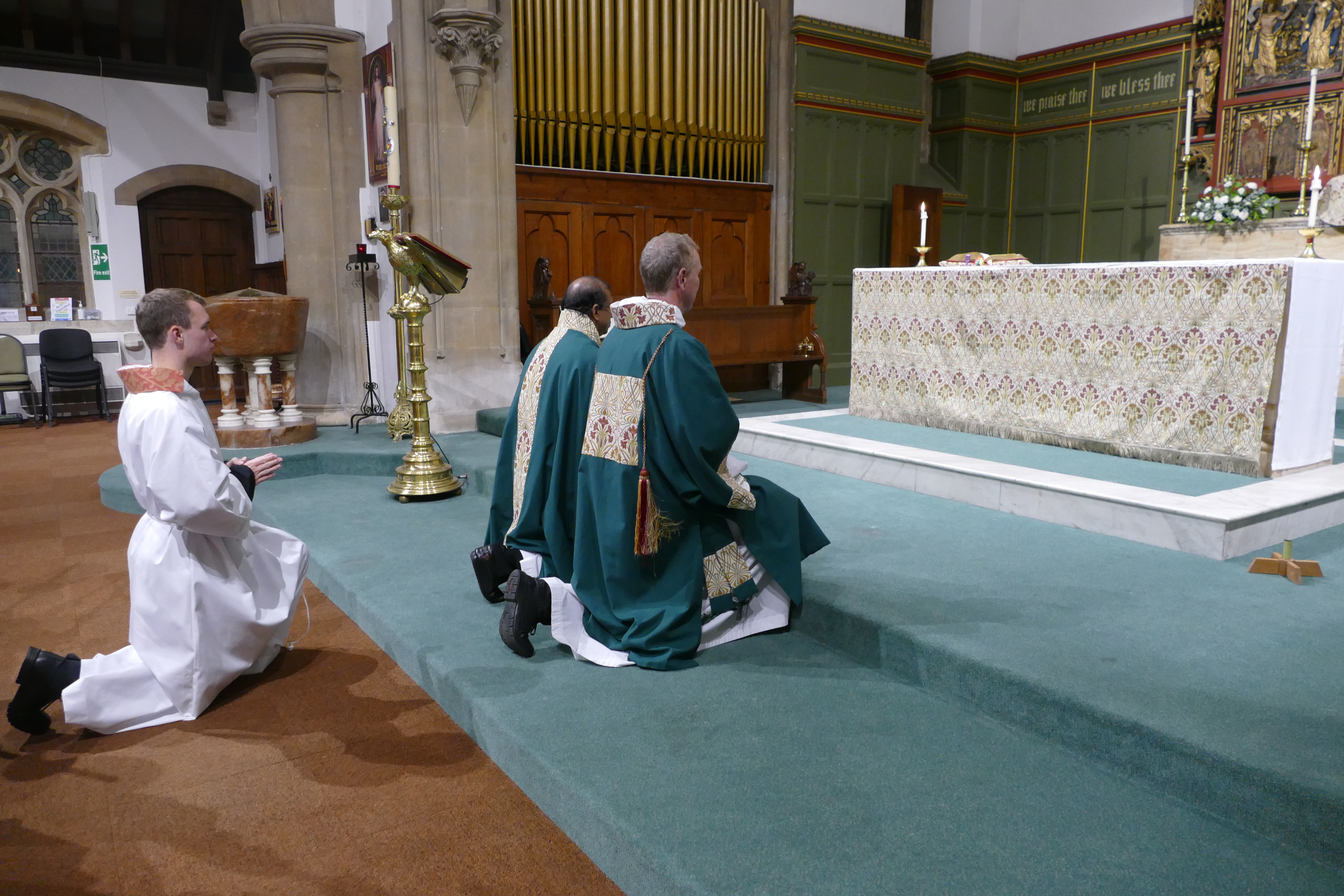
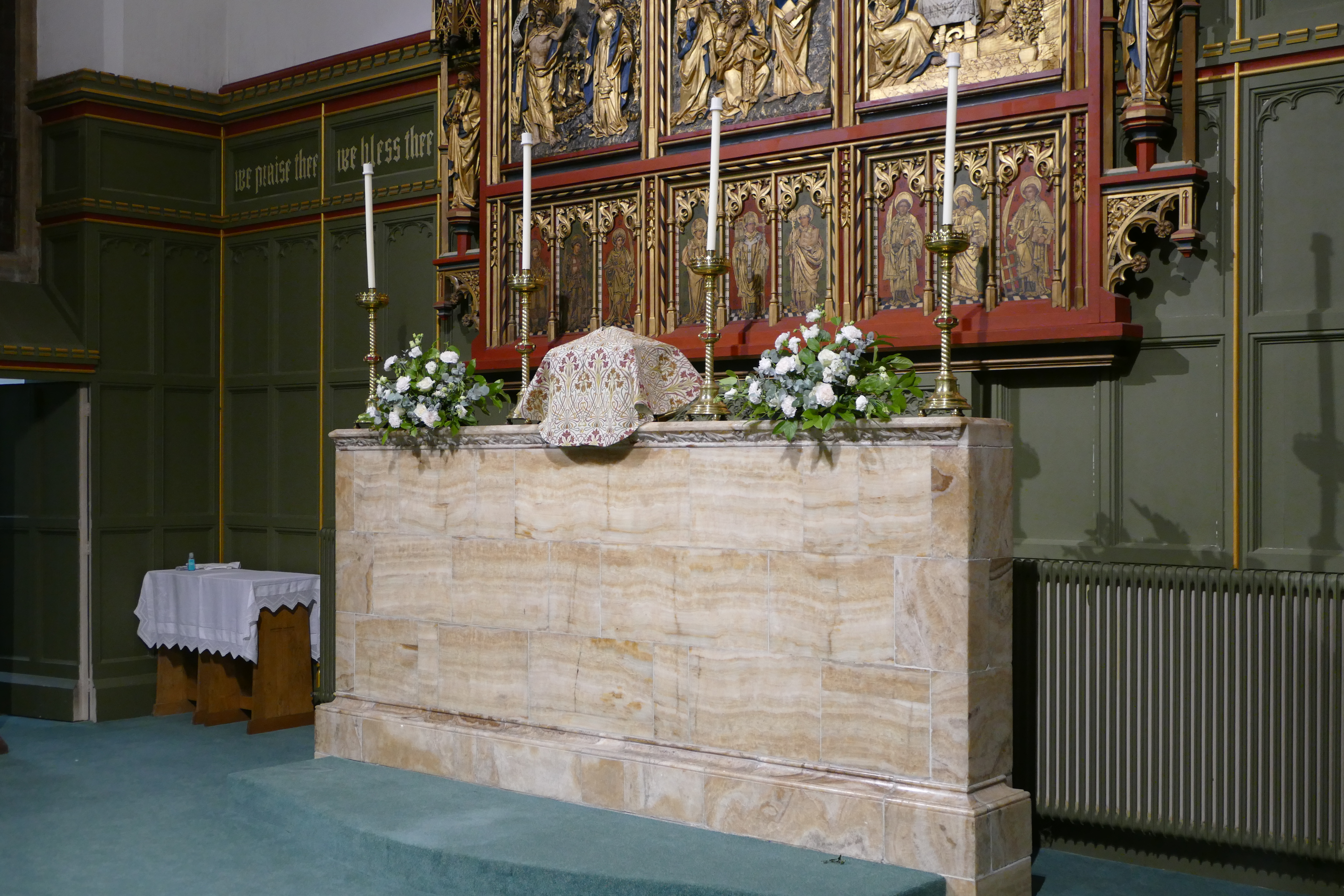
The Mass was photographed in the church of the Holy Trinity, Dorchester, Dorset. This small Gothic Revival Church, built in the 19th century to the designs of Benjamin Ferry, was originally a parish church of the Church of England. It was bought by the Roman Catholic Diocese of Plymouth in 1975 to serve the needs of Catholics in Dorchester where the former Catholic church building had become too small. It is a competent piece of work, designed along the principles established by AWN Pugin, with some good stained glass by CE Kempe and an elaborate painted and gilded reredos carved at Oberammergau.
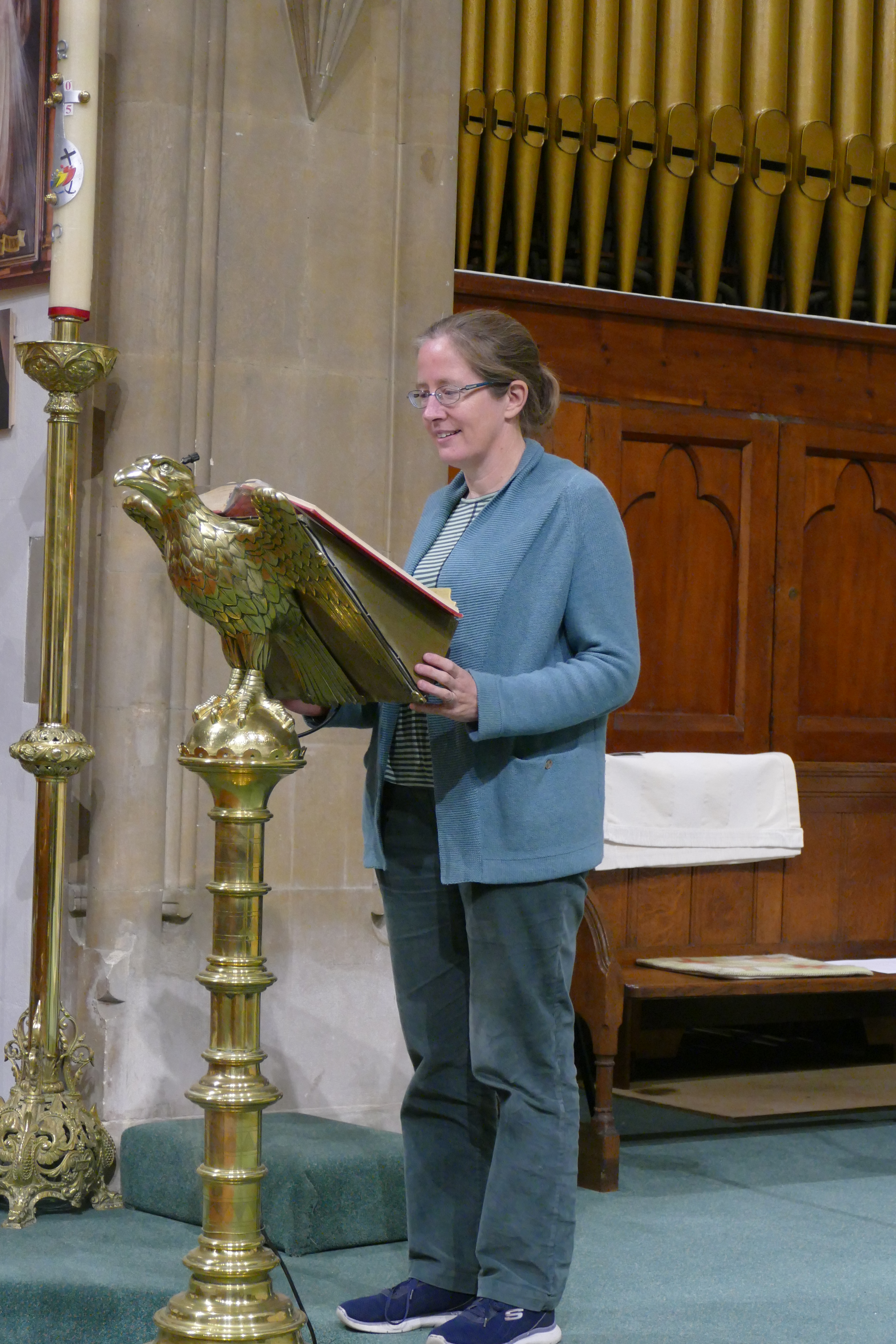
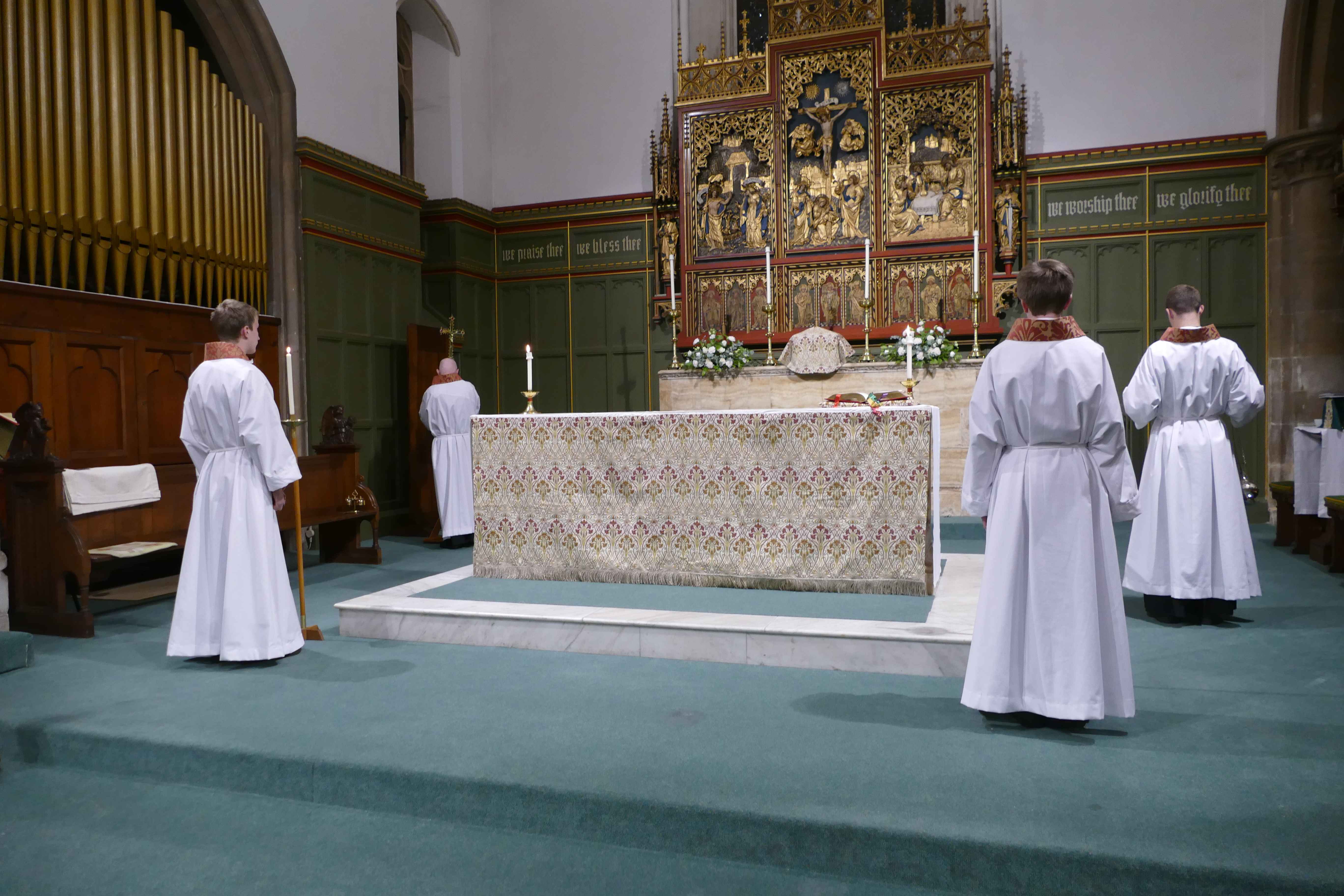
The Catholic congregation redesigned the small chancel removing the choir and creating a spacious sanctuary. They brought with them the beautiful alabaster altar from their old church and retained the brass eagle lectern from Anglican days. Interestingly, they placed the altar at the centre of the sanctuary with a single step (predella or footpace) which extends both in front of and behind the altar. The Blessed Sacrament is reserved in a central tabernacle situated on the shelf (gradine) at the foot of the reredos. The Celebrant’s chair is normally placed at the right side of the altar with the deacon’s seat next to it. Since the space here is limited I have chosen to seat the two ministers on the former choir bench facing north. This becomes less of an issue where the first part of the Mass is celebrated at the altar (an option in the Ordinariate rite) but might be an issue in the celebration of the current Roman Rite. The altar is vested in a frontal: this was almost universal among Anglicans (indeed the omission of the frontal on Catholic altars dates only from the 17th century ) and has two candles with more standing around: again, Anglican custom. There is no need for a standing crucifix on the altar as there is a prominent crucifixion on the reredos. Depiction of the Lord’s death should be treated with reticence: the constant repetition of the sacred symbol on vestments and even carpets is to be avoided! The altar missal rests on a cushion, a beautiful feature of the English tradition. Flower vases, altar cards and reliquaries and all the clutter of the Victorian altar are avoided: the English liturgical tradition retains the primitive notion that only what is necessary for the celebration of the Eucharist is placed on the Holy Table. This is also the norm for the current Roman Rite. If the need is felt for the Celebrant to have the Offertory prayers and words of Institution in front of him then a laminated card may discretely lie flat on the altar table – whether the Mass be celebrated ‘facing the people’ or ‘eastward facing’.
It seems appropriate at this stage to consider the position of the Celebrant at the altar. Up until the Council Catholic altars were often built in such a way that the priest could only take the ‘eastward position’. The tabernacle was on the centre of the altar, and the six candlesticks might stand on a shelf (gradine). In the 19th century the reredos, often containing a throne for Exposition grew in size and magnificence, but left the altar as a mere sideboard at its foot. It took the work of the Liturgical Movement and the subsequent reforms of the Council to restore the significance and dignity of the Catholic altar. Of course, as with all reforms, the pendulum may swing too far in the other direction. Architects do not always understand the practicalities (altars too small or the wrong shape) and the sheer ugliness of some recent designs, leaves one gasping.
The credence table is always at the Celebrant’s right (and will therefore ‘change sides’ depending on whether he celebrates ‘ad orientem’ or ‘versus populum’. It should be large enough to take the chalice(s) and paten (or ciborium) before Mass, together with cruets and lavabo bowl, as well as normally being the place for the ablutions after Communion. The vessels are never placed on the altar before the Offertory.
Seats for the servers are provided to the left and right of the sanctuary.
In both the ‘Ordinary Form’ as well as in the Ordinariate Rite the Celebrant may take either ‘eastward’ or ‘westward’ position. The Ordinariate Rite expresses a preference for the ‘ad orientem’ position. ( Most Anglo-Catholics in the UK installed a ‘nave altar’ in the 1970’s at which the Eucharist was celebrated ‘facing the people’, at least on Sundays. In the United States I understand that the ‘eastward position’ remained more common) . So much must depend on the building. I have seen the Divine Worship Mass celebrated on a small altar, cluttered with candlesticks and altar cards, and with the priest precariously perched on the narrow front step. The sight was faintly ludicrous! Forcing the liturgy into a straitjacket where what is deemed to be ‘correct’ is given preference over what is sensible, simple and beautiful.
The deacon goes to the foot of the altar steps, bows to the altar and ascends to the centre. The Celebrant remains seated at the sedilia. The clerk moves the Missal to its position left of the corporal and the taperers bring from the credence the chalice, pall and purificator
The chalice veil, and with it the burse, seem to have made a comeback in recent years. The Roman Missal does not mention the burse, but mandates a veil of white or the colour of the day over the chalice. The use of the burse to hold the corporal(s )(hence the ‘corporas case’ of the inventories) is older than the veil which did not come into widespread use until the 16th or 17th centuries. It seems hard to justify in these days where several chalices are placed on the credence to be used for communion in both kinds, to veil just one of the empty chalices. Certainly the chalice should not appear on the altar until the Offertory, nor should the burse be propped up between the candlesticks. If either burse or veil are used they should be taken away to the credence as soon as the deacon has prepared the Table.
The deacon spreads the corporal in the centre of the altar, unfolding it carefully , not shaking it out, and making sure that the edge of the corporal is aligned with the front edge of the altar. He places the chalice and purificator to the right beyond the corporal, and then, if there is to be an Offertory Procession, turns and goes to the sanctuary step to receive the bread and wine from the people. He receives all the bread including that which will be broken and consumed by the Celebrant. Unleavened bread is always used in the Western rites, but the wafers should not be inordinately thin like rice paper. Any suggestion that the priest has his ‘own’ wafer should be avoided, several medium sized wafers being available to be broken, say, into four, or a large ‘concelebration’ host broken into pieces at the fraction. It is desirable that a large deep paten be used with all the bread in it, rather than a small paten for the ‘priest’s host’, and a closed ciborium containing wafers for the everyone else. He may be assisted by the taperers, passing them the wine cruet.
In the meantime, the Celebrant goes directly to the centre of the altar and receives the paten from the deacon who comes up to his right. The taperer with the wine cruet goes to the right of the altar where he is joined by the second taperer who has brought the water cruet from the credence. Together they assist the Deacon who fills the chalice and adds a few drops of water, saying ‘By the mystery …’ The Celebrant for his part begins the Offertory prayers ‘Blessed art thou, Lord God of all creation …
Note on the Offertory prayers: The Divine Worship Missal provides the familiar prayers for the Celebrant and Deacon. It also provides the prayers which were used at this point (though in English) in the 1962 Missal. Liturgists have pointed out that these prayers appear somehow to anticipate the Eucharistic Prayer, which is turn seems to have led to a muddling of the Offertory as the preparation of the bread and wine on the altar at this moment in the liturgy, and the offering of the Body and Blood of Christ in the Eucharistic Prayer by which the perpetual offering of the Son to the Father is set forth in time.
Having mixed the chalice, the Deacon hands it to the Celebrant who prays, ‘Blessed art thou… ‘ and places the chalice on the corporal. The thurifer approaches, hands the boat to the Deacon, who holds it while Celebrant spoons incense into the thurible and blesses it with a single sign of the cross. The thurifer closes the thurible and hands it to the Celebrant. He censes the gifts, and then the crucifix and altar as at the beginning of Mass. Returning to the centre of the altar, he gives the thurible to the Deacon who turns, retires to the right of the altar (off the footpace) and censes the Celebrant. The Deacon then goes (with the thurifer) to the entrance to the sanctuary, and censes the people, bowing to them before and after. He returns the thurible to the thurifer.
While the Deacon is censing the people the taperers come with bowl, jug and towel to the right hand end of the altar and the Celebrant washes and dries his hands. ( Hands mean hands, not tips of fingers)
The Celebrant, at the centre of the altar, turns to speak to the people with the ‘Pray brethren ….’. The deacons turns to the right and then turns inwards. The clerk, having brought the Missal on its cushion to the Celebrant’s left, remains there to turn the pages of the book. The Celebrant remains facing the people while they make their response ‘May the Lord accept …’ and then turns again to the altar where here says the Prayer over the Gifts. The Deacon moves to stand behind him.
After a reverent pause the Celebrant begins the Sursum Corda. The general opinion is that this dialogue should be sung facing the altar without turning to the people. As the Sanctus begins the Deacon steps up to the Celebrant’s right. At the same moment the taperers leave their places at the credence, go to the centre of the pavement before the altar, bow and go to stand at their tapers (not picking them up) The thurifer, (having added a small amount of incense in the thurible at his place if necessary ) goes to the centre of the pavement or entrance to the sanctuary carrying the thurible. No exaggerated swinging of the thurible on the long chain is necessary and only disturbs the people.
At the end of the Sanctus the people kneel and the servers may do the same. The Deacon and clerk remain standing until the Invocation of the Holy Spirit, when the Deacon removes any palls and lids from the vessels, and both ministers turn and kneel of the edge of the footpace.
It should be noted that the Celebrant in the Divine Worship rite genuflects both before and after the Elevation of the Host and chalice. The Words of Institution are to be said clearly and naturally. This is the more important where the ad orientem position if adopted. The ‘silent Canon’ of the pre-Council Mass has not been re-introduced via the back door of the Ordinariate
At the Elevation of the Host and again for the Chalice the servers and ministers look up, but any sort of showy prostration is out of place. One of the servers may gently ring the bell at the elevations, and the thurifer censes the consecrated Sacrament. This should be done discretely, on the short chain, and without any clashing of the chains. Single or double swings are used but the rubrics do not anywhere prescribe a triple swing.
As soon as the Celebrant has elevated the chalice, the Deacon and the clerk stand and go to their places left and right of the Celebrant. The Deacon covers the chalice (and ciborium/paten) , the Clerk makes sure that the Missal is correctly set for the continuation of the Eucharistic prayer, and the Celebrant with the Deacon and Clerk genuflects. The Celebrant extends his hands and continues the Prayer.
The Celebrant joins his hands, the Deacon uncovers the chalice and elevates it as the Celebrant elevates the paten. They replace the vessels on the corporal and both genuflect.
The taperers stand and so does the thurifer. The taperers move to the centre of the pavement where they genuflect together with the thurifer. The the taperers turn to the right and go to their places at the credence. The thurifer turns to the left and goes to his place where he hangs up the thurible (or returns it to the sacristy if this can be done discretely.) The deacon turns and goes to stand behind the Celebrant
The servers having returned to their places and, facing the altar; the Celebrant invites the people to say the Our Father., and then continues with the Libera nos and the Prayer for Peace.
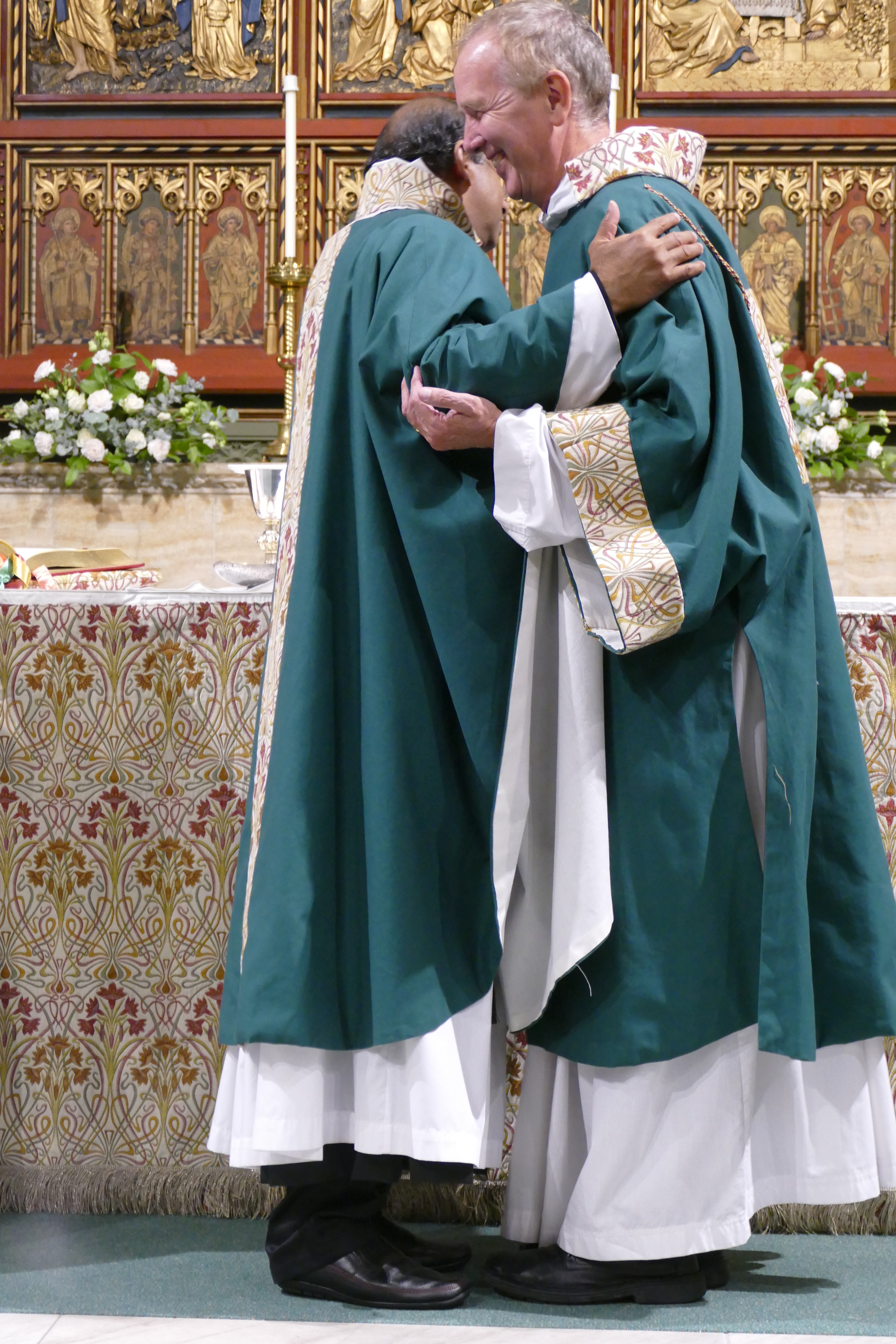
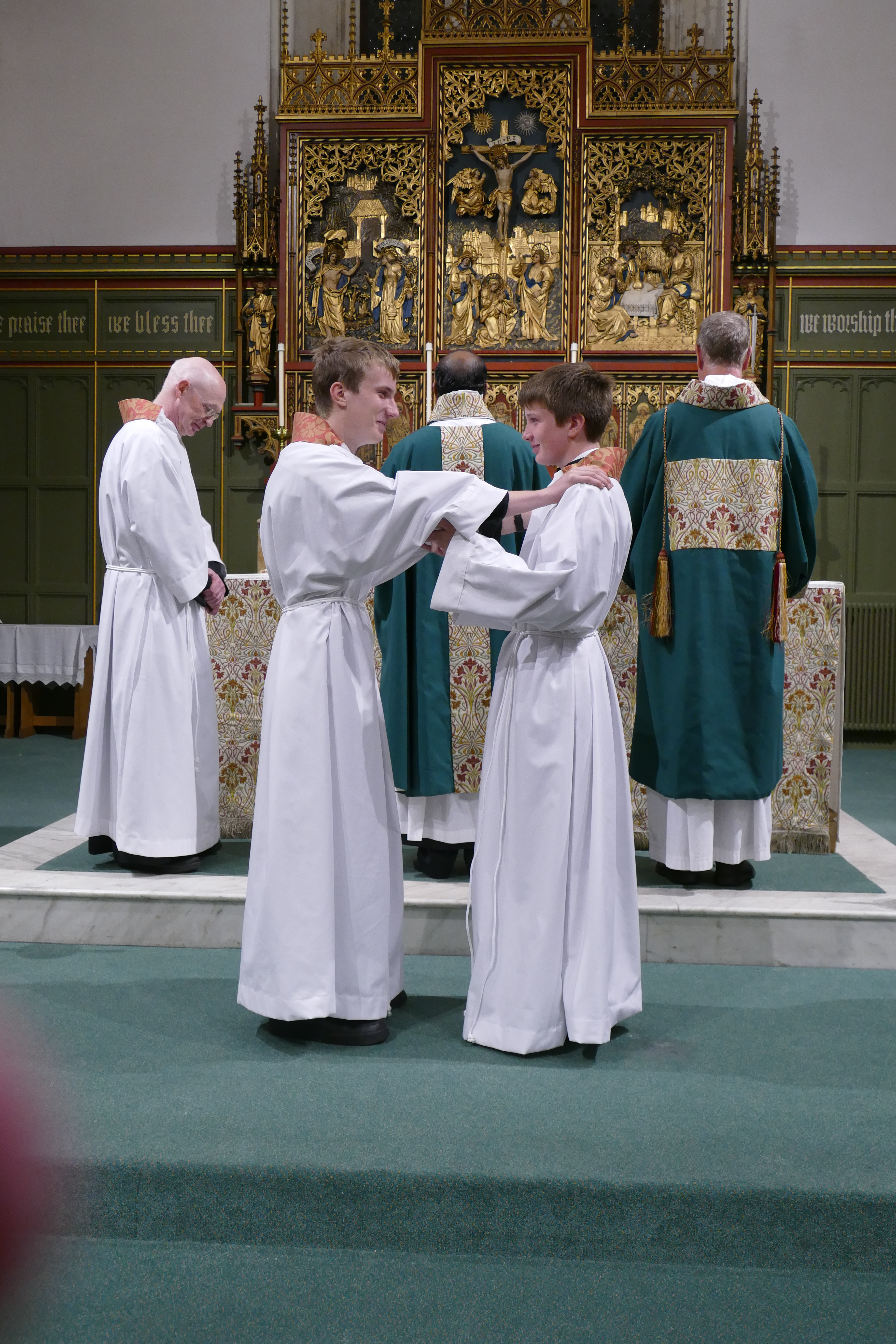
As the Celebrant turns to say ‘The Peace of the Lord …’ the Deacon withdraws to the right and then turning to face the people invites them to exchange the Peace. He goes to the right of the Celebrant and exchanges the Peace with him. If this is done formally then the two Ministers bow to each other, the senior places his hands on the shoulders of the junior, inclines, withdraws and they then bow to each other. The Deacon and Minister may descend to the step or pavement and exchange the Peace in like manner, the servers and people turning to the person next to them and greeting them. It will be better if the people do not leave their places or cross the sanctuary or church.
Deacon and Clerk return right and left of the Celebrant who recites ‘Christ our Passover …’ with the people responding. The Celebrant then performs the fourth action breaking the Host deliberately in two and then continuing to break up the Hosts for Communion. The Deacon may, if necessary go to the Place of Reservation, opening the tabernacle, genuflecting and returning to the altar with the ciborium. The Agnus Dei is sung or said.
The Prayer of Humble Access is recited, and then the Celebrant turns to the people, showing them the Host (and chalice) and saying ‘Behold, the Lamb of God …’ The people respond, ‘Lord, I am not worthy …’
The servers and people receive Holy Communion.
After Communion the Celebrant returns to the sedilia and the Deacon cleanses the chalice (and other vessels) assisted by the servers. He covers the chalice with the veil, folds and places the corporal in the burse. All vessels are removed to the credence table.
At the end of the silence the Celebrant and Deacon rise. The taperers go immediately to the centre of the pavement before the altar where they bow and go to stand by their torches. The clerk stands close to the credence with the processional cross and the thurifer stands at his place on the left of the altar (without the thurible.) The Celebrant and Deacon make their way to the foot of the altar where they bow. The Celebrant ascends to the centre of the altar, and the Deacon takes his place. The Celebrant recites ‘Almighty and everliving God …’ alone or with the people. Then he says, ’Let us pray’ and the Post Communion Prayer.
The Celebrant turns to face the people. The Deacon turns to his right, so as not to obscure the Celebrant and then turns inward. The Celebrant greets the people and blesses them. The People respond ‘Amen’.
The Deacon turns to face the people and announces ‘Go forth in peace’ (with hands joined) and the people respond.
Celebrant and Deacon turn back to the altar and kiss it. Then they turn and descend to the pavement where they make the appropriate reverence with the servers and depart.
The Celebrant and Deacon turn to the right and go to the sedilia. The Deacon assists the Celebrant to sit (useful with heavy and full vestments) and then sits himself. They listen attentively to the Word of God without fidgeting or talking to each other.
The Reader goes to the ambo (lectern) and proclaims the First Reading, Psalm, Second Reading where ordered, and the Gospel Acclamation is sung.
As the cantor or choir begins the Acclamation, the thurifer approaches the sedilia. (The custom of doing this during the Second Reading is to be deprecated: it disturbs the people and is disrespectful to the word of God which is being read. If necessary let the blessing of incense be done in silence before the Acclamation begins.) The Celebrant stands, spoons incense into the thurible and blesses it in silence making the sign of the cross once over it with the right hand.
The taperers move to their candles at the altar step, take them up and wait. The thurifer meanwhile closes the thurible and goes to stand in the centre of the sanctuary. The Deacon asks and receives the Celebrant’s blessing, and then goes directly to the centre of the altar where he picks up the Gospel Book. He inclines moderately with the servers, turns and goes to the ambo.
The taperers go left and right of the lectern standing, as it were, to light the Gospel book, and the thurifer to the right of the Deacon. The Deacon greets the people (with hands joined) and announces the Gospel. Then he receives the thurible, censes the book, and returns the thurible to the thurifer who goes to stand at a distance behind the Deacon. During the reading of the Gospel he gently swings the thurible on the long chain. (Any thing which distracts – excessive smoke, clanking of chains – is to be avoided. )
The Deacon now reads or sings the Gospel, kissing the Book at the end. He then returns to the sedilia, unless he himself is to preach at the ambo.
The Celebrant or Deacon preaches the homily from the ambo (or the Celebrant may preach from the chair)
If the Creed is to be said the Celebrant and Deacon remain at the sedilia, genuflecting at the Incarnatus; and making the sign of the cross at the end, as ordered.
The Book of Common Prayer of the Church of England restored an ancient feature of the Eucharist which had been largely lost during the mediaeval period, that is the Prayer of the Faithful. This BCP prayer was called The Prayer for the Church Militant as it reflected the belief of the Reformers that prayer for the dead was not an ancient Christian practice. (They were mistaken, though prayer for the dead had become scandalously perverted over the preceding centuries) The Divine Worship Missal provides several alternatives. There is tacit permission for the long-established custom of the Prayer of the Faithful being written according to the needs of the time and place. There should be no need to compose in thee/thou form (with all the complications of verb endings) if the rule is observed that the petitions are addressed to the people i.e. ‘Let us pray for …. ‘ and not cast as prayers i.e. ‘Heavenly Father, we pray that …’ which form is reserved to the Celebrant at the Eucharist. Traditionally the Prayer of the Faithful is part of the Deacon’s liturgy.
The Prayers of the People being ended the servers and congregation kneel at the behest of the Deacon and pray together the Confession.
A PRESENTATION IN PHOTOGRAPHS OF THE MASS CELEBRATED ACCORDING TO DIVINE WORSHIP – THE MISSAL OF THE ORDINARIATES
With the creation of the Ordinariates for receiving Anglicans into the full communion of the Catholic Church, together with the publication of a Missal containing elements of our liturgical heritage; I first conceived this photographic project some years ago. With my retirement from Parish ministry I now have the time to pursue such a project. It is not a celebration of the Mass but rather a series of posed photographs. Nor is it in any way ‘official’ though I believe I have followed the rubrics and instructions carefully .I shall be glad to receive comments and criticisms
I am grateful to Fr Babu Francis, parish priest of Holy Trinity, Dorchester, for permitting me to use the church as the setting for this photo shoot, and for taking the part of the Celebrant. My thanks also to Deacon Jonathan de Kretser, to Mark, Tom, Michael and Mark, the servers, members of the congregation and Sue, the photographer (with whom I was at school a few years ago).
The Divine Worship Missal authorised for the use of the Ordinariates created in 2009, is prefaced by the same Instruction as that of the Missal of 1970 and used by Catholics across the western world.. In the Ordinariate Missal the Instruction is followed by the Rubrical Directory, with rubrics and recommendations peculiar to the Mass rite of the Divine Worship Missal but it has been made clear on a number of occasions that the Ordinariate Rite is a variant of the current liturgy, although the Directory ‘ sometimes permits or mandates customs from the 1962 Missal. It is not the ‘old’ Mass in English and should not be treated as such.
I therefore make no apology for the fact that in this presentation of the Mass I have kept the shape of the Mass as close as possible to that of the ‘Ordinary Form’. But I need to explain my preference for a ceremonial form common among Anglicans in the 20th century: often (though misleadingly, I think) called the ‘English Use’. My hope therefore is that the presentation will be of use the priests and congregations who do not use the Divine Worship rite and with a minimum of adaptation may produce a liturgy which is dignified, fresh and beautiful.
In establishing the Ordinariates the Pope expressed the hope that former Anglicans coming into the wider communion of the Catholic Church would bring with them a ‘Patrimony’, not least in the area of liturgy. We assume that the first English liturgy after the break with Rome (the Prayer Book of 1549) was celebrated according to the usage which had been current for hundreds of years, though there is evidence of simplification. Much of this was swept away in the Prayer Book of 1552 in which the influence of the Protestant reformers is most obvious. All the subsequent liturgical changes of the C of E manifested – at least until the 1980’s – a desire to return to the mainstream of Catholic worship.
This process began almost immediately with the insertion into the Prayer Book of 1559 of the ‘Ornament Rubric’, repeated in 1604 and in 1662.
“THE Morning and Evening Prayer shall be used in the accustomed Place of the Church, Chapel, or Chancel; except it shall be otherwise determined by the Ordinary of the Place. And the Chancels shall remain as they have done in times past. “And here is to be noted, that such Ornaments of the Church, and of the Ministers thereof, at all Times of their Ministration, shall be retained, and be in use, as were in this Church of England, by the Authority of Parliament, in the Second Year of the Reign of King Edward the Sixth.”
The interpretation of the second paragraph was debated when it first appeared but became a major issue towards the end of the 19th century during the conflicts over what vestments and ceremonies were legal in the Church of England. At the end of that century the researches of Dr Percy Dearmer were encapsulated in his book ‘The Parson’s Handbook’. Dearmer was a ‘working’ parish priest, Vicar of St Mary’s Primrose Hill in north London, and his work contained pages of practical suggestions. He was motivated too by his deep aesthetic sensibilities, so that what he advocated was not mediaevalism, nor a copying of current Roman Catholic practise, but a fresh look at worship which drew on the wells of tradition. He insisted that liturgical worship should be beautiful not just ‘correct’, and in many ways he reflected the concerns of the growing Liturgical Movement in the wider Church. Dearmer’s work had a huge influence in the C of E not least in its Cathedrals where dignified and beautiful liturgy became the norm, not the exception. Many will remember the look of appreciation on the face of Pope Benedict in Westminster Abbey (where Dearmer had been a Canon between 1931 & 1936) as the servers, choir and clergy entered with him to the singing of ‘Christ is made the sure foundation’.
This tradition of liturgical worship, shaped by both ancient Christian symbolism, the concerns of beauty, and practical considerations, is an essential part of the Patrimony. I believe it is one of the gifts which Anglicans who have been received into full communion bring with them for the enrichment of the wider Church. In this spirit I respectfully offer this illustrated guide to the presentation of the Mass not only to the Ordinariates in the UK, America and Australia, but to the Church as a whole.
The ministers approach the altar. The Priest Celebrant is accompanied by the Deacon, as he will be wherever possible, regardless of whether the Mass is celebrated with music and singing or not. Under the 1962 missal (The ‘Tridentine Rite’ or ‘Extraordinary Form) ‘High Mass’ was celebrated with three ministers, Celebrant, Deacon and Subdeacon. In fact these three ministers were usually in priests’ orders, though permission was given latterly for a layman to take the part of the Subdeacon. The reforms to the liturgy after Vatican 2 required that from henceforward the Deacon must be a ‘real’ Deacon (transitory or permanent) and that a priest might not assume the dalmatic and deacon’s stole. The Subdiaconate had been abolished as an Order, being replaced by the instituted ministries of Lector and Acolyte. From the 19th century many Anglicans had copied the form of ‘High Mass’ without the corresponding orders, though it is worth noting that the ‘Epistoler’ and ‘Gospeler’ were to accompany the Celebrant in Cathedral and Collegiate churches, wearing copes.
The form of ‘High Mass’ with three ministers continued in the C of E after the reforms, especially in the Cathedrals, though the reasons seem to have been largely aesthetic rather than a reflection of a clear understanding of the different Orders. Otherwise this form died out quite rapidly in the UK with the clergy preferring to concelebrate where appropriate. The Divine Worship Missal has the (unclear) rubric ‘In the absence of a second Deacon, another cleric or even an Instituted Acolyte may serve the sub-diaconal ministry and read the Epistle. Does this then mean that it would be appropriate to celebrate the liturgy with a ‘sub-deacon? I think not. The ‘Minister’ of our rite is much closer to the ‘Clerk’ of the English tradition (and indeed Bishop Challoner in ‘The Garden of the Soul’ in the 18th century, uses the title of Clerk for the one who serves and ‘answers’ the Mass (i.e. responds to the priest on behalf of the congregation, the Mass being celebrated in Latin, a tongue unknown to to majority present) Should the Clerk (or Minister) wear the tunicle? I think not. To revive this vestment which is so similar to the Deacon’s dalmatic over half a century since it became obsolete, would only confuse – and to what purpose?
So the Mass is seen here celebrated by a priest Celebrant who is assisted throughout by a single Deacon wearing his distinctive vestments. If there is a second deacon available he may also function, the two deacons dividing the role between them. This is particularly appropriate where the Celebrant is the Bishop. It should be noted that the deacon remains at the right hand of the Celebrant. He should not be displaced by the concelebrating priests, and it would be better if they stayed off the footpace altogether, allowing the Clerk (Minister) to stay at the left of the Celebrant to turn the pages of the altar Missal.
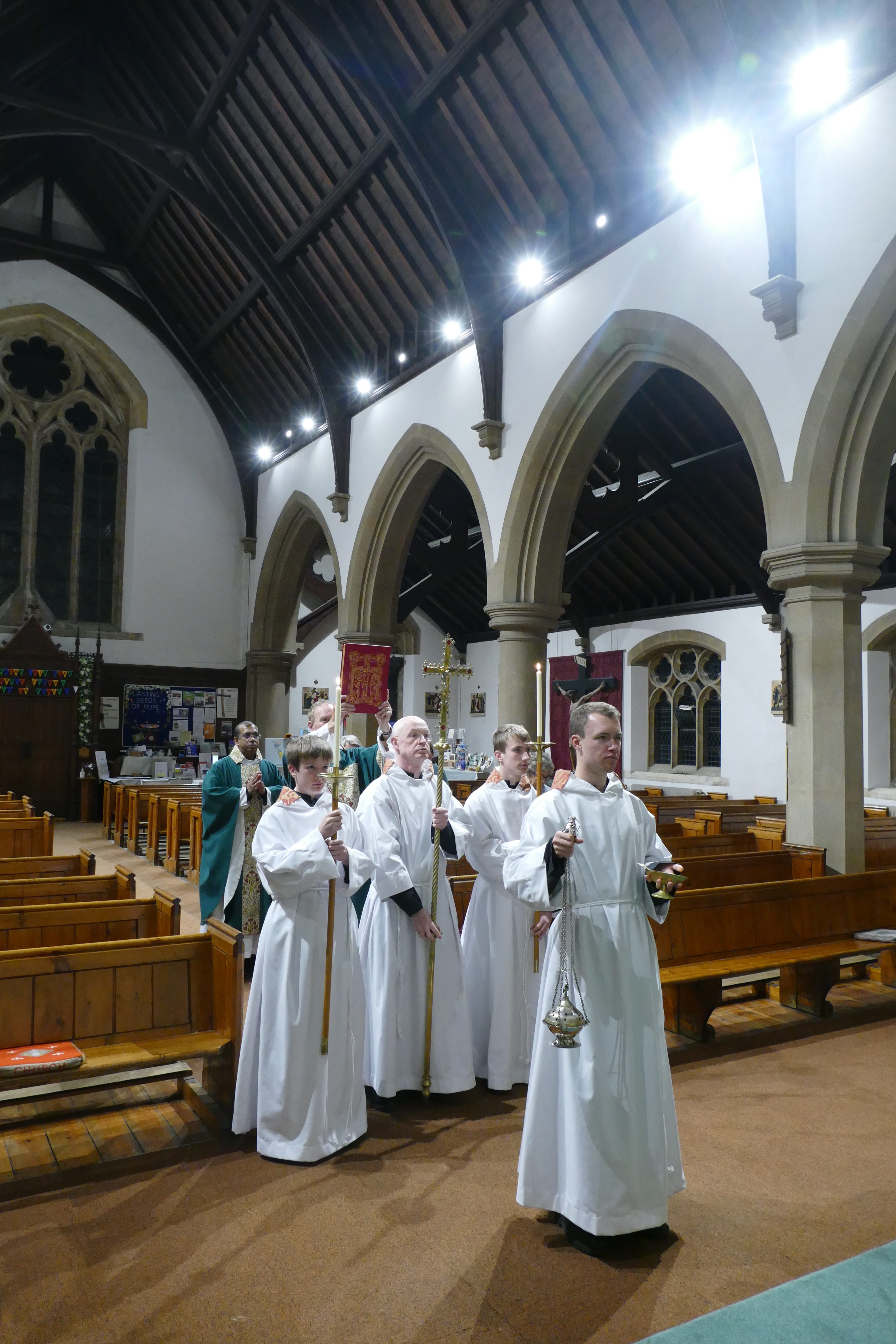
Four servers take part in the celebration, the clerk, carrying the processional cross; next, the taperers who are often referred to (somewhat confusingly) nowadays as acolytes, with their tapers or candlesticks; and the thurifer, who carries the thurible swinging it gently on the long chain in the Entrance Procession. The Celebrant will have put on and blessed incense in the sacristy.
All ministers (both lay and ordained) wear the alb with amice and girdle (cincture). The amice has a collar called an apparel, a particularly attractive English tradition. The amice is the first of the vestments to be put on, but rests over the head until the chasuble or dalmatic is in place. Then the amice is lowered, the apparel forming a collar over the outer vestment.
The ministers approach the altar through the assembly.
Arrived before the altar the servers and ministers make the appropriate reverence. If the Blessed Sacrament is reserved in the sanctuary then a genuflexion is made. This acknowledgement the Real Presence of the Lord in the tabernacle is made at the beginning and end of Mass. Otherwise the genuflexion is made only to the Sacrament on the altar after the consecration. If the Sacrament is reserved elsewhere in the church then the ministers and servers make a profound bow to the altar. If the Deacon is carrying the Gospel Book he neither bows nor genuflects.
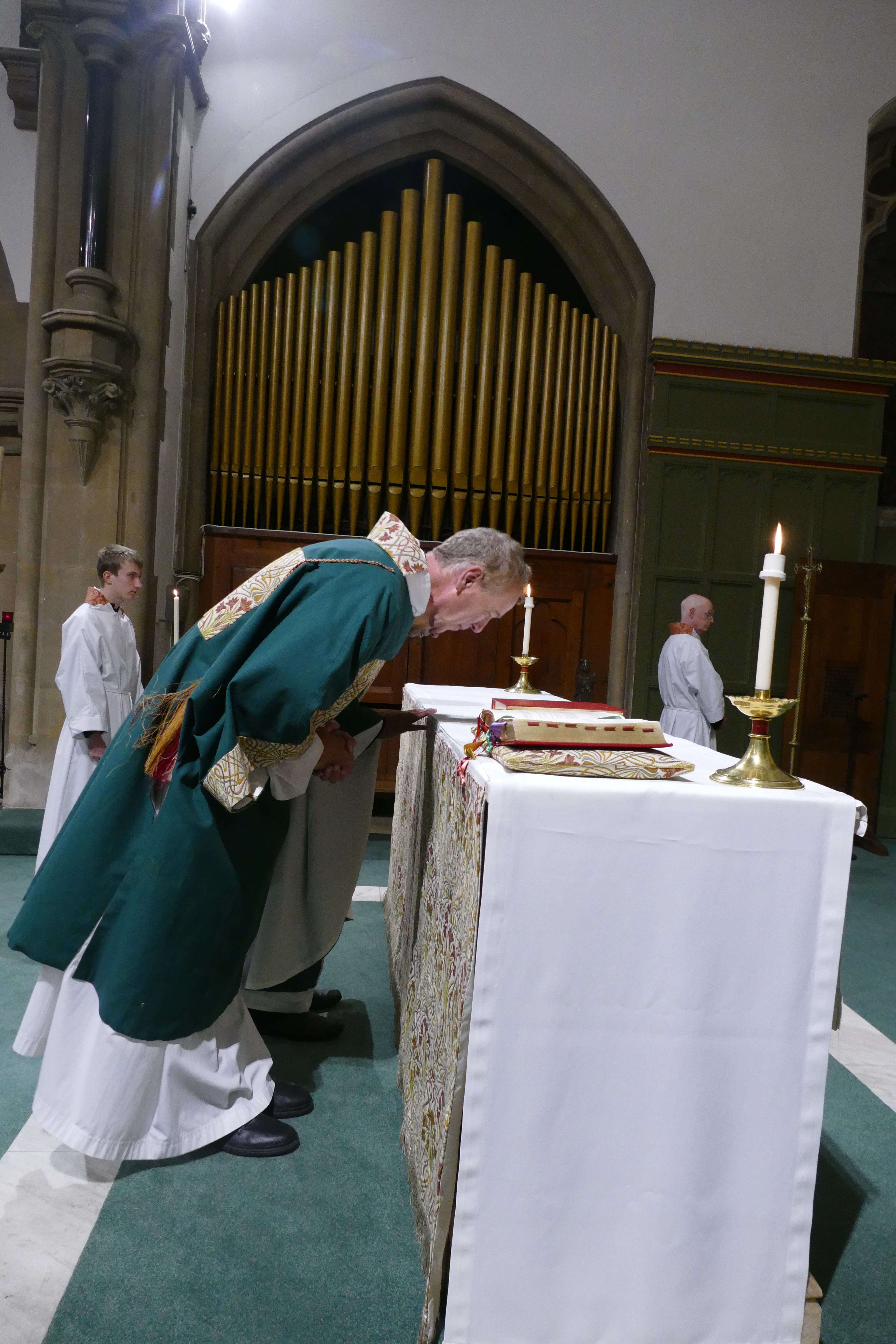
The Priest and Deacon ascend the altar steps, the Deacon places the Gospel Book on the altar and both ministers kiss the altar. The thurifer approaches and gives the thurible to the Celebrant. (Incense will have been put on and blessed by the Celebrant in the sacristy and there should no need for more to be added and blessed at this point.) The Celebrant censes the crucifix, on or above the altar, bowing before and after the censing, and then, (moving anticlockwise) censes the altar. He may be accompanied and aided by the deacon and clerk or thurifer., especially if he is wearing very full and heavy vestments. The altar is censed in the simplest manner possible going right round the altar, gently swinging the thurible. (Where the sanctuary is very small and the altar is close to the east wall then the Celebrant will cense the altar to the right and then to the left. ) There seems no reason to revive the custom of censing the Celebrant at this point. Having handed the thurible back to the thurifer, the Celebrant and Deacon go to the north or left-hand side of the altar.
The rubric from the 1662 Prayer Book of the Church of England requires the priest to begin the Communion Service at the ‘north end’ of the Holy Table. From the Offertory onwards he is to stand ‘before’ the Table. Standing and kneeling at the ‘north end’ became a hallmark of evangelical Anglicans until the 1980’s, in spite of liturgical scholars pointing out that the ‘north end’ is not the ‘north side’. Before the Reformation it was apparently the custom in some places for the vestments to be laid out at the ‘north end’ of the altar and it was there that the Celebrant vested and said his preparatory prayers.
The Celebrant, facing the altar, says the Invocation, and (alone) the Collect for Purity. He will need a card on the altar (which should not be propped up on the candlestick!)
Still at the ‘north end’ the Deacon turns to the people to read the Commandments or Summary of the Law. The Clerk (Minister) holds the card or gives it to the Deacon.
The Celebrant and Deacon move to the centre of the altar. The Celebrant, opening and then joining his hands, sings the opening phrase of the Gloria. (On occasions when the singers perform a lengthy setting of the Gloria, the priest and deacon go to the sedilia (their seats) They and the people sit and participate in listening. There is no reason for the priest to recite the Gloria sotto voce at the altar as this implies that he is celebrating his ‘own’ Mass separately from the rest of the congregation.
Still at the centre of the altar the Celebrant turns to the people and greets them (the Deacon moves to one side, turning and walking deliberately, and not shuffling sideways. He then turns inwards at right angles to the Celebrant). The Celebrant greets the people and then together he and the Deacon and move to the right-hand side (the south side) of the altar where the Celebrant says the Collect. Only one Collect is ever used. (The moves here are complicated and need to be practised carefully and accomplished slowly and deliberately.) The Clerk (Minister) has left his place on the footpace and gone to stand at his seat.
After the people have responded with their Amen the Celebrant and Deacon turn to the right and go to the sedilia. The Deacon assists the Celebrant to sit (useful with heavy ad full vestments) and then sits himself. The taperers move to the centre, bow to the altar and together go to their places.
“The truth is that the English puritan’s crusade against all forms of sensuous beauty in worship has had more effect than we realise upon our notion of the worship of the primitive church. It disconcerts us to find that that church did not share the puritan theory of worship so far as corporate worship was concerned. No small part of our liturgical difficulties … come from confusing two things: protestantism – a purely doctrinal movement of the sixteenth century, confined to Western christianity and closely related to certain aspects of fifteenth century Western catholicism, from which it derived directly by way both of development and reaction, and puritanism – which is a general theory about worship, not specifically protestant nor indeed confined to christians of any kind. It is the working theory upon which all mohammedan worship is based. It was put as well as by anybody by the Roman poet Persius or by the pagan philosopher Seneca in the first century, and they are only elaborating a thesis from Greek philosophical authors going back to the seventh century B.C. Briefly, the puritan theory is that worship is a strictly mental activity, to be exercised by a strictly psychological ‘attention’ to a subjective emotional or spiritual experience/ For the puritan this is the essence of worship, and all external things which might impair this strictly mental attention have no rightful place in it. At the most they are to be admitted grudgingly and with suspicion, and only insofar as practise shows that they stimulate the ‘felt’ religious experience or emotion. Its principal defect is its tendency to ‘verbalism’, to suppose that words alone can express or stimulate the act of worship. Over against this puritan theory of worship stands another – the ‘ceremonious’ conception of worship, whose foundation principle is that worship as such is not a purely intellectual and affective exercise, but one in which the whole man – body as well as soul, his aesthetic and volitional as well as his intellectual powers – must take full part. It regards worship as an ‘act’ just as much as an ‘experience’. The accidental alliance of protestant doctrine with the puritan theory of worship in the sixteenth century may have been natural, and was as close in England as anywhere. But it was not inevitable. The early Cistercians were profoundly puritan, but they were never protestant. The thorough protestantism of the Swedish Lutherans, with their vestments and lights and crucifixes, has never been puritan.
The puritan conception of worship may be right or wrong in itself – catholics must excuse a monk for finding it understandable and, in some respects at least, sympathetic,. But from the point of view of history we have to grasp the fact that there was little in antiquity to suggest to the church that it was even desirable for Christians. The elaborate ceremonial worship of the Jerusalem Temple had never been condemned on those grounds by our Lord. And although they came to regard it is in some sense superseded, it had never seemed wrong to the christians of the apostolic age, whose most revered leaders had continued to frequent it until they were driven from Jerusalem. Images and metaphors drawn from it saturated the language of the new christian scriptures, and entered at once into the very fabric of eucharistic doctrine. Clement in the first century takes its practice as the most natural analogy of the christian eucharistic assembly….What is striking about the pre-Nicene liturgy is to no much its simplicity as what I have called its ‘directness’, its intense concentration and insistence upon the external sacramental action in itself as what really mattered, and its exclusion of all devotional accretions of a kind which stimulate or satisfy a subjective piety. This is a type of worship the very reverse of the puritan, for which the subjective experience, not the external action, is always the important thing.”
Dom Gregory Dix The Shape of the Liturgy Dacre Press 1943
In the 1960’s the Kelham Fathers published a little collection of hymns under the title ‘Some Kelham Hymns’. It cost 4/- (20p.) for 36 pages. They were part of the liturgical renewal of the time, and the Preface points out that new hymns are coloured by the theological climate of the era and, as such, are bound to ‘date’ fairly quickly. Looking at these hymns which were written over 50 years ago they retain a freshness and directness which is remarkable. They stand in contrast to the work of Fr Geoffrey Beaumont CR and his group, in that they (for the most part) retain traditional tunes with new words. The Twentieth Century Church Light Music group provided new tunes for traditional words: the music (to my ear) seems very dated, in the 1950’s dance band style.
‘Some Kelham Hymns’ includes twenty one hymns. Fifteen were written by Fr Hilary Greenwood SSM, two by Fr Giles Ambrose SSM, one by Fr Alex Adkins SSM and the remainder by Old Students. The Processional for Michelmas ‘Sons of the Holy One’ and several other hymns have been included in editions of the English Hymnal.
These are hymns in the traditional sense. They are objective, biblical and theological. They are unlike the ‘Worship Songs’ which were then becoming popular, which are usually expressions of personal devotion (‘Jesus, we love you, we worship and adore you’ for example). They use scriptural imagery, as in the children’s hymn ‘Walking in a garden’ where Fr Hilary weaves the three verses around the Garden of Eden, the Garden of Gethsemane, and the Garden of the Empty Tomb. Then there is that extraordinary hymn ‘Wonderful completeness’ where the same author begins with Samson, migrates through Herod’s Temple (‘While the Temple curtains billow/ Round the wak’ning dead’) and ends with the Resurrection and the Church. Powerful stuff!
This use of startling imagery and paradox is found in any number of the hymns. Mary, the Incarnation and the Eucharist are brought together in ‘The breath of God, which ev’ry heart’, and it contains the wonderful lines: ‘And he whose speech can rouse the dead / Is cradled in the House of Bread.’
‘The Trinity of mutual love’ is set to be sung to a traditional English folk song. It finds the image of the Trinity imprinted in Creation and the remaking of the unity of the world a return to the unity of God the Trinity. We find this same concern that the life of the Trinity may be restored in human living in the hymn ‘God does not shrink the human form’ (by a different author) .
From time to time the music reveals the era in which these hymns were written. ‘The wind blows on the mountain side’ is based on the Didache and the tune which accompanies it is an arrangement of ‘House of the Rising Sun’. I was told that Fr Hilary wrote ‘Walking in a garden’ to be sung to the tune of ‘Puff the magic dragon’ but that the composer/publisher of that song refused permission. Pity! It fits rather well.
I cannot finish without a mention of ‘Sons of the Holy One’, the great Michelmas Processional Hymn by the Revd F A Judd, an old student of Kelham who died in 1939. Even as I type these words I can hear it being sung by sixty young men to that splendid tune Liebster Emmanuel(harmonies by J S Bach of course). I don’t suppose it is much used these days, for Processions which were such a joyous part of mediaeval liturgy died as the laity were (and are) safely confined to their seats to be lectured by a ‘personality preacher’ … Someone once said that Anglicans learned their theology through the hymns they sang. They quoted the example of Mrs Alexander’s hymn ‘There is a green hill’ where the New Testament theories of the Atonement are successively explained in the verses. Strong words and strong music are needed if the Christians of our generation are to offer worthy worship, and to articulate the Faith to a hungry world.












 Ordinariate Pilgrim