
‘Groups of Anglicans’ – that’s what ‘Anglicanorum Coetibus’ means. So ‘groups’ is an important word for us; it’s part of who we are as Catholics in the Ordinariate. As Anglicans we had lots of groups! Lent groups, home groups, Group Ministries to name but a few. My fellow class members at Kelham (all Catholics now) may even remember our Encounter Groups which had such a devastating effect on the life of both the Community and the College.
I read once in a book about Church Growth theory that all Christians need to belong to three groups. To help us remember these things, they are called the ‘3 C’s’. The groups are Celebration, Congregation, and Cell. We’re most familiar with the middle one, congregation. The theory describes it as the group which one priest or minister can effectively relate to, say 100 – 150 people. Much above that and it becomes difficult for the priest to know everyone. Much below a hundred and financing and resourcing the group becomes difficult, especially funding a priest/pastor and a place where the whole congregation can meet for Sunday worship.
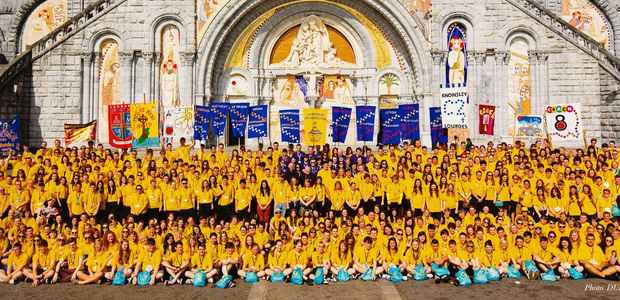
Young people on pilgrimage
Celebration means 150+ and it can be thousands. For us Anglo-Catholics it was the Millenium Celebration Mass at the London Arena – it’s Lourdes and Walsingham and a Papal Mass in Rome. Now, just as an aside, and because someone is likely to pick me up on this, I recognise that many Catholic parishes in England are Celebration size, and even individual Sunday Masses may have congregations of 300 – 500 which is a lot bigger than the ‘Congregation Size’ that my theory will allow. I think there are special reasons for this, to do with the financial giving of Catholic congregations, and with the number of priests available. That’s another issue, perhaps another post. What I do notice is that a growing number of Catholic congregations are getting to ‘Large Congregation size’ with about 150 – 200 at Sunday Mass. With these numbers the dynamics change, and it is the dynamic – the way that a group functions depending on its size – which is so important.
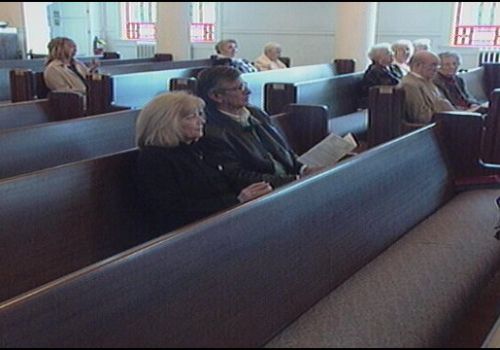
empty and ageing?
If I take you back to our C of E days we remember that many of us belonged to congregations with about 40 – 50 at the Sunday Eucharist. What used to puzzle me was that we often talked about the decline in the C of E compared with the growth of Pentecostal/Evangelical congregations. I took some time comparing numbers and I found that many of the latter were also drawing 40 – 50 to their Sunday worship. Yet they talked enthusiastically about the blessing of growth, and we talked about the burdens of decline. Why?
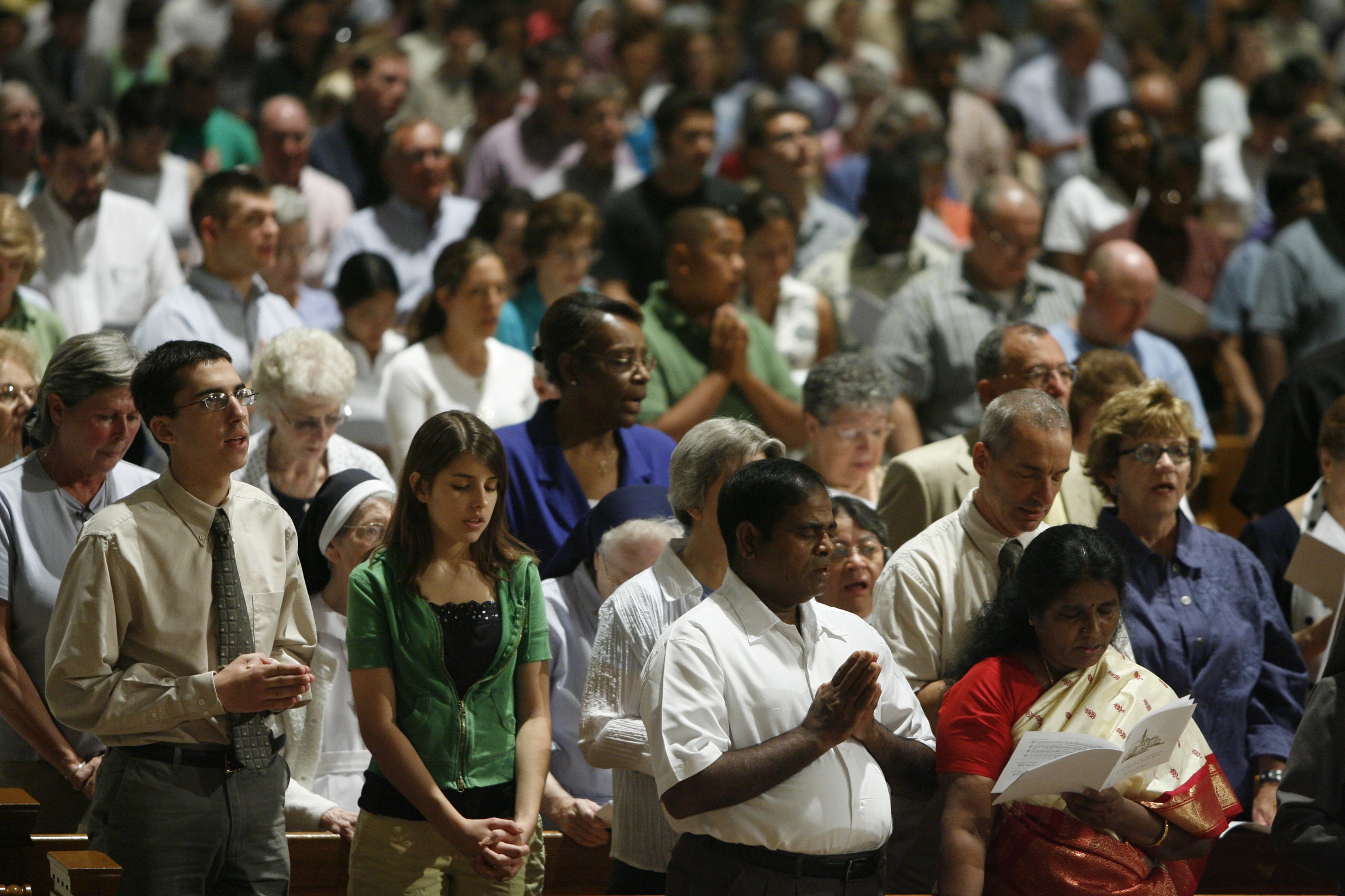
The Lord added to their number
I think the answer is simple. We thought of our group of 30 people as a Congregation, remembering the glory-days when we had been 120, with a choir and Sunday Schools and a Youth Club. Yet with only 30 people we continued to keep open the same building with chairs for 200, and most of us were on the PCC because we still had to keep that going. Now down the road Full Faith Jesus Loves You Community Church Inc. had started with ten of them in someone’s front room. Their mission – to GROW! As soon as their group reached fifteen they divided and occupied two front rooms. A year later there were three home groups of fifteen – so on Sunday they hired a room (probably in our Church Hall!) and filled that. Now they were a small congregation, sitting on every chair available, but still with minimal organising needs and financial overheads. So the time and the energy went into MISSION and GROWTH.
It’s a tragedy – both for Anglo-Catholicism and for the Church of England – that whole congregations did not respond to Pope Benedict’s call to unity. Can you imagine what it would have done for the for Christianity in the UK if the C of E had announced the end of the Reformation breach, and the return of Anglicans to the Universal Church? But it hasn’t happened like that, and we have to accept what the Lord of the Church has given us, as his will for us now, today.
prayer and praise
But acceptance of that will does not mean staying where we are, failing in hope for the future, and not looking to the great things that the Holy Spirit does to those who trust his power. The small Ordinariate Group looks to grow. It finds its continuing identity perhaps in a weekly meeting as a Home Group. Most of our groups are fortunate in having a priest, so that all the members may continue to be formed in the Scriptures and the Catholic Faith, and in the celebration of the Eucharist. The group prays together, the group socialises, and the group has pastoral care for each other, for families and neighbours. The group is part of a Catholic Parish and offers itself as a group of committed and dynamic people to the life and service of the Catholic Parish. It evangelises, and has no shame about bringing former Anglican friends, many of whom are grieved at the direction of the C of E in this country, into the group. The Ordinariate Group outgrows the front room, and divides in two and three and four, but continues to meet each other on Sunday.
And at this point the Ordinariate Priest, with his Catholic Parish Priest, go to the bishop: ‘Here we have a growing group of committed laity, inspired in their Mission to evangelise, to recover the lapsed. Where do you want to plant them, to revive a congregation, to re-open a Mass Centre? ‘ Impossible? Not a bit of it. Just lift up your eyes to see – not what God might have done, and certainly not what you want him to do – what what he will do today and tomorrow with you and me.

Here am I: send me

 Ordinariate Pilgrim
You’ve overlooked one thing – the apparent willingness on the part of Catholics to drive (in some cases) a thirty-mile round trip to attend the Mass of their choice – with the result that “small group” Mass centres are closing at a frightening rate, and non-driving Catholics left stranded.on Sundays, an d retricted to weekday Masses (also disappearing at a frightening ratee)
The problem is that it’s the non-driving low-income people, who live in restricted space, who need the small groups – so, who is going to fund the small group church plant you envisage, and where can it afford to meet?
I do take your comment very seriously, and I have been thinking about it a lot. I will try to write a post about isolated Catholics and how we develop a Church life for them – given the constraints of money and numbers of priests.
Pingback: Ordinariate Pilgrim – Small groups: a model for growth through the Ordinariate | Ordinariate Expats
My research team recently completed a study. Details can be found at:
https://www.researchgate.net/publication/262531418_Does_Church_Size_Matter_A_Cross-sectional_and_Longitudinal_Study_of_Chinese_Congregants_Religious_Attitudes_and_Behaviors
Abstract: Despite the proliferation of megachurches, it is unclear how the size of a religious organization affects its members. Two opposing assumptions are (1) size is a liability and (2) size is an asset. According to the first assumption, size negatively impacts the religious attitudes and behaviors of church attendees through the reduction of motivation and a loss of coordination (Hypothesis 1). According to the second assumption, a large church benefits from the economies of scale, and therefore size positively influences religious attitudes and behaviors (Hypothesis 2). A third possibility is that the outcome variables are curvilinearly related to size (Hypothesis 3). Using an Asian sample, we compared congregants from churches of different sizes to evaluate these hypotheses empirically. Analyses of cross-sectional and longitudinal data revealed that although churches of medium size (501–1,000 attendees) may be more successful in attracting and retaining believers more committed to their religion and positive about their congregation, they are no better or worse than smaller or larger churches in fostering religious commitment or building relationships among the congregants. Furthermore, our data showed that larger churches are more effective than smaller ones in preserving the “vertical” aspect of faith maturity. They are, however, less effective in fostering a sense of bonding among attendees. Thus, both Hypotheses 1 and 2 received partial support. A sweeping statement of whether being large is good for a religious organization and its attendees cannot be made.