
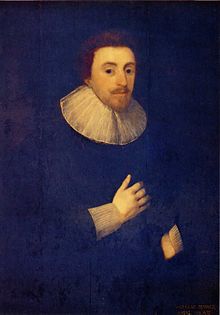
Nicholas Ferrar of Little Gidding
In 1625 the Ferrar family purchased the manor house and church at Little Gidding in Huntingdonshire, nor far from Cambridge. Nicholas Ferrar had prospects at the royal court, but with the loss of the family fortune, he retired to Little Gidding with his mother, Mary, and his extended family: Nicholas himself was unmarried. In 1626 Nicholas was ordained deacon (though never priest) by William Laud, later to be Archbishop of Canterbury. The family immersed itself in a life of prayer, going daily to the church for Morning and Evening Prayer, gathering regularly during the day and keeping vigil in turns during the night for the recitation of the psalter. Practical works of charity involved the family in the care of local people, and they became skilled in the making and binding of books, especially parallels of the Gospels.

King Charles 1
The community attracted and repelled: King Charles I visited Little Gidding three times; the Puritans wrote pamphlets denouncing the family for trying to revive the ideal of the religious community abolished in the previous century. In 1637 Nicholas Ferrar died, although the family continued their community life under his brother until 1657.
Little Gidding was largely forgotten until the Catholic Revival of the 19th century. One of the earliest achievements of the Movement was to restore with the Church of England the Religious Life for women and men. The attraction of Little Gidding was undoubtedly its simplicity and devotion, its humble hiddenness, its sanctifying of the relationships of the family, and its willingness to trust in God for its beginning and its end.
As the family disintegrates in western Europe so the ideal of the Christian family becomes harder to maintain, and yet ever more vital in its witness. It does not exclude, but draws into its life of care and service. It is rooted in prayer, simple forms of the Office, grace before meals, the Rosary and intercession, Sunday Mass together. At a time when more and more people are living on their own it sets the counter-ideal of the community. One might envisage family members and single friends buying or renting homes close to each other in an area so that daily prayer and community life are possible, as well as the care of the older and sick members of the community.

Perhaps this form of simple community living might be adapted by young people especially in our cities. Accommodation is often difficult to find, and young Catholics may be forced to live alongside a lifestyle of hard-drinking and casual sex with their flat mates. Perhaps here there is an ecumenical dimension: young Catholics and young Anglicans living in simple community flat-shares; during the week praying the Office and doing some pastoral work; though on Sunday going to the Eucharist in their respective parish churches. The challenge is there too to the rich and influential. Nicholas Ferrar retired from this life to live for God. He used what was left of his fortune to pay for this way of life. Will the wealthy and sophisticated in our society feel the call to embrace it too? The call to holiness in difficult times is as real today as in the times of Nicholas Ferrar, though in very different circumstances.


 Ordinariate Pilgrim
When I read this, Little Gidding rang a faint bell. Some “Goggling” lead to this web site:
http://www.patrickcomerford.com/2012/12/with-saints-through-advent-2-1-december.html
The reference to the Four Quartets by TS Eliot explains the faint bell, though I don’t remember Nicholas Ferrar. I like the collect quoted in this site and by other Anglican/Episcopalian sites:
“Lord God, make us so reflect your perfect love; that, with your deacon Nicholas Ferrar and his household, we may rule ourselves according to your Word, and serve you with our whole heart; through Jesus Christ our Lord, who lives and reigns with you and the Holy Spirit, one God, for ever and ever”
Perhaps he could be included in the Ordinariate Calendar?
Little Gidding was not only the title of the last of TS Eliot’s Four Quartets, but it also hosts the annual TS Eliot Festival, on the first weekend of July – full details are on the TS Eliot Society website at http://www.eliotsociety.org.uk.
The church itself is maintained by the Friends of Little Gidding. It was visited three times by Charles I; on the final occasion, he came at night, alone except for his chaplain, on his way north to give himself up to the Scots. Hence the lines in Eliot’s poem:
“It would be the same at the end of the journey
If you came at night like a broken king”
Eliot himself visited Little Gidding only once, and said in the poem of his visit:
“You are not here to verify
Instruct yourself, or inform curiosity
Or carry report. You are here to kneel
Where prayer has been valid.”
The site and church are well worth a visit, particularly during the festival, and it remains very much as Eliot described it:
“If you came by day not knowing what you came for
It would be the same, when you leave the rough road
And turn behind the pig-sty to the dull facade
And the tombstone. And what you thought you came for
Is only a shell, a husk of meaning
From which the purpose breaks only when it is fulfilled
If at all. Either you had no purpose
Or the purpose is beyond the end you figured
And is altered in fulfilment. There are other places
Which also are the world’s end, some at the sea jaws
Or over a dark lake, in a desert or a city—
But this is the nearest, in place and time
Now and in England.”
One might also remember Fr. William of Glashampton, who was a failure in establishing a community, but an athlete in the eyes of God:
50 years ago or so, I read a biography of him at the SSJE monastery in Cambridge Mass, and I’m still stuck by his obedience to what he figured his life should be about.