
Personal customs and habits in the priest celebrating the Mass were very common among Anglo-Catholics. Indeed, some churches prided themselves on ‘the way we do it at St X’s’ . While it was hardly a problem for the vicar, in a parish where he was well-known, it could be curious and difficult for a visitor, especially if he had to be sent lengthy instructions in order to learn the parish foibles. I recall assisting as the ‘deacon’ at a High Mass in one of the big Anglo-Catholic shrines. After the Mass a server thought to compliment me: ‘That was almost perfect, Father.’ Slightly put out, I replied, ‘I have been ordained for over twenty-five years; I should hope I know what I’m doing.’ To which came the slightly patronising reply, ‘But you have never taken part in the High Mass at St X’s, have you?’.
Liturgical chaos is no aid to worship; and the modern Mass can be just as clericalist as the old Mass was supposed to be. A priest who ‘makes it up as he goes along’, with lots of chatty asides and witticisms whenever there is a hiatus, not only dominates, but also takes the liturgy away from the people. This is because they laity have a right to know how the worship is to be ordered: so that they can take their part in it. This happens both through individual ministers who read, assist at communion, and serve the altar, as well as the congregation as a whole, who participate fully and intelligently, as the Mass proceeds.

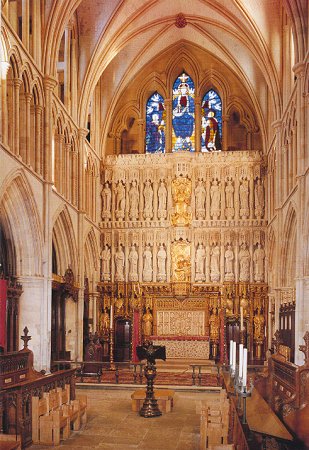
The English tradition at Exeter Cathedral
By the end of the nineteenth century there was considerable liturgical chaos in the Church of England! In order to rectify this the Revd Percy Dearmer, vicar of St Mary’s, Primrose Hill in north London, wrote the Parson’s Handbook. Its directions for the ordering of the church building, and the celebration of the Eucharist and the Divine Office had a profound effect. They produced what many of us would have, until recently, recognised as ‘Cathedral worship’: dignified, restrained, beautiful, combining art, music, and liturgical principle to elevate worship as an offering to God, and an edifying and moving event for those who participate.
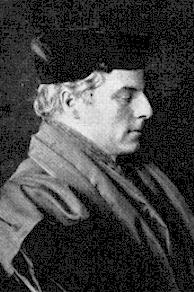
The Revd Dr Percy Dearmer
Dearmer was single-minded, opinionated, and sometimes known to have adjusted historical evidence to fit his own tastes. He was however committed to the vernacular worship of the Book of Common Prayer, and to its (sometimes misguided and misinformed) attempts to reform and restore the liturgy. The ceremonial he revived and devised was designed to serve the Prayer Book forms. In all these areas the other school, the ‘Roman’ or ‘Western Use’ found difficulties. They were attempting to marry together a Latin liturgy with one in English; they were attempting (with various degrees of elaboration) to fit the ceremonial of a liturgy weighed down by centuries of accretions, to one which had been purged (some would say stripped) of all but the essentials; finally, they were not averse to subjugating the rite to the ceremonial.
It has been remarked elsewhere that most English Anglo-Catholics were quick to adopt the reformed ceremonial of the 1970 missal (and after 1994 they adopted the rite, too). They recognised that many of the concerns from the Reformation period – lay participation, frequent communion, audibility and visibility, simplicity and clarity – had been recognised by the Council and put into effect – (many thought much more effectively than the Anglican Prayer Book) in the new Missal.
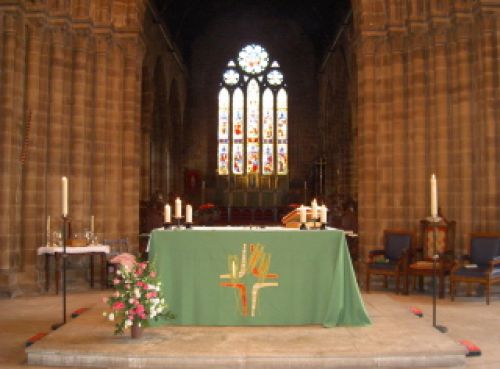
The Nave Altar in Anglican tradition
It is also true to say that most English Anglicans were content with a modest, rather than a radical, change in worship. The High Altar retained, and a new altar in front of the screen was often as far as it went. Anglicans were used to singing, and continued with their chant, hymns and anthems, much as before: they added the best of post-conciliar music and song, rather than becoming addicted to the worst of it. The tradition of beauty as servant of the liturgy held them back from the excesses of Brutalism which seemed to have taken hold of some parts of the Catholic Church.
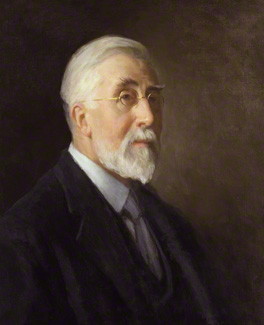
Sir John Ninian Comper
In this we see the influence of the Anglo-Catholic architect, Sir John Ninian Comper, who made a significant contribution to this ‘English’ tradition, though he was a very different character from Percy Dearmer. He is dismissed by some as ‘pretty’ and rather too fond of gold leaf. For others his significance is seen in exquisite mediaevalist re-creations, as for example at Cantley, Clarence Gate (London) and Wimborne St Giles. But I believe that his later work as he moved away from mediaeval precedents has more significance for us. Here we see a man directing his architecture to serve the liturgy. His little church at Cosham, near Portsmouth, is a remarkable anticipation of the liturgical reforms of the Second Vatican Council. It is also very beautiful. It stands in contrast it with, say, Coventry Anglican Cathedral, where the plan shows no evidence of liturgical thinking, and the 1960’s art-works are at best period pieces, and at worst, extremely ugly. (It is not entirely clear, from the picture below, that the altar stands almost at the centre of the church, while the sanctuary is defined only by a single step and low rails on four sides. ‘Eastward’ and ‘Westward’ position are both feasible as the people are circumstantes as in the earliest rites.
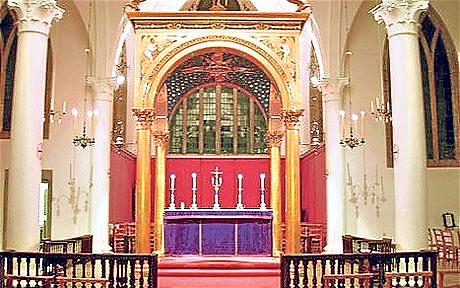
The Altar of St Philip’s Cosham
As the Ordinariate starts, perhaps rather tentatively, to adopt and celebrate its own liturgy, it needs to be guided by liturgical principle and a sound knowledge of art and architecture. It seems unlikely that we shall be in a position to build churches, and much more likely that we be setting up in a school hall, or trying to make something of a fan-shaped brick-and-concrete mass-centre circa 1963. The Anglo-Catholic temptation is to hide the ugliness with clutter, rather like Auntie Sheila in her dreary council flat. (For china animals, dralon pouffes, and crotcheted doilies – read numerous brass candlesticks, shiny acetate vestments and lace!)
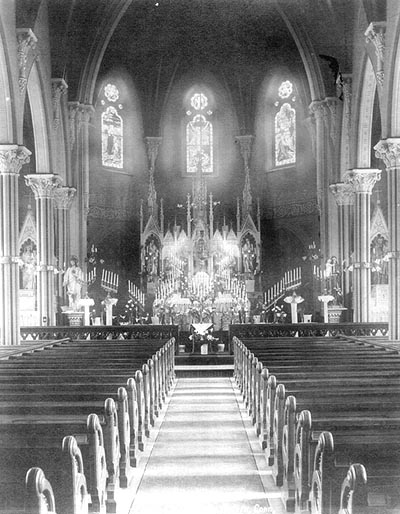
The clutter of a 19th century Catholic church
Both Dearmer and Comper reacted against industrialisation. They believed that there was a moral dimension to beauty. Dearmer saw that the ugly (which was so often fussy and pretentious) was usually produced by cheap labour, working in appalling conditions for poverty wages.
Where these is not much money to spend, then simplicity rules. We have been persuaded that there is a ‘correct’ and ‘ecclesiastical’ fabric for making of vestments. This is a ruse of the church furnishers to get us to patronise their establishments. I have in my possession a rose silk Spanish chasuble, made in the 18th century. The fabric is powdered with what look like daisies: there is not a cross or Chi-Rho in sight! When Comper started producing his own fabrics and interpreting the colours he found on his travels, the results shocked the ecclesiastical establishment. Here was an almost pine-green in place of the rotting-grass-clippings green favoured by the late Victorian designers. Here was the deep rose-red (I have read that he did not like it called ‘Comper pink’) which contrasts with and enlivens his white interiors. Proportion, honest materials and great care over ornamentation – all combine to produce a ‘noble simplicity’. Alongside my Spanish chasuble I have a set of six candlesticks – turned wood, stained dark, well proportioned – bought at IKEA. They complemented perfectly the massive lines of the grey slate altar in my last parish.
Dearmer and his ‘English Use’ may be of value to us, before we uncritically adopt the styles and customs of what Peter Anson called the ‘Back to Baroque Movement’. There is something rather effete now, rather faded and unappetising, about this 20th century attempt to take the Anglo-Catholic Movement back to 18th century France and Belgium. I read recently on an American blog that the English Ordinariate favours the baroque. Let me assure the blogger that this is not so! Caring about the liturgy is not the same as an obsessive fussiness about its details. One the main differences between the Tridentine Missal and the post-Vatican II rites is precisely this: that the former prescribes in minute detail what is to be done, while the latter expects the priest and ministers to have a deep understanding of the liturgy, and a grasp of beauty and order, which are served by its rubrics and guidance. That the Ordinary Form of Mass is sometimes celebrated so badly, so shabbily, just shows that the implementation of the reforms of the Council have a long way to go.
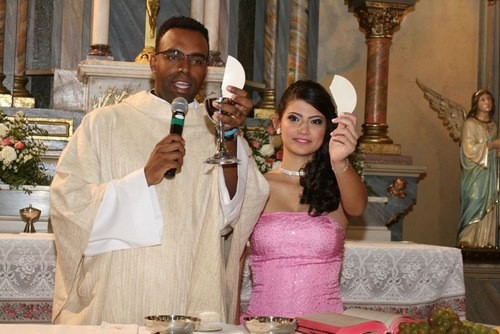
And I suppose the point of this post is that regard for the liturgical patrimony of the English Use might well help us continue the reforms, and come to feel that we are in heaven when we go to Sunday Mass.

 Ordinariate Pilgrim
Please give a reference for your last photograph. Is this Catholic or Anglican? I have never witnessed anything like this at any Mass I have ever attended. I think you need to make clear exactly where this photo is from and when and if any discipline happened from the bishop as a result. Otherwise it appears that you are encouraging scandal and want to shock and offend on your blog.
The picture I found by googling ‘liturgical abuse’ and is from http://www.magnificat.sk. It purports to be an example of ‘political correctness’ from the United States. From the detail I believe it to be a Catholic Mass not an Anglican Eucharist. If you think it is bogus then please let me know immediately. I have no desire on my blog to be shocking for its own sake. I do hope to make people think, and respond if they wish to: which may make me re-think what I have said.
Many thanks for your analysis Fr, It’s a pity that comments on this blog and others seem to have dried up – perhaps because it’s the silly season. My own experience of the liturgy varies from the Prayer Book – Church of Ireland variant, the ‘English Missal’, followed by the various ‘series’, ASB and then the post Vatican II rite. With the exception of the Prayer Book rite, all of this has been within the Anglo-Catholic tradition, mostly done with that particular care and attention that I would regard as part of our Patrimony. There were occasions when I thought that things had become too fussy with over-attention to detail, it was a discussion over some minute aspect of ritual in the vestry before the Guild Office and Benediction, that in fact made me decide not to join the GSS! There are times when I feel that the Ordinariate may be heading back a little into the Baroque, but then I really only get to big events, where I suppose this is to be expected. I also remain uncomfortable with the Ordinariate Rite. Most of my time is taken up by my local Parish where I attempt a little gentle ‘liturgical reform’ in the sacristy and server training.
I agree with you that the Ordinary Form of the Mass can be celebrated very badly, though I’ve never seen anything quite as troubling as your last picture. I also agree that all of involved in the Liturgy “should have a deep understanding of the liturgy, and a grasp of beauty and order, which are served by its rubrics and guidance.”. Like others I have a collection of various liturgical guides, including ‘Ritual Notes’ (remember that?) and the Parsons Handbook, but I hope that I used them to gain an understanding of the Liturgy, rather than an obsession with detail.
Many years ago I came across two books by Canon Colin Stephenson, ‘Merrily on High’ and ‘Walsingham Way’. These I’ve always found the perfect antidote to liturgical fussiness, in one or the other, Canon Stephenson remarks that he can’t remember where his biretta is, but even if he found it, he says he has forgotten what to do with it. This blog
mentions one of my other favourite passages in Merrily on High, when he first encounters St Bartholomews in Brighton, I really like the thought of elephants on either side of the high altar!Walsingham Way in turn was important to me in my understand of Marian devotion and eventually forming my deep affection for Walsingham, I was lucky to go there for the first time on a dull October day, when I had to be in the area for work. We had lunch in The Bull and then visited the shrine – I was well and truly hooked and I still have a deep affection for the Anglican Shrine, in many ways it’s still home to me and I suspect many others.
Let’s hope, that our presence and liturgical patrimony may have a part to play in helping make the celebration of Mass that little glimpse of heaven.