The title of this post indicates the three ways in which people become Catholic Christians. But there is a lack of coherence, a mismatch, if you like, between the three.
Research has shown that a substantial of people become Catholics who are already believing Christians; they have practised their faith as Anglicans, Methodists, Pentecostals … A much smaller number are converted to Christ; they have not been baptised or brought up in the Christian Faith, and are therefore called Catechumens. Then there are the infants of Catholic parents brought to baptism. The commitment of these families will vary from those who are regular at the Sunday Eucharist and manifest a clear understanding of the Faith, right through to those who are there for social reasons – grand-parental pressure or the party afterwards.
The preparation of people in these different groups varies enormously, and the link between what is basically the same process – men women and children entering the Catholic Church – is not at all clear.
The preparation of those who are already believing Christians has become much more sensitive and understanding in recent years. These are people who have been living the Christian Faith for many years. They have come to realise that for the fullness of Christian life they need to embrace the unity and truth of Peter. If they come from the C of E and its Anglo-Catholic tradition they may well have a grasp of the Eucharist, a devotion to Mary, and an adherence to the Sacrament of Penance deeper than some cradle Catholics! In the past this has not always been understood by Catholic laity and even some Catholic clergy. Nonetheless, they do not want to ‘slip in by the back door’. They want to prepare seriously for a profound moment in their Christian journey and they want to mark that moment liturgically within the Catholic Community.
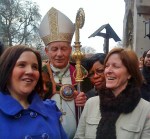
The preparation for adult baptism lasts normally two years. Various rites presided over by the Bishop in his Cathedral Church mark the decisive process of becoming a Catholic Christian. The newly baptised are anointed in Confirmation and receive the Eucharist, thus restoring the traditional order of Initiation. The process is profound and absorbing, though it needs to be animated effectively and imaginatively by those who accompany and teach the Catechumens.
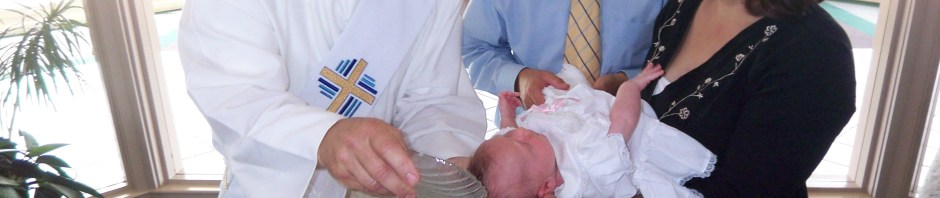
Sunday by Sunday, often in the afternoon fitted in between the morning and evening gatherings for the Mass, infants will be baptised. Here in this rural diocese in France the huge majority will be of families who rarely, if ever, go to Mass. More and more parents in this group defer the baptism until they can afford the obligatory party (which they have arranged before approaching the parish) The Baptism preparation team does its best in a couple of sessions, but its suggestion that the families might want to continue their connection with the parish community after the baptism is greeted with blank looks. Of course, this attitude is not universal, but I believe it is widespread. Even among the faithful there is a belief that baptising a child – without any sign of commitment from the family – might somehow do some good; and that refusal or even conditions somehow “puts off” parishioners. The evidence suggests otherwise.
I am not for one moment suggesting the abolition of infants baptism – such a position would be unscriptural! I am proposing that the gap between baptism of adults and of babies (and questions concerning preparation, celebration of the baptismal liturgy, and discipline) be acknowledged and tackled.

 Ordinariate Pilgrim