
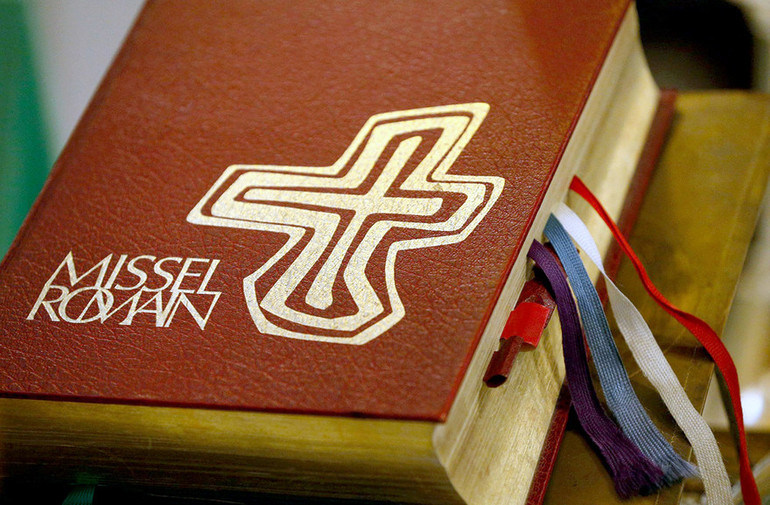
At long last the Catholic Church in France (and the other francophone countries) is to have its new translation of the Missal, which comes into use on Advent Sunday 2021. At last I shall not be the only priest in this diocese needing to use a card for the Eucharistic Prayer at concelebrations!
Mgr AUBERTIN, the Archbishop of Tours, explained the process lying behind this new Missal, which comes into force on Advent Sunday 2021, in book published recently, “Discover the new translation of the Roman Missal”. He explains that the Missal published in 1970 was the result of the Liturgical reform willed and initiated by the Second Vatican Council. An important Instruction Liturgiam authenticam appeared in 2001, modified by the motu proprio Magnum Principium issued by the present Pope. Three principles were established: faithfulness to the original (Latin) text; faithfulness to the language into which the Latin text is being translated; faithfulness to the sense of the original text so that its full meaning may be conveyed to the faithful as they pray it.
If I have understood rightly, the process by which the new translation was developed involved 1. the preparation of the the new text under the guidance of the French-speaking Episcopal Conferences. 2. The submission of the text to Rome for verification of its conformity both to the original Latin and to the doctrinal norms of the universal Church, and finally (but crucially) 3. the concern of the French bishops that the translation would be good French, and not that of a Latin primer! In this process we see clearly all the principles of Liturgiam Authenticam and Magnum Principium at work.
The concern for their language is a particularly French thing, and they have tried to resist the importing of americanisms which they see as a sort of cultural colonialism. It is a lesson to which English-speaking Catholics might be more attentive. The English language has a beauty when written and spoken well. (I heard Ken Clarke when he was ‘Father of the House’ , and still an Member of Parliament, speaking- and more recently hearing Alec Guiness in “Smiley’s People” – both reminded me just how fine English can be.
Translating from a Latin original into a vernacular language is not easy. It requires a knowledge and fluency in Latin, and a fluency and appreciation of the beauty of the vernacular language. Few people these days have both skills. Thomas Cranmer, the compiler, translator and producer of the English Prayer Books of 1549 and 1552 was such a man. His ability to translate Latin into beautiful and memorable English is to be seen par excellence in the Collects. He is less sure with some of his own compositions, where his doctrinal concerns come to the fore: the Confessions at the beginning of the Office and in the Communion Service being obvious examples.

The English-speaking Ordinariates, in the production of their Divine Worship Missal, tried to combine Cranmer with the translations from the Latin made for the various Anglican Missals at the beginning of the 20th century. The success of these later translations is questionable. These Missals (the Anglican Missal in particular) had remained in use in the United States, while being largely abandoned in the UK, where the adoption of current English was not seen as a threat to orthodoxy (as it was by many American Episcopalians). The English were less than enthusiastic about having to re-learn a liturgical language remembered only by those over a certain age!
Remaining close to the Latin was said to be one of the key aims of the new Missal produced for English speaking Catholics in 2011. It came out at a time of the so-called “Liturgy Wars” when there was suspicion among “conservatives” that the 1970 translation was “liberal” – or at least being used by the “liberals” to play-down the traditional understanding of the Mass. Its attempt to introduce “latinate” words into the English liturgical vocabulary has not been entirely successful. Where the previous translation could be characterised as “bland”, the 2011 translation is, in places, “lumpy”. It only shows the difficulties for the Universal Church of a single Eucharistic Rite in many languages!
The French, it seems to me, have been right in insisting that French language experts should have the last say over the language, just as doctrinal experts (theologians) have the final say over the theology which is being expressed in the liturgy: not either-or but both-and. Nothing less will do.

 Ordinariate Pilgrim