
My grandmother (born in 1891) was brought up as a Baptist though not baptised in adolescence. In fact she was baptised before her marriage to my grandfather, at St Mary’s Weymouth, a stronghold of low-church Anglicanism. But my grandmother knew that Anglicans knelt! She used to hiss at her cousin Jessie, whom she accused of ‘coopying’ – what we called in those far off and unecumenical days, the ‘Free Church Squat’. This meant that, when the Minister said, ‘Let us pray’ the congregation slipped forward in their pews, resting their foreheads on their clasped hands and leaning on the pew in front. Not so in the Church of England! Even in the ‘lowest’ of churches, kneelers or hassocks would be provided, so that people could pray on their knees.
Catholics knelt. They knelt a lot, because Mass was in latin and only the devout followed it in their missals. So for most of the twenty-five minutes on Sunday morning you were on your knees. You knelt, not on a hassock (which was C of E) but on a padded board which dropped down from the bench in front.
For Catholics all that began to change after the Vatican Council. The laity were expected to participate in the Mass which was now in the vernacular. They stood as the priest entered, sat for the readings, stood for the Gospel, kneeling only for the Eucharistic Prayer. Communion standing quickly caught on with the people going in procession to the altar. In France they even stood throughout the Eucharistic Prayer, though perhaps this was preferable to the immense clatter as congregations turned round those distinctive low-seated chairs to kneel on them!
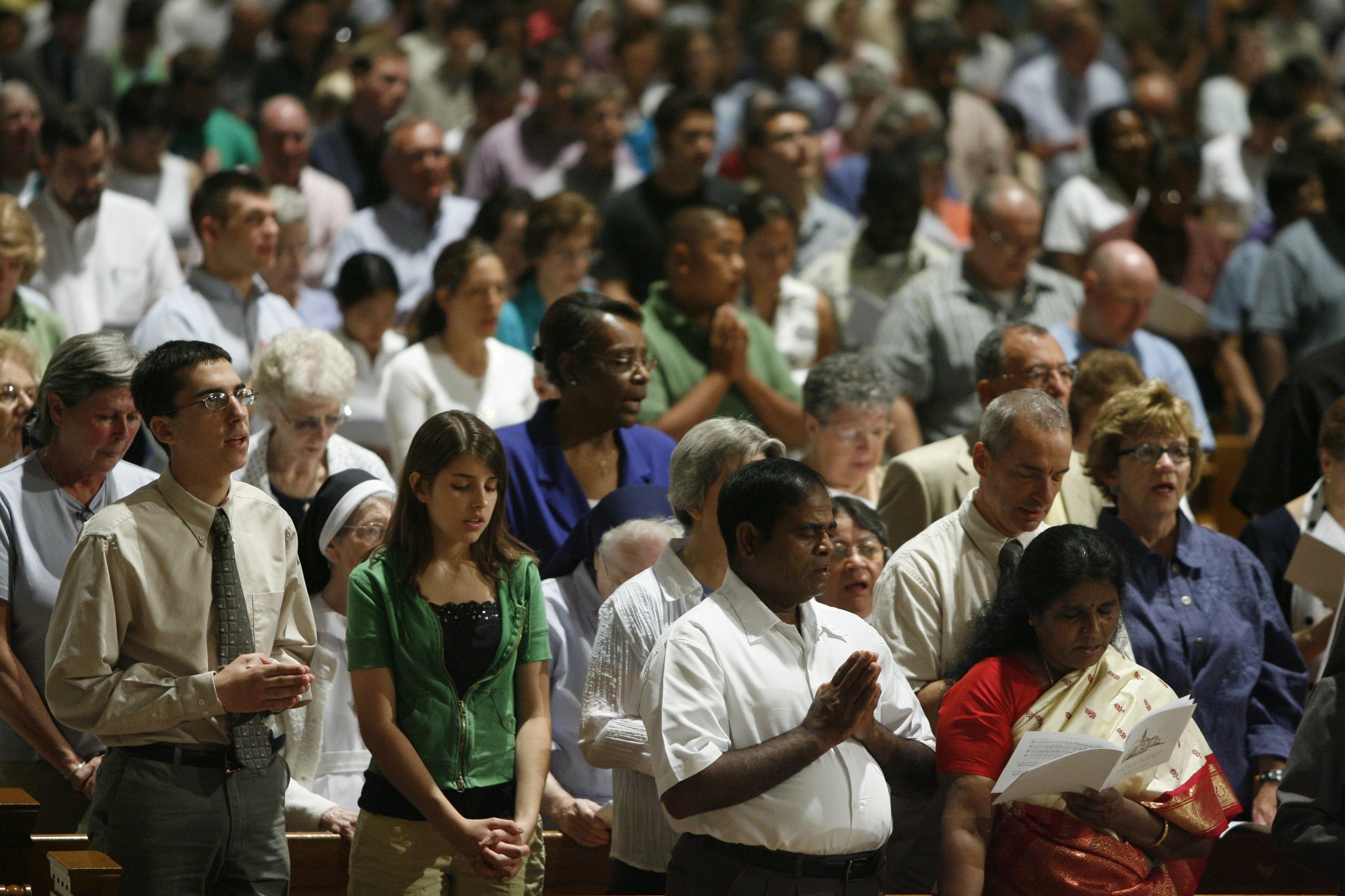
By the 1980’s Evangelicals in the C of E were increasingly rejecting the idea of anything distinctively Anglican. They looked towards the large and ‘successful’ Christian denominations of the United States, whose comfortable, carpeted church interiors resembled rather more an auditorium which was focussed on a stage, not an altar. This led to the curious situation in a neighbouring parish to me in London. As they prepared to open their new church building, the older ladies got together and embroidered several hundred kneelers. They were obsolete from the beginning!
Very soon the rubric ‘sit or kneel’ began to appear in printed service books, even at ordinations. The following rubric appears in a recent Sunday service booklet in one English Cathedral:
You may like to adopt a prayer posture such as sitting with your head bowed,
as we remember our brokenness and call to mind our sins.
Gosh! That’s a lot of words for what we would once have done instinctively.
And in France? Kneeling seems to be coming back in again and especially among young Catholics. (Maybe their knees are more up to it). I notice that many more young people kneel during the Eucharistic Prayer, and receive kneeling even though they are not at the rail. Good for them: it’s their choice and not for me to tell them that they must stand and must receive the Communion in the hands.
But sitting for prayer in church is not normal practice for Christians. In the early centuries the people stood, as they still do among the Orthodox. The English expression, ‘The weakest go to the wall’ comes from the days before pews when the only seating was the stone bench around the walls. Pews and Puritans go together when worship ceases to involve movement, senses, action – and is replaced by isolated and static individuals listening to a sermon or watching something on a stage.
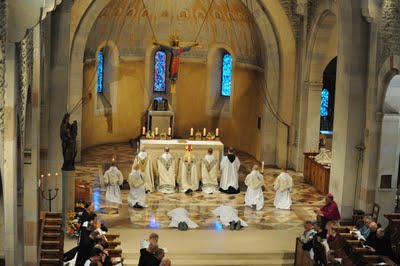
Let’s free up worship, with kneeling, sitting and standing, and congregations confident enough to know when and how.

 Ordinariate Pilgrim