

One of my hopes for the Ordinariate in the UK is that it would introduce into the Catholic Church something of the Liturgical Revival which overtook the Church of England from the end of the 19th century until the 1960’s. This remarkable movement transformed English Cathedrals and many Parish Churches, but is now in danger of being swept away in the C of E. Although some of its protagonists delighted in reviving elaborate mediaeval ceremonial (thus rightly earning the mocking title ‘British Museum Religion’ from other Anglo-Catholics) many more confidently adapted the findings of liturgical researches to the liturgical needs of their day.
But there was more to it than that. Many of the leaders of the Movement were appalled by the poor quality and dowdiness of much that was placed in church buildings, and the fussy and thoughless ceremonial that was then current. They believed (as I think Pope Benedict did) that there was a moral quality to beauty. Ugliness was not “all just a matter of taste” but could be debilitating, and even soul-destroying. Believing that it is our duty and our joy to celebrate the sacraments – no matter how simply and in whatever humble circumstances – with reverence, care and beauty – I continue to offer these reflections.
The following of the Liturgical Year is one of the great joys of being a Catholic Christian. It enables us, through story, song and action (scripture, music and liturgy if you prefer) to proclaim and live out the wonder of our Redemption – God’s love for the human race in creating us, sending his beloved Son to live among us, teach us and to die and rise again, and to celebrate the gift of the Holy Spirit in every age of the Church. Through the Liturgical Year the action of God leaps out of the past, and becomes real in our generation.
The Second Vatican Council continued the renewal of the Liturgical Year as it had been begun by Pope Pius XII in his restoration of the liturgies of Holy Week and Easter. They greatly simplified the Calendar, reasserting the primacy of Sunday and abolishing the keeping of Octaves which tended to overlap and create confusion. Thus the seasons followed each other – Advent, Christmas – Winter Ordinary Time – Lent, Easter culminating with Pentecost, and then Summer Ordinary Time through to Christ the King and the end of the Liturgical Year.
The provision for the Ordinariates elaborated this scheme, re-introducing the time before Lent (the ‘gesima’s), the two weeks of Passiontide of which Holy Week is the second, and the Pentecost octave, as well as numbering ‘Sundays after Epiphany’ and ‘Sundays after Trinity’. Whether this was helpful is not within the scope of this article to comment! But what I do want to draw your attention to is the way in which the so-called ‘Roman’ liturgical scheme is unhelpful in the case of Lent, and a modification in an ‘English’ direction could be both clearer and more logical.
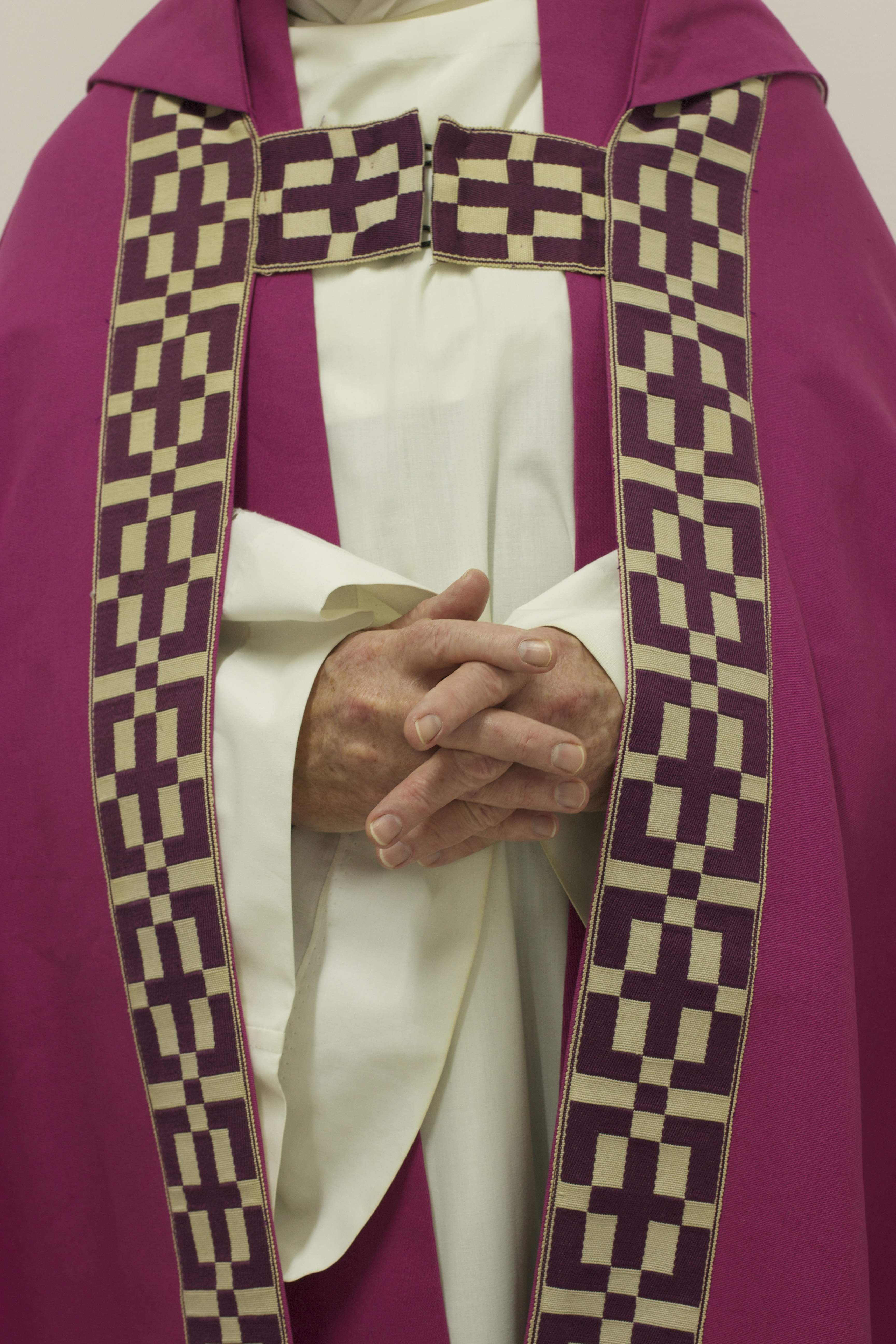
The colour purple is used in the basic ‘Roman’ scheme for Advent and Lent (including Holy Week), as well as for funerals. As a colour it is a mixture of blue and red – more blue and we usually call it ‘violet’, more red and we call it ‘Roman purple’. Although it can speak of preparation, mourning and sombre reflection, it also has notes of splendour and regal kingship. It is particularly associated with this last quality as the production of purple die was a costly business before the invention of chemical dyes. None of the shades though violet to purple is easy to match and contrast with other colours and it is not diffcult to make awful mistakes in church. Black, silver and grey are good for linings and orphreys – red and yellow are dreadful! Just be careful if you are buying a chasuble ‘off the peg’ , or getting an enthusiastic member of the congregation to make a frontal or banner.
So to Lent – and the Gesima Sundays of pre-Lent because you are an Ordinariate Parish. Ten weeks or so before Easter you go into purple; Ash Wednesday arrives – no change; Passiontide – no change; Holy Week – no change (I acknowledge that you might have the Palm Sunday Procession in red, and Good Friday too) But those parishes in the C of E which followed an English Use marked these changing seasons with a change of colour. The Gesima Sundays of pre-Lent were in violet or dark blue. (Whether blue was in fact faded violet is another question!)

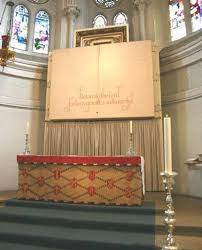
The blue altar frontal above is a splendid example. The contrast of the dark blue with the orange fringe is inspired. (Quite why the cross is veiled in white and the doors of the reredos closed – suggesting – Lent – I do not know. )
Please note that this blue is not – definitely not – the blue sometimes now sold by the Church Furnishers – as the appropriate colour for the Blessed Virgin Mary.
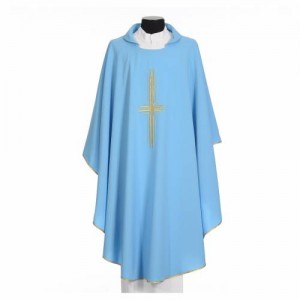
Ash Wednesday arrives and the English Use takes the church into the Lenten Array. The use of unbleached linen to cover images, altars and reredoses was pretty universal across mediaeval Europe, though we cannot be sure that chasubles and other vestements were also made of off-white linen too. Maybe, at least in some places, the use of blue/violet continued through Lent . Simple decoration in red, black or blue was used.
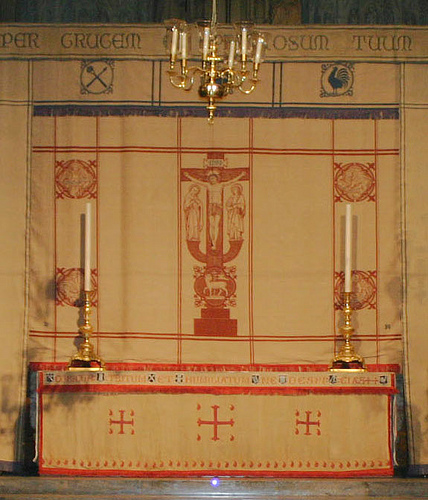
And now to Passiontide, those two weeks from the Fifth Sunday of Lent through to Holy Saturday. The off white veiling remains in place but the altar frontal and vestments change to red – not the red of Pentecost, the bright red of fire, but blood-red perhaps decorated and lined with black …
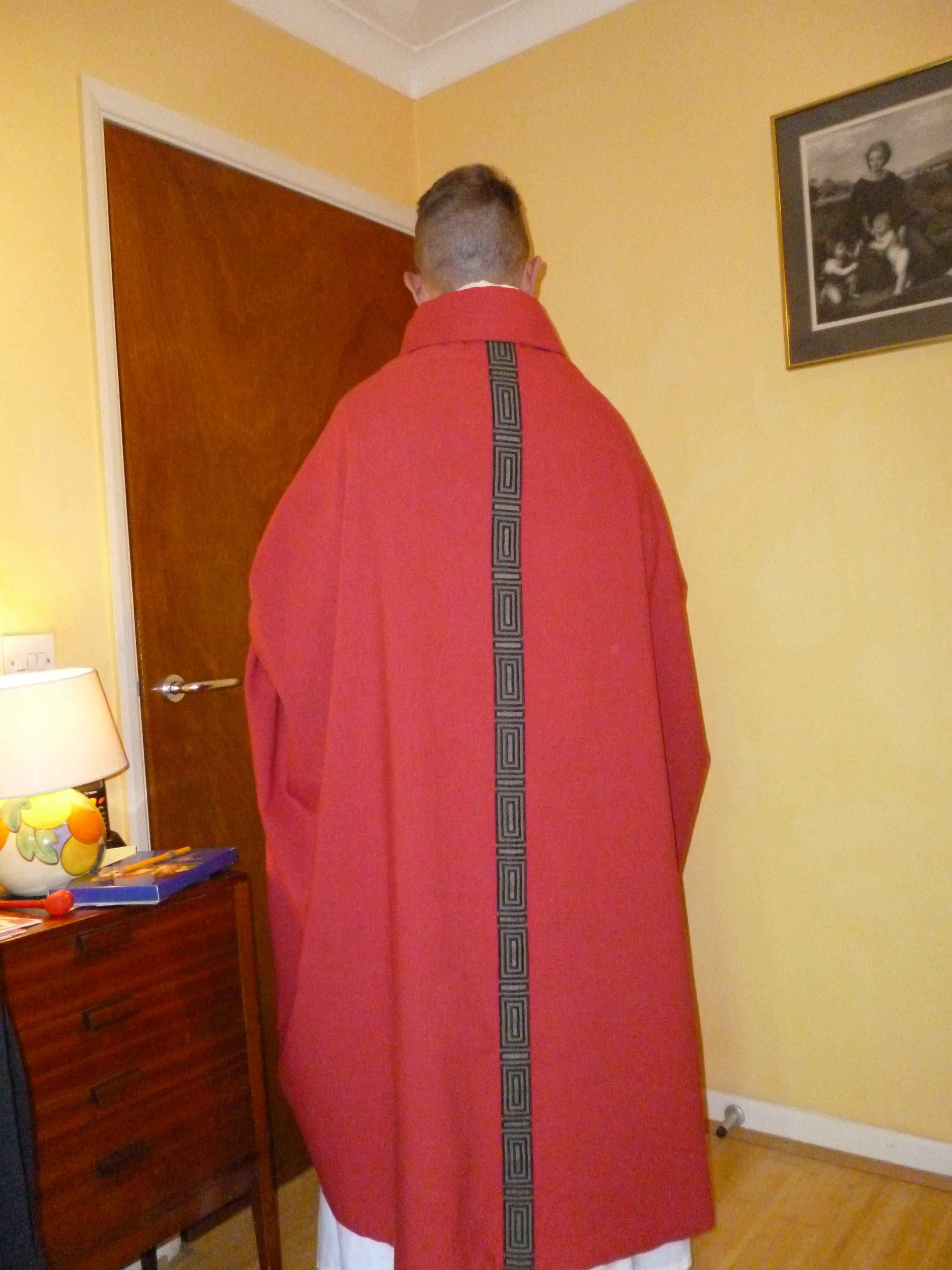
Could any of this rich and evocative colour scheme be adapted for our use? Yes, I think so. Violet would be retained for the pre-Lent Sundays. If it is not thought correct to veil with the Lent Array, then try changing the hangings: here at Pont Rémy we take down the huge red altar curtains and go into off-white: the violet banners and vestments look very striking against it. Red for Passiontide – well Palm Sunday and Good Friday are red nowadays – but surely not scarlet with doves and flames!


 Ordinariate Pilgrim