
Catholics of the Ordinariate (i.e. former Anglicans) may be forgiven for their nervousness about the process of Synodality which is being encouraged by Pope Francis. The actions of the General Synod of the Church of England in the 1990’s and subsequently, in which the C of E debated and voted by majority to overturn the 2,000 year practice of the Church to ordain men to the priesthood, remains a painful part of their history. It needs always to be remembered that the General Synod had voted several times not to ordain women to the priesthood – and that this decision was simply not accepted. However, once the decision was made, it became irreversible, in spite of promises to the contrary. And in the case of the ordination of women to the episcopate, the intervention of the Prime Minister and his threat to disestablish the National Church, was needed to reverse the vote not to proceed. Painful as it is to write of these events, it seems necessary to remind both Anglicans and Catholics of what impelled the departure to the Catholic Church of some of the Church of England’s best clergy and laity.
I am indebted to my friend Antonia Lynn for the observation that Synodality in a Church with a Magisterium is rather different from doctrine being decided by majority vote after a debate in General Synod! That contrast may seem a little harsh – even ‘unecumenical’, yet it is the experience of many former Anglicans that their ‘cradle-Catholic’ brothers and sisters really believe that, if only the Catholic Church were a more like the C of E, life would be much easier. On issues like abortion, divorce and remarriage, and women priests, they look towards the C of E, while contrasting the confident behaviour of its leaders with the scandal of child abuse in their own Communion. Indeed, may I also thank Ronald Crane for sending out the article in the Tablet which seems to me to make this equivalence between the Catholic notion of Synodality and the Synods of the Anglican Provinces: an equivalence which I reject.
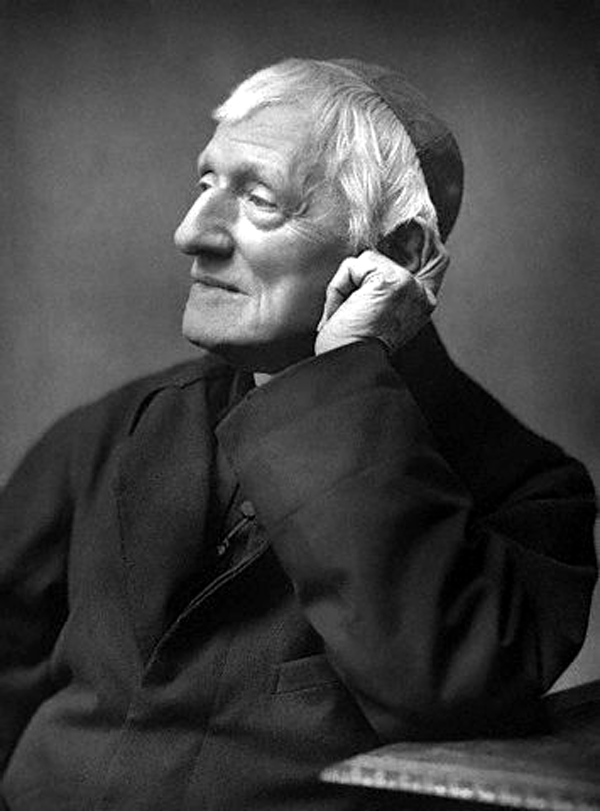
Nor is this simply a case of the grass being greener on the other side. There is a suspicion among some Catholics – not entirely unjustified – that the Ordinariate is too closely identified with traditionalists who are unhappy with the development of the Church after the Second Vatican Council. In matters of liturgy, spirituality and doctrine – indeed, the whole place and mission of the Church in the modern world – such people would like to turn the clock back to a pre-Council world. In this argument they would wish to enlist the support of the Ordinariates, but this they cannot do. And why not? Because the figure of Saint John Henry Newman, who himself made the journey into full communion, and is the patron of the Ordinariate of Our Lady of Walsingham in the UK, will not let them.
Ordinariate Catholics will embrace the Synodality which the Holy Father proposes because this feature of the Catholic Church is already part of their Patrimony. Having realised this simple fact they will then be in a position to speak respectfully to the whole Church of the risk of the distortion of this process which they themselves suffered as Anglicans.
In 1867 a controversy broke out in the Catholic Church in England over the place of the laity in the governance of the Church. Newman entered into this debate with an article in the Rambler, a Catholic periodical. Mgr Roderick Strange, an authority on Newman asserts that Newman’s purpose was certainly not to support some loose exercise in democracy. (A reading of the saint’s own Apologia for its account of his submission to Catholic authority would make nonsense of such a claim.) Rather, he sought to point to a vital process for the health of the Church, encouraging the lay faithful and their pastors to work together. Newman believed that the maturity of the Church depended on an educated and vigorous laity – “a conspiracy of pastors and faithful” (and what a delicious phrase that is!) He supported this assertion with massive historical evidence, showing that at crucial moments in the Church’s history it was the laity and not the bishops who had remained faithful in resisting innovations.
Newman’s standpoint provoked outrage. Monsignor George Talbot, a Papal Chamberlain to Pope Pius IX, wrote from Rome to Cardinal Manning, Archbishop of Westminster. (Manning was himself an ex-Anglican but of a rather different sort from Newman. He was an enthusiastic proponent of the definition of Papal Infallibility, about which Newman had expressed some reservations, though of course accepting it once it had been promulgated at the First Vatican Council) In his letter Talbot wrote:
If a check is not placed on the laity of England they will be the rulers of the Catholic Church in England instead of the Holy See and the episcopate … the laity are beginning to show the cloven hoof. They are only putting into practice the doctrine taught by Dr Newman in his article in the Rambler. What is the province of the laity? To hunt, to shoot, to entertain. These matters they understand, but to meddle with ecclesiastical matters they have no right at all, and this affair of Newman is a matter purely ecclesiastical. Dr Newman is the most dangerous man in England and you will see that he will make use of the laity against your Grace.
Mercifully, Talbot’s assessment of Newman was not that of Pio Nono’s successor, Leo XIII who created him Cardinal, nor of Benedict XVI who beatified our Patron and Pope Francis who canonised him.

 Ordinariate Pilgrim