
We British talk of our country as ‘Great Britain’ without really thinking. Perhaps during this month of November we might do well to reflect on this idea of ‘greatness’ and in particular, what it is that makes a nation or people ‘great’.
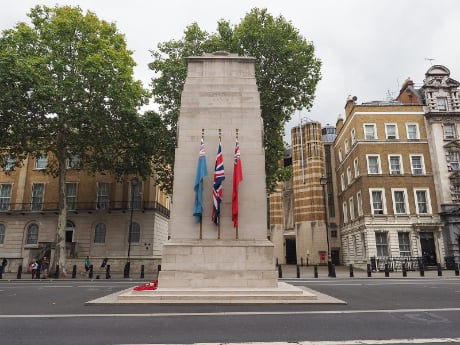
During the past months the election campaign of the United States of America has been fought around the slogan ‘Make America great again’. The last word, the word ‘again’ suggests that America was great in the past and now has to recover that ‘greatness’ for the present and the future. Standing at our local War Memorial this past Sunday, as I did in the 1960’s with my parents and sister, brought back many memories of those years when the Second World War was only just over – and indeed, veterans of the First World War were younger than I am now! More than half a century later the WWI veterans are all gone and those of WWII grow fewer each year. They gave their lives for ‘Great Britain’ and certainly in my childhood that ‘greatness’ meant things like ‘freedom’ and ‘justice’. We were pretty clear about our moral foundation for going to war in 1939; The morality of the Great War and its prosecution and indiscriminate slaughter has raised many questions in recent years: not so (at least not yet) the Second World War.
The large numbers of Christians voting for Donald Trump in the recent Presidential elections has puzzled the British, I think. The numbers I heard were something like 80% of Protestants (Evangelicals) and 50% of Catholics. In listening to interviews with ordinary American voters I noted that the issue for both Catholics and Evangelical Protestants was often abortion. Mr Trump was perceived as ‘anti-abortion’ (on the grounds that, at most, the time limit during which the ending of a pregnancy is permitted) might be shortened under his leadership) while Ms Harris is seen as ‘pro-abortion’ because she talks of it as a ‘right’ for women.

But the notion of a ‘return’ to some period of ‘greatness in the past is a difficult one. For Britain the 19th century, a time of great expansion and growth, is often regarded as a time of greatness. Yet the behaviour of the British Government with regard to the Irish Famine constitutes a blot of considerable proportions on that perception of greatness. The deaths of men and women and children, and the emigration of so many Irish people, led directly to the departure of Ireland from Empire and Commonwealth, and to the continuing problems of partition in the North.
A similar question, I would suggest, needs to be asked by Americans who locate their greatness in the past and long to recover it. Well into the second half of the 20th century racist attitudes and behaviour were perfectly normal in parts of America. Lynchings and murders of black Americans passed unpunished. Only when President Kennedy recognised this as a moral cancer, eating away at the heart of his country, could this be tackled and measures taken to root it out.
Catholic Christians are sometimes tempted to look for ‘greatness’ in the past; they mistake the outward signs of pomp and splendour which have prevailed at certain periods in the past as somehow witnessing to the King who draws the whole world to himself when he is lifted up on the cross.
This is not for one moment to reject the past, to imagine that we somehow create a new and better world by sweeping away all that has gone before. One of the most unpleasant features of our current Western society is its arrogance; its certainty that this generation has ‘got it right’. In this week when we shall see the British Parliament begin to debate the Assisted Suicide Bill, with people arguing that ‘personal choice’, ‘my right to decide’, ‘compassion for those who suffer’ let us pray that we shall truly learn from the past , growing in humility, as we seek to conform society to the will of God our Creator, who wants to show us how to live rightly in the world he has made. Only in the Kingdom of God shall we discover what it means to be truly great again.

 Ordinariate Pilgrim