
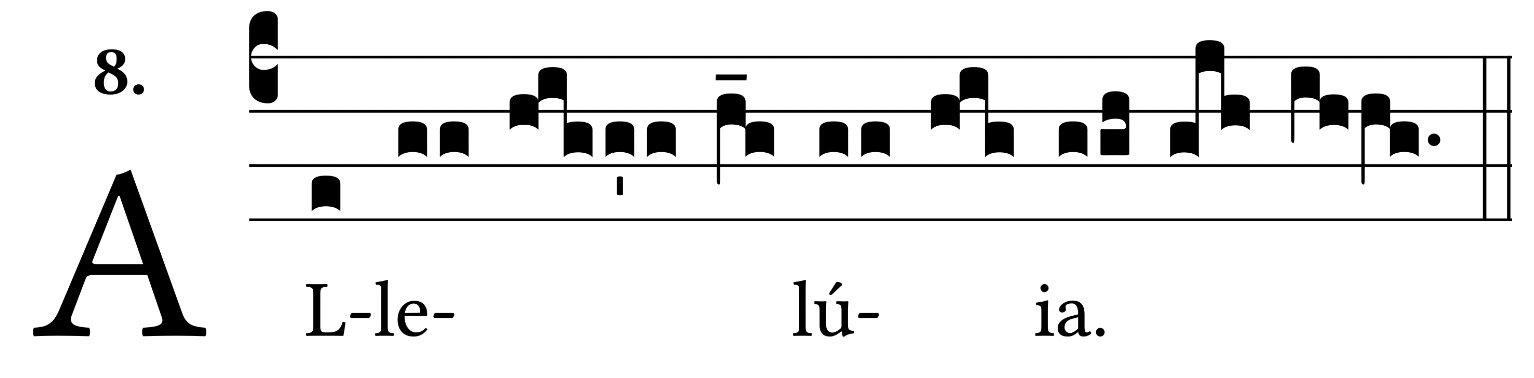
A contemporary of mine from Kelham days – with whom I am very glad to be back in contact – reminded me recently of the singing of the ‘Easter Grail and Alleluia’, ( which I am ashamed to admit that our perverse humour often called ‘The Easter Wail’. The Grail (the word simply a variant of ‘Gradual’ I think) music I reproduce below in its latin form of ‘Haec Dies’ was a lengthy and exuberant chanting of a verse of psalm 118 v 4 followed by an even longer and more exuberant Alleluia!

This was the Gradual we sang after the New Testament Reading and in preparation for the Gospel at the Easter Mass. But I think we also sang it at Evensong during the Easter Octave i.e. until Low Sunday (Easter 2) which would explain the rather odd custom among Anglo-Catholics of not singing an Office Hymn on Easter Day (because they had misunderstood the note at the bottom of page 165 of the English Hymnal).
The English Hymnal only provides the words of the Grail at n° 738 where it notes that the music may be obtained from St Mary’s Convent at Wantage. I imagine that the editors thought that it would be too complicated for use in parish churches. They were probably right, though the typical reaction to any sort of chant is ‘too difficult’, ‘ too complicated’, ‘a bit mournful’ . Cathedral choirs often make a hash of plainchant, singing it in a ‘rigid’ fashion with too much organ accompaniment. The melodies need to be well known – reading it note by note has a deadening effect. Then sing it lightly with the rhythm resting with the words. (More difficult these days, I know, since those who read the weather forecast and news on National Radio and TV began ruining our language with their appalling speech rhythms)
At Kelham we sang plainchant with gusto, rather than refinement, and we were fortunate to have good accompanists. Some people insist that chant should not be accompanied: I like accompanied chant – though my own attempts to do it were execrable. But I know what it should sound like. It is there to support the voices and to maintain the pitch. Often it does not play the melody – that is the responsibility of the voices. It is not there to push the speed or to give the singers the ‘right’ notes; if they don’t know them already that’s their problem.
Alleluia is a wonderful word. It has no meaning outside the context of Christian worship – save as an expression of grateful joy. ‘Alleluia, you’re here at last, good to see you’, I suppose you might say. Saint Augustine of Hippo writes:
The season before Easter signifies the troubles in which we live here and now, while the time after Easter which we are celebrating at present signifies the happiness that will be ours in the future. What we commemorate before Easter is what we experience in this life; what we celebrate after Easter points to something we do not yet possess. This is why we keep the first season with fasting and prayer; but now the fast is over and we devote the present season to praise. Such is the meaning of the Alleluia we sing.
In these words of Augustine we understand why the word Alleluia is not used during Lent but returns when it is joyfully and solemnly sung by the Celebrant and People, alternating three times, at the Easter Vigil.
However, it makes little sense ff this putting away or ‘fasting’ from the great word of praise has not been strictly observed during Lent. For years I insisted that the choir substitute ‘eggs and bacon’ for ‘Alleluia’ when rehearsing for Easter during Lent, and that the ‘the A word’ is how we refer to it during the Penitential Season. At first people think you are just being fussy, until as happened in one of my parishes where the local Baptists insisted on singing Alleluia during the ecumenical Procession of Witness on Good Friday, and destroyed something which had attracted over 1,000 people, and then they realise just how potent is is this Easter word of praise.
(In one parish the deacon approached me at this point in the Vigil with the words, ‘Reverend Father, I bring you news of great joy: I bring you the Easter message of ‘Alleluia’. Where he had found this I do not know though he maintained it was ‘official’. That it moved me greatly is surely shown that I remember the moment from fifty years of Easter Vigils!)
When I was in East London one of our clergy (who was a bit of a ‘stirrer’) bounced into a clergy meeting with an American liturgical magazine, and read out the assertion that ‘no one should be ordained deacon who cannot sing’. This caused a certain amount of annoyance among the assembled clergy but surely it is worth taking the point that the musical education of the clergy has been neglected. I shall always be grateful to Kelham for the musical formation of music at every Office every day, Sung Mass every Sundays and Feast Day, and Sung Evensong every day.
And finally, should Alleluia ever be said? No, always sung. Even if the priest is celebrating with just one brother or sister, let them rise to their feet to greet the Risen Christ, alive and active in his holy word, singing the Easter word of joyful praise – Alleluia.

 Ordinariate Pilgrim
In the old Latin rite there was no Chapter or Hymn at Lauds or Vespers from Easter until the first Vespers of Low Sunday, both being replaced by the Grail only – might that be the origin of the omission of a Hymn at Easter evensong?
And the origin of this? I’d be interested to know.
This was something that I noticed to my surprise in an 1888 Roman Breviary I picked up years ago, therefore the state of things prior to Pius X’s reform in 1911. The 1911 office revision was a revolutionary reform, arguably a bigger disruption than the 1970 Missal.
I’ve read speculation that this very simple ancient form of Vespers for the Triduum / Easter week (Psalms; Gradual; Magnificat; +/- Lord’s prayer; Collect) is the primitive form, Chapter and Hymn being a later addition to the daily Office throughout the year. However, the argument goes, the Office on these particular days was highly conservative and keeps it simple.
It’s striking that the Sarum Vespers of Easter week doesn’t even have Opening Versicles, it starts with a Kyrie, then straight into the Psalms with a fourfold Alleluia as antiphon, then the Grail with a response changing as per the Gospel of the day.
I don’t know how one could verify this speculation without some Office books from the time of Bede etc.! which alas I don’t think have survived. But maybe (if it was that simple) they just had the old Roman psalm cursus for the Office, and added the Collect of the day on after the Magnificat and the Preces or something like that… in which might one have needed the Psalter only for the Office.