
A PRESENTATION IN PHOTOGRAPHS OF THE MASS CELEBRATED ACCORDING TO DIVINE WORSHIP – THE MISSAL OF THE ORDINARIATES

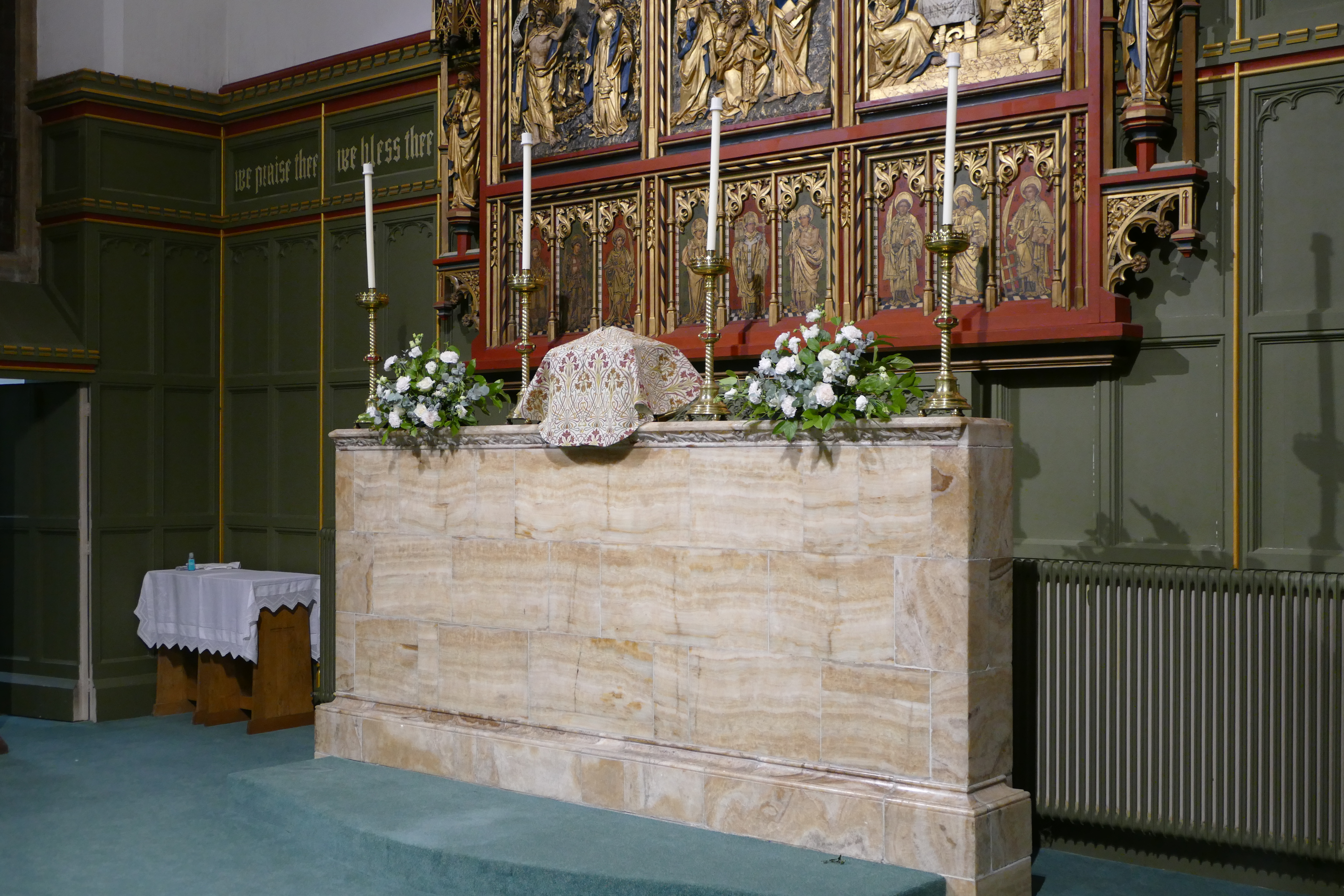
With the creation of the Ordinariates for receiving Anglicans into the full communion of the Catholic Church, together with the publication of a Missal containing elements of our liturgical heritage; I first conceived this photographic project some years ago. With my retirement from Parish ministry I now have the time to pursue such a project. It is not a celebration of the Mass but rather a series of posed photographs. Nor is it in any way ‘official’ though I believe I have followed the rubrics and instructions carefully .I shall be glad to receive comments and criticisms
I am grateful to Fr Babu Francis, parish priest of Holy Trinity, Dorchester, for permitting me to use the church as the setting for this photo shoot, and for taking the part of the Celebrant. My thanks also to Deacon Jonathan de Kretser, to Mark, Tom, Michael and Mark, the servers, members of the congregation and Sue, the photographer (with whom I was at school a few years ago).
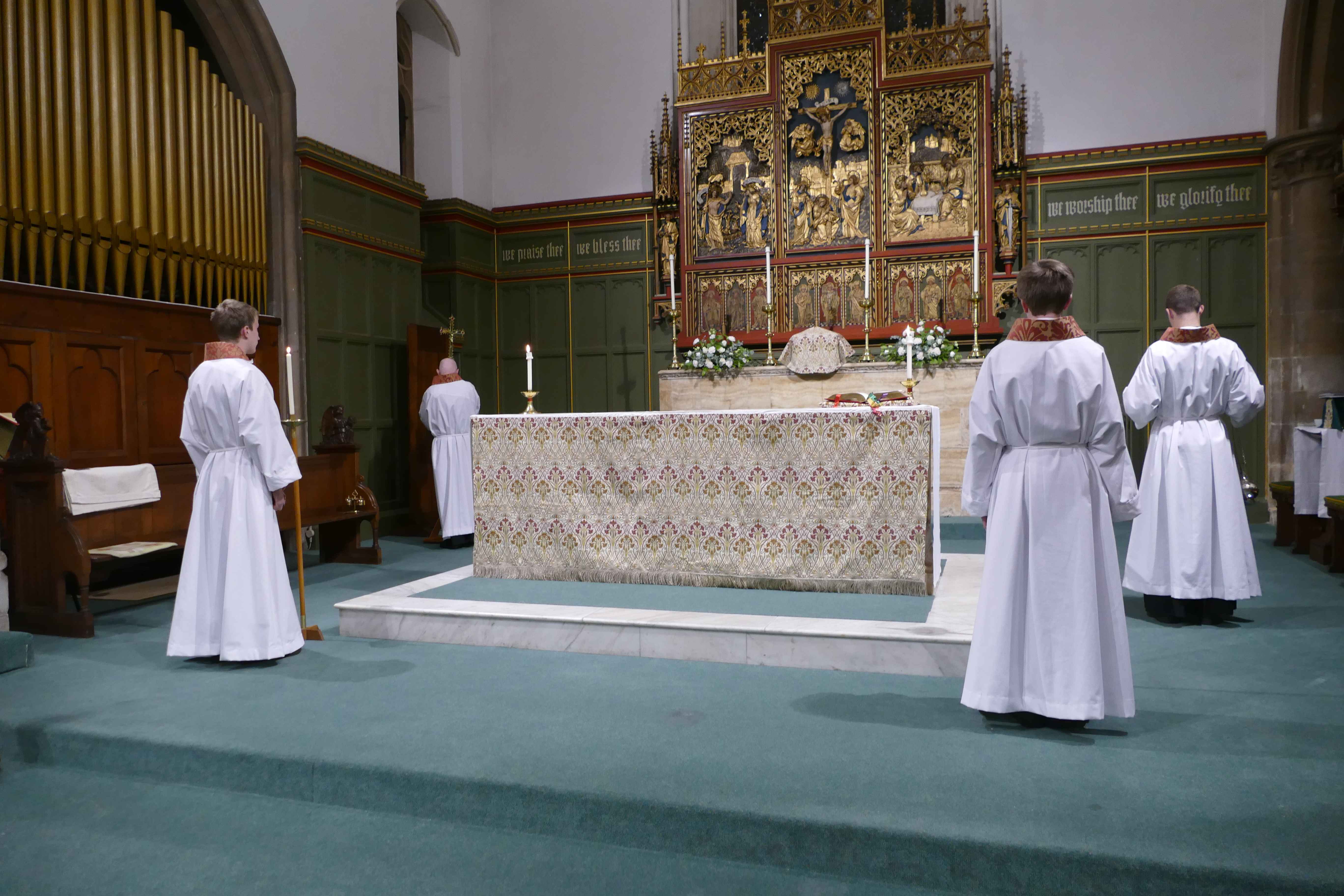
The Divine Worship Missal authorised for the use of the Ordinariates created in 2009, is prefaced by the same Instruction as that of the Missal of 1970 and used by Catholics across the western world.. In the Ordinariate Missal the Instruction is followed by the Rubrical Directory, with rubrics and recommendations peculiar to the Mass rite of the Divine Worship Missal but it has been made clear on a number of occasions that the Ordinariate Rite is a variant of the current liturgy, although the Directory ‘ sometimes permits or mandates customs from the 1962 Missal. It is not the ‘old’ Mass in English and should not be treated as such.
I therefore make no apology for the fact that in this presentation of the Mass I have kept the shape of the Mass as close as possible to that of the ‘Ordinary Form’. But I need to explain my preference for a ceremonial form common among Anglicans in the 20th century: often (though misleadingly, I think) called the ‘English Use’. My hope therefore is that the presentation will be of use the priests and congregations who do not use the Divine Worship rite and with a minimum of adaptation may produce a liturgy which is dignified, fresh and beautiful.
In establishing the Ordinariates the Pope expressed the hope that former Anglicans coming into the wider communion of the Catholic Church would bring with them a ‘Patrimony’, not least in the area of liturgy. We assume that the first English liturgy after the break with Rome (the Prayer Book of 1549) was celebrated according to the usage which had been current for hundreds of years, though there is evidence of simplification. Much of this was swept away in the Prayer Book of 1552 in which the influence of the Protestant reformers is most obvious. All the subsequent liturgical changes of the C of E manifested – at least until the 1980’s – a desire to return to the mainstream of Catholic worship.
This process began almost immediately with the insertion into the Prayer Book of 1559 of the ‘Ornament Rubric’, repeated in 1604 and in 1662.
“THE Morning and Evening Prayer shall be used in the accustomed Place of the Church, Chapel, or Chancel; except it shall be otherwise determined by the Ordinary of the Place. And the Chancels shall remain as they have done in times past.
“And here is to be noted, that such Ornaments of the Church, and of the Ministers thereof, at all Times of their Ministration, shall be retained, and be in use, as were in this Church of England, by the Authority of Parliament, in the Second Year of the Reign of King Edward the Sixth.”
The interpretation of the second paragraph was debated when it first appeared but became a major issue towards the end of the 19th century during the conflicts over what vestments and ceremonies were legal in the Church of England. At the end of that century the researches of Dr Percy Dearmer were encapsulated in his book ‘The Parson’s Handbook’. Dearmer was a ‘working’ parish priest, Vicar of St Mary’s Primrose Hill in north London, and his work contained pages of practical suggestions. He was motivated too by his deep aesthetic sensibilities, so that what he advocated was not mediaevalism, nor a copying of current Roman Catholic practise, but a fresh look at worship which drew on the wells of tradition. He insisted that liturgical worship should be beautiful not just ‘correct’, and in many ways he reflected the concerns of the growing Liturgical Movement in the wider Church. Dearmer’s work had a huge influence in the C of E not least in its Cathedrals where dignified and beautiful liturgy became the norm, not the exception. Many will remember the look of appreciation on the face of Pope Benedict in Westminster Abbey (where Dearmer had been a Canon between 1931 & 1936) as the servers, choir and clergy entered with him to the singing of ‘Christ is made the sure foundation’.
This tradition of liturgical worship, shaped by both ancient Christian symbolism, the concerns of beauty, and practical considerations, is an essential part of the Patrimony. I believe it is one of the gifts which Anglicans who have been received into full communion bring with them for the enrichment of the wider Church. In this spirit I respectfully offer this illustrated guide to the presentation of the Mass not only to the Ordinariates in the UK, America and Australia, but to the Church as a whole.
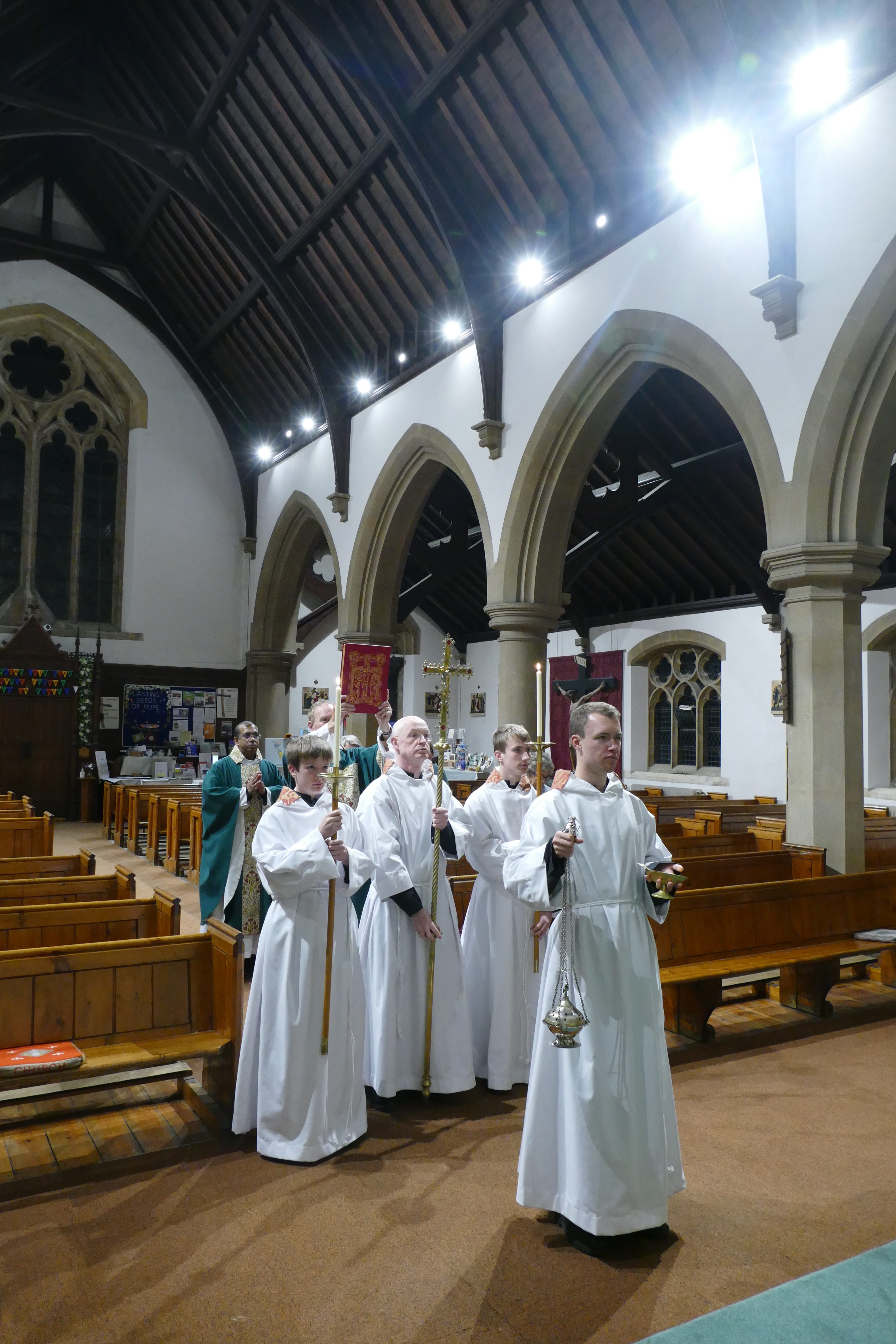
The ministers approach the altar. The Priest Celebrant is accompanied by the Deacon, as he will be wherever possible, regardless of whether the Mass is celebrated with music and singing or not. Under the 1962 missal (The ‘Tridentine Rite’ or ‘Extraordinary Form) ‘High Mass’ was celebrated with three ministers, Celebrant, Deacon and Subdeacon. In fact these three ministers were usually in priests’ orders, though permission was given latterly for a layman to take the part of the Subdeacon. The reforms to the liturgy after Vatican 2 required that from henceforward the Deacon must be a ‘real’ Deacon (transitory or permanent) and that a priest might not assume the dalmatic and deacon’s stole. The Subdiaconate had been abolished as an Order, being replaced by the instituted ministries of Lector and Acolyte. From the 19th century many Anglicans had copied the form of ‘High Mass’ without the corresponding orders, though it is worth noting that the ‘Epistoler’ and ‘Gospeler’ were to accompany the Celebrant in Cathedral and Collegiate churches, wearing copes.
The form of ‘High Mass’ with three ministers continued in the C of E after the reforms, especially in the Cathedrals, though the reasons seem to have been largely aesthetic rather than a reflection of a clear understanding of the different Orders. Otherwise this form died out quite rapidly in the UK with the clergy preferring to concelebrate where appropriate. The Divine Worship Missal has the (unclear) rubric ‘In the absence of a second Deacon, another cleric or even an Instituted Acolyte may serve the sub-diaconal ministry and read the Epistle. Does this then mean that it would be appropriate to celebrate the liturgy with a ‘sub-deacon? I think not. The ‘Minister’ of our rite is much closer to the ‘Clerk’ of the English tradition (and indeed Bishop Challoner in ‘The Garden of the Soul’ in the 18th century, uses the title of Clerk for the one who serves and ‘answers’ the Mass (i.e. responds to the priest on behalf of the congregation, the Mass being celebrated in Latin, a tongue unknown to to majority present) Should the Clerk (or Minister) wear the tunicle? I think not. To revive this vestment which is so similar to the Deacon’s dalmatic over half a century since it became obsolete, would only confuse – and to what purpose?
So the Mass is seen here celebrated by a priest Celebrant who is assisted throughout by a single Deacon wearing his distinctive vestments. If there is a second deacon available he may also function, the two deacons dividing the role between them. This is particularly appropriate where the Celebrant is the Bishop. It should be noted that the deacon remains at the right hand of the Celebrant. He should not be displaced by the concelebrating priests, and it would be better if they stayed off the footpace altogether, allowing the Clerk (Minister) to stay at the left of the Celebrant to turn the pages of the altar Missal.
Four servers take part in the celebration, the clerk, carrying the processional cross; next, the taperers who are often referred to (somewhat confusingly) nowadays as acolytes, with their tapers or candlesticks; and the thurifer, who carries the thurible swinging it gently on the long chain in the Entrance Procession. The Celebrant will have put on and blessed incense in the sacristy.
All ministers (both lay and ordained) wear the alb with amice and girdle (cincture). The amice has a collar called an apparel, a particularly attractive English tradition. The amice is the first of the vestments to be put on, but rests over the head until the chasuble or dalmatic is in place. Then the amice is lowered, the apparel forming a collar over the outer vestment.
The ministers approach the altar through the assembly.
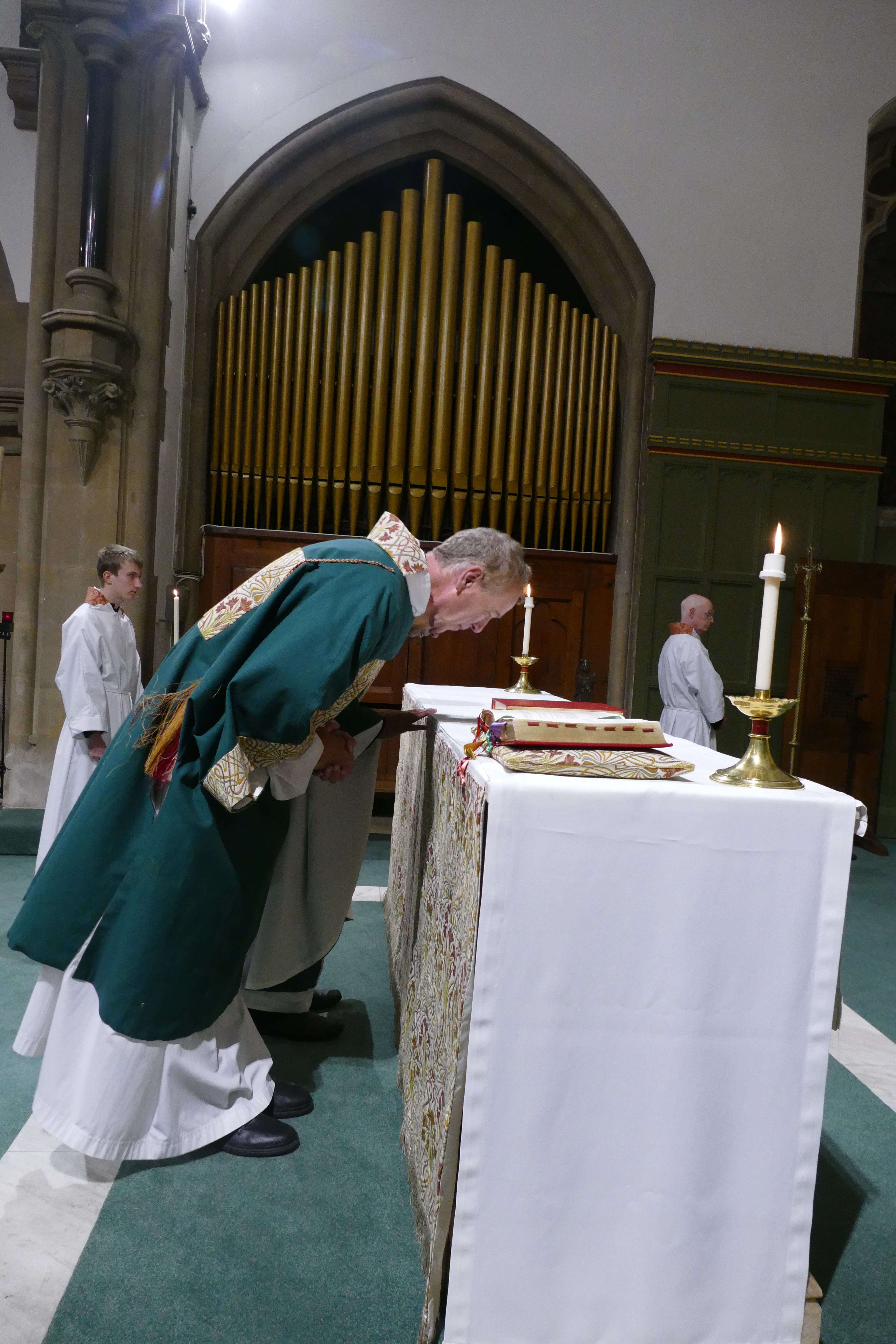
Arrived before the altar the servers and ministers make the appropriate reverence. If the Blessed Sacrament is reserved in the sanctuary then a genuflexion is made. This acknowledgement the Real Presence of the Lord in the tabernacle is made at the beginning and end of Mass. Otherwise the genuflexion is made only to the Sacrament on the altar after the consecration. If the Sacrament is reserved elsewhere in the church then the ministers and servers make a profound bow to the altar. If the Deacon is carrying the Gospel Book he neither bows nor genuflects.

The Priest and Deacon ascend the altar steps, the Deacon places the Gospel Book on the altar and both ministers kiss the altar. The thurifer approaches and gives the thurible to the Celebrant. (Incense will have been put on and blessed by the Celebrant in the sacristy and there should no need for more to be added and blessed at this point.) The Celebrant censes the crucifix, on or above the altar, bowing before and after the censing, and then, (moving anticlockwise) censes the altar. He may be accompanied and aided by the deacon and clerk or thurifer., especially if he is wearing very full and heavy vestments. The altar is censed in the simplest manner possible going right round the altar, gently swinging the thurible. (Where the sanctuary is very small and the altar is close to the east wall then the Celebrant will cense the altar to the right and then to the left. ) There seems no reason to revive the custom of censing the Celebrant at this point. Having handed the thurible back to the thurifer, the Celebrant and Deacon go to the north or left-hand side of the altar.
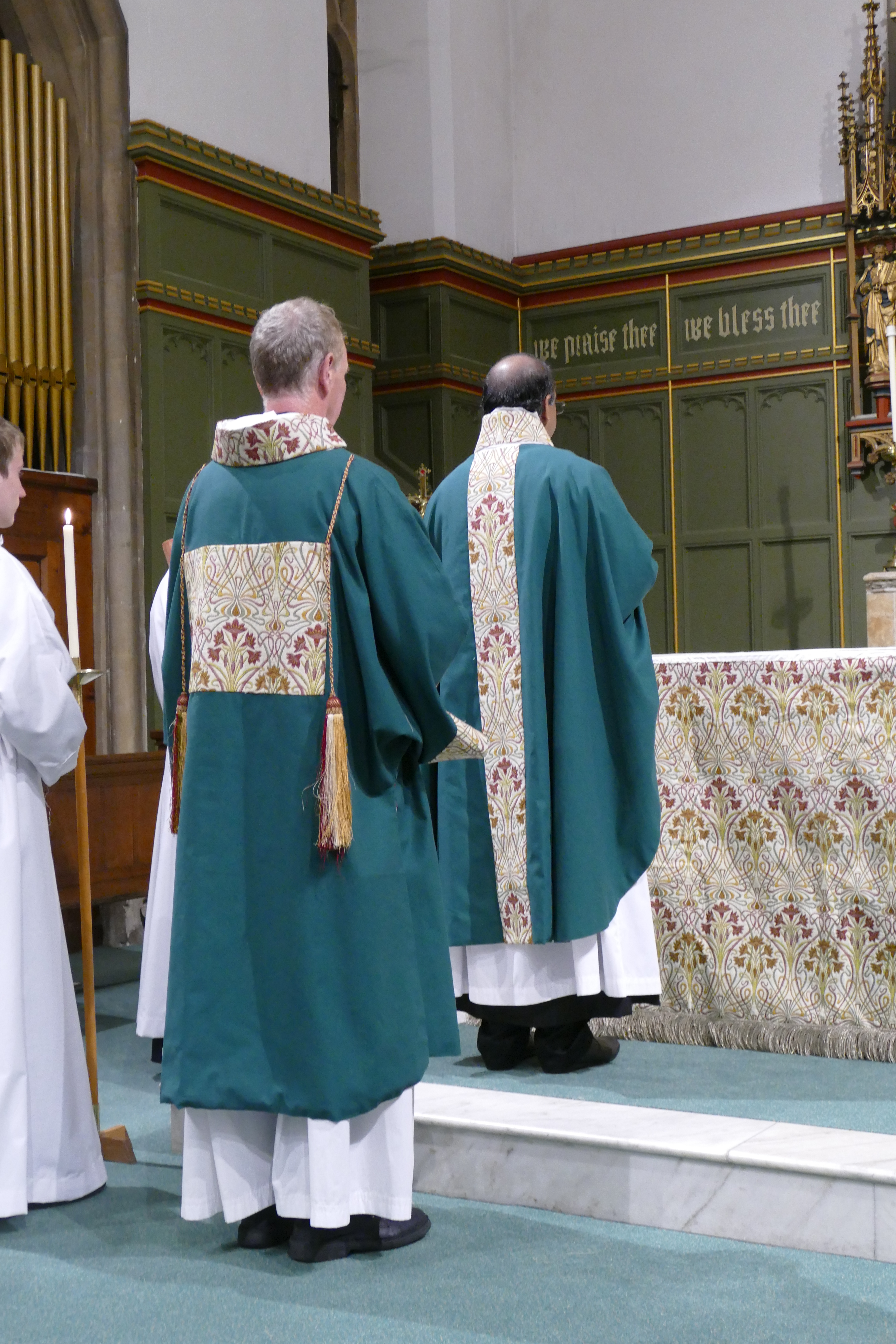
The rubric from the 1662 Prayer Book of the Church of England requires the priest to begin the Communion Service at the ‘north end’ of the Holy Table. From the Offertory onwards he is to stand ‘before’ the Table. Standing and kneeling at the ‘north end’ became a hallmark of evangelical Anglicans until the 1980’s, in spite of liturgical scholars pointing out that the ‘north end’ is not the ‘north side’. Before the Reformation it was apparently the custom in some places for the vestments to be laid out at the ‘north end’ of the altar and it was there that the Celebrant vested and said his preparatory prayers.
The Celebrant, facing the altar, says the Invocation, and (alone) the Collect for Purity. He will need a card on the altar (which should not be propped up on the candlestick!)
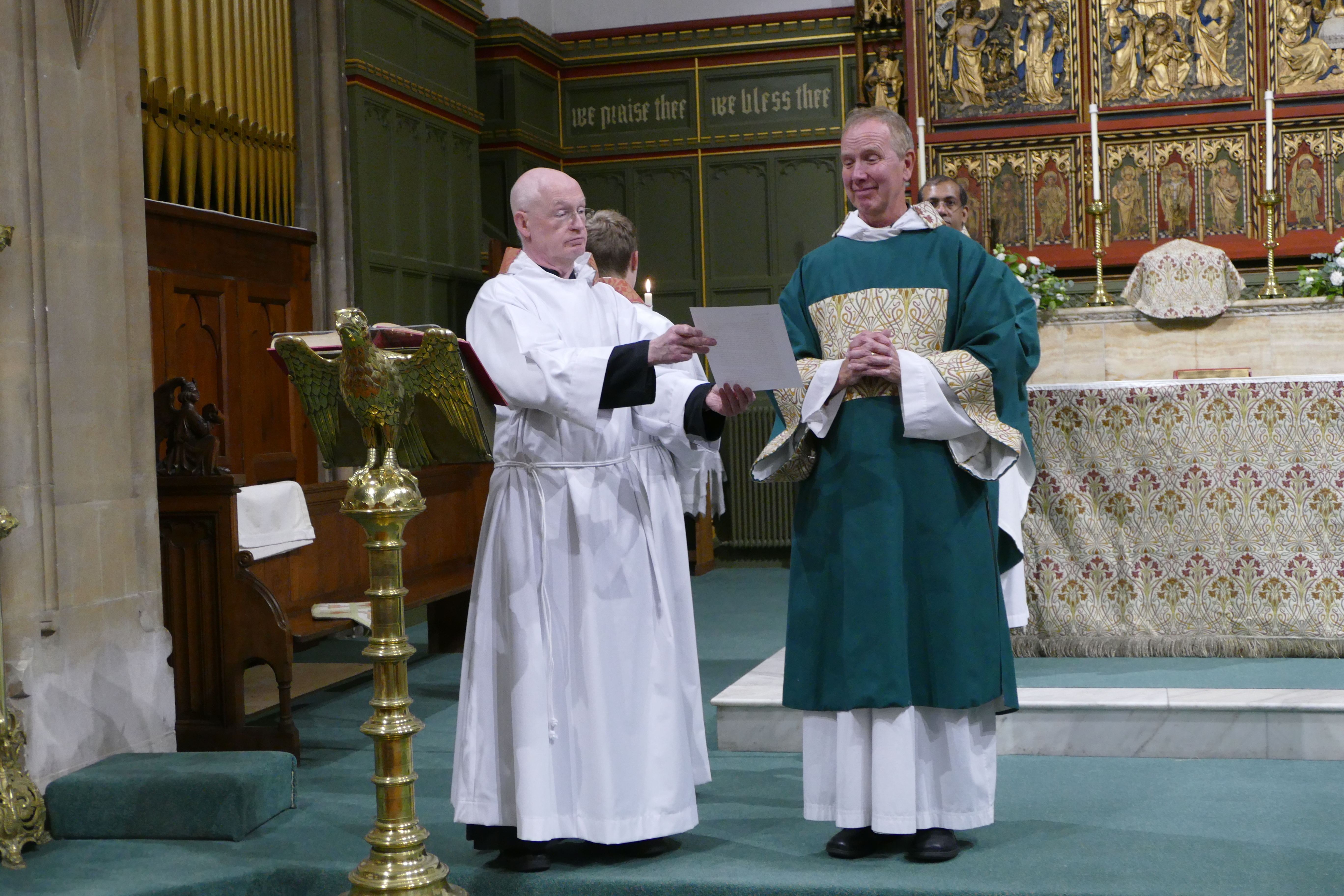
Still at the ‘north end’ the Deacon turns to the people to read the Commandments or Summary of the Law. The Clerk (Minister) holds the card or gives it to the Deacon.
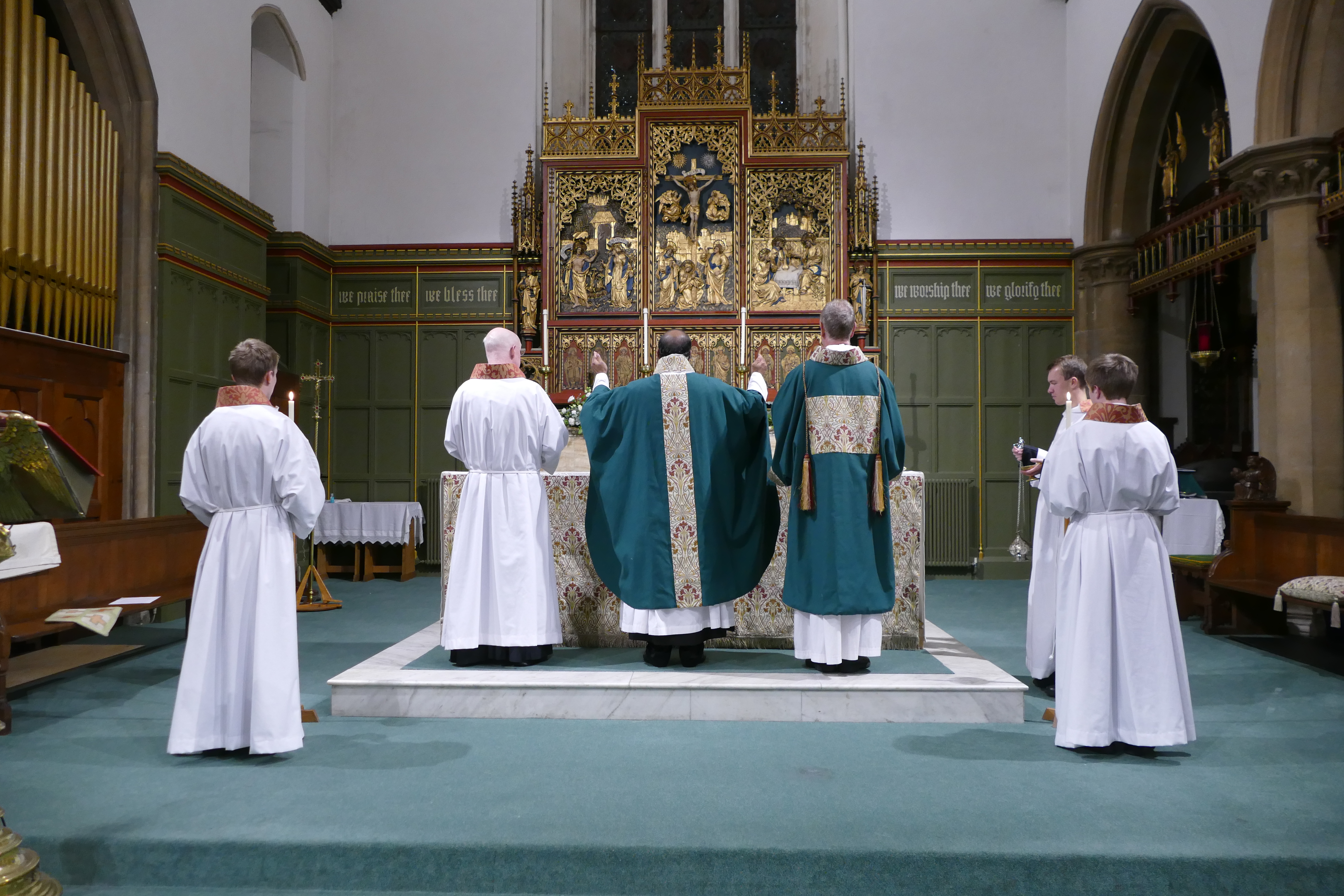
The Celebrant and Deacon move to the centre of the altar. The Celebrant, opening and then joining his hands, sings the opening phrase of the Gloria. (On occasions when the singers perform a lengthy setting of the Gloria, the priest and deacon go to the sedilia (their seats) They and the people sit and participate in listening. There is no reason for the priest to recite the Gloria sotto voce at the altar as this implies that he is celebrating his ‘own’ Mass separately from the rest of the congregation.
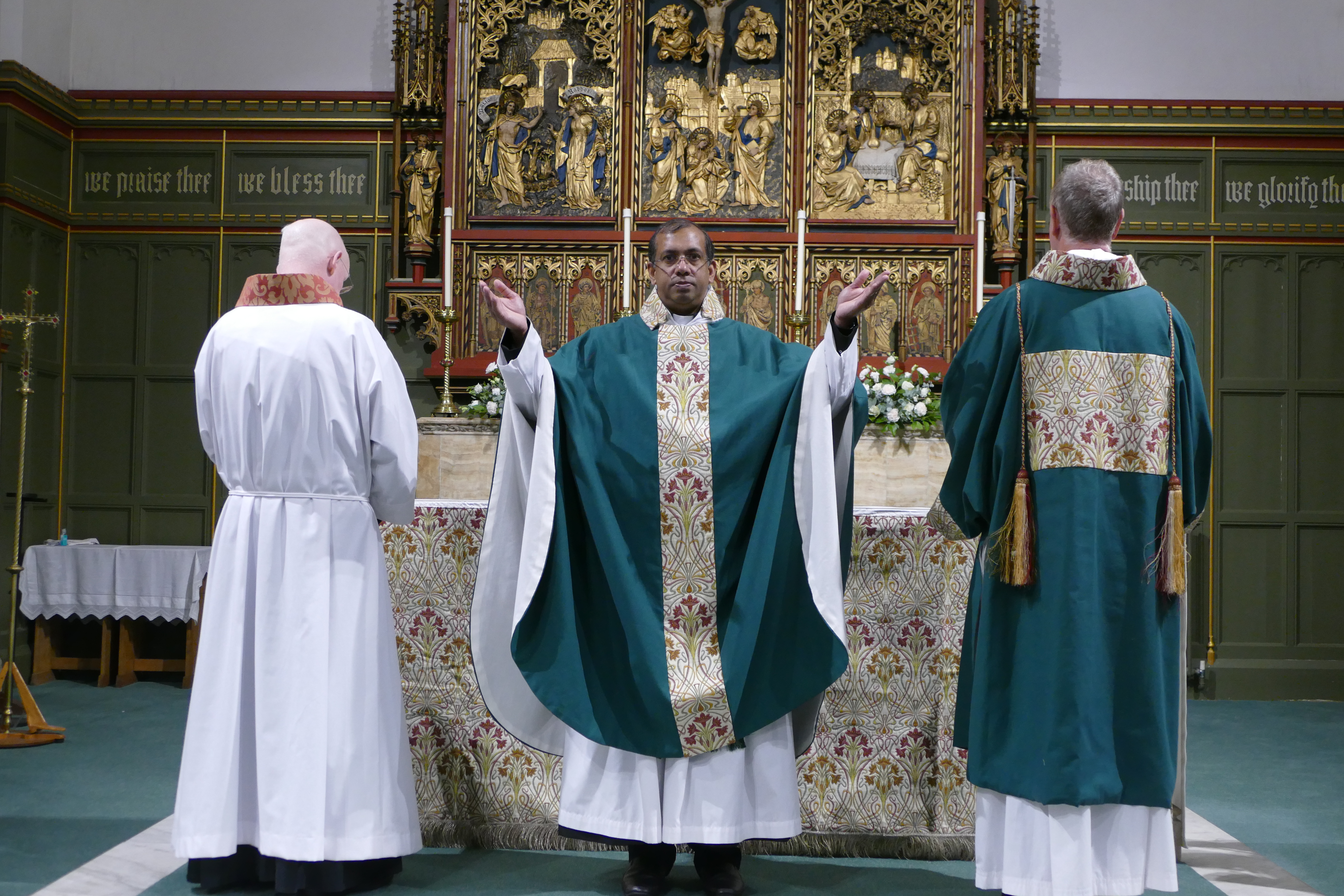
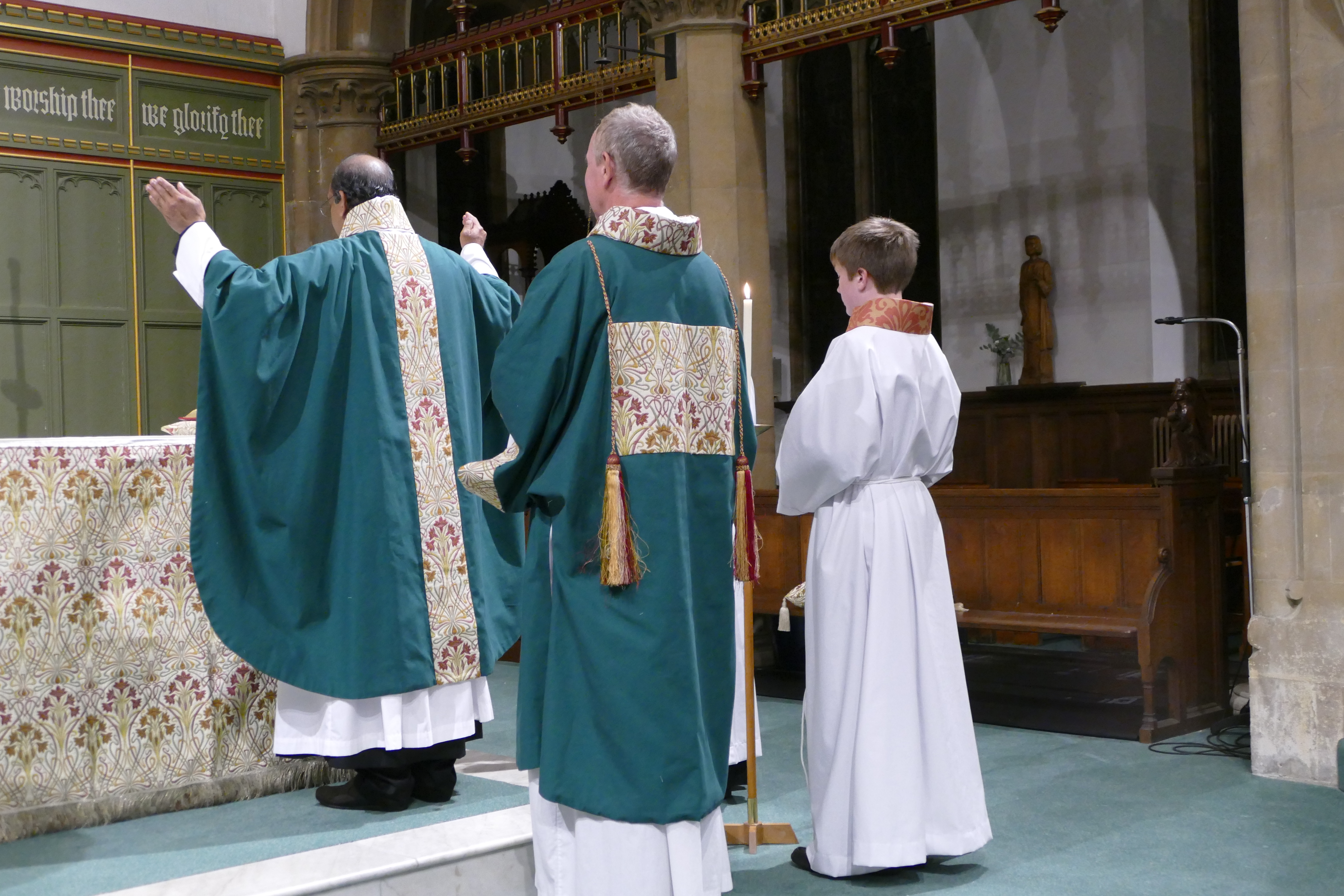
Still at the centre of the altar the Celebrant turns to the people and greets them (the Deacon moves to one side, turning and walking deliberately, and not shuffling sideways. He then turns inwards at right angles to the Celebrant). The Celebrant greets the people and then together he and the Deacon and move to the right-hand side (the south side) of the altar where the Celebrant says the Collect. Only one Collect is ever used. (The moves here are complicated and need to be practised carefully and accomplished slowly and deliberately.) The Clerk (Minister) has left his place on the footpace and gone to stand at his seat.
After the people have responded with their Amen the Celebrant and Deacon turn to the right and go to the sedilia. The Deacon assists the Celebrant to sit (useful with heavy ad full vestments) and then sits himself. The taperers move to the centre, bow to the altar and together go to their places.
To be continued …

 Ordinariate Pilgrim