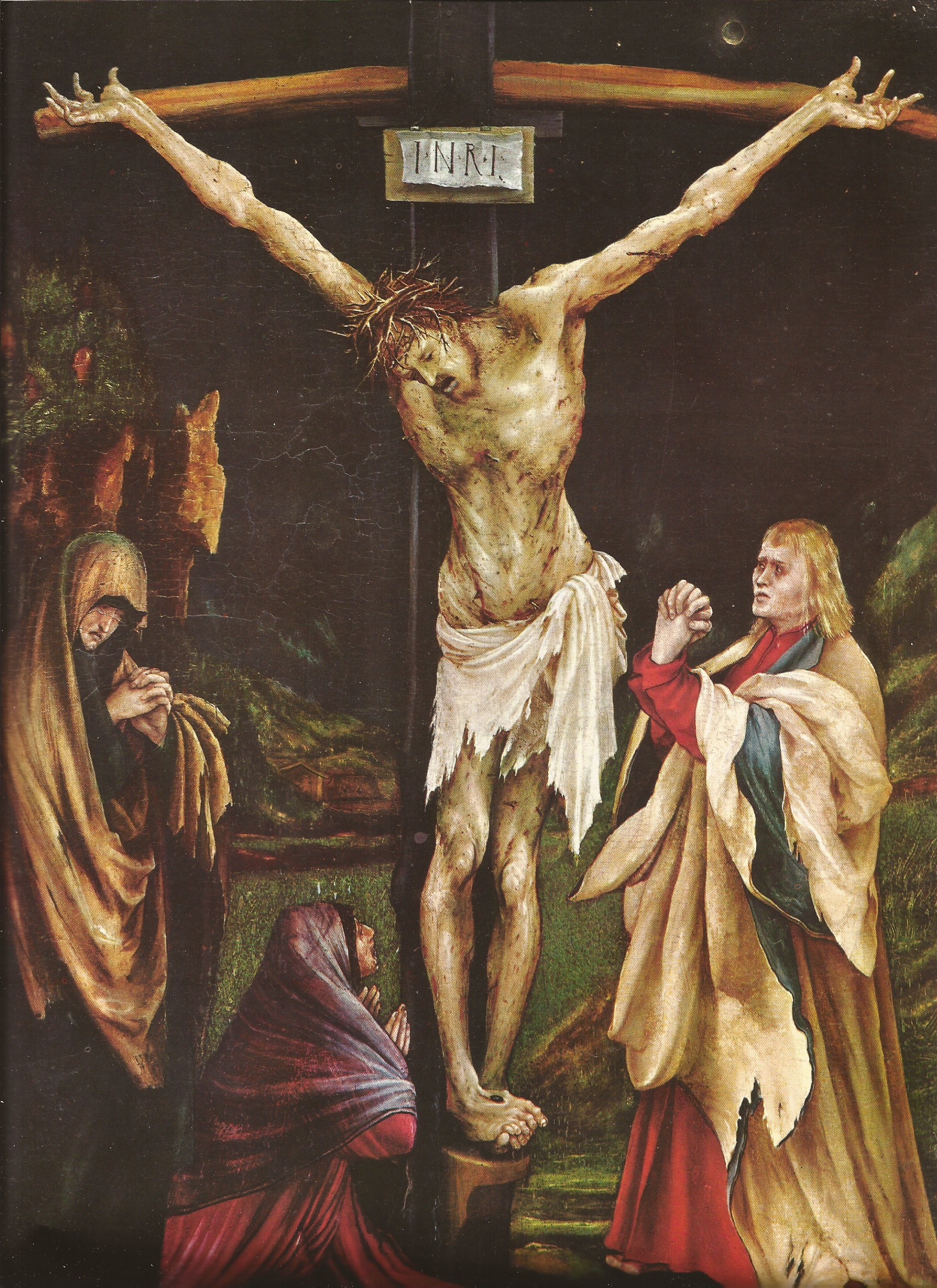
Good Friday

Crucifixion: Albrecht Durer

Crucifixion: Albrecht Durer

A homily

Crucifixion is probably the most barbarous death ever devised. It was used by the Romans, not only as a punishment, but as a deterrent: anyone tempted to rebellion would think long and hard if once they had seen someone crucified. It is the death to which the Lord Jesus Christ went, freely and of his own will, for the salvation of the whole creation, throughout all time. Totally innocent of all sin, he took the sin of the whole human race upon himself. Offering his perfect life to the Father, he won our forgiveness, and brought us back to God.

Forgiveness lies at the very heart of the love of God which we see in Jesus. This Good Friday I want to put before you those words of Jesus, as he first experienced those great iron spikes being driven into his hands and feet. And he prays: ‘Father, forgive them, they know not what they do’. There are two inspired lines in the hymn by Graham Kendrick we call, ‘The Servant King’. The writer says of the Lord Jesus,

‘hands that flung stars into space
to cruel nails surrendered.’

In these few words he reminds us just who it is who lies upon the ground being nailed to his cross: it is the eternal Son of God, the Second Person of the Trinity, who emptied himself of glory and took our flesh: not just to live among us, though that would have been wonderful enough, but to die with us and for us, to share our death so that we might share his resurrection. Such love, such forgiveness.

You may know the words of this prayer, found in one of the concentration camps of the Second World War: places which mark, as nowhere else, the utter cruelty and depravity of which human beings are capable. This prayer was written by an inmate of the camp, one who had to suffer at the hands of his or her captors. This prisoner prayed:

O Lord, remember not only the men and women of good will, but also those of ill will. But do not only remember the suffering they have inflicted on us, remember the fruits we bought, thanks to this suffering: our comradeship, our loyalty, our humility, the courage, the generosity, the greatness of heart which has grown out of all this. And when they come to judgment, let all the fruits that we have borne be their forgiveness.
(Richard Foster, Prayer: Finding the Heart’s True Home. HarperOne, 1992. page 224)

Such love – such forgiveness

Posted in Uncategorized | 2 Comments

A reminiscence of Margaret Street

There is concern about a school in Birmingham which, it is asserted, is being targeted by Muslim extremists. A teacher was quoted, earlier in the week, saying that “there is some gender segregation in religious assemblies”.

All Saints' Anglican Church, Margaret Street, London W1

All Saints’ Anglican Church, Margaret Street, London W1


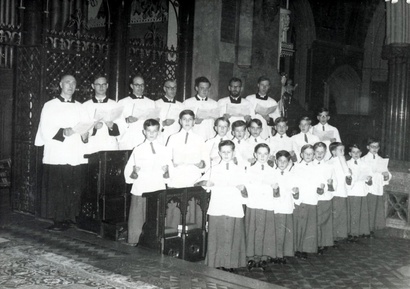
About fifty years ago “gender segregation” came to an end at All Saints’, Margaret Street, in London’s West End. For many years the congregation had divided, male and female, on either side of the nave in the front part of the church. This had been one of those examples of ‘correctness’ which the Catholic revival in the Church of England, the ‘Oxford Movement’, had sought to encourage. In the early 60’s I went with my aunt to the celebration of Candlemas on 2nd February. Although the custom of separation had been given up I seem to remember that she was the only woman sitting on our side of the church. The choir school was still going, and the boys wore very short cottas, eton collars, and purple socks to match their cassocks. Choir schools and daily sung services had also been part of the Revival. And now? Even the English Cathedrals are struggling financially to keep their choirs. In any case fifty years of ‘pop music’ have left the British unable to sing, so even if they can find the money, the Cathedrals can no longer find the boys to fill the choir stalls.

The men and boys choir at Margaret Street

The men and boys choir at Margaret Street

But for a moment, back to that February day at Margaret Street. As we hovered after Mass a tall lady in a long fur coat hurried down the centre aisle saying loudly, ‘Has Mr Gorse gorn?’ (For the younger generation and overseas readers, you should know that in English as spoken by the upper classes at that time, words like ‘lost’ and ‘cross’ and ‘gone’ were pronounced to rhyme with ‘mourn’ or ‘lawn’ – a cross between the two … ) A few years later my aunt sent me the Notice of Death from the Daily Telegraph of the said Mr Gorse, and the date and time for his funeral at All Saints’. But she could not resist writing in the margin, ‘Mr Gorse has finally gorn.’

Posted in Uncategorized | Tagged , , , , , | 2 Comments

Sweet Spirit, comfort me

Jeremy de Satgé   R.I.P

Jeremy de Satgé R.I.P


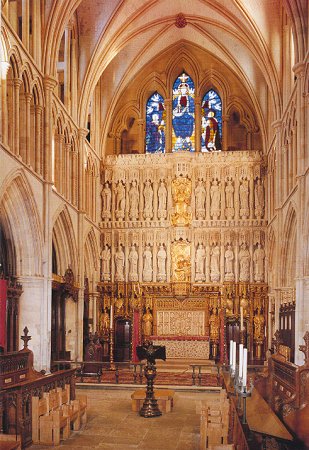
I went recently to Southwark Cathedral for the funeral of the musician Jeremy de Satgé, who had organised the music and singers for my ordination at Most Precious Blood. The boys of Westminster Cathedral choir sang at the funeral, and the music included a setting by Peter Hurford of part of this poem by Robert Herrick. If you want to hear the musical setting go to You-tube; it’s sung by the boys of Southwark Anglican Cathedral, with accompaniment on the Lewis organ – also the chance to see an English altar combined with a towering reredos. The management of the scale is interesting (it’s Sir Ninian Comper, I think) and avoids the altar looking like an overwhelmed sideboard as in the later classical/baroque period.

High Altar - Southwark Anglican Cathedral of St Saviour

High Altar – Southwark Anglican Cathedral of St Saviour

HIS LITANY, TO THE HOLY SPIRIT

In the hour of my distress,
When temptations me oppress,
And when I my sins confess,
Sweet Spirit, comfort me!

When I lie within my bed,
Sick in heart, and sick in head,
And with doubts discomforted,
Sweet Spirit, comfort me!

When the house doth sigh and weep,
And the world is drown’d in sleep,
Yet mine eyes the watch do keep,
Sweet Spirit, comfort me!

When the artless doctor sees
No one hope, but of his fees,
And his skill runs on the lees,
Sweet Spirit, comfort me!

When his potion and his pill,
Has, or none, or little skill,
Meet for nothing but to kill,
Sweet Spirit, comfort me!

When the passing-bell doth toll,
And the furies in a shoal
Come to fright a parting soul,
Sweet Spirit, comfort me!

When the tapers now burn blue,
And the comforters are few,
And that number more than true,
Sweet Spirit, comfort me!

When the priest his last hath pray’d,
And I nod to what is said,
‘Cause my speech is now decay’d,
Sweet Spirit, comfort me!

When, God knows, I’m tost about
Either with despair, or doubt;
Yet, before the glass be out,
Sweet Spirit, comfort me!

When the tempter me pursu’th
With the sins of all my youth,
And half damns me with untruth,
Sweet Spirit, comfort me!

When the flames and hellish cries
Fright mine ears, and fright mine eyes,
And all terrors me surprise,
Sweet Spirit, comfort me!

When the Judgment is reveal’d,
And that open’d which was seal’d;
When to Thee I have appeal’d,
Sweet Spirit, comfort me!

Robert Herrick

Southwark Anglican Cathedral - the reredos

Posted in Uncategorized | 1 Comment

Let us now praise famous women …

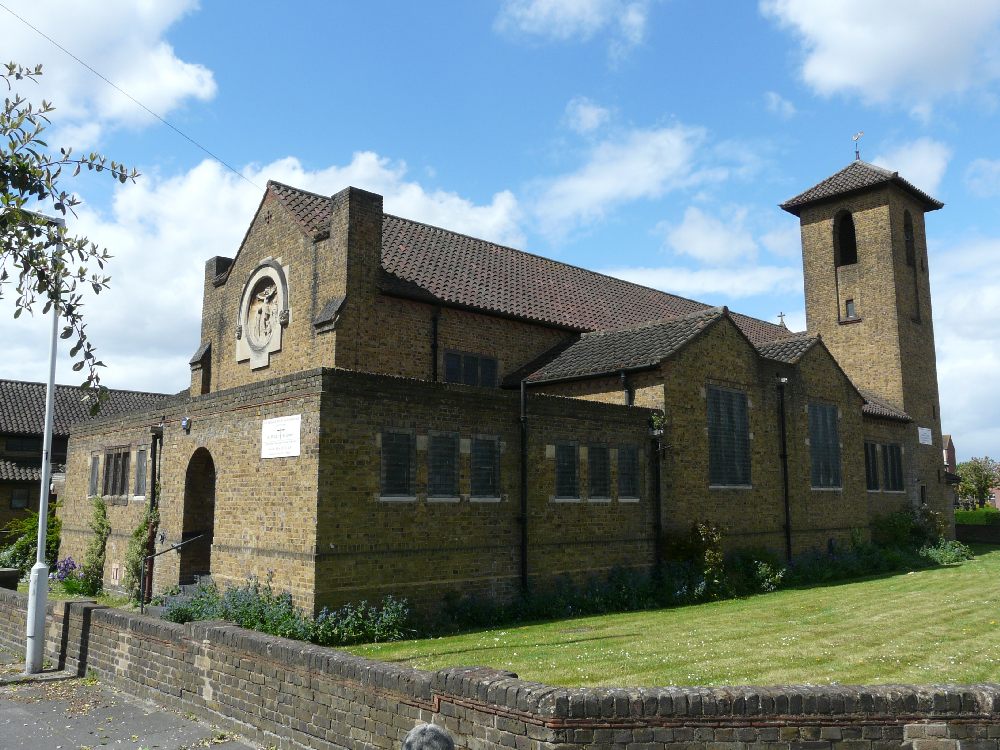
St Edmund, King & Martyr, Forest Gate in East London: the old church

St Edmund, King & Martyr, Forest Gate in East London: the old church


… at least, famous in the C S Lewis sense. If I remember rightly, for I have not got my copy of ‘The Great Divorce’ to hand, he heard singing and joyful tumult, and asked his guide who was coming. The reply came that it was one of the Great Ones, who on earth had been Sarah Smith of Golders Green. I count myself privileged to be old enough to have known some of the great ones of the Anglo-Catholic Movement – not, of course, Newman and Pusey, nor even Dom Gregory Dix and Dr Mascall – but rather some of those ordinary but wonderful lay women, usually single, devoted to their parishes and to their priests, who were once such stalwarts of the Faith.

Emily Lenderyou, always known as ‘Lindy’ was well into her seventies when I went to be priest-in-charge of St Edmund, Forest Gate. She had moved as a child into a house in the parish which her parents had bought before the First World War. She had cared for both of them until they died, and had been a civil servant. Taken to St Edmund’s in her teens by a friend, she was a was a loyal and even fierce supporter of its tradition. Mass every Sunday, a regular penitent, her financial giving sacrificial to the point of recklessness, she was a talented seamstress, and made two albs and two cottas which I still wear, decorated with rows of fine drawn thread work. There was nothing of the ‘narrow minded spinster’ about her, and she seemed instinctively to understand many of the pressures which a priest nearly fifty years younger than her was subjected to. She was wise, funny and contented. She saw the church she had worshipped in all her life demolished and redeveloped, and she amazed the Bishop on the day of the consecration of the altar in the new Church Centre by telling him, ‘This is the happiest day of my life.’ Well into her eighties, her wonderful Irish doctor found she had a slow and painless cancer. He got her into St Joseph’s Hospice where she had a marvellous six months, made all the net curtains for my new Vicarage, and travelled by builders’ van (more kind friends) to see my new church. She asked me to leave her for a time in front of the Blessed Sacrament altar. When she died I grieved for my loss and rejoiced for her gain. I still do.

St Philip, Plaistow - former conventual church of the Anglican Franciscans, now the parish church

St Philip, Plaistow – former conventual church of the Anglican Franciscans, now the parish church


Eileen King had been a missionary teacher in Papua New Guinea returning to retire to Plaistow in East London. She had worked with them overseas, and in retirement was close to their house at Balaam Street. She joined the congregation at St Philip’s Plaistow where I was Rector. She was tall and angular, strode round the parish collecting children (she revived the youth work in the parish) and would hoot with laughter. She looked after the altar linen and one Holy Saturday fell down the steps behind the Blessed Sacrament Altar. Although badly shaken and bruised she refused to go to hospital. ‘They might keep me in and I’d miss the Easter Vigil’ she said – and she got her way. During this time her block of flats was being upgraded, to turn the bed-sits with shared bathrooms into self-contained one bedroom flats. Eileen was appalled at such extravagance, and threatened to sub-let her bedroom if she was not given one of the two ‘bed-sitters’ which were left. She got her way! By this time the controversy over the ordination of women was under way and dividing our parish. She told me that she had always wanted to see women ordained. But she did not believe that I and others were misogynists and that we had done more to enable the ministry of women in our parish than anywhere she had known. I treasure that: it gave me great comfort at a very difficult time in my life. Eileen was taken ill while with friends in Yorkshire. She stayed in hospital in the north because she thought that people might “fuss” if she came back to London. She badgered the Lord to take her home, and he did two weeks before I left the parish. I celebrated her funeral Mass on the day before I moved.

Thanks be to God for the service that these women gave to his Church and to us, his priests. May they receive the reward of their labours.

Posted in Uncategorized | 2 Comments

I vow to thee my country

The British Parliament

The British Parliament

The unravelling of the relationship between the Church and the State in Britain has accelerated rapidly in the last thirty years. But the process has been going on rather longer than we care to remember. I don’t mean that disestablishment of the Church of England is just around the corner: it probably isn’t (though in matters religious and moral these days who can tell what the Government will come up with at very short notice). I’m thinking rather of what we now call ‘core values’. Until quite recently it was assumed that the ethical and spiritual heritage of the UK was Christian. The word may have been used rather loosely, and the majority hardly ever went inside a church building. But we now live in a society in which the younger generation defines itself as secular. Some, including some religious leaders, are hopeful about ‘spirituality’: I am not. Indeed, we need to see that the moral high ground is increasingly being claimed by the secularists, and the teaching of the Christian Church on many matters is targeted as unreasonable, harsh, out of touch, certainly un-loving – and even ‘un-Christian’.
The Church is often lampooned for being obsessed with sex. It is certainly true that in terms of morality Christians have continued to hold to a sterner and more disciplined code than society at large. Secular society itself is not entirely comfortable with the widespread changes. But it is worth noticing in passing how important language has become as a tool to manipulate moral thinking in our society. ‘Abortion’ is an ugly word for the single act of destroying a foetus, whereas ‘termination’ has different meanings in a variety of situations. ‘Anti-abortion’ sounds negative, so we come up with the word ‘pro-life’. But the other side will not let us get away with that and call themselves ‘pro-choice’. Careful, thoughtful moral discussion takes too long, and the arguments must be conducted with sound-bites.

untitled (2)

Interestingly, the dislocation of British Church and State received a real boost, not from divorce law or gay marriage, but from the Sunday Trading Laws. In 1994 the Government under Prime Minister John Major deregulated Sunday Trading. A similar Bill had been voted down in 1986 when Margaret Thatcher was Prime Minister, but the Law had been challenged (and broken) by the big retailers. There had been considerable opposition from the churches who combined to support ‘Keep Sunday Special’ Campaign. But the argument based on ‘choice’ and ‘individual freedom’ trumped everything, though close beneath the surface was also a secularist agenda. I remember clearly a discussion in which one of the group, a businessman and entrepreneur rounded on me and said, ‘I don’t see why you lot should tell me when I can open my shop’. It amazed me then – and still does – that we should have given away the freedom in the 20th century to have a corporate day of recreation, a freedom so hardly won in the 19th, and all for the ‘freedom’ to go shopping.
It had seemed perfectly natural to everyone in our country that the chosen day of freedom from the daily routine should be Sunday. This was because of our Christian heritage: after all, if we were going to have a weekly day of freedom and recreation, we only had seven choices! The results of Sunday deregulation are there for all to see, and they have been dire. London streets and shopping centres are clogged with traffic (although I notice that the City of London where the wealthiest work is still firmly shut up at weekends). People work longer and longer hours, and the break-up of the family, deprived now of any quality time together, has continued.
But for the forces of secularism Sunday deregulation was a triumph. It marked a vital step in the ‘privatisation’ of Christianity and the removal of one of the most obvious signs of the Christian faith from public life.
Again it is worth observing that as a Conservative government removed the Christian Sunday from the national consciousness, so it is another Conservative government which has now re-defined marriage. Indeed the new definition of marriage which came into force yesterday is so different from the old one that I suggest that any opposite-sex couple now going to the registry office will in fact be civilly-partnered when they come out. Perhaps this does not matter greatly to the secularists: the hidden agenda was, once again, to break away from a Christian institution which had been embedded in the life of our country for centuries.

images

For the Churches in our country there will now have to be varied and different responses. There are many Catholics who know their orientation to be homosexual: they live according to the teaching of the Church which they love. They find themselves more and more isolated and ‘disapproved of’ for their loyalty by secular gay friends and colleagues. The Church needs to teach as much about the richness and fulfilment of friendship and the single life, as it does about sex outside marriage. And the Church of England – which we in the Ordinariate still love and revere – she needs to see the dreadful danger of being bullied into silence over issues which she knows are key to the Gospel.

Posted in Uncategorized | Tagged , , , , , , , , , , , | 2 Comments

Ordinariate Pilgrims of faith

The Samaritan Woman at the Well Guercino 1640

The Samaritan Woman at the Well
Guercino 1640

At the beginning of Lent around 500 people were present at Southwark Cathedral for their Rite of Election. Among these 500 are Catechumens – those who have come from unbelief and are to be baptised at Easter – and Candidates who have already been baptised and are now to receive Confirmation and the Eucharist. And there will be those entering into full Communion with the Catholic Church – those whose faith journey has brought them from committed life in other Christian communities, now to continue within the fullness of belief and sacramental life in the Catholic Church.

During this past week I have heard three experiences of the journey of faith which relate to the Ordinariate. The first from a young man who became a Catholic in his teens, some ten years ago. Although not a member of the Ordinariate, he felt that its formation by Pope Benedict had encouraged him to give thanks for his Anglican past, and not to hide it.

My next conversation was with someone trying to help a young friend decide whether to enter the Catholic Church. She felt that the Ordinariate could help her with a sense of continuity in her journey: that this great step of faith did not cut her off from all that God had done for her in the past.

And finally a reflection from a priest, grateful that the Catholic Church has taken an important step with the Ordinariate in recognising God’s grace in the Christian pilgrimage. But sadly he was reminded of his meeting with a woman who had joined another Christian denomination. She was now talking of her recent ‘conversion’ and ‘meeting with the Lord’ – yet this priest had prepared her for Confirmation and Confession some years before. Such language seems to imply that what went before is of little worth, even bogus.

With Dag Hammarskjöld we shall surely want to say: “For all that has been, thanks. For all that is to come,
Yes!”

Posted in Uncategorized | Tagged , , , , , | 2 Comments

The Lenten Fast

sun on mountain

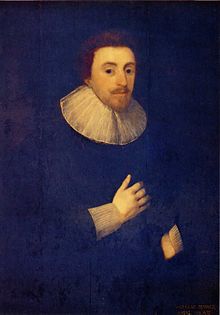
Robert Herrick (1592-1674) was an Anglican cleric of the 17th century. He was vicar of Dean Prior in the county of Devon. From this parish he was ejected by the Puritans and restored by King Charles II. This poem appears in the ‘Divine Office’ of the Catholic Church, and I have found it quoted on American Catholic sites, which do not always seem to be aware of his background. How good it is to see the Anglican spiritual patrimony already bedding down in the Catholic Church.

IS this a Fast, to keep
The larder lean?
And clean
From fat of veals and sheep?

Is it to quit the dish
Of flesh, yet still
To fill
The platter high with fish?

Is it to fast an hour,
Or ragg’d to go?
Or show
A downcast look and sour?

No; ’tis a fast to dole
Thy sheaf of wheat,
And meat,
Unto the hungry soul.

It is to fast from strife,
From old debate
And hate;
To circumcise thy life.

To show a heart grief-rent;
To starve thy sin,
Not bin;
And that’s to keep thy Lent.

Posted in Uncategorized | 2 Comments

Nicholas Ferrar: a call to holiness in difficult times

Nicholas Ferrar of Little Gidding

Nicholas Ferrar of Little Gidding


In 1625 the Ferrar family purchased the manor house and church at Little Gidding in Huntingdonshire, nor far from Cambridge. Nicholas Ferrar had prospects at the royal court, but with the loss of the family fortune, he retired to Little Gidding with his mother, Mary, and his extended family: Nicholas himself was unmarried. In 1626 Nicholas was ordained deacon (though never priest) by William Laud, later to be Archbishop of Canterbury. The family immersed itself in a life of prayer, going daily to the church for Morning and Evening Prayer, gathering regularly during the day and keeping vigil in turns during the night for the recitation of the psalter. Practical works of charity involved the family in the care of local people, and they became skilled in the making and binding of books, especially parallels of the Gospels.
King Charles 1

King Charles 1


The community attracted and repelled: King Charles I visited Little Gidding three times; the Puritans wrote pamphlets denouncing the family for trying to revive the ideal of the religious community abolished in the previous century. In 1637 Nicholas Ferrar died, although the family continued their community life under his brother until 1657.
Little Gidding was largely forgotten until the Catholic Revival of the 19th century. One of the earliest achievements of the Movement was to restore with the Church of England the Religious Life for women and men. The attraction of Little Gidding was undoubtedly its simplicity and devotion, its humble hiddenness, its sanctifying of the relationships of the family, and its willingness to trust in God for its beginning and its end.
As the family disintegrates in western Europe so the ideal of the Christian family becomes harder to maintain, and yet ever more vital in its witness. It does not exclude, but draws into its life of care and service. It is rooted in prayer, simple forms of the Office, grace before meals, the Rosary and intercession, Sunday Mass together. At a time when more and more people are living on their own it sets the counter-ideal of the community. One might envisage family members and single friends buying or renting homes close to each other in an area so that daily prayer and community life are possible, as well as the care of the older and sick members of the community.
care for sick
Perhaps this form of simple community living might be adapted by young people especially in our cities. Accommodation is often difficult to find, and young Catholics may be forced to live alongside a lifestyle of hard-drinking and casual sex with their flat mates. Perhaps here there is an ecumenical dimension: young Catholics and young Anglicans living in simple community flat-shares; during the week praying the Office and doing some pastoral work; though on Sunday going to the Eucharist in their respective parish churches. The challenge is there too to the rich and influential. Nicholas Ferrar retired from this life to live for God. He used what was left of his fortune to pay for this way of life. Will the wealthy and sophisticated in our society feel the call to embrace it too? The call to holiness in difficult times is as real today as in the times of Nicholas Ferrar, though in very different circumstances.
Youth at prayer

Posted in Uncategorized | 3 Comments

Anglican Patrimony: the voice of the laity (2)

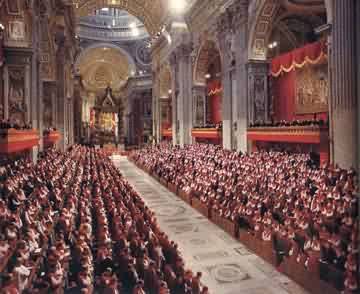
Second Vatican Council

Second Vatican Council

Fr Philip North has described the General Synod of the Church of England as “clumsy, dysfunctional and dangerous”. As an Anglican – and an Anglo-Catholic – Fr North has reason to use these harsh terms, given the way that the Synod has diverted the C of E from its claim to be a part of the Catholic Church, and to hold no other doctrine beyond that held by the Church Universal. But the kind correspondent who gave me this quote after reading my post on the voice of the laity wonders if ‘generalsynodism’ is the inevitable result of councils of the laity in parishes.

I am clear that it is inevitable for the Church of England as it now is. I believe that Pope Benedict saw this clearly, and reached out to the Anglican Communion, offering it the gift of Christian Unity, for which the Pope has a special responsibility. In offering it unity the Pope was also offering it the gift of authority, the authority of Peter which is the authority of Christ himself, entrusted to his Apostle – and his Apostles. The source of this authority had troubled Anglicans since the 16th century Reformation. The lack of this authority has made the Anglican Communion increasingly dysfunctional at its heart.

This failure to function, which has afflicted Anglican Christianity increasingly since the 1960’s, is the result of two historical events. The first is the separation of the English Church in the forced schism of the 16th century from communion with the Bishop of Rome; and the second is the disastrous influence of the ‘establishment’ of the Church of England. It is clear from the pages of the New Testament that the Son of God left to his followers the Gospel – the saving knowledge of his life, death and resurrection. In order to ensure that this knowledge of salvation, which is truth, be handed on faithfully, the Lord Jesus sent from his Father the Holy Spirit. The record of the life of Jesus Christ, and the response of the men and women who were the Church of the first century, is contained in the Scriptures, in the New Testament. But it is not knowledge of these Scriptures in themselves, that brings salvation. Rather it is to know Jesus Christ and through him to come to the Father, in the company of the faithful who are the Church – this is salvation: this is new life here and now and the promise of life forever in the world to come.
By the end of the first century, those who had known the Lord in the flesh had all died. The bishops were the clear successors to the Apostles. To them was entrusted the responsibility of preserving the unity of the Church in its belief. The Bishop of the City of Rome, where both Peter and Paul had died, came very quickly to have a key role in the decisions which now had to be made, if the faith were to develop along right and true lines. Meeting together in various parts of the known world, the bishops would pray and talk, coming to a consensus about some belief or practice which was troubling their local Church. This decision would then be referred to the wider Church (there was no question of unilateral action) and particularly to the agreement (or otherwise!) of the Bishop of Rome. Presiding in charity, his was a gift of the Holy Spirit, to maintain communion in true belief among the churches spread throughout the world.

It was this charism for the preserving of unity within the worldwide Church which was lost in the 16th century Reformation. It may well be true that the mediaeval Papacy had often failed in its responsibility to the Church, to the obscuring of the Gospel. But the ‘cure’ was far worse than the ‘ailment’ and the subsequent fracturing of the Church has done incalculable damage. In England the severing of the national Church from its communion with Rome was brought about for political ends, and the ‘authority’ of the Church in matters of faith and practice was vested in the monarch and in parliament. This establishment by which the Church of England became the Church of the people of England held in uneasy alliance people who held diametrically opposed understandings of Christian truth. On the continent the Counter Reformation Council of Trent, under the authority of the Pope, Bishop of Rome, met to consider the challenges to traditional faith which were coming from men like Luther and Calvin. Trent reformed, and it clarified, and it reinforced, but above all it declared authoritatively what was to be held as Christian belief. In the Church of England, now under secular control, no such declaration was possible.
The Oxford Movement in the 19th told the Church of England that it was part of the One, Holy, Catholic and Apostolic Church. This came as quite a surprise to many who thought it was the Religion Department of the British Parliament. Inevitably, a Movement which had challenged the right of Parliament to abolish and amalgamate dioceses, challenged the very establishment of the Church of England – or, in other words, its control by the secular power. And after it had submitted its new Prayer Book to Parliament in 1927, only to have it thrown out, it was hardly surprising that calls for disestablishment and the freedom of the C of E to order its own affairs grew in strength. But if Parliament were not to be the final arbiter of doctrine and practice in the C of E, who would be?

The answer from 1970 would seem to be the General Synod. Here was a body consisting of Bishops, Clergy and Laity, praying and deliberating so that the mission of the C of E might be forwarded. But two huge obstacles stood in the way. The first was that the ultimate authority still remained with the secular Parliament. From the 70’s onward successive Parliaments brought in legislation which flew in the face of Christian teaching, and Parliament began to demand that the Synod follow this agenda. Nowhere has this been more obvious than in the discussions over whether women might be bishops. The second obstacle was the failure to define the roles of bishops, priests and laity, and in particular their part in the formation and declaration of doctrine – what we believe and why. But of course, such definition could never be, because the C of E was still trying to live with three understandings of the Church, of revelation, of the Bible, of the ministry, of the sacraments – of almost everything! For over a century, cautiously, gradually, it had been borne in on the C of E that what it needed (for its salvation!) was true, living authority. It needed Peter! Which is why the Ordinariate was not offered to a tiny group of clergy ‘disaffected’ (how I hate that word) by women priests – but to the whole Communion, in order that it might become just that: a part of the Communion of the whole Church.

The Constitution Anglicanorum Coetibus recognises the place of the Synodical ideal within Anglicanism, and makes provision for it. Maybe we former Anglicans have some insight into the role, vocation and vision of the laity in the life of the Church, for as Pope Pius XII remarked, ‘They are the Church’. And maybe it is only within the Catholic Church, in right communion with the Bishops and with Peter, that the Synodical sharing with priests and laity for the good of the whole body, can be properly – and effectively – realised.

Posted in Uncategorized | Tagged , , , , , , | 1 Comment

Anglican Patrimony: the voice of the laity

church council 1928

church council 1928

One of the most obvious features of a parish church in the C of E is its Church Council. It has huge legal responsibility for the building and finances, and more general authority – in tandem with the Vicar – for the worship and mission of the parish. It is the relationship of the vicar with the members of the Church Council which is key. In some churches the Council is the stronger partner, and willingly or unwillingly the vicar goes along for a quiet life. In some places the Vicar is the dominant figure, and manages to ensure that only people who agree with him (or her these days) get elected at the Annual Meeting each year. Domineering clergy usually result in some of the lay people moving to other churches or ceasing to go to church altogether. The same things happen when a group of lay people oppose the authority of the vicar, and the life of the parish becomes dominated by this struggle. In the C of E it may well be theological: the new vicar is too evangelical and wants to stop wearing ‘robes’ and sack the choir – or he may be too catholic and uses incense or talks about ‘going to confession’. Yet at its best the Church Council is a vital part of the life and mission of the parish. I am glad that some form of this council structure has been recognised as part of the Patrimony, and must be appointed in an Ordinariate parish.

priest and people 3
In the Diocesan Parish a Council of the lay people to advise and assist the Parish Priest is not obligatory. I was surprised in my Catholic Deanery to find that only two of the parishes had such a Council. One parish priest spoke warmly of its work in mobilising the laity to ‘get things done’; the other priest was not enthusiastic about his group. As far as I could tell, this was not a ‘liberal/conservative’ divide, as might be expected, with the ‘liberals’ keen to share with the laity, and the ‘conservatives’ jealous of the prerogatives of the parish priest. For Roman Catholic Canon Law makes it clear, I think, that the duty of ‘governing’ the parish lies with the Parish Priest. I am reminded of the advice given to me by my local bishop when I was an Anglican. I had been very upset by what I perceived as trivial opposition on the PCC, sniping and time wasted by people gossiping behind my back, while the parish was set to founder. The bishop said to me, ‘It is your responsibility to lead; if you don’t there are others in the parish who will. The difference is this: you are accountable for your leadership to me: they are not and if things go wrong they will just up and leave.’

the People of God

the People of God


For the wise parish priest the advice, support and guidance of a good Council of laity is invaluable. He refers and checks his own plans and ideas. He gains insights and information which he could never have known otherwise. He is able to encourage new initiatives which he could not possibly undertake himself. He is able to exercise oversight (which is not the same as control) through listening and advising. As the parish grows is size no one priest can hope to relate personally to the many hundreds of people coming to Mass and the Sacraments. But in these difficult days people quickly lapse if they feel that they do not ‘belong’. The risk for the Ordinariate Groups is that they lose the will to grow because being small is comfortable. So the group revels in its warmth and closeness. But this can also be excluding to anyone trying to join. In my Anglican days I have certainly seen small congregations which talked endlessly about their desire to be bigger: but did everything to keep going with just the same numbers and people as they always had: with the unwritten message ‘Will the last person out after the last funeral please return the church keys to the Bishop.’

As Anglicans we used to say (admiringly) that Catholics would go to Mass anywhere: unlike Anglicans they were not so attached to their buildings that they would walk out if someone dared to move a flower vase! But the attachment to the building could, rightly channelled, give to the laity a sense of ‘ownership’, of responsibility not only for the building but for the life of the parish. My argument in the ‘Catholic Herald’ article on the Ordinariate as Church Planting still holds good. The former Anglicans of the Ordinariate need buildings and parishes into which to pour their energies. Put Ordinariate Groups on the margins of existing parishes with ‘their own’ Mass and you risk wasting a real resource to the renewal of Catholic life in this country.

A wise priest trusts his laity. And the laity respond to his challenge to them with enthusiasm and affection. When the People of God (laity and priests) get it right it is a joy to be part of.

Posted in Uncategorized | 3 Comments