Rose Macaulay
Soon after my aunt introduced me to Anglo-Catholicism she showed me its humour. I remember gales of laughter coming from her bedroom as she sat up reading ‘The Towers of Trebizond’ by Rose McCaulay. The book begins with the immortal lines ” ‘Take my camel dear’, said my aunt Dot, as she climbed down from this animal on her return from High Mass”, and continues with the antics of Father Hugh Chantry-Pigg holding a Corpus Christi Procession in the gardens at Istanbul. It was many years before I returned to read the novel in full, and realised that underneath this ridiculous humour lay a profound and moving examination of human behaviour, moral decisions, and the bitter tragedy of sudden death. Rose McCaulay wrote her novel from within the world of 1950’s Anglo-Catholicism which she embraced as a result of the influence of Fr Johnson, a Cowley Father (Society of St John the Evangelist). She was writing to a society which understood her allusions and her jokes: much of what she writes about would be incomprehensible now in a society which does not know or care about its Christian history: indeed, rather resents any suggestion that it should know or care!
The humour of the Anglo-Catholics is often witty, irreverent, and mocking of authority. It is the humour of a minority, and often a persecuted minority. It has sometimes been private, disapproved of as trivialising serious belief, but part of being ‘in-the-know’ – a sign of belonging. But will it survive – should it survive – the move of the Anglo-Catholics into the Communion of the wider Church? And is it still a weapon in the armoury of those who continue in the Anglican Communion is their struggle against liberalism and protestantism?
Anglo-Catholic humour was often used as a weapon. The stories of Archdeacon Armitage Shanks who appeared in ‘New Directions’ (the magazine of the campaigning organisation, ‘Forward in Faith’) in the 1990’s were a way of undermining the liberal agenda in the Church of England. They were not always popular, even among the supporters of Forward in Faith: Anglo-Catholic humour has been accused of ‘lacking in seriousness’. Oddly, they were sometimes seen as part of the ‘oppression’ of women – who by that time had won the vote, were being ordained and were claiming overwhelming support in the parishes. But it takes time for a minority to stop behaving like one: and to realise that they must now appreciate humour being used against them. It also greatly amused the creator of Archdeacon Armitage Shanks that not everyone realised that he was a spoof!
The juxtaposition of great seriousness and outrageous humour has been a feature of Anglo-Catholicism. Those who trained for the priesthood with the Kelham Fathers will remember five services in the chapel seven days a week, washing up after meals, the Greater Silence every night, shovelling coal for the furnaces, and compulsory football. They will also remember the Mid-Lent Review, the student who was packed into a laundry basket and put behind the High Altar just before Compline (and had to stay there until everyone had gone to bed) and that bizarre card which described the Chapel vacuum cleaner as ‘Fido’ who had to be taken out regularly to ‘do his business’. Yet even as I write this I know that it must sound like a cross between a prison and an old-fashioned public school. Humour changes and what one generation finds funny another finds boring, silly or even dangerous. Yet this humour was, I think, part of the way that the whole Community coped with a disciplined way of life, with the business of a hundred men living under the same roof, and living with all the struggles and emotions of the single state.
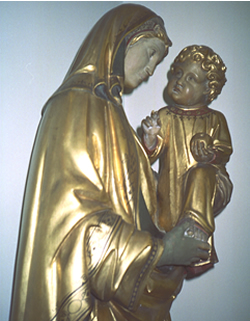
The self-deprecating humour of the Anglo-Catholics was another coping mechanism: deeply serious about the things of God, about the Church and sacraments and prayer – and yet often wildly irreverent about their daily life. The stories are legion: the vicar of a west-end church with a magnificent hanging pyx who remarked to a prospective curate, ‘In this church the Lord lives in a lift’; or the Marian Procession where the statue, dressed in cope, crown and earings was carried past a draughty alley between the houses: and seeing in one’s imagination the servers rushing to recover clothes and jewellery as they were blown down the street. Fr Colin Stephenson’s book, ‘Merrily on High’ contains a life-time of such stories. He has been accused of trivialising the Movement, and if his book were the only history of those days, then there might be some force in the accusation. But we need to balance the nonsense against the devotion, self-discipline, spirituality and hard work of many priests and countless numbers of lay people; and to recognise that the laughter balanced the tears and heart-ache: the froth on the surface with the depths beneath.
The nearest I have come to this humour in English (Roman) Catholic circles is found in the novels of Neil Boyd (Peter de Rosa) ‘Bless me Father’. The television series of the same name, starring Arthur Lowe, is not as funny. Many of the situations could only be familiar to Catholics – and now only to those who remember the Church before the Second Vatican Council. The story I recall is of the poor curate coming down in the morning to discover that his trendy university chaplain friend has celebrated the Mass with his students on the dining room table with a loaf of bread. In those days the Blessed Sacrament was treated with almost fanatical reverence, and in the story we are confronted with the young priest who puts on a stole and uses the vacuum cleaner to gather up what he believes to be the Body of Christ. Remembering his seminary training for the disposal of the Eucharistic species, he then buries the vacuum cleaner in the garden – and brazens it out with the housekeeper who is puzzled by its disappearance from the Presbytery. Of course, this rather risky joke is relieved when, a week later, he receives a thank-you note from the chaplain, explaining that they had a quick breakfast in the diningroom, left early (apologies for the mess we left) and celebrated Mass when they arrived at the pilgrimage church which was their destination.
What place, then, if any, has the tradition of humour now that Anglo-Catholics have entered the fullness of communion? (Is there something here about growing up because we have grown into?) First, there is something peculiarly English about laughing at oneself. It is a tradition which must not be allowed to die. Secular humour claims to be ‘cutting edge’, but this too often means that it is crudely pornographic, needlessly rude to the vulnerable, and yet desperately politically correct. Anglo-Catholic humour was often subversive: and where Christianity is pompous, boring and ignorant it needs to be subverted. Remember Jesus and his wonderful image of the man struggling round with the plank in his eye! The absurd (and bitter) discussions on some internet sites about the length of a maniple fringe need to be subverted – and so does the dreary pontificating of some of the liberals too.
Peter Berger in his book ‘A Rumour of Angels’ suggested humour as one of the pointers to the existence of God. Can anyone imagine heaven without laughter? We are not talking just about a smile, but the laughter of freedom which belongs to the children of God, who rejoice and exult when there is no more crying and pain, when death and fear and sorrow are swallowed up by Life – then we shall laugh for the sheer joy of knowing as we are known.