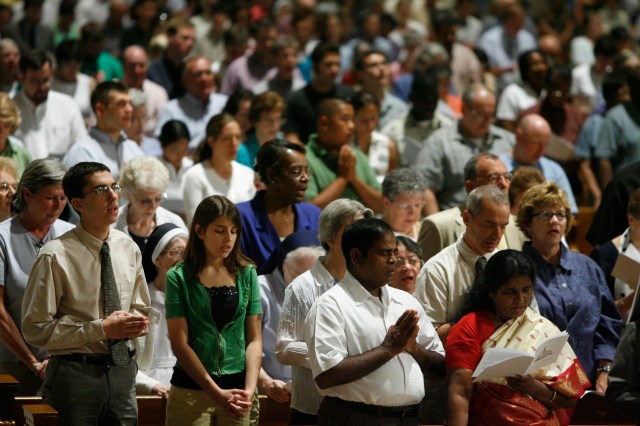
The renewal of worship is central to the life of the whole Church and every individual Christian. In the service of worship the performance of the liturgy with care, devotion, reverence, fine ceremonial and good music – but equally with warmth, passion and loving-care for one’s fellow worshippers – is vital.
_______________________________________________________________________
Day and night they never stopped singing: Holy, Holy, Holy is the Lord God, the Alnighty, who was and is and is to come … the twenty-four elders prostrated themselves before him to worship the One who lives for ever and ever, and threw down their crowns in front of the throne. Apocalypse (Revelation) of John 4:8f (NJB)
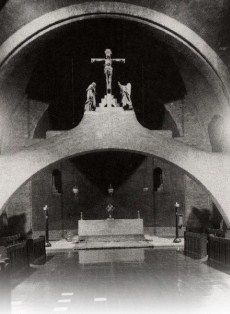
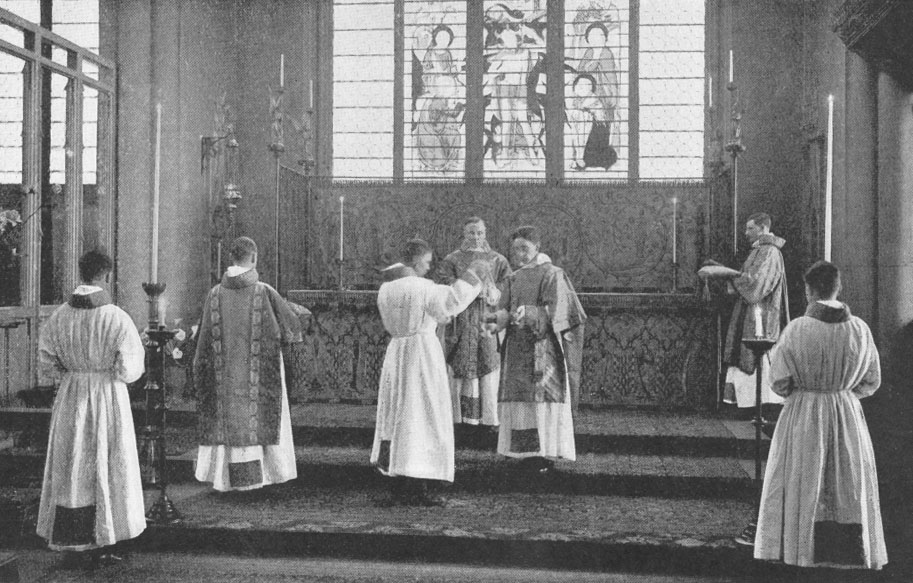
Leafing through my late father’s music copy of the English Hymnal, looking for a tune, I came across the hymn by T.A.Lacey which begins, ‘O faith of England taught of old/by faithful shepherds of the fold/the hallowing of our nation.’ The magnificent 16th century tune (which you can find on youtube at http://www.youtube.com/watch?v=v5L7Vpk1GpA is by Matthaus Greiter and called in English Hymnal ‘Psalm 68’. In a moment I was back forty years, in the Great Chapel of the Kelham Fathers, in Nottinghamshire, taking part in the Procession at the end of first Evensong of Whitsunday (it seems a curious choice of hymn, but I think I’ve remembered the occasion rightly). Processions were always headed by the crucifer and acolytes, wearing albs and apparelled amices (the crucifer in a tunicle) and the thurifer and boat bearer followed, for Kelham followed the English Use.

Great Chapel Kelham
Recently there has been some talk about an English Use in relation to the first ‘Prayer Book’ rites now authorised for the Ordinariate. In the course of this post I want to ask two questions: what is the English Use, and has it any place in the thinking and planning of the Ordinariate today?
Prior to King Henry VIII’s break with Rome, it was the latin rite of the Roman Church which was in use throughout England, and at the heart of the Mass was the Roman Canon or Eucharistic Prayer, symbolising the communion of the local diocese with the Bishop of Rome. The various Uses differed in things like liturgical colours and points of ceremonial during the celebrations.
The instructions for ceremonial in the Prayer Books of Edward VI and Elizabeth I are extremely meagre, and even under the Caroline Bishops there is little that could be said to constitute an English Use. The Holy Table was to be covered with a ‘carpet’ of silk or other material, and a white cloth when the Holy Communion was celebrated. The celebrating priest was to wear the surplice (with the cope retained for use in Cathedrals). True there was the Ornaments Rubric which referred to the second year of King Edward VI as the standard for what was (and was not) to be used in the services of the Church of England. But until the 19th century it was generally held that the Rubric had been superceded.
This was challenged by the Oxford Movement in the 19th century. This Catholic Revival held that the Ornaments Rubric must hold its face value: although it had never been implemented, now was the time to make sure that the Prayer Book liturgies were conducted with all the ceremonial permitted in 1548/9. But while one group of 19th century Anglo-Catholics worked to try and devise an English Use, another thought it was a waste of time. This latter group tried to fit the then current rules of the Sacred Congregation of Rites for the celebration of the Mass to the services of the Prayer Book.
In the late 19th century English Use churches were often rather exotic, spreading rushes and herbs on the sanctuary floor. Much work was done to research and sing mediaeval plainchant, and in the revived gothic architecture, stained glass and rich fabrics, to create an atmosphere of continuity with the Middle Ages. In the early work of (Sir) John Ninian Comper we have the most exquisite examples of the revived mediaeval style, seen perhaps most perfectly in his re-furnishing of the church at Cantley, near Doncaster. The altar provided the prototype for countless ‘English’ altars which were installed up and down the country subsequently. The altar is without shelves or ‘gradines’ and with its two candles and crucifix is low in profile to fit underneath the east window. Posts called ‘riddels’ stand at the four corners and are surmounted by candles. In the roof over the altar is a canopy or ‘tester’ from which hangs the pyx in which the Blessed Sacrament is reserved. (This method of Reservation of the Eucharist was universal in England until the Reformation)
The most significant figure in the development of a characteristic English Use in the Church of England was the Revd Percy Dearmer, who became Vicar of St Mary’s, Primrose Hill, London in 1901. He had already written ‘The Parson’s Handbook’ which sought to clothe the services of the Book of Common Prayer in Catholic Ceremonial, derived from pre-Reformation England. Dearmer was a man of great taste, a poet and musician, with much common sense. (The Parson’s Handbook contains considerable practical wisdom about the design of churches and the care of liturgical furnishings and vestments.) He was also strongly ‘anti-Roman’, with little appreciation of the classical or the baroque in design or architecture, and a loathing for what he regarded as the commercialisation of church art.
Dearmer publicised what became the norms of the English Use: full and flowing vestments instead of the attenuated ‘latin’style; servers wearing albs with the distinctive ‘apparels’ at the neck, cuffs and skirt; long surplices instead of short cottas, and never a trimming of lace on anything or anyone! He lowered sanctuary levels, lengthened altars and would not allow any more than two candles, modest in height. (One of the obvious distinguishing features of a ‘Western Use’ church, was its row of six tall candlesticks often on a gradine, behind the High Altar.) In a reaction against the vivid coloured brickwork of the high Victorian architects, he advocated whitewashing church interiors, as a background for furnishing and richly coloured hangings.

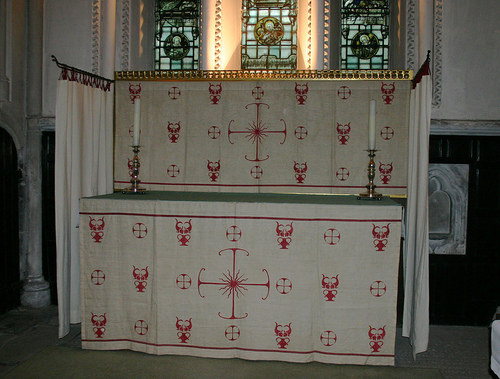
In a striking divergence from the Roman use, altar frontals and hangings in Lent were made of cream unbleached linen marked with the instruments of the Passion in red and black. Statues were covered throughout Lent in veils of the same colour. The practice in newly whitened churches was austere and effective, no doubt.
Dearmer argued his case that his English Use was entirely loyal to the Church of England and its Prayer Book. Thus the Use spread rapidly and was adopted by many of the Cathedrals. It was safe and it was defensible. But unlike Ninian Comper, Dr Dearmer was rather quiet about the place of the Blessed Sacrament which, in its pyx above the High Altar, had been such a centre of devotion in the Middle Ages. Anglican Bishops were at best nervous of, and at worst belligerently opposed to, reservation in Parish Churches.Dearmer would allow no place either for the Elevation of the Host in the Eucharistic Prayer.
To continue then, the authority for such an English Use was, in the end, just Percy Dearmer himself, and he was not averse to using some pretty tenuous arguments for what he liked. (Anglican clergy are good at that!) Later in life he was to become more and more liberal in his theology, advocating the ordination of women and intercommunion with the Free Churches.
In the early years of the 20th century the Liturgical Movement in the Catholic Church was growing in strength and influence. It had received a boost from the reforming papacy of Pope St Pius X, and reflected his concern that the laity should be able to participate in the Mass and other celebrations. Thus began the restoration of the altar as the place of sacrifice and communion, rescuing it from its position as a sideboard to support the tabernacle and Benediction throne. The scholarship of Geoffrey Webb in his book, ‘The Liturgical Altar’ began to influence the design of Catholic sanctuaries in this country.
It is one of those curious paradoxes that, at about the same time, the Anglo-Catholics in England were deriding Dearmer’s work as ‘British Museum Religion’ and installing Baroque furnishings in their churches.
It would be easy to miss the significance of Ninian’s Comper’s developing thought on the altar in the churches he built in his long career as an architect, simply because he continued to use historical styles, Gothic and Classical, often blended with assured beauty.
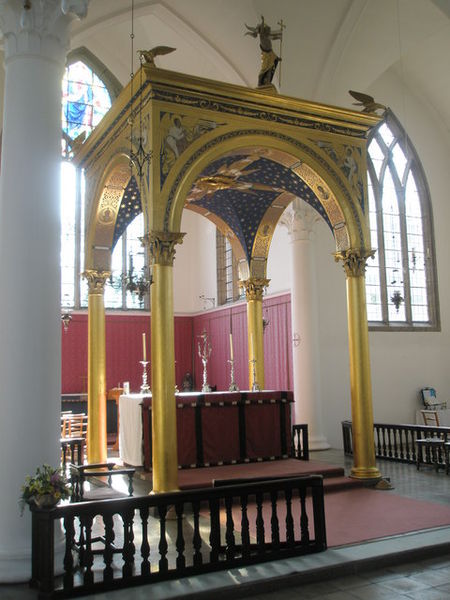
In this picture of St Philip’s Cosham, in Portsmouth, we see that Comper has left behind the English Altar. Now the altar standing stands almost in the centre of the church, and is given significance not by tall candlesticks or towering reredos, but by the use of a baldachino or canopy on pillars. Some believe it to be the most coherent modern church in England. (Compare and contrast the work of Basil Spence in the design of the Cathedral at Coventry.)
As the impact of the liturgical reforms of Vatican II became clear is seemed to many Anglicans the Catholic Church had now taken on board much of what the Reformers had argued for so many years earlier. The liturgy was now in the vernacular, with the full participation of the laity. Vestments were cut in much fuller shape and cottas rivalled surplices in length. With the changes in the Eucharistic rites of the Church of England there seemed to be a real convergence, and ‘Ritual Notes’, the handbook for the Western (Roman) Use was no longer needed: you simply read the introduction to the new (Roman) Missal and then celebrated Series 3 or the Alternative Service Book according to the rubrics.
The liturgical reforms were enthusiastically received by the majority of Anglo-Catholics, certainly by those who were working and praying for reunion with the Holy See. Indeed, it seemed as is attachment to the old ways was greater now among the more liberal elements. Perhaps just one example will suffice: it is quite common still to see in Anglican Cathedrals, the celebrant assisted by a ‘deacon’ and a ‘subdeacon’ . The ‘orthodox’ or ‘traditionalist’ Anglo-Catholics largely gave up this form. In any case priests would usually concelebrate rather than offering a ‘private’ Mass.
We come then to the question of whether an ‘English Use’ can now be devised for former Anglicans, now Catholics, in the Ordinariate (and indeed, whether it should be) . There are those who argue that Anglo-Catholics in England have celebrated the Eucharist perfectly happily for the last forty years according to the current rules and customs of the Roman Catholic Church, in what we now call the Ordinary Form. Perhaps they have done so in a rather more conservative way than among Catholics in England. High Altars have often remained intact, becoming the place of reservation; servers have retained the cassock and cotta, and incense is always used at the principal Mass on Sunday. It is surely this unobtrusive influence which might be valued in the Catholic parishes, for it is, I think, the ‘noble simplicity’ desirable in liturgical worship today.
We are in a missionary situation in England, and we need to get on with evangelism, teaching, pastoral care of our groups, formation of the clergy – good liturgy, certainly, but on the whole we’ve got that and we’ve had it since we embraced cheerfully the liturgical work of the Second Vatican Council. That came to Anglicans like manna from heaven, and I believe we have interpreted it wisely. Please God we shall continue to do so within the full communion of the Church and with the deep assurance that such communion brings us in our life and work in the Ordinariate.
The liturgy involves universality, and this universal character must enter ever anew into everyone’s awareness. Christian liturgy is the worship of the universal temple, which is the Risen Christ. His arms are extended on the Cross in order to draw all men into the embrace of God’s eternal love. It is the worship of heaven opened wide. It is never merely the event of a single community, with its own position in time and space. It is important that every Christian feel and really be inserted into this universal “we”, which provides the foundation and refuge for the “I” in the Body of the Christ, which is the Church.
Pope Benedict XVI
I have tried not to use copyrighted images in this post. If I have please let me know and I will remove them.