A new perspective on the Easter Vigil

Last year I celebrated the liturgies of the Easter Triduum on my own! We were in lockdown, here in France. This year we are in lockdown again, but we can gather in church for worship providing we are careful to observe the necessary precautions. But one of features of the confinement is the curfew: we cannot go out after 7pm. This meant no Vigil during the night of Holy Saturday, and we were advised to celebrate it beginning before dawn on Easter morning.


The immediate cry of the faithful was “too early” but we pressed ahead with the arrangements. I had not attended such a pre-dawn celebration since my days at Kelham, when we had a truncated liturgy without the Mass. I had always defended (as well as enjoying ) the night Vigil – so what would this experience, forced on us by the times we are living in, mean for me?


I was immediately struck by our drive through the dark and silent villages on our way to the other end of this parish. We had simplified the rite as per the instructions and I missed gathering round the large bonfire outside the church, and looking in the gloom across the valley. We proceeded with the Exsultet: after five years I can sing it fairly fluently in french and the words now make a direct impression on me. When we reached the Gloria the bells of the carillon started to ring; I imagine that at least a few of the inhabitants of the village of Long were wondering what on earth was going on. We finished with the hymn “Allez par toute la terre” which repeated the words of the Risen Christ in St Mark’s Gospel, as we came out into the first light of Easter morning.


In spite of the initial reservations 40 people exactly came to the Vigil. (In 2019 there were 55 present at 9pm on Saturday evening). What did surprise me was the number who went home, had breakfast and then came to the 11 am Mass at Pont Rémy. I teased the singers and musicians that they sang better first thing in the morning: certainly, the music was good, and the participation by everyone clear and confident. This, I think, is the result of several years of consistent and straightforward liturgy in which the people are expected to be alert and intelligent – and not treated like children who have to be taught some novelty on every occasion!


The early morning Vigil has a different ethos: it is gentler (more English?) while the night Vigil has great strength and power in it. During Eastertide it will be helpful to hear the reactions of those who took part in this fresh expression of Easter worship.

Posted in Uncategorized | Leave a comment

Were we really Catholics?

Soon after the vote in the General Synod of the Church of England in 1992 to ordain women to the priesthood, a colleague of mine expressed his sense of anger: “Once I was a bitter Catholic; now I am just bitter.” For many laity and clergy in those years after that vote there was to be profound questioning of what they had previously believed about the nature of the Church of England. It was expressed by the late Brian Brindley who said that he felt like a vacuum-cleaner salesman who had discovered that the product he had been selling all his life just didn’t work. Some who went “over to Rome” were quite happy to leave all that they had been and done in the past; others hesitated over the move, believing that to accept Catholic ordination would be to deny what they had previously believed.

Many were helped by the remark of the Pope Benedict XVI, that the Anglicans who had approached him were living the Catholic life, although outside the Catholic Church as defined by the Catechism. Those who sought to be reconciled with the Catholic Church were encouraged to bring the life they had led as Anglicans as a gift to be shared.

Those who have experience of school inspections will perhaps recall the phrase ‘working towards’ – for those who had not achieved a certain level but were on the right path. Increasingly in the second half of the 20th century Anglo-Catholics rejected the ‘Branch Theory’ – that the Catholic Church had three branches, Anglican, Roman and Orthodox. The dynamic move towards Christian unity convinced them that Anglo-Catholicism could not be a ‘party’ within the C of E. Its aim was to identify elements of Catholic belief and practise, and to steer her into fullness of communion with the See of Peter, the rock from which she was hewn.

Would this have been possible? Yes, it would! But as we look back now over nearly 30 years we can see that the C of E stood at the cross roads and had to make a crucial decision. Before it could decide whether or not to admit women to the priesthood, it had to be clear what that priesthood was. But it could not ask that question because it feared the answer. Or rather, the answers: for the C of E had held together three groups who held mutually incompatible doctrines of the ministry. This was most vividly illustrated recently by the ordinand on BBC Radio 4 Sunday worship who spoke of being “ordained a curate” later this year. It appears that this is now the understanding of ordained ministry in the C of E – as we feared after that fateful vote.

Now what of the Ordinariate project? Certainly in England the numbers did not materialise as hoped. At times there were surprises among those who became Catholics and those who did not – not always the people one imagined. The groups were small, and whole or even majority congregations fewer than expected. The Anglican authorities were defensive and not, on the whole, generous; the Catholic authorities (in the UK at least) seemed sometimes not to understand the rationale for the Ordinariate. Yet it has survived, and perhaps most important of all, shown a new path to unity. This has been a real challenge when the unity movement has been largely reduced to a service in January followed by a weak cup of tea. Perhaps the chief difficulty for the Ordinariate in the UK is the unwillingness of so many, both within and without the religious scene, to treat it seriously and to give it that publicity which it needs.

The question of the “Anglican Patrimony” – that gift to be shared with the whole Church – remains a tricky one. The publication of the Divine Worship Missal has led many to concentrate on liturgy, somewhat to the marginalising of spirituality, pastoral practice, the clerical life, preaching and music. In all of these areas there is a rich Anglican heritage. But then it is difficult to develop these areas when so much time and energy has to be spent in the business of survival!

Jesus said, ” unless a grain of wheat falls into the earth and dies, it remains alone; but if it dies, it bears much fruit. ” (John 12,24) These words give me hope for the future.

Posted in Uncategorized | Tagged , , , , | Leave a comment

And after the virus?

I was on the ‘phone recently, one Thursday evening, to some friends in the UK. A few minutes before 9pm they said they had to ring off, as it was time to stand in their front porch and applaud the National Health Service and all its personnel.

Bravo to that say I. Both before and during the crisis we (by which I mean the British) have often spoken of how much we value the Health Service and all who work in it – doctors, nurses, ancillary staff. But we have a problem which is that we don’t want to pay for it. That’s because it’s a ‘service’ and is funded out of taxation, and we don’t vote for any party which might increase taxation. Yet we are prepared to pay phenomenal prices to go to a football match or the opera, or to go on holiday or to a restaurant. We tell ourselves that we ‘need’ all these things, when in fact we ‘want’ them, which is different. That’s where advertising comes in – to convince us, first, that we ‘want’ something (usually with the argument that everyone else is having/doing/enjoying it) and then justifying the ‘wanting’ by turning it into ‘needing’ (which is morally more comforting).

We don’t have advertising campaigns for the National Health Service. From time to time the tabloid newspapers run a sentimental story about our ‘angels’  but you can be sure that, come the next election, their anti-tax campaigns will have ousted stories about health workers.

So what will happen when the pandemic is over, or when we have got used to living with it? Was the Thursday night clapping a sentimental gesture, or will there be real change, which means a change in our values? We human beings in our unregenerate state are selfish. Our present economic system relies on that selfish individualism to maintain itself. Only conversion of heart to the true God who created us and redeemed us, can change the way we live. The Church must call for conversion and grace, not just in individual lives, but in politics and society.

The Church knows (it) to be false – namely man’s competence to save himself. In this respect, the human race is in the same plight as Humpty-Dumpty, whose fall involved a break into fragments, just like that of the human race, which no-one, neither he himself nor even all the King’s horses and all the King’s men, could mend; for man’s only hope of re-integration lies in the act of the One who originally created him. 

Man made schemes such as Communism (‘Workers of the world unite’), National Socialism (‘the solidarity of the race’) Federal Union (‘Nations, get together’) all collapse because of their partiality, the limitation of their scope to men in some particular capacity as class, nation or race and because they ignore the root cause of this disruption, which is sin. 


Fr P McLaughlin of the Church Union, writing in 1944, in a series designed to look forward to the re-building of society after the Second World War. 


Posted in Uncategorized | Leave a comment

The language of the liturgy

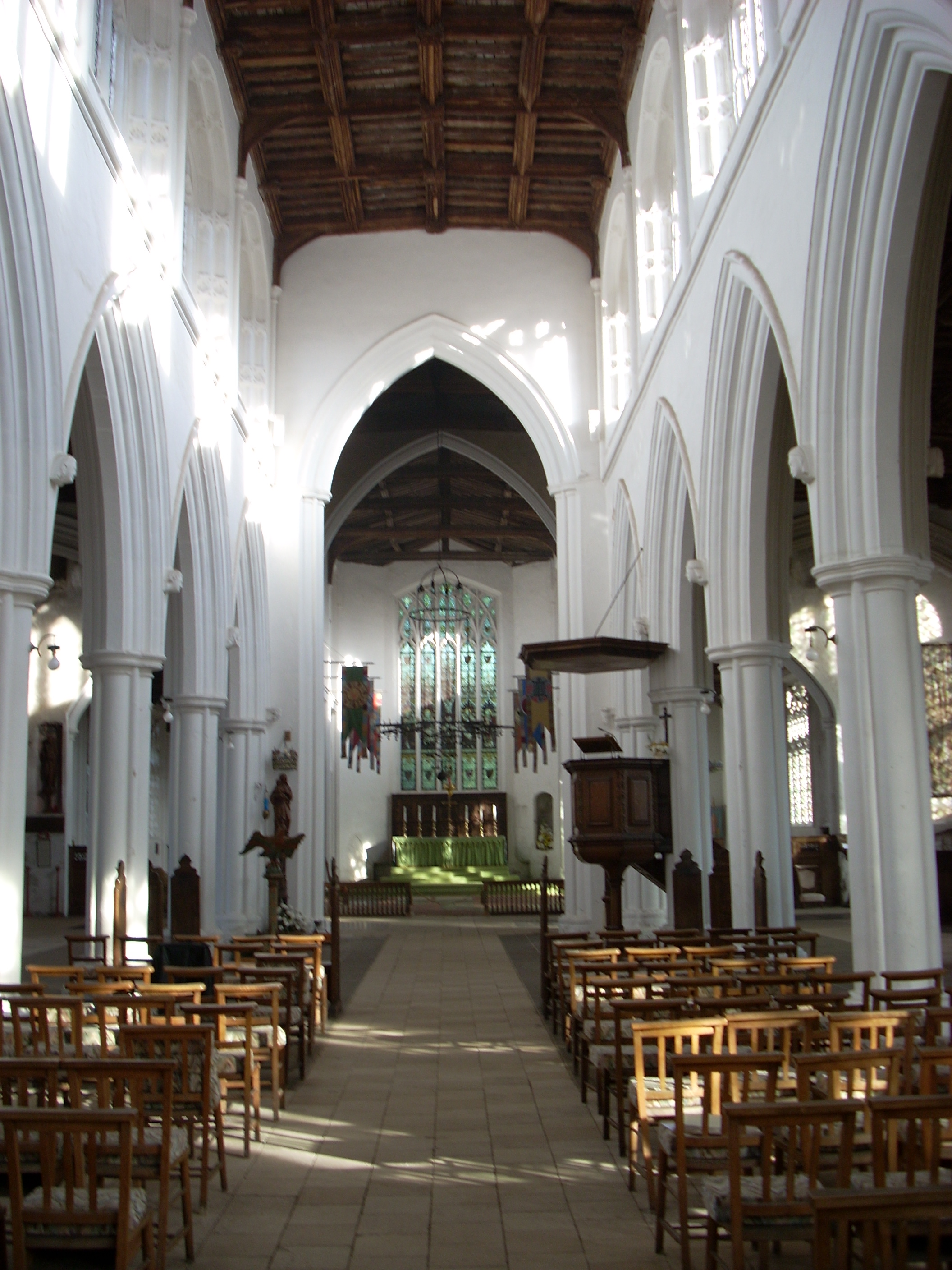
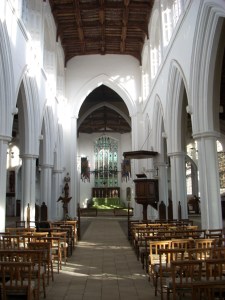
Thaxted Church in Essex

At the Reformation the Catholic Mass emerged from behind the screen and became visible: the Anglican liturgy emerged from behind the screen and became audible.

Compare and contrast, as they used to say in exam papers, the mediaeval building with its long chancel and rood screen, with the classical churches of Rome or the baroque churches of Austria. In the former the liturgy is veiled and distant, the people are almost in another room. In the latter the altar is visible, close, and all the participants are in a single space. In the Anglican buildings from the 16th – 19th century it is the pulpit which dominates often with the reading desk. The word is proclaimed to the people in their pews. From time to time – even every Sunday in  town churches – some will move from their seats to gather round the Holy Table. The  action of the liturgy, which had almost disappeared in the 1552 Prayer Book of Edward VI, is somewhat restored in the 1662 Book where the priest is required to place bread and wine on the Table, and during the Prayer which is now headed Prayer of Consecration, he is to take the bread and break  it, and then to take  the cup of wine. In the Catholic Mass of the post-Reformation period there is considerable (perhaps too much) action, but at the heart of the liturgy the taking-blessing-breaking-giving action remains intact. The gradual withdrawal of the laity from Communion, which began in the mediaeval period, has now become the norm. It takes the concerted action of Pope St Pius X at the beginning of the 20th century to restore this central act of participation to the Mass.
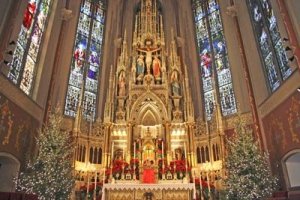
The Gothic Revival in architecture in the 19th century, combined with the Oxford Movement in the C of E,  saw the restoration of the altar, though distanced from the people by the erection of screens and the positioning of the robed choir in the chancel. In spite of the frenetic activity of AWN Pugin, the long chancel and the screen did not return to Catholic worship: indeed, the colossal reredoses and soaring Benediction thrones serve to make the sanctuary more prominent, though sometimes reducing the altar to the appearance of a shelf or sideboard.

So we enter the 20th century with the Liturgical Movement in both the Catholic Church and the Anglican Communion, encouraging the restoration of both the  visual and the  aural,   action and  word, in the worship of the Eucharist. This is realised to some extent in the  Parish Communion Movement in the C of E, though there is a reactionary movement among some Anglo-Catholics copying the then current Catholic practice, and among Evangelical Anglicans who want to return to a Cranmerian doctrine of the Communion Service, and for whom  action  leads inexorably to offering. 

In the liturgical reforms which emanate from the Council, the restored emphasis is on both  action and  word and the full participation of the whole People of God in the worthy offering of the Mass.
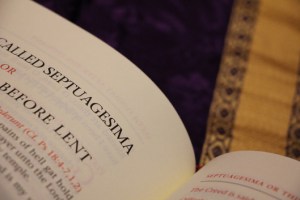
The Ordinariate liturgy stands within the liturgical and theological context of the Ordinary Form of the Roman Rite. In its celebration therefore, the active participation of all the people is to be clearly seen. From the theological emphasis of the English Reformation comes its insistence on the proclamation and preaching of the Word of God in scripture.

Fr Herbert McCabe, writing in 1964, said, “The actual Scriptures ceased to be thought of as a nourishment for Catholics, and they substituted books of Christian doctrine. It did not seem to them scandalous or even particularly surprising that the Epistle and Gospel at Mass should be read in an inaudible manner in a foreign language by someone standing with his back to them – it is all right because soon he will turn round and tell us quite audibly about the catechism and the second collection. ” (The New Creation – Herbert McCabe OP p.14)

The ‘proclamation’ of the Ordinariate liturgy in a careful, articulate, thoughtful and coherent manner is all the more important because it uses Tudor English, with words and grammar which are not immediately obvious to our generation. Speaking too quickly, mumbling, emphasis on the wrong words all detract from the one of the fundamental principles of the liturgical patrimony of Anglicanism, clearly included and incorporated in  Divine Worship. 

It will not be easy, that is clear. We live in an age when the English language, because of its wide use across the world, is subject to uncontrolled change. Unlike the French, we have no  Académie to direct the evolution of the language. To suggest that some new words, phrases and grammatical constructions have debased and spoiled the language are greeted with hoots of laughter and cries of ‘elitism’. The truth is worse still: that many of these words and phrases are designed to hide the real meaning or to cover up the fact that the speaker does not know what he is talking about!

Divine Worship  is not perfect. It includes ‘sublime’ Cranmer (the Collect for Advent Sunday), ‘heavy’ Cranmer (the Confession at Mass) and sometimes the sort of latinate translations so wickedly parodied by Fr Harry Williams CR in his autobiography. But nonetheless, when it is used it deserves to be ‘proclaimed’, as far as the words of the liturgy are concerned, with clarity, simplicity and even a certain elegance; but always with the intention that it shall be ‘Pastoral Liturgy” – that the people may be enabled to worship worthily and to grow in the faith.



Posted in Uncategorized | Leave a comment

Can you teach an old priest new tricks?

Yes, you can!  My sister and her husband in England suggested that we might put my new acquired competence with Skype to spiritual use. So today the three of us recited the Office of Lauds on Skype. Slight problem with synchronising – quite took me back to Kelham days when we used to sing the Psalms back and forth across the choir with a long pause in the middle of each verse. I used to wonder whether, one day, no-one would come in for the second half. It never happened, and a sort of grunt from Fr Alfred was the usual prompt. When Fr Robin Ward was my colleague at Willesden Green he taught me to recite  the Breviary Office like that.  Most people nowadays seem to say the psalms with the 4-line stanzas, and no pauses, and don’t know what the asterisks and daggers denote.

Posted in Uncategorized | Tagged , , | Leave a comment

Holy Mass from the Divine Worship Missal (the background)

    I imagine that many of us during the confinement will have set ourselves a task or project. I have several, including learning to say the Ordinariate Use of the Mass. Perhaps you are surprised by this, but I have very little opportunity to celebrate this rite. In France I am not able to – it is the Ordinary Form in French, and in the UK it is only on those Sundays when I help out at Warwick Street. But with public celebration of the Mass suspended here, so that all Masses are private (or solitary) I am able to say Mass in English and according to the Ordinariate Use.

Some may ask whether I will have anything useful to say. I am not in an Ordinariate Parish and I have no group. But perhaps I am able to stand back a little, to reflect both on the theory and practise of this rite, and to be critical in the proper sense of that word.

In 2015 Pope Francis promulgated  Divine Worship: The Missal for the celebration of the Mass in the Ordinariate communities of England, Australia and North America. In his 2017 presentation to the Liturgical Institute of Mundeline, Mgr Steven Lopes, the American Ordinary spoke of Divine Worship as a distinct form of the Roman Rite, situated within the context of the Ordinary Form, not the Extraordinary Form, bringing in to Catholic worship something of the liturgical patrimony of Anglicanism developed during the years of separation, “so as to maintain the liturgical, spiritual and pastoral traditions of the Anglican Communion, as a precious gift nourishing the faith of the members of the Ordinariate and as a treasure to be shared.” (Anglicanorum Coetibus article 3) . 

The Ordinariate Missal was I think, received with more enthusiasm in the States than in England, and it is important to understand why. By many English Anglo-Catholics of the 19th and 20th century the Book of Common Prayer was regarded, to put it bluntly, as a Protestant liturgy imposed by the monarch and parliament on the National Church. Appeal to the Prayer Book had enabled the Evangelical wing of the C of E to exclude the notion of the Eucharistic offering and prayer for the dead in all revisions of the Prayer Book. In other parts of the Anglican Communion, synodically governed and not by law established, their particular version of the Book of Common Prayer had a much more Catholic feel to it. In the States in particular the American Prayer Book in its traditional language form became a symbol of doctrinal orthodoxy.

Nonetheless, it was the decision of the Anglicanae Traditiones Commission to adopt traditional (thee/thou form) English, and many Prayer Book texts to form the basis of Divine Worship. New liturgical texts were not to be devised, but material from the Anglican liturgical books recast and re-directed for the use of those groups now in full communion with the Catholic Church.  There was also the significant decision to include material from the English and Anglican Missals.  First published about 1910 the English Missal was widely used until the 1960’s. Much of the 1662 Book of Common Prayer was there, with translations from latin of material to supplement it, for example for saints days. The Order of Mass was based on the custom of saying aloud the Prayer of Consecration but preceding and following it by the Roman Canon in English of Latin. When I went to St Margaret’s Leytonstone in the 1970’s, our retired priest, Fr Wilfrid Leeds, who had been Fr Hope Patten’s curate at Walsingham before the shrine was built, said Mass in this way. As the choir began to sing the Sanctus so Fr Leeds would begin the Canon quietly. Aloud he would then continue with the Prayer of Consecration, but after the elevation of the chalice there would be a long silence for the second half of the Canon, before he sang ‘throughout all ages, world without end’. The vicar and I used the so-called Interim Rite, as St Margaret’s at the time had not changed over to the newly published Roman Missal in English. The use of this Roman Missal became standard practise among English  Anglo-Catholics, largely on the grounds that here was in fact what the English Missal had always set out to be – an authorised English translation of the Roman Rite. The fact that it was not authorised by the C of E was another matter!

The Anglican Missal was published by the Society of St Peter and St Paul (SSPP) after the First World War. It took for its Eucharist the 1549 rite (the First English Prayer Book) but surrounded it with the ceremonial, vestments and furnishings of the ‘Back to Baroque’ Movement, which was intended as a counterblast to the mediaevalism of the ‘English Use’ Movement which was transforming parish churches and Cathedrals up and down the country. Its illustrations were drawn by the architect and designer Martin Travers, and his ‘Illustrations of the English Liturgy’ might be taken as a companion volume to show the ideal celebration of the Mass according to the SSPP and its followers.

There is yet another strand in this development and that is the work of the considerable number of Prayer Book Catholics. Loyalty to the Book of Common Prayer was important to them; they held to the ‘branch theory’ which proposed that (Roman) Catholicism, Anglicanism and the Orthodox East form branches of the One Catholic Church; they maintained that the Prayer Book Communion service was the Eucharist of the Church and not a ‘Lutheran ordinance’. Their Missal was in fact the 1662 Book with some provision of a minor character for Saints Days. Such a Missal was ‘Altar Services’ published by Rivingtons, together a companion volume with the Epistles and Gospels bound together – a Lectionary as we would understand it today.

Unfortunately,  this group  is sometimes characterised (and dismissed) as proto-liberal. In fact they were largely orthodox (as was much of the C of E at that time) though independent in theology and liturgy and with a strong sense of Anglican and English tradition. Their liturgical influence is significant for us, I think, for the work of this group in the parish churches and cathedrals has been far more obvious than, say, that of the SSPP. What Pope Benedict in his visit to the UK saw in the service at Westminster Abbey was a quality of the Anglican liturgical tradition developed from  scholarly research, tested in many parishes, linked with a powerful pastoral tradition and allied with a musical and aesthetic movement which flourished in the first half of the 20th century.

In subsequent posts I will try to comment upon the texts of  Divine Worship that is, the Rite, as it has been given to us – then the ceremonial or action of the Liturgy – and finally its presentation by means of vesture, ornaments, buildings and furnishings.


Posted in Uncategorized | Tagged , , , , | Leave a comment

Geoffrey Kirk

Yes, I was always a bit scared of Geoffrey. I had no reason to be as he was always attentive and charming. The first real personal contact I had with him happened like this. I had noticed the growing use of the word ‘Church’ without the definite article – as in ‘New ways of being Church’ – and it puzzled me. Where had it come from? So I ‘phoned Geoffrey. “Give me half-an-hour” said he. Sure enough,  on time, he rang me back; questions answered and references given.

There was closer contact to come when I moved to become vicar of the neighbouring parish of St Mary, Lewisham. That parish, like St Stephen’s, had passed the resolutions AB & C, and so came under the jurisdiction of John Broadhurst, the Bishop of Fulham. Only a handful of parishes in the Anglican diocese of Southwark had passed these resolutions and in doing so had angered and annoyed the then Bishop, Tom Butler. For Southwark regarded itself as the flagship diocese of the C of E, shattering stained glass ceilings and boldly going where no woman had gone before. In the midst of centralism and intolerance, Geoffrey was a beacon of light.

In those testing but remarkable days we looked forward to the arrival of New Directions and the antics of Archdeacon Armitage Shanks. Geoffrey was merciless in exposing the New Thinking sweeping across the C of E as little more than the Old Heresy in different clothes. Some thought him cruel in what he wrote. Looking back, we had few other weapons. The promises made of two integrities and mutual flourishing were as thin as the paper they were written on. At least in Southwark diocese there was no charm offensive!

With the ordination of women bishops at the behest of Parliament which threatened disestablishment if the C of E did not conform, the way ahead for Anglo-Catholics became clear. Geoffrey was received into the Church, but his health was already giving cause for concern, and he was not ordained. In more tolerant days one could have imagined him in his later years in a Cathedral Close, an examining chaplain perhaps to the Bishop of Barchester, terrorising the younger clergy with his insistence that words should mean what they say.

Journey home, Geoffrey, aided by many prayers said and masses offered. Our world will be duller and narrower without you.

Posted in Uncategorized | Tagged , , , , , | Leave a comment

Shall we learn again to pray for the dead?

In the aftermath of the First World War, with so many young men dead, and their bodies lost for ever in some foreign field, the British learned again to pray for the dead.

“Now when the bells for Eucharist  Sound in the Market Square, 

With sunshine struggling through the mist  And Sunday in the air. 

The veil between her and her dead  Dissolves and shows them clear. 

The Consecration Prayer is said  And all of them are near.” 

These words of the Poet Laureate, John Betjeman (1906 – 1984) sum up the belief of many an Anglican as prayer for the departed became again part of the restored heritage of the National Church. It is true that Cranmer and the Protestant Reformers did their best to exclude such prayer from the liturgy and devotion of the English. Perhaps the mediaeval cult of the dead had lost something of its assurance in the mercy of God and of the victory of Jesus Christ over sin and death of which St Paul talks most powerfully. (I Corinthians 15, Romans 6). Nonetheless, the abolition of prayer for the dead struck at the heart of people’s consciousness of the communion of saints, of the community of earth and heaven linked above all in the celebration of the Mass. It  led inevitably to the weakening of belief in the world to come, and ultimately to the widespread secularism of our generation.

The overwhelming sense of loss of the First World War saw many people  turn to spiritualism and the occult. The Prayer Book of 1662 provided nothing to meet this crisis of grief.

How quickly we forget. The widespread loss of faith from the 1960’s onwards led to a curious forgetfulness of the dead. Unable to face the awfulness of atheism and say, ‘You’re dead and that’s it’, many have turned to the ‘Celebration of Life’ funeral. Expressions like “They live on in our hearts and minds” have become commonplace. It’s another way of saying  “You will go on thinking about X, and they will be warm memories, until inevitably they fade.”


At the same time, as the National Church, proceeded with the revision of its liturgy, the Evangelicals started a renewed attack on the practice of prayer for the dead. Unable to see the damage that the Reformers had done, they forced the  exclusion of any explicit prayer for the dead from the official services. The liberals simply went with the flow, and have continued to do so, so that I recently heard an Anglican cleric remark that the inability of people to attend funerals during the period of social distancing would lead to a lot of parties when it was over!

Sadly, the Catholic Church contributed to this too. The desire to escape from the funeral (and funereal) style and thinking of pre-Council Catholicism led to funerals in white and  eulogies instead of homilies. When I mentioned Purgatory recently in the homily, I was told “we don’t believe in that nowadays”.  Most Catholics, I suspect, are universalists, and Judgement sounds distinctly old-fashioned!

Here in France the dire shortage of clergy led to the formation some 25 years ago of teams of lay people who lead funerals.  Their commitment to this ministry, their pastoral care of the bereaved and their careful preparation and conduct of funerals is marvellous.  About a year ago I started to look with our parish team at the liturgy, and at the commentaries which they prepare and give on the Gospel reading chosen by the family. In my opinion as we have it here in France  the funeral liturgy concentrates too much on the bereaved family as its first aim, and not on the prayer for the departed person.  This has lead to the team preparing commentaries in which the life of the person takes up much of the time allowed, with a nod at the end to show how their manner of life (sadly nowadays often with little connection with the Church) really was in accordance with the Lord’s command to ‘love thy neighbour’. The shortage of priests has broken the connection between the dead and the Eucharist, so profoundly and movingly expressed by Monica, mother of Augustine of Hippo as she prepared for her death.

“Bury my body wherever you will; let not care of it cause you any concern. One things only I ask you, that you remember me at the altar of the Lord wherever you may be.”

When we return to normal (whatever that new normal will be) there are going to be a lot of grieving people, who have been deprived by the virus of the funeral rites for the person they loved. Actually, that process of deprivation has been going on for much longer, in the poverty-stricken ‘Services of Thanksgiving’ which we have trotted out with all their feeble theology. Those who pray for the dead place their hope firmly in the Resurrection of Jesus Christ – which is God’s final word, the victory of life over death. This is the Good News and we have no right – and no need – to water it down.


And, by the way, can anyone direct me to a French translation of Newman’s ‘Dream of Gerontius’ so that I can convince my parishioner of the beauty, love and wisdom of Purgatory?


Posted in Uncategorized | 2 Comments

Everyone’s entitled to their own opinion – aren’t they?

Poor old Eamonn Holmes! Got it in the neck for some comments  on his morning TV show  about baseless conspiracy theories which link the coronavirus outbreak to 5G technology. OFCOM received 419 complaints from viewers after he said  the media shouldn’t dismiss claims that 5G is spreading Covid-19 — despite the fact that such rumours have been widely debunked by scientists and public health authorities.

“What I don’t accept is mainstream media immediately slapping that down as not true when they don’t know it’s not true,” Holmes claimed Monday on the popular ITV breakfast show “This Morning.”

Yet it seems to me that what Holmes was doing was protecting the unquestionable belief of people today that “Everyone’s entitled to their own opinion.”

Some years ago when I was vicar of a London parish, 2 am on Sunday morning I was awakened by booming music from our Parish Hall. Hurrying round I eventually located the host and made my complaint, pointing out that the contract she had signed required the Hall to be cleared by 11.30 pm. “But this music is my culture” she replied, and before I could point out that early morning sleep was part of the culture of our neighbours, she retorted, “So you’re saying that I’m not entitled to my culture, are you?”

“My opinion” “my culture” – all part of the unassailable ‘rights’ of each individual. And what happens when they contradict the facts, or interfere with someone else’s rights? Well, they mustn’t! After all “Truth, what is that? as Pontius Pilate remarked. And anyway, my truth might not be your truth.

So perhaps poor Eamonn Holmes will be rebuked – and not rebuked; and maybe even sacked – and not sacked. Who knows?

Posted in Uncategorized | Leave a comment

Extended Communion – a new take

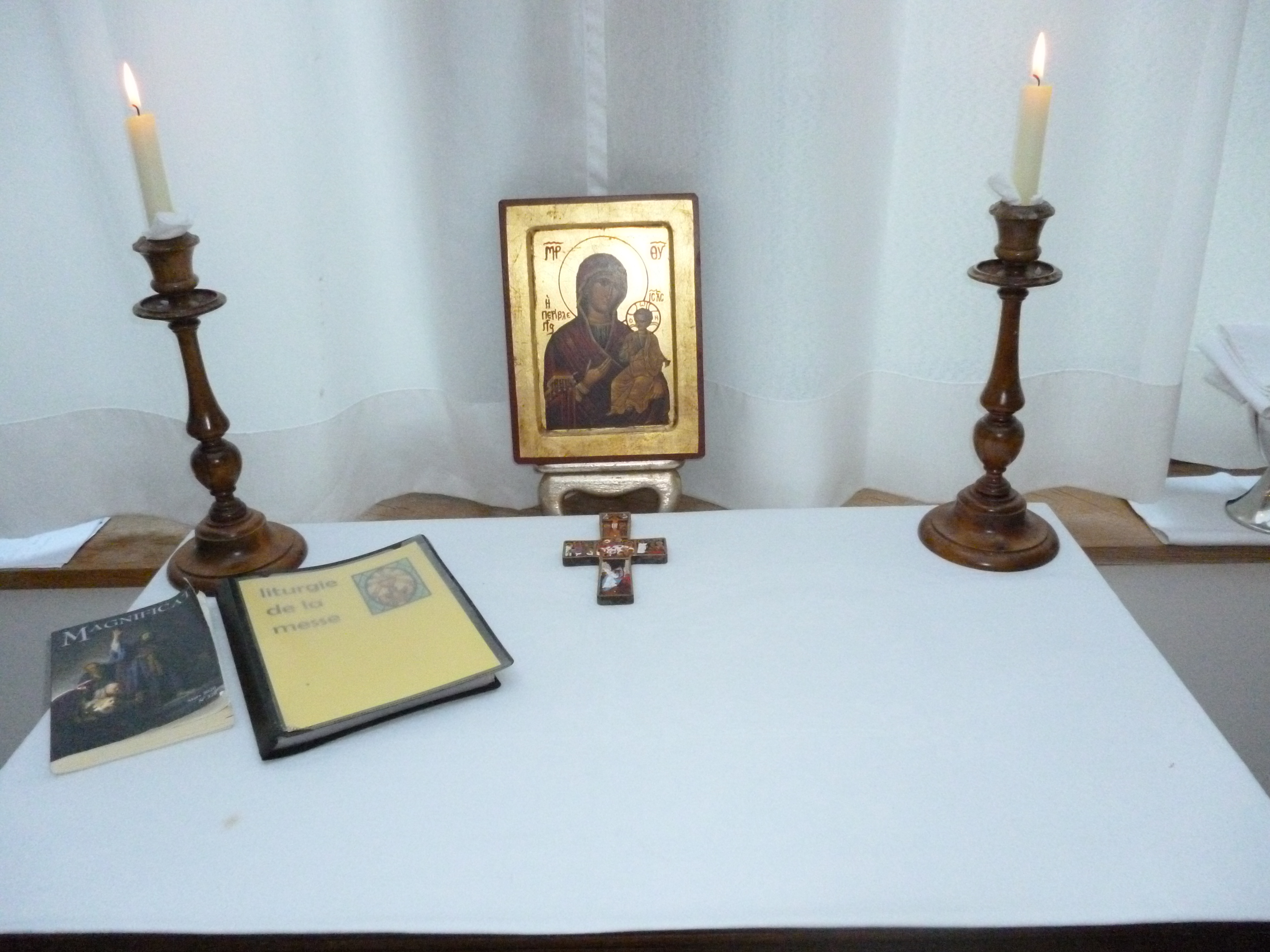
Temporary altar in my house

I remember the frustration of Anglo-Catholics some years ago when the General Synod decided to tackle the issue of ‘extended Communion’. For the best part of 100 years an increasing number of parishes had been ‘reserving’ the Sacrament, so that it might be taken to the sick and housebound: increasing to such an extent that Liverpool (Anglican) Cathedral – once a bastion of Protestantism – had installed a safe for reservation in one of its side-chapels. Naturally, the place of reservation became also a place of prayer. But no, such was the intransigence of the Evangelicals (lovely people, devout Christians, but still fighting Reformation battles) and their fear that some of us might engage in idolatrous bread-worship that ‘extended Communion’ had to be timidly presented to the Synod.

Yet how wonderful has been the tabernacle, and with it the worship of Christ present in the Host, which is now sustaining us in these times when the public celebration of the Mass is not possible.

Here am I: send me

Thank goodness, the churches are able to be opened here in France. Perhaps, in spite of the separation of Church and State, there is a recognition here of the need of people to come into the presence of the Lord Jesus. The Catholic instinct has been shown to be spot on in this time of confinement.

Easter morning, just three of (all of us well apart) in the church at Pont Rémy. A family came in and sat apart. After Benediction as I returned to the tabernacle they burst into a  song of praise, harmonising, singing most beautifully.

Thus Communion, narrowly interpreted as receiving the consecrated Bread and Wine, is extended and becomes Communion at the deepest level with the Lord himself, in prayer and worship, thus feeding us with the life of the Saviour, even during this time of Eucharistic fast.

Posted in Uncategorized | Tagged , , , , | Leave a comment