Studies in Holiness: Lincoln Stanhope Wainwright

Father Wainwright (1847-1929) lived and died a member of the Church of England. Had it been otherwise, he would perhaps have been canonised and known as ‘The English Cure d’Ars’. He ministered as curate and then vicar of St Peter’s, Wapping, when the Docks of East London were at their height – and the living conditions of the dockers and their families at their most fearsome.
Evelyn Underhill, herself one of the most remarkable Anglican spiritual guides of the 20th century, wrote this appreciation of Fr Wainwright, in the Spectator.


In 1873, a dapper young clergyman, very correctly dressed, with well-brushed hat and black kid gloves, arrived at the Clergy House of St Peter’s London Docks. Fifty-six years later, on a bed as poor and comfortless as any ascetic could desire, a little old man lay dead in his bare and carpetless room; and in the words of one of his children, “Dockland was washed with tears,” because this tiny but indomitable figure, shabby, untiring, spendthrift of love, would not serve them on earth any more.
There are two ruling factors in all the varied types of Christian holiness. One is the great stream of tradition which rises in the New Testament, and in which all these lives are bathed. To that tradition, each adds something; and from it each takes inspiration, formation, power. The other factor is the social life within which the saint emerges; with its special incitements to heroic virtue, its special demands and needs. Thus the world of the sixth century asked for just what St Benedict gave it; it was to the intellectual turmoil of the thirteenth that St Thomas sacrificed his career; the world of the Counter-Reformation gave St Ignatius his peculiar call. But the demand and the response may also be found in their perfection within a narrower sphere. St Vincent de Paul is nowhere closer to his pattern that in the slums of Paris; hunting the rubbish heaps for abandoned babies, and serving poverty in its most repulsive disguises with reverent love. The Cure d’Ars fulfils his vocation in an obscure French village and among the simplest souls. Perhaps it was the inspiring force of these two lives, with their self-spending passion for the sinful and the abject which – more than any other factor – determined Father Wainwright’s particular place in the communion of saints. For in them he saw radiant charity triumphing in an environment very like his own.


Nineteenth century Dockland was not conspicuously above the standards of seventeenth century Paris; nor were its inhabitants much more promising material than the peasants of Ars. It was for this very reason that they made their overwhelming appeal. He served them for over half a century, without holidays and always in a poverty of life very near their own. The blankets from his bed had a way of disappearing; several times he gave away the shirt he was wearing … Yet his life was not so deliberately, as inevitably austere….
Every day developed naturally from its invariable beginning; a long period of rapt devotion before the altar, which nothing but an urgent summons to the dying was allowed to interrupt. The morning was usually absorbed by letters and interviews with the growing crowd who brought him their difficulties and sorrows. The afternoon was given to the visiting of the sick, always one of his chief cares. He went with an untiring zest from house to house and hospital to hospital, often those in distant parts of London which had patients from among his flock; and slept in the train between his visits to make up for the shortness of his nights … the sick, the destitute, the outcasts and the sinful had always the first claim on his time and love; direct personal contacts with individuals, unlimited self-spending in their interests, was pastoral methods he thoroughly understood. He was always ready to leave the ninety-nine good churchgoers and start single-handed to rescue one lost sheep.
There was much that was mediaeval in his outlook and the realistic temper of his religious life; and he would have been completely at home among those English mystics who wore printed above their hearts the Holy Name … But a sweet little smile and gentle manner hid an iron will where the essentials of the faith and practice were concerned, for he remained loyal to the strict Tractarian tradition within which his vocation had developed and made few concessions to modern ideas… his character and his presence did more for the true social salvation of Dockland than all the forces of law and order and social reform. He found an all-lit, insanitary, largely lawless area; where policemen went in couples and no-one’s property was safe. With the entire fearlessness of a person whose life in not his own, he went at all hours through its worst alleys, intervened in street rows, fraternized with the roughest inhabitants, and attracted children who formed his constant bodyguard. At first he was ridiculed, then tolerate, then liked; at last, universally loved and revered.
And this was achieved by a person without striking qualities of intellect or manner, and with none of the “extraordinary” gifts so commonly attributed to saints. He was an inarticulate preacher; people came to his sermons not so much to listen as to look at his face and be in his atmosphere. In practical matters his judgement, from a worldly point of view, was not always sound. But a compassion that was more than human seemed to reach out through his spirit from beyond the world, and move among derelict men as one that serveth.
For there is a kind of sanctity in which human love and pity are transfused and transmuted into a channel of the Celestial Charity itself: and it was Fr. Wainwright’s entire self-giving to that holy Energy which sent him out as its agent to the hospital and the slum. In his old age it was said of that fiery little soldier, St Ignatius, that “he seemed to have become all love.” The power which operated that transformation is still at work within the world of men.

Posted in Uncategorized | 2 Comments

‘Songs of Praise’ does it again!

Surely a trailer for ‘The Moral Maze’? But no – there it was in the ‘Sunday Telegraph’ guide to Radio and Television (Sunday 2 August 2015):

Songs of Praise A woman who acted as a surrogate
mother for her sister

I almost wish I had been in time to watch the programme just to see what hymns go with such a theme!

Posted in Uncategorized | Tagged , , , , , | 2 Comments

‘Song of Praise’ and the faith of Christians

My caller last Sunday evening was not angry but rather puzzled. “Have you watched ‘Songs of Praise’ this evening?” I explained that it was not something I often watched these days. My caller continued: “The theme was marriage, and after interviewing a young couple, they went to Scotland. There was a service being conducted by a Bishop but the couple were both men. When they interviewed the Bishop he said that he was glad to be offering marriage to gay couples … ”

The first time I took part in Songs of Praise was in 1974 when it was broadcast from St Wilfrid’s, Harrogate, in Yorkshire. The large nave was entirely filled with choirs from all the churches in Harrogate. The choir of St Wilfrid’s sang ‘Thee we adore, O hidden Saviour thee’ which is the English version of Thomas Aquinas’ ‘Adoro te devote’ – a hymn to the Blessed Sacrament. This was quite strong stuff for ‘Songs of Praise’, and I remember that the presenter recited those words of Queen Elizabeth 1 “Christ’s were the words that spake it” as an ‘explanation’ of the Eucharist which we could all agree on!

The second occasion when I participated in ‘Songs of Praise’ was in 1991, this time in an outdoor broadcast from Rathbone Street Market in Canning Town. In fact little of the market remained, because of the decision to drive the A13 directly through what had been one of the longest street markets in Europe. We began with a hymn specially written to the theme-tune of ‘Eastenders’ and sang ‘Shine Jesus shine’ and another song of which I can only remember the chorus which went
“nothing – nothing – absolutely nothing – nothing is impossible to thee-ee”

At the time I felt that a Protestant/Pentecostal takeover of the event had invented a mythical Christian East End to parallel the curious presentation of its life paraded by ‘EastEnders’. Moreover, it almost completely airbrushed from history the proud contribution of Anglo-Catholicism to East London over 100 years, represented by the great Dock churches, and its hugely influential religious community, the Society of the Divine Compassion, with its saintly founder, Fr Andrew Hardy. Nor shall I forget one of our women deacons patiently but firmly explaining that she was not wearing ‘robes’ (which had been ‘forbidden’) but the everyday working gear (the cassock!) of an Anglican cleric.

Last Sunday’s edition of ‘S of P’ raises for me a number of questions. I had assumed that the programme had remained firmly in the hands of the Evangelicals, but it would seem that the liberals are now back in the driving seat. It is less than a year ago that Parliament re-defined marriage, in the face of opposition from Catholics, Anglicans and the majority of the Free Churches. One is aware, of course, that there is a liberal minority – within the C of E and some of the Free Churches – which accepts this re-definition, and is willing to run with it. Nonetheless, one has to ask whether it is appropriate for Songs of Praise to ‘celebrate’ the new definition of marriage, in a Christian programme, even though the new ‘marriage’ is opposed by the huge majority of Christians worldwide.

Posted in Uncategorized | 1 Comment

A possible way into the Ordinariate liturgy

Like many former English Anglican clergy of my generation I grew up at a time of liturgical change. I can still recite by heart some of the liturgy of the 1662 Book of Common Prayer which I learnt as a child. By the time I went to Theological College we were moving through Series 2 (different ‘shape’ but traditional language) to Series 3 (modern ‘you’ form English). I was taught to celebrate the Anglican Eucharist in conformity, as far as possible, with the rubrics of the 1970 missal, and I recited the Divine Office with its 5-fold daily pattern. Even when, as an incumbent in the C of E, I felt obliged to use authorised forms, I stretched this to include the four-fold daily office published by the Society of St Francis (the Anglican Franciscans) as I found the provision of only two, albeit substantial, services a day to be inadequate.

As for language, I had never been a particular lover of the 16th century English is which the Book of Common Prayer is written. And although I thought the 1980 Alternative Service Book rather ‘thin’ in its language, I admired the attempts (often successful in my opinion) in Common Worship to develop a rich and resonant liturgical language. If only its theology of the Eucharist and the life of the world to come had been as good! But that, as they say, is history.

One of the features of the Ordinariate has been the compiling of a distinctive liturgy, as part of the family of Roman rites. The decision was made early on to use traditional English (in the thee/thou form) and to include prayers written or translated by Archbishop Cranmer, and the Psalter of Miles Coverdale. There have been some Ordinariate congregations who have found this liturgy to be exactly what they want and need, and others who have not. But we have been encouraged to use these forms, and they are part – though my no means the only part – of our patrimony, our inheritance as Anglicans who have been reconciled into the wider Church. How might a former Anglican find his or her way into the Ordinariate liturgy, without just abandoning the way of praying which has become spiritually ingrained. I came up with an idea while at Douai Abbey on retreat.

There the monastic community uses a five-fold Office, but continues to sing latin Vespers from the old Breviary every day. And that is what I am trying with Evensong i.e. The Divine Office for Readings, Lauds, Prayer during the Day, and Compline – but Evensong in place of Vespers. It is permitted to use the four week psalm-cycle of the Divine Office in the Ordinariate Office, in the Coverdale version, and the New Testament Canticle(s) in place of the Nunc Dimittis which is part of Compline. The advantages of this pattern are not insignificant. For a retired priest two Offices plus the Mass means a substantial start to the morning, and Evensong with two Scripture Readings, Creed and Collects in addition to psalms and Canticles, provides a fuller time of prayer in the evening, while still leaving Compline as night prayer on going to bed. In addition it is compatible with the rest of the Daily Office. Disadvantages? You need several books instead of one, which makes it impossible to say the Evensong while travelling. But here the internet is invaluable, and it is not difficult to down-load psalms and collects – in fact most of the variables. Yes, it means loose-leaf-folder liturgy, but in this time of change that is unavoidable.

Posted in Uncategorized | Tagged , , , | Leave a comment

How the liturgy bridges the centuries

I had the privilege of presiding at Mass today in the Catholic Church where my sister and brother-in-law belong; the Parish Priest is on holiday at the moment. We celebrated the First Martyrs of the Church at Rome, honouring those who gave their lives in the bloody persecution of the Emperor Nero in 64 AD. I used the Roman Canon (Eucharistic Prayer 1) which is less familiar perhaps  to modern Catholics than Prayers 2 & 3. It is long, but those of us who were there had come to pray and worship – and it was a lovely day. It has two lists of saints all connected with the early years of the Faith in Rome, and the Prayer as a whole demands of the Celebrant careful and attentive articulation if it is not to sound rushed and incomprehensible. But prayed quietly and thoughtfully, by people and priest, it takes one back to those early years and to the brave people who chose an awful death rather than deny the Lord Jesus Christ. Among my most special moments I include serving a Mass in the crypt of St Peter’s, Rome, where the priest used the Roman Canon. Now that was something else, as they say.

Posted in Uncategorized | Leave a comment

Catholic – or Christian?

Week of Prayer logo

Last week I stopped off, mid-morning, to have a cup of coffee in Wimbledon. The cheerful waitress asked me if I was a Catholic priest. Then she went on to tell me that she was a Catholic, but her friend had said that she needed to become a Christian and get baptised. I explained that she was already a Christian, and (whatever else she might have needed in the way of sacraments) she had already been baptised, and only once was possible.

She seemed puzzled by my assertion that Catholic and Christian were not opposites. I simplified. ‘Everyone who follows Jesus Christ is a Christian. The majority are Catholic Christians, in the East there are mainly Orthodox Christians, and some are called Protestant Christians.’ I went on, ‘I expect you know that all Muslims are followers of Mohammad, but some are Sunni Muslims and some are Shia Muslims.’ Yes, indeed, she had heard of this and so she grasped the answer to her Catholic/Christian question.

But I was left with a nagging resentment, not against the waitress’ friend, but against whoever had taught her that Catholics were not Christians. For such people have claimed the name Christian as exclusively theirs. No doubt they and I would disagree over significant parts of the Faith, including some of its fundamentals. As Protestant Christians they would maintain that I had added things which were not in the Bible. As a Catholic Christian I would maintain that they had arbitrarily cut out parts of the Bible they didn’t like, and were ignoring 2,000 years of Christian history during which the Holy Spirit had been very active. What I would not and could not do is deny that they are Christians, if they believe in God the Trinity, have been baptised in the three-fold name of God, and are sincerely trying to live the Christian Way.

So, please my Christian brothers and sisters, let us have no more of this. And coming at this story from a completely different angle, does it not prove the value of the clerical collar. Without it my cheerful waitress would never have engaged me in this discussion. My French friends who recently complained to me about ‘invisible clergy’ surely have a point.

Posted in Uncategorized | Tagged , , , , | 10 Comments

Religious education – or running scared?

When I was at Grammar School in the 1960’s the demolition of Christianity had already started. Assemblies were perfunctory – a hymn, a Bible reading, and a couple of prayers. There was one period of Religious Education for every class, often ‘single-sex’ while the other half of the class was doing P.E. For text books we had a set of dog-eared Authorised Version Bibles – and that was it. The Head of Sixth Form regularly ran down Christianity, telling anti-religious jokes, mocking the RE teacher and predicting the demise of the Faith within fifty years.

In the 1960’s the new liberal establishment, especially the media and celebrities,  decided that it had had enough of the Christian religion, and subjected it to mockery, stereotyping, and endless criticism. The multi-faith agenda was promoted in schools and local councils, not because the establishment was in the least interested in other religions as an alternative to Christianity, but because it was a way of bashing the Church. So the pathetic teaching of the Christian Faith was replaced in schools by the ignorant and uninformed teaching of ‘other faiths’.  As a youngster I knew that the school brand of Christianity had little in common with the faith and life of the Church which I was coming to know and love. And my guess is that young Muslims, Hindus, Sikhs and Jews feel much the same about the way their faith is approached in school.

Charles Clarke, former Education Secretary, was interviewed on the Today programme this morning (15 June 2015). He made a number of fascinating statements, asserting that religion is very important for many people in our country today; that the quality of Religious Education in schools is not good, and teachers are not properly informed; that RE is helpful in encouraging people to respect and honour religious belief. But all of these things were have been true for the last fifty years. So why the sudden interest in RE now?

There were two remarks that were especially significant, I thought. The first was that, among the people he had been talking to, Mr Clarke had found several ‘Church of England bishops’ who were keen on an ‘inclusive’ approach including in worship and prayer. Is this really so, or is it an example of  the good old C of E being cajoled into adopting the ‘British values’ which politicians are always now talking about, but have so far failed to identify. His second significant point, was that it was important to have RE teachers who could teach what religion is, and what it is not. I think he means that teachers would assert that, for example,  Islam does not condone violence against other people, and that therefore ISIL is not true to Islam. But can someone who is not a believer really talk, as it were, from within, about the reality of religious belief? And if a class of year 9, say, have a discussion about ‘gay marriage’ will the Jewish or Catholic or Muslim position be described as homophobic by other students, or by the teacher, and how will parents react when their children go home and repeat what was said?

Just how far will this new RE go? When the C of E General Synod turned down proposals to allow women to be bishops, Members of Parliament expressed their outrage at such ‘inequality’. Will there now be pressure on the Muslim Council to introduce women imams? And most Catholic adoption agencies were closed when they indicated that they could not, in conscience, place children with same-sex couples. Are orthodox Jews going to have to face the same choice? The secular establishment has got used to bullying the Church into conformity, but is it now willing to use the same techniques with other faiths? All the signs are that it is not, and that it is desperately looking for other ways.

In fact it has been largely indifferent to ‘immigrant’ religions while such groups have been small and insignificant, while using them to remove the perceived ‘privileges’ of Christianity. Like my Head of Sixth Form, they  swallowed the lie that the Christian Faith was rapidly dying out, and assumed that all other religions would quickly follow them, as people realised just how much happier and fulfilled they were with  secularism. The experiment has been a dismal failure. A new generation is looking for something better to live by.  It  amazes me that  the secular establishment, having worked for fifty years  to destroy our Christian culture and  belief,  is  surprised at the weird and dangerous philosophies which are attracting the naïve and inexperienced.


Posted in Uncategorized | Tagged , , , , , , , , , | 2 Comments

Catholic attitudes on abortion

Since my  Catholic ordination I have said Mass on a regular basis for the Good Counsel Network, which promotes Catholic pro-life teaching , and gives practical and emotional support to couples and single mothers choosing not to abort an unplanned pregnancy.

Yesterday I went to join them for two hours of prayer outside a London abortion clinic where they are holding a Novena (nine days) vigil. I found it a disturbing experience, and I came away with even greater respect for those (many of them young) who struggle against the abortion culture which is now almost unquestioned as a ‘right’ in British society.

This particular clinic is situated in one of London’s smartest suburbs, in a street of large houses. There is nothing to identify the purpose of the clinic, unless you understand ‘BPAS’ as British Pregnancy Advisory Service on the notice at the entrance gate.  One of the Good Counsel workers stood not far from the gate, and offered a leaflet to everyone entering; in some cases she had a quiet discussion. I was on the opposite side of the road, for most of the time praying the rosary. My first ‘encounter’ was when a smartly dressed woman (who was not going in to the clinic) called out at me that I should have brought a picnic as I was obviously settling in! By and large people passed us without a second glance, until a woman in her 40’s, I guess, approached me and the priest who had now joined us. She demanded to know where we were from and why we were  cluttering a residential street with all our stuff. (A modest picture of Our Lady of Guadalupe, a folding stool for me to sit on and ease my back, and a bag!) When the other priest reminded her of the place of quiet protest in our democratic society, she continued her objections on the grounds that we were ‘Americanising’ the whole business. She declared herself to be a practising Catholic, and was especially angry at the suggestion that we would want to witness outside a ghetto where, for example, Jewish people were being put to death, and yet we must apparently not protest at the abortions going on inside the clinic.

I was stunned that a Catholic lay-woman could be more willing to protest to her local Council about clutter on the pavement, than about the presence of an abortion clinic in her road. But as I realise now the consciences of the huge majority of us have become blunted to what goes on so discretely. And yet it would be unthinkable for someone at a dinner party to announce, ‘I was in hospital last week, just day surgery for an abortion.’  And when a few days ago a new and much safer test for Downs Syndrome during pregnancy was announced, the BBC newsreader did not say, ‘thus making the abortion of the foetus much more certain’. Most people know deep within themselves that it should not happen: that it is wrong.

Government statistics tell us that in 2013 there were just over 185,000 abortions in the UK. That is a shocking number, and future generations will look back in horror at how we could have let this happen: only by closing our eyes, hurrying past the clinics, and refusing to discuss it. No wonder people get so cross with Catholics for daring to continue their quiet but insistent opposition. The phrase ‘back-street abortions’ was used to condemn a society which refused to admit that something nasty as termination of pregnancy went on in our midst. Has anything changed?

Posted in Uncategorized | Tagged , , , , , , , , , | Leave a comment

Another model for Ordinariate life and mission

In the early days of the Ordinariate I tried to identify some ‘models’ which might be appropriate for groups with their pastors. My initial experience was of the ‘church-planting’ model, successfully applied at the Most Precious Blood at Borough in South London. With the agreement of the Bishop and the Ordinary, the Ordinariate priest became Parish Priest to a congregation facing closure became of dwindling numbers. With an enthusiastic and committed Ordinariate group of laity new life was rapidly injected into the parish.

Over Easter I had the joy and privilege of assisting the Hemel Hempstead Ordinariate group, presiding over the liturgies of Palm Sunday and the Triduum, through to Easter Sunday. The Group drew together about the same number of laity as at Most Precious Blood, Borough, and formerly from several different Anglican churches. They have made their home in one of the four Hemel Hempstead Catholic parishes, which are now joined together and served by two Diocesan priests and a deacon.  The Ordinariate group has been without its own priest for a year, though is hopeful that this situation will change soon. In the meantime the group has maintained its own Sunday Mass  (at 9 or 8.45 am) with a rota of Ordinariate priests. The Group uses only the Ordinary Form of the Mass.

The church used by the Ordinariate is small and modern. With 40-50 people at the 8.45 am Mass it looks half-full, rather than half-empty! The Mass is sung, with a variety of music led by a competent organist and singers – and the people sing. There is a team of servers, and incense. They expect to be engaged by the preaching. Coffee is served in one of the school-rooms, with much of the group business being conducted, as well as pastoral care and chatter.

The Ordinariate priest, as and when he comes, will be welcomed by the clergy team. He is, after all, another Catholic priest! Depending on his age, and his other ministerial commitments, he will negotiate his Ordinariate and parish duties: the Group has already been doing this, and the process is a little more complicated than it would be in other models, where the Ordinariate has its own church, or where the Ordinariate priest is parish priest. Over the Triduum, for example, there was just a single liturgy each day (i.e. no separate Ordinariate provision) but the lay teams from Parish and Ordinariate took it in turns to serve/choose and provide music etc.

Of course, there is potential for disagreement and even resentment!  ‘We’ve always done it this way’ springs very quickly to the lips of any group feeling even mildly challenged. But the potential for renewal and growth is much greater. The challenge for the Ordinariate group, it seems to me, is to value its heritage, its distinctiveness, but to see this as a special contribution which it makes to the future of the whole Catholic Mission in Hemel Hempstead. And the challenge for the parish? To welcome, encourage and use these people whose Catholic journey has been so different from their own – and perhaps to ask themselves what these new people find so wonderful about a Faith they sometimes take for granted.

Posted in Uncategorized | Tagged , , , , , | 2 Comments

The Sunday worship of the People of God

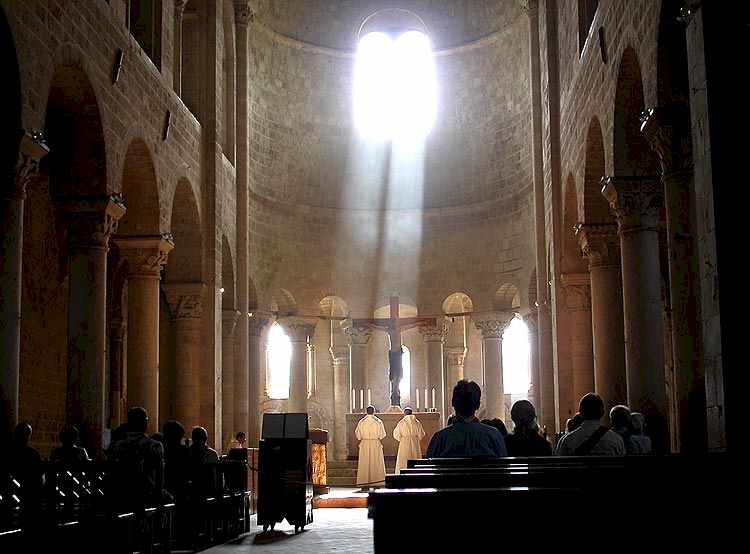
I went recently to Sunday Mass outside London: a modern church, a congregation of about a hundred, and a relatively new parish priest; three hymns (two ‘trad’ and one ‘mod’) and the Kyrie, Gloria and Agnus sung to the simple chants of the new missal, led by a small group of singers at the back; a carefully worked out homily  for which the children were asked to come and sit at the sanctuary step with the celebrant, and there took place a form of catechising, question and answer, with the adults being drawn in to the instruction as it proceeded; an unhurried feel to the Mass, with the prayers read carefully and thoughtfully, and the people joining in without rushing; the sanctuary simple (it was Lent) some nice iron candlesticks by the altar and heavy woven vestments of a very full shape.


mass in france


Spectacular? No. Just good Sunday worship, with care taken about every part of it and full use of the simple resources available.  Above all, the sense that the liturgy belonged to everyone, and that the priest was not dominating it by chattering, or by making things up as he went along.  Perhaps this is the new spirit to the liturgy which is now developing among us.


Posted in Uncategorized | 2 Comments