St Agatha Portsmouth
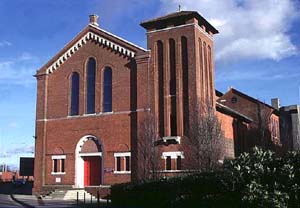
Exterior
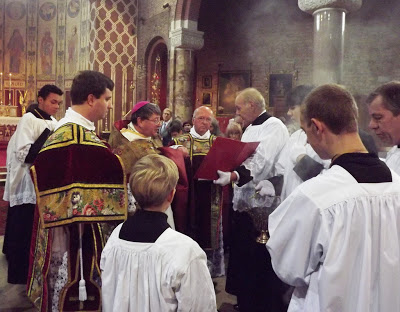
An invitation from my family to join them for the day took me down last Saturday to Portsmouth. St Agatha’s Church were celebrating their Patronal Festival, and I was interested to see how the Ordinariate Use might be presented. St Agatha’s, Landport, is part of that now fading Anglo-Catholic history on which many of my generation were brought up and inspired. Father Robert Dolling had the church built in the dock slums of Portsmouth, but eventually resigned over a dispute with his Bishop concerning prayer for the dead. Indeed, the Abbot of Farnbrough who was the preacher, referred to this in a thoughtful sermon. He pointed out to us that this and other controversies within the Church of England are only now seen to be resolved when Anglicans return to fullness of Communion with the Bishop of Rome. The priest and congregation at St Agatha’s have done this via a time as a ‘Continuing Church’ i.e. those Anglicans who left the Anglican Communion in protest at the growing liberal stance of parts of the Communion, notably America.
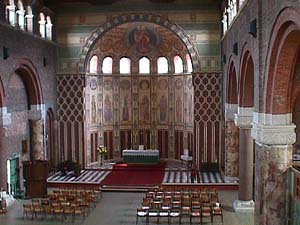
The church building itself was closed after the Second World War, as the parish it served had been largely destroyed in the bombing of Portsmouth. Converted into a naval store, it was more recently recognised for the architectural gem that it is. A trust was set up to restore it, and the Ordinariate congregation meets there for Sunday and weekdays Masses. I last saw the building some twenty five years ago, and the restoration has been impressive. The interior is dark and austere, a brick basilica with a wide and open sanctuary. The murals around the apse by Heywood Sumner are particularly fine, and are very visible without the baldachino (which must have been very splendid).

St Agatha Portsmouth
Interior
The use of the Ordinariate form in St Agatha’s has been described as ‘the Extraordinary form in English’. My interest then, was to see how this was worked out, in contrast to our own practise at Most Precious Blood, Borough, where the Ordinariate Use (Thursday evening’s) is based on the Ordinary form of the Roman Mass. The Mass was celebrated by three priests – a celebrant, deacon and subdeacon, and there were two laymen who also wore dalmatics (but not stoles or maniples) one of whom carried the processional cross and the other sat with the Abbot.
St Agatha Portsmouth
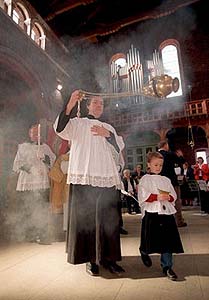
Procession
Like the Procession at the beginning of the Mass this owed rather more to English mediaeval ceremonial than to the Roman Rite. Nonetheless, the High Altar with its numerous candlesticks, the lace albs and birettas, and the heavily embroidered vestments gave the feel of 19th century Anglo-Catholicism, rather than 18th century Belgium or France. The Mass Rite was the Ordinariate Use, with the ministers and servers saying the Preparatory Prayers before the altar while the choir sang. The Mass setting was Mozart’s Credo Mass (with orchestra) and all the movements including the Creed were sung by the choir. After the Blessing the Last Gospel was read by the Celebrant, followed by the Angelus, Salve Regina and Prayer for the Conversion of England. The First Reading (or Epistle) was sung facing the people, and a procession for the Gospel went into the nave (not facing north as in the EF). The Mass was long (five minutes short of two hours) even though some time was saved by the Celebrant beginning the Eucharistic Prayer (Roman Canon) while the Sanctus was being sung. One notable departure from the Extraordinary Form was the recital of the Institution Narrative in a clear voice for all to hear.
I present this description of the Ordinariate Use celebrated in this particular way for comparison: you might like to read my earlier post of our practice at Most Precious Blood.
St Agatha Portsmouth
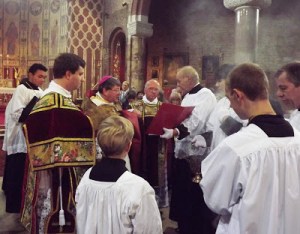
Visit of the Ordinary

About Scott Anderson
Formerly an Anglican priest (ordained 1975) I was received into the Catholic Church in February 2012, and ordained to the Diaconate on 27th July 2013 and on 29th October 2013 was ordained to the priesthood by the Archbishop of Southwark Peter Smith. After a spell in London (Precious Blood, Borough) I became parish priest of Pont Rémy in the Diocese of Amiens, northern France.
I am deeply committed to the Ordinariate as a gift of the Holy Spirit in the search for unity. Like many Ordinariate members I feel a personal gratitude to the late Pope Benedict, together with loyalty to our Holy Father, Pope Leo. My blog tries to make a small contribution to the growth of the Ordinariate by asking questions (and proposing some answers) about the 'Anglican Patrimony'.
I shall be ever grateful for the years in France, a wonderful ending to the years of parish ministry. Back in the UK I am attached, very happily, to the parish of Holy Trinity, Dorchester (HTD) and help out where needed in the Catholic parishes of South Dorset.




That looks like home to me. Pity I am several hundred miles from my nearest Ordinariate parish — but a joy that there is a regular EF mass with decent music within half an hour.
Ah, happy memories of long ago, I wish I’d been there. But realistically, suitable only for “high days and holidays”. There is however an approach to the Liturgy that can be applied to the “ordinary” Sunday Parish Mass to make it more dignified that it sometimes is.
Pingback: Examples of Anglican Patrimony in the Personal Ordinariate of Our Lady of Walsingham, Part 15 – A very “English” celebration of the Ordinariate Use Mass in its English Missal inspired form | Ordinariate Expats
Pingback: St Agatha’s- all are welcome | St Agatha's Ordinariate Group