
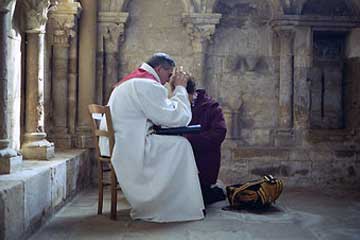
When around the age of 14 I discovered Anglo-Catholicism I made my first Confession within a couple of months. It did not occur to me that this sacrament was any more optional to my Christian life than, say, going to Mass on Sunday.
When I was training with the Kelham Fathers, I imagine that every student went to Confession. Then, as now, the ‘seal’ of the confessional was taken very seriously. My chaplain, summoning me at the end of the first term to see how I was getting on, engaged in this fascinating exchange which I have never forgotten.
‘Are you a penitent, old boy?’ ‘Yes, Father.’
‘Have you been to confession this term?’ Yes Father, three times.’
‘Have you a regular confessor?’ Yes, Father – you.’
Years later, I was talking with our local Elim Pentecostal Minister (we had a mutual love of motorcycles) about the Sacrament. He asked me if I was really sure that nothing I said to a fellow priest got back to – the Bishop, for example. I assured him that this just did not happen, and that I was able to be open and honest with my confessor – no matter who he was. Our Pentecostal minister expressed his wonder (and his approval, I think) that such trust and confidence could exist between us.
Yet, over my years as an Anglican I often found blank ignorance about going to Confession, and more and more, a rejection of the Sacrament as ‘un-Anglican’. Yet like many priests of my generation I continued to require it as part of preparation for Confirmation. Indeed, I used to write in red in the Register, where the Bishop could see it, ‘All candidates have made their first Confession.’
When I was sent a short biography of one of my predecessors at St Mary’s Lewisham, I was delighted to read of his misgivings (circa 1910) at the number of parishioners who were pressing him to hear their confession on a regular basis. This gave the lie to the ‘Establishment’ belief that it was being pressed on the laity as a sort of ‘clerical control’ method.
Abraham Colfe who had been vicar of Lewisham in the 17th century was friendly with Adrian de Saravia, and I found this fascinating account of Saravia’s ministry to the famous Richard Hooker:
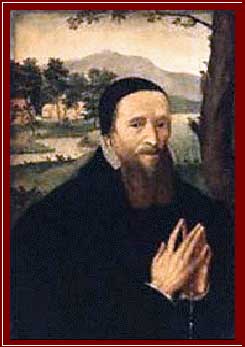
Richard Hooker
About one day before his (i.e. Hooker’s) death, Dr Saravia who knew the very secrets of his soul (for they were supposed to be confessors to each other) came to him, and after a conference of the benefit, the necessity, and safety of the Church’s absolution, it was resolved that the doctor should give him both that and the Sacrament the day following. To which end, the doctor came, and after a short retirement and privacy, the two returned to the company; and then the doctor gave him and some of those friends which were with him, the Blessed Sacrament of the body and blood of our Lord Jesus. (quoted in Baverstock and Hole The truth about the Prayer Book)

 Ordinariate Pilgrim
Confession is one of the Sacraments that so many non Catholics understand and which needs a great deal of explanation. For me, it is the one thing that people bring up more than most about our faith.
As an aside, I know Kelham well – my family link, if you can call it that, is that my parents were married by an SSM Priest.