
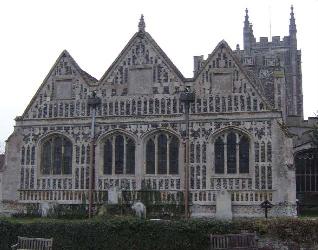
The Lady Chapel (Clopton Chantry) at Long Melford
I was at St Joseph’s, Weymouth, for All Souls’ Day, and I am indebted to Fr Stephen Geddes, the parish priest of Weymouth, for this reminiscence. He recalled that in the ‘old days’ the one of the three masses was offered for the Pope’s intentions. In England this intention was always for the souls of those who had been deprived of masses and prayers for the dead at the time of the Reformation.
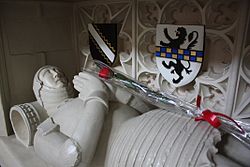
The Clopton Chantry at Long Melford, Suffolk
Anyone looking around a mediaeval church of any size in this country will have noticed the chapels built on to the original structure. This has nothing to do with the need to accommodate a small village population for these chapels were ‘chantries’ provided with altars where Mass was celebrated for the dead: either individuals or collectively in the guilds. The chantries were ‘endowed’ with sufficient funds to pay the stipend of a priest, who was responsible for the daily offering of the Holy Sacrifice for the departed donors. Over the years the chantries were given plate and vestments, and the endowments increased by gifts of land and rents. While some chantry priests were wealthy and indolent, it is also true that many more – not being parish priests – provided schools, and taught the local children. In my own former parish of St Mary Lewisham, the school collapsed with the closure of the chantry and the loss of its priest/schoolmaster. Thus the local children went untaught until the refounding of the school by Abraham Colfe, Vicar of Lewisham, some one hundred years later. This school still exists as Colfe’s, though the buildings are now not far away at Lee.In 1545 (under Henry VIII) and 1547 (under his son Edward VI) Chantry Acts abolished the Chantries and disbursed their endowments, lands and buildings to those favoured by the King – or for the replenishing of royal funds depleted by war.

Illustration by Martin Travers
Mediaeval men and women would have been puzzled by the expression so often heard on radio and television when speaking of someone who has died: ‘sadly no longer with us.’ Their world was peopled not only by the living but by the dead too. Earth, purgatory and heaven were close, and nowhere more so than in the celebration of the Mass. Our mediaeval ancestors had no easy assurance that when they died they were ‘going to a better place’. The rich particularly were deeply concerned, as they grew older, with their eternal salvation. Their wills provided for the poor, for hospital and alms houses. Those who had enjoyed this world’s riches and its comforts sought to avoid the fate of the rich man in the parable of Dives and Lazarus. But knowing that in purgatory they could do nothing for themselves, the aristocracy and the nobility provided for the offering of the Mass and the prayers of the faithful after their deaths.
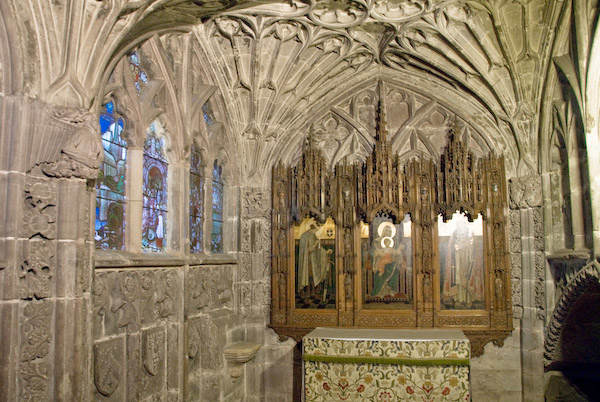
The Stanford Chantry at Hereford
Further down the social scale, men and women bound themselves together, contributing to the provision of Masses and prayers. The Bidding of the Bedes (a form of the modern Prayer of the Faithful) at the High Mass on Sunday was of importance, for it included the names of the departed. Each Guild kept its Bede-Roll in which were entered the names of departed members, so that they could be prayed for on the anniversary of death, and at All Souls-tide.
The shock in every parish community at the abolition of the chantries – and Archbishop Cranmer’s liturgical reforms which abolished prayer for the dead altogether in 1552 – cannot be underestimated. For centuries the living and the dead had been bound together in prayer and worship. With such prayer abolished, the dead disappeared from the remembrance of the living. The faithful in this world might no longer pray for the forgiveness of the departed, and very soon any notion that the dead need such forgiveness disappears, too. Their memorials now list their good deeds, with the implication that God will wish to reward them for their virtue. Death becomes but an extension of the English class system, in which the wealthy still come out on top! How different from the mediaeval understanding. And how clearly we see now that the abolition of the dead from the consciousness of the living, leads inevitably to the abolition of God himself from the lives of the English.
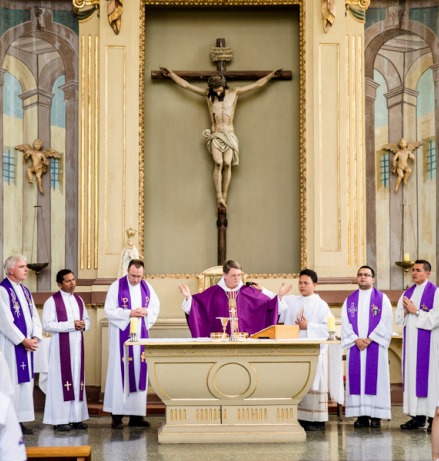
The Church’s offering for the living & the departed
The recovery of prayer for the dead was one of the first – and among the most controversial – acts of the Oxford Movement. The Guild of All Souls is the oldest of the ‘Catholic Societies’. And in the aftermath of the ‘War to end all wars’ prayer for the dead became an accepted part of the Anglican practice. Except that this never really happened. The Evangelicals managed to exclude such prayers from the Eucharistic revision called ‘Series 2’ and even in the funeral rites, weakly worded prayers are still to be found only in an appendix. Thus the funeral becomes a service of prayer for the mourners, to which may be attached a panegyric listing the good deeds of the departed. We are but one step from the ‘Celebration of the life of X’ which is the normal way today of marking the ‘passing away’ of our friends and family.
Perhaps the Ordinariate might take on this concern for those who were deprived of their right to prayer after their death by the Reformation. Is it happening already? Many of us older priests in the Ordinariate have no altar of our own (as have parish priests) and are perhaps concelebrating most days at our local church. We have the privilege of (con)celebrating each Mass with our own intention, and perhaps some interested lay-people might investigate the local chantries and bede-rolls, and we might begin again to offer the Mass for them. In this way history comes alive again and we link our present Catholic life in the community with those who went before us. As we have been glad to re-enter Catholic Communion, so by our prayers and offerings for the dead we are able to put right another of the wrongs of the Reformation in our country.

 Ordinariate Pilgrim
Long Melford! Spent several happy summers there as Kentwell recreators and Lady Hyde Parker (Sister ?) was very kind to my children
(1533 1569 1610 and we did 1569 again in 1996)