The Revd Paul Benfield, writing in the Ordinariate Portal magazine, comments thus on the current reorganisation of the Anglican diocese of Sheffield:
” … the Diocese of Sheffield is to have four
further Associate Archdeacon Transition Enablers to
work with two existing ones. The diocesan website
informs us that:
These are innovative and transformational roles
aimed at leading and supporting … twinned
Deaneries through a period of transition. The
intention is to create a collaborative context that
enables Deaneries, Parishes and Mission Areas to
embrace significant change. Full-time Associate
Archdeacons will work with flexibility, ingenuity
and imagination to grow teams of lay and
ordained leaders in shaping a mission-focused
church.
The role of the Associate Archdeacon is to work
in partnership with the Bishops, Archdeacons,
Parish Support Team, Area Deans, Oversight
Ministers, Focal Ministry Teams, Lay Leaders,
and all the baptised members of the diocese of
Sheffield, to help realise the Diocesan strategy
to be a flourishing and generous Diocese of
Sheffield by 2025: Renewed, Released and
Rejuvenated!
This is of particular interest to me, since I was ordained as an Anglican in 1974 to a parish in Sheffield Diocese. The parish of Parson Cross became something of a cause célèbre for its successful evangelistic strategy in an area not before or since associated with such success in the C of E. Moreover, I have recently been in touch with some Sheffield Anglicans who are becoming concerned about what is happening there. It had been my intention for some time to write about the experience of Anglo-Catholic evangelism in the 70’s, and perhaps some comparison with the current experiments might not go amiss.
The parish of Parson Cross on the north edge of the city of Sheffield had been established when the estate was built between the wars. With a population of 42,000 it was reckoned to be the largest conventional parish in England. The parish had been staffed by the Kelham Fathers, but after their withdrawal, a married vicar and curate had struggled with this colossal parish and its three churches. In the late 1960’s a team of five clergy and one lay member of the Company of Mission Priests established itself in the rambling clergy house (the former Kelham priory) under the leadership of the late Fr Derek Gibbs (himself an old student of Kelham). The evangelistic thrust of parish life was clear right from the beginning with a simple but demanding commitment expected of Church members. Every year in preparation for the Patronal Feast of St Cecilia the clergy visited those on the electoral roll to renew his or her Rule of Life. During this time the large majority of people made their Confession.
The numbers rose steadily: I was there as a curate from 1974 – 1977 and on a average Sunday 200 people made their Communion. There was a noticeably high proportion of men – indeed at the weekday masses the congregation might consist entirely of men who had come straight from work in the steel mills. A great feature of the parish was the Social Club. Several years of hard fund-raising (no grants to my knowledge) provided a modern hall, bar and lounge, open every night of the week with social events at the weekend. Here the Church met the Parish – in a place familiar to the local people, clergy and church members socialised with their friends – a began to explore the deeper questions which began to arise. The annual Confirmation provided an opportunity for witness and commitment: local people were proud of the parish and belonging to it. Fr Gibbs prepared a large adult class with teaching which was deeply biblical and made real demands.
What was the role of the Bishop in all this? In terms of policy I guess he had little input: he was a pragmatist in believing that if it worked, if people were being brought to Christ, he would support it. But it was essentially a local initiative, and it went against the grain for its neighbours. And yes, there was a good deal of disapproval from the diocese at large. Our practice of Mass attendance and Confession annoyed both the liberals and evangelicals: our opposition to the Anglican Methodist Reunion Scheme and the growing feminist movement in the C of E meant that we were not supposed to grow the way we did. Today the Parish Church of St Cecilia is closed and demolished, the parish left with one daughter church and combined with its neighbour. No Anglican clergy live on the estate.
Faced with tiny congregations, worried laity and indifferent parishioners, the Anglican diocese of Sheffield is certainly working at its plan to reverse this trend. Here is a quote from its website,
The role of the Associate Archdeacon is to work
in partnership with the Bishops, Archdeacons,
Parish Support Team, Area Deans, Oversight
Ministers, Focal Ministry Teams, Lay Leaders,
and all the baptised members of the diocese of
Sheffield, to help realise the Diocesan strategy
to be a flourishing and generous Diocese of
Sheffield by 2025: Renewed, Released and
Rejuvenated!
The contrast with what we did at Parson Cross is obvious: this is a top-down plan, the initiative of the Diocesan Bishop and staff, a plan to appoint many more people at management level while cutting posts at the parish level, eye-watering amounts of money spent on re-organisation. What is going on at a deeper level? Well, what’s in a name? It’s easy to dismiss the title of “Associate Archdeacon Transition Enablers” with a giggle about what the word ‘transitioning’ means today, but I was struck by “Oversight Ministers” – who would seem to be Team Rectors by a new name. “Oversight”, that’s what bishops do, isn’t it? And “ministers” is what the Protestants call their clergy; it’s “priests” in the C of E, or used to be. The diocese of Sheffield, at least some people in it, created a stink about the nomination of Bishop Philip North, on the grounds that he couldn’t accept women as priests. It would be ironic if now they were working towards the abolition of priests of either gender!
There will be those who argue that my concern about an Anglican diocese is impertinent: when I became a Roman Catholic I ‘deserted’ the C of E and left it to go its own way. I do not agree with them. The greatest boost to evangelism in England would be the re-union of the C of E with the worldwide Catholic Church. From its inception the Oxford Movement sought to demonstrate that the National Church stood in a peculiar and particular relationship to Catholicism. It claimed that it had not rejected hallmarks like the episcopacy, ordained priesthood, sacraments and liturgy. The formation of ARCIC and the pronouncements of Archbishops and Popes all seemed to be pointing the C of E in the direction of re-union (something even our secularised press would have found it difficult to ignore). The worry that this process has now gone into reverse must be of deep concern to all Christians. 150 years of progress towards unity and the possibility of the transformation of the religious scene in England should not be lightly set aside.

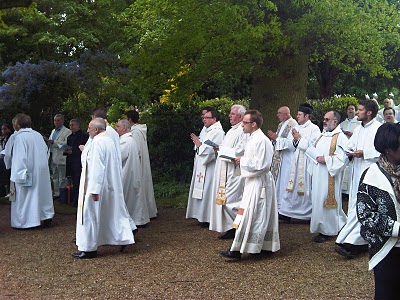
Anglican clergy concelebrate at Walsingham