Last Sunday I was confronted at the moment of Holy Communion by a young woman insisting on receiving the consecrated host on the tongue. Currently this is not permitted in France, as part of the COVID precautions.
In the liturgical changes which came through in the aftermath of Vatican 2, the laity were given the choice of receiving Communion in the hand (the practice of the Church for the first 1,000years of her history) or of receiving on the tongue (the later custom which came in the Middle Ages).
Some while ago, to circumvent stories going around that priests were refusing to give Communion to those who knelt and/or wished to receive on the tongue, I made it clear that these decisions were for the individual communicant. As the Catholic Church validated both practices I, as a priest, was duty bound to respect that freedom.
Until, of course, COVID arrived among us. In order to maintain the celebration of the Mass, the Bishops’ Conference announced a number of restrictions, among them the insistence that concelebrating priests must communicate from the chalice by intinction (dipping the fragment of consecrated host into the chalice and carefully take both species to the mouth) and for the laity communion in one kind only, with the priest or extraordinary minister placing the Body of Christ into the palm of the hand, and not on the tongue.
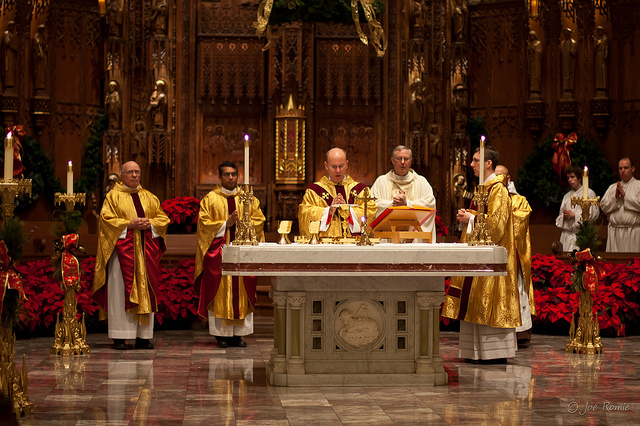
I am aware of the controversy which has been stirred up and I have read articles and comments on the internet. Some of it is rude and inaccurate : at times I have been shocked by the language used by people claiming to be Catholic Christians, language offending against the law of charity which binds us. But I had not expected to enter into this controversy until last Sunday. I very much doubt if the young woman concerned will read my English language blog ; she left before the end of Mass so I did not have the chance to speak with her. The irony is that we are among the more trad parishes of the diocese – the chasuble is worn for all masses, the Missal followed – indeed, last Sunday I used Eucharistic Prayer 1, the Roman Canon. I was upset and I felt deeply that her behaviour towards me was unjust.
Two questions arise in my mind. The first concerns the way in which holy communion is received. It really cannot be maintained that the older custom (into the hands) is in any way lacking in reverence: it was the custom of Catholic Christians for hundreds of years, and only gave way to the later practice when regular Communion at Mass was on the decline. One might ask why placing the host on the tongue – with all that the Letter of St James has to say concerning the sinfulness of this member – is to be preferred to the hands!
The second question which arises is that of authority in the Church. As a former Anglican I rejoice that I do not have to make controversial decisions on the own authority: that it the responsibility of the Pope and the Bishops. I feel myself to be part of a body, a family, in which decisions are taken corporately. I may not end up on the “winning” side of the argument, but that is neither here nor there. I accept the Church’s decision because I am a Catholic and that’s what Catholics do. It’s part of Jesus Christ’s plan by which the Holy Spirit leads us into all truth. I can argue that principle with Protestants, with Anglicans, (within myself as I once had to) – but I cannot argue it with people who claim to be Catholics but seem to be at odds all the time with the Church.

 Ordinariate Pilgrim
A huge amount to think about here. It is extraordinary and weird to think that a “trad.parish” is now defined by use of the missal the wearing of full vestments – it shows to what a state the church has come to. My family “fasted” from Holy Communion for nearly a year here in England because we were forbidden to receive in what is now considered the traditional and Catholic way (the norm in the Roman rite) on the tongue. It is now once again allowed in England but our crafty priests are keeping it very quiet and i have only heard of one example where at every Mass the priest has announced that Holy Communion may once again be given on the tongue. I also heard a priest preach last week on St Aloysius Gonzaga and how his times were just like our own and how in a plague he went out and ministered to the people. I almost laughed in a bitter and cynical way. It’s not at all like our times – in our times the church has closed itself up and priests have stayed away from their people and NOT ministered to them. What a crowd ! just as well our current priests and bishops were not serving at the time of the Reformation. I am sure they would have worked out a good “agreement” with the Tudor state.
Thank you for your comment. The Bishops here in France have now restored the choice to the laity of the way in which they receive Holy Communion and in this parish the Host is given as the communicant indicates. You may also be interested to hear that the new younger clergy are recovering many of the things rejected by an older generation – clerical collars and the soutane among them! Unfortunately here, holding to a traditional way of doing this is often linked with extreme right-wing views – wrongly, I’m sure – and usually ignoring the consistent social teaching of the Popes from Lei XIII onwards.