
Like many Catholics I was at first taken aback by the Pope’s recent Motu Proprio, Traditionis Custodes – On the Use of the Roman Liturgy Prior to the Reform of 1970. I had been aware of problems around the use of the 1962 Missal, but this seemed like a sledge-hammer to crack a nut. Had not the permissions granted by Pope Benedict XVI been gladly received and led to greater harmony and understanding?

Yet in talking this through – both the Holy Father’s decisions and the subsequent reaction – I became more aware of the situation and why Pope Francis has felt the need to safeguard the unity and cohesion of the Catholic Church. In this post I want also to draw on my experience of Church Planting into parishes in the UK when I was an Anglican. This is now causing real concern in the C of E ; and there are at least some parallels with the Extraordinary Form Movement.
A friend who is more au fait with the social media than I am pointed out that more enthusiasm for the EF – and more opposition to the liturgical reforms of the Second Vatican Council – seems to come from America than from the UK and Europe. It has often been noted that people are more aggressive and rude on social media than ever they would be face to face, or even in print, and some Catholics have fallen into this way of expressing themselves. This has led a minority to write abusively about the Holy Father, and even to deny the legitimacy of the Council and the validity of the reformed Mass. Ironically, their freedom to do so and to remain Catholics is itself one of the results of the Council. Prior to Vatican 2 such sentiments would have led to excommunication!
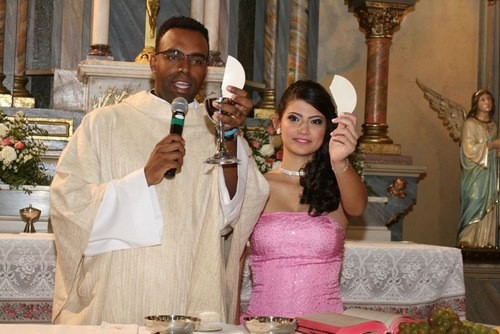
Of course, it is possible to find Masses celebrated like this one above, but they are nothing like as widespread as some maintain. Moreover, those of us who are old enough to remember the liturgy before the Council will recall Mass rushed through in 20 minutes, congregations arriving late and leaving early, priests who seemed to take little care over what they were doing – and polyester vestments long before they became a bone of contention for the traditionalists. Peter Anson writes in Fashions in Church Furnishings that the average Catholic Mass must have been more of a penance than a joy for the discerning convert. I have myself taken part in Extraordinary Form High Mass beautifully organised and celebrated, with splendid music and a devout congregation – though the complicated ceremonial left me shaking – and at times puzzled. But let me assure you that it was not like that when I was a lad, apart from Westminster Cathedral!
So I begin to understand the Pope’s concern for the integrity and the unity of the Church. Moreover he has given back to the Bishops the ordering of liturgy and worship in their dioceses, which is part of what a Catholic bishop does. The attempts to by-pass Bishops and national Bishop’s Councils (with the perception that they are ‘liberal’ ) has not been good for the Church.
Let me turn now to the experience of those of us who are former Anglicans. In the 1970’s we became aware, particularly in London, of a resurgence in certain large churches. They began to draw middle-class professional people from all over the capital with a particular style of worship and life. As areas of London ‘gentrified’ in the 80’s young professionals moved into new housing built in areas previously occupied entirely by working-class families. The tension which this created socially was unfortunately mirrored in Church life. I recall one priest in such an area saying that if only three or four of these couples came locally to their parish church it would be enough to revivify his church. But alas, just as they commuted in to work from their gated communities Monday to Friday, so on Sunday they drove in to the West End to worship with their friends and people of their own class.
Church Growth and Church planting, imported from the States, began to grow in popularity as more and more Anglican parishes struggled with falling numbers. With little actual power residing with the Bishop to do anything about it, the house-groups began to hold Sunday services with no reference to the Parish in which they were situated (and with scant reference to anything looking like Anglican liturgy). For some years the parish clergy resisted this incursion into their parishes, until General Synod took away this right. There was a certain arrogance on the part of the Church Planters who sometimes (in private at least) doubted the commitment and even the Christianity of the clergy and people of the parish system. This “diocese within a diocese” spread out of London, south of the river and even to the south coast!
Catholics in Europe see the Church organised into the parish system sometimes dating from well over 1,000 years. They are amazed when they drive down long American roads to see the Episcopal Methodists next door to the First Baptists and the Pentecostal Healing Ministry – and then the Catholic Church. Have Catholics in the States become accustomed to this “pick ‘n mix” Christianity – and have the “Extraordinary Formers” imported a free Protestant attitude (I go to what I like, where I like) into the Catholic Church? I know this is a tender area, but I know too, as a former Anglican, just what private and personal judgement can do to the unity of the Church. (Saint John Henry Newman understood it too.)
On the other hand, we (and I mean especially the priests and laity of my generation, for whom the Council came as such a breath of fresh air) need to reflect deeply on why groups of young people are so dissatisfied with the worship that they find in this parishes that they prefer to worship according to the old rite. We need to understand the very different world in which they live – a world which now lives without reference to God, and which regards Christianity in general, and Catholicism in particular, as irrelevant and even dangerous. And we need to do a lot about the quality of our liturgical worship and preaching. But that is another post.
It is believed that Pope Benedict looked forward to the two Forms nourishing each other; that a time would come when the latin west would once again celebrate a single form, clearly within the tradition of the ages yet refreshed and renewed by the insights of the Council. Has Pope Francis abolished the latin Mass? No! Has he stopped the use of the 1962 Missal? No!

 Ordinariate Pilgrim