
“Now when the bells for Eucharist / Sound in the Market Square, With sunshine struggling through the mist / And Sunday in the air. The veil between her and her dead / Dissolves and shows them clear. The Consecration / Prayer is said / And all of them are near.”
John Betjeman
The Catholic beliefs of John Betjeman were often reflected in his poetry. He understood the importance of praying for the dead and, in particular, offering the Mass for the repose of their souls in a way that fewer and fewer people would think about today, including many Catholics. At a British funeral people are now much more keen to celebrate and give thanks for a life than to reflect upon the eternal world God has prepared for those who love Him, beyond the moment of physical death, and to commend their dead loved one to His love and mercy. Hence it was increasingly my experience as a parish priest that the eulogy (or eulogies) at a funeral took almost as long as the rest of the funeral; and that for many people the eulogy was the most important part of the funeral.
Here in France (at least in this diocese) most funerals are taken by teams of lay people. This has been the custom for quite a few years, due to the shortage of priests. Most of the older generation expect their funeral to be in church and in the village where they have lived. The lay teams do a superb job. They arrange to visit the family before hand in order to prepare the liturgy, the music and the ‘Mot d’accueil’ – the tribute read out at the beginning of the funeral service. At the end it is French custom for the whole congregation to ‘bless the body’, walking round the coffin and sprinling it with holy water. Having done this, they place a donation in a basket held by one of the funeral directors. The Covid virus put an end to the blessing with hyly water, as we were not able to pass the sprinkler from hand to hand. The devout will make the sign of the cross; others will pass the basket by. Nor is it unknown to find buttons and foreign coins in the collection!
The close connection between the living and the dead unravelled very quickly at the English Reformation. The chantries closed and the reading of the names of the departed, Sunday by Sunday, ceased. The Reformers had the strange idea that praying for the dead was not known to the early Christians, and that the practice somehow lacked in trust for the saving death of Christ. One young evangelical explained to me some years ago, ‘When you die, you are dead, every bit of, and you have to wait for the resurrection; Ther’s nothing to pray for.’ So heaven is quite a lonely place. The dead are not there, and nor are the saints. ‘Mary is just a dead Christian’, I have heard it said. Very soon the chantries and tombs of mediaeval Christians were replaced by the pompous monuments of the 17th and 18th centures. The request to the passer-by to pray for the dead person was replaced by a list of his merits and good deeds in this world. So much for salvation by faith alone! The class system now stretched into eternity, for the mediaeval tombs of prelates and princes had often warned that ‘as I am now you will one day be.’
The replacement of the parish clergy by ‘funeral celebrants’ was a process favoured by the large funeral companies (increasingly American owned) which bought out local firms from the 90’s of the last century. The ‘celebrant’ was there to reflect back to the family their own beliefs. As the nation became secularised the lack of faith and hope for the dead accelerated. Now one only has to look into the eyes of most young people at a funeral to see the lack of comprehension of any Christian understanding of death – and life beyond death.
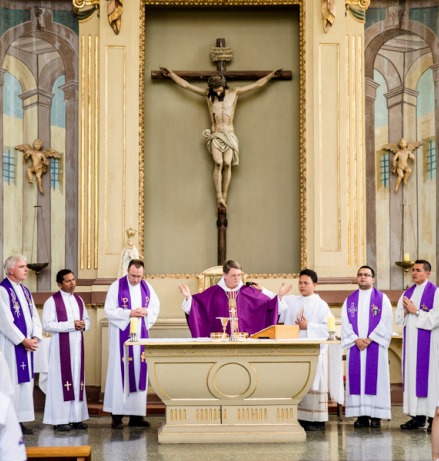
I think we are faced with two choices, those of use who lead funerals. We can either give in and offer the family what they want. It’s often not what they want but what they have been persuaded by an unbelieving world that they want. Or we can preach a full-throated belief in the resurrection of the dead because of the resurrection of Jesus Christ. And we can make sure that the funerals of the faithful are celebrated in the fulness of hope and prayer – and above all within the context of the Mass.
Remember St Monica’s words to her sons, ‘You are not to fret about where my body rests; this only I ask of you, that you remember me when you go to the altar of the Lord.’ The only truly Christian funeral is a Catholic one!


