
Fifty years ago on Parson Cross, a large housing estate on the outskirts of Sheffield, we did a lot of funerals. And we visited the family in their home before the funeral. On this occasion the husband was ‘C of E’ but the wife and her family were ‘Catholic’. So I went to do the funeral visit and was greeted by the widow and her mother. The old lady looked at me somewhat suspiciously, in my black suit and Roman collar. ‘Are you priest or parson?’ she asked. ‘The priest,’ I replied confidently, for what young Anglo-Catholic would have thought of himself as a ‘parson’? Reassured, the old lady gestured to one of the grand children. ‘Fetch an ash tray for Father’, she ordered.
Anglo-Catholics had been arguing for decades that they were proper priests in the Catholic sense of the word. They claimed the authority of the Book of Common Prayer which, they pointed out, makes a clear distinction in its services between what a ‘Minister’ may do (a Deacon or lay person) and when a ‘Priest’ is required. But ordinary people remained stubbornly unconvinced. So from time to time, having introduced myself as ‘the priest from St X’s’ I would received a puzzled look and the comment ‘But I thought ‘priest’ was Catholic … ‘ But I think that fifty years ago an Evangelical Anglican clergyman who introduced himself as the ‘Minister from St X’s’ would probably have got the same puzzled look, and the protesting remark, ‘But we’re Church of England!’ For in common parlance, Catholic clerics were ‘priests’, the C of E had ‘vicars’ and the Free Churches ‘ministers’.
In the 1980 Alternative Service Book the Evangelicals managed to smuggle in the word ‘Presbyter’ in the title of the Ordination Service, which they felt somehow distanced the ordained ministry of the C of E from that of the Roman Catholic Church. A bishop told me that he had had younger clergy complaining that they had to be ordained ‘twice’ (as Deacon and Priest). Certainly I recall attending an Ordination to the Priesthood at St Paul’s Cathedral where the vicars and congregations of some of the Deacons being priested were not present. (Presumably they could not spare the time for this unnecessary piece of ritual.) And by the ’90’s a friend remarked ruefully that the C of E now only used the word ‘priest’ in the expression ‘woman priest’. Given such uncertainly over even the word ‘priest’, let alone his role and ministry, the hundreds of clergy who left the C of E from then on accepted Catholic ordination without the qualms that a previous generation might have had.
A friend recently sent me a copy of this advert from the Church Times asking if I understood it. (For those who do not know, the ‘Church Times’ is a weekly newspaper of the Church of England founded in he 19th century. For a long time it took a consistently Anglo-Catholic line, but a change of editorial policy led to it becoming the mouthpiece of the ‘Liberal Establishment’ wing of the C of E. The ‘Church of England Newspaper’ leans towards the Evangelical wing of the C of E. The ‘Church Times’ should not be confused with ‘Not the Church Times’ – a one-off publication in the last century which satirised the C of E in all its manifestations. But what of that recent advert?
jobs.CHURCH TIMES
_______________ _____________________
JOB OF THE WEEK
____________________________________
Lead Ordained Ministry Enabler
Yorkshire and Lincs
This is a new opportunity to take on a strategic oversight role
which will seek to develop personalized and integrated
pathways from ordination through to experienced Oversight
Ministry.
What on earth, my friend asked, did this advert tell us about the new understanding of ordained ministry and leadership in the parishes? Had bishops, priests and deacons, which the Prayer Book asserts existed from the time of the Apostles, been superseded by a new and more modern pattern?
The job would seem to involve devising and organising training courses for those recently ordained through to their entering upon ‘Oversight Ministry’. The use of capital letters would suggest that this is a recognised position in the C of E. My friend had come across Area Dean, Associate Vicar, Worship Leader and Pastoral Assistant – but Oversight Minister was a new one. The New Testament uses the word ‘episcope’ for ‘oversight’ – the pastoral care of the Church in a particular area – and we see it for example in the ministry of St Paul as he cares for the unity, doctrinal orthodoxy and way of life of the Christian Church at Ephesus, Philippi, Corinth and so on. Is this Oversight Ministry another name for the role and work of the Bishop? Could the C of E be identifying newly ordained clergy for a future as Bishops. Certainly this would not be something new. Forty years ago some clergy were invited on a residential weekend (hosted at Windsor, I think) and, although it was always a bit hush-hush one got the impression that these were men who were destined for the hierarchy.
The truth is rather more mundane. For ‘Oversight Minister’ read ‘Team Rector’. I discovered some months ago that a certain northern diocese had received a substantial grant from the Church Commissioners to develop a new form of Team Ministry. The grouping of parishes together to form a single new parish is not new. In the 19th century with the rapid growth of population and the building of new housing estates, parishes were divided and subdivided, new churches built and incumbents (vicars) appointed. With church attendance and vocations to the clergy falling from the 1960’s onwards, a period of retrenchment began. Four parishes would be combined into a single Team Ministry parish; none of the churches would be closed at this stage, and each would have its own Team Vicar. But one of the clergy would be the Team Rector – with care (oversight) of all the congregations and clergy in the parish. In time, as clergy numbers fell, so the Team might lose one of its clerics, with the four churches of the team now being served by three clergy. Surely, just what happens now in the Catholic Church, where a single priest celebrates three Sunday Mass in three neighbouring parishes! But the parishes of the C of E were far more disparate and therein lay the problem.
A recent newspaper article highlighted the difficulties in the Diocese of Truro, pointing to a vicar who was now obliged to celebrate a Solemn Mass with incense in one of his churches followed by a Family Service in the next parish – where, the article joked, the congregation would leave if there was a whiff of such High Churchery! But what if the priest does not regard all the outward signs and ceremonies of worship as indifferent, but rather speaking and showing forth doctrine, belief – and ultimately truth? Ah well, that’s a problem. And it’s why Anglo-Catholics were less and less at ease with Team Ministry. Not without reason, as it turns out.
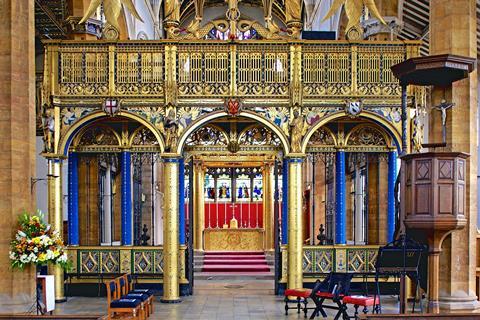
The diocese where I grew up was not exactly stuffed with Anglo-Catholic parishes. I went recently to the website of one, to find that on three Sundays in the month their service is a ‘High Church Eucharist service’ (I kid you not). You’ve guessed, they are now part of a Team Ministry! Team Rectors are usually chosen from the liberal tradition. It is widely held that they will be able to keep the ‘High Church’ in the parish going because they wear the vestments – although they will probably let it be known that they prefer to be addressed as ‘Dave’ rather than ‘Father’. There may be a sticky moment when the Bishop appoints a women as the Team Rector. But then very few people at St Ichabod’s want to be accused of misogyny. Evangelicals do become Team Rectors; I remember one parish where the cleric concerned was able to abandon the ‘robes’ because, so he claimed in the Parish Magazine, they got in the way when he wanted to play the guitar.
As I look back over this article I see moments of bitterness – or perhaps frustration – creeping in. This is a bit strange; it is after all, thirteen years ago that I became a Catholic. I have never regretted the decision, and I am, more or less, at ease with C of E clergy and C of E services when I attend them. From time to time I ponder on what might have been had the Catholic Movement not become a Party, and had convinced the C of E of its true past and its hoped-for future. And I hope my Catholic friends may have some greater insight and understanding of where we ‘converts’ are coming from.


