
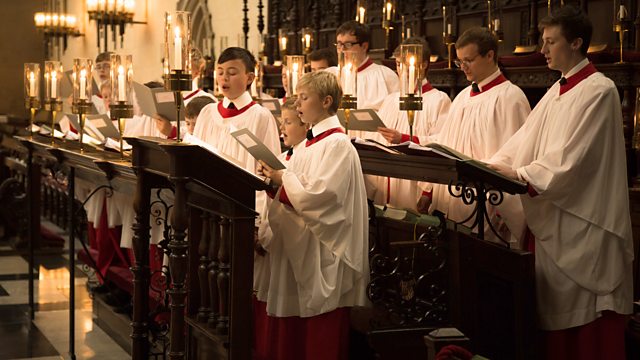
It is remarkable that Choral Evensong has survived as a weekly broadcast by BBC Radio for a hundred years. It is all the more remarkable since Evensong as a Sunday evening service had begun a rapid decline over fifty years ago. Yet there remains an impression that Choral Evensong is of the essence of the liturgical tradition of the Church of England. Within the Ordinariate it is sometimes spoken of as part of the patrimony or inheritance which former Anglicans bring with them to inform and enrich the worship of the Catholic Church.
Earlier this week I called in at St Aldhelm’s Church Weymouth and was warmly received by the Rector and given a tour of the church and parish Centre. It was there, in the early 60’s that I was confirmed and first received a sense that God was calling me to ordination to the priesthood. St Aldhelm’s in the 60’s was typical of Evangelical Anglicanism. There were three Sunday Services – Holy Communion at 8am, Morning Prayer at 11am and Evening Prayer at 6.30 pm. Morning and Evening Prayer were ‘choral’ with a large robed choir in the chancel, several hymns, often an anthem … There was a distinct ‘evening congregation’ i.e. people who only went to Evening Prayer: whether they went to Communion occasionally or were unconfirmed I do not know.
The discovery of Anglo-Catholicism took me to St Paul’s Weymouth where the emphasis on the Mass and the Parish Communion Movement had led to dwindling numbers at Evensong. I think the choir did not sing in the evening. There was certainly no ceremonial, so that outwardly there was little difference between churches of very different traditions. It’s worth noting that Benediction was unknown: the Bishop of Salisbury was believed to disapprove, although St Mary’s Dorchester had an occasional weekday service called ‘Devotions’ where the Ciborium was taken from the Aumbry and placed on the altar.
Sunday Evensong at Kelham, where I went in 1968 to train for the Ministry, was rather different. Of course, Evensong was sung every day to plainchant (in English) The one hymn (the Office Hymn) preceded the Magnificat, which Canticle was sung with an elaborate Antiphon before and after. On Sunday Evensong was Solemn, with a priest presiding and wearing a cope, servers in albs, and the altar incensed at the Magnificat. Later liturgical experiments led to Evensong being transformed into a sort of evening Liturgy of the Word with three Scripture Readings and a procession to the lectern where the Officiant read the Gospel. During the Summer months we would often be joined by parties of visitors though they were not encouraged to join in the plainchant. The sole concession was a hymn sung at the end. (We were snooty enough one Easter Day to sing the original version of the tune to ‘Jesus Christ is risen today’ which the English Hymnal gives, and to feel comfortably righteous when the congregation veered off on their own in the last line!)
On the twice termly exeat a group of us would go to Lincoln where there was a 4 pm Choral Evensong in the Cathedral. I suppose I encountered there what people mean by Choral or Cathedral Evensong: sitting in the stalls of a huge mediaeval building, in the growing darkness of a November afternoon: meanderings on the organ; the approach of the choir of men and boys preceded by the verger with gown and wand; several clergy in long surplices, academic hood and scarf, a certain amount of discrete bowing – and then from the Precentor’s stall (unless preceded by ‘Dearly Beloved’ ) the opening Versicle, ‘Mo Lord, open thou our lips’. No, it’s not a typo. As the Precentor pitched his note it really did sound like ‘Mo Lord’. Then followed a music by those composers who in great numbers had provided for the Anglican choral tradition – Stainer, Walmisley and Stanford, Sumsion, Harwood and the magnificently named T Tertius Noble – canticles in E minor, B flat and F’ – and an anthem, ‘Thou visitest the earth’ or ‘The souls of the righteous’ or perhaps ‘I saw a new heaven’ … and from time to time something ‘modern’ or ‘difficult’ by Vaughan Williams or Matthias ….
My first curacy in the Parish of Parson Cross knew nothing of this. Sunday evening was a Mass, for the steelworkers of our parish worked on a three-shift seven-day-a-week pattern and our Sunday reflected this. And anyway we clergy recited the new Roman Breviary, having breathed a sign of relief that we could pack away the Book of Common Prayer!
So Sunday Solemn Evensong and Benediction came as a bit of a shock in my second curacy. I learned from the vicar (Staggers trained) the proper management of a biretta (to be carried when walking and only put on when seated for psalms and readings, unless of course, wearing vestments) a change of cope for Benediction and that delightful custom of singing O salutaris and Tantum ergo to seasonal tunes.
Then after years of no public Sunday evening worship I went to St Mary Lewisham – which had a robed choir of women and men – and a monthly Choral Evensong. It was not an evangelistic outreach service nor did it detract from the morning Eucharist to which the large majority came. So I enjoyed singing bass for Rutter anthems – and even a decent rendering of the Vivaldi Gloria (opening section only) An enjoyable’ if nostalgic, close to my ministry on the C of E.
Has Choral Evensong a future? The Anglican Cathedrals are struggling because there are too many of them, and choirs are struggling because ordinary people do not sing. Classical music is sadly a closed world to so many young people after years of aggressively marketed ‘pop’. I reflect that fifty years ago the sixty or so students at Kelham could manage sung services every day and four-part harmony with ease; and at St Wilfrid’s Harrogate where I sang in the choir, we were good enough to make and sell a record.
I count myself blessed to be attached to a church which has a choir and a pipe organ and where the musical diet is considerably wider than ditty’s from the 70’s. There is even some possibility that the local secondary school choir might come once a year. Choral Vespers, perhaps?
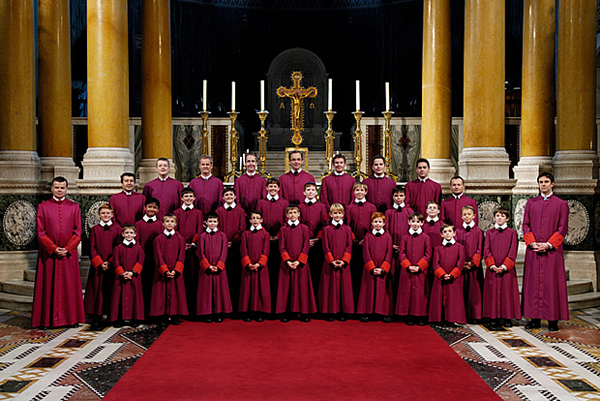


I’m sure that it has a future, especially in cathedrals