The Holy Spirit and the Council


Second Vatican Coun cil

Second Vatican Coun cil

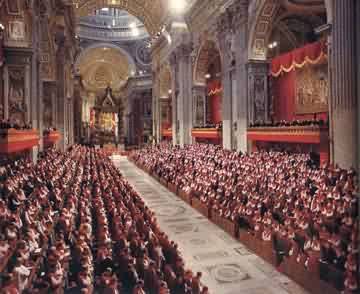
In a recent homily Pope Francis spoke words which will bring joy to all who see the Holy Spirit at work in the continuing implementation of the Second Vatican Council. Indeed, the Holy Father spoke of work still incomplete fifty years on – because there is a desire to ‘tame the Holy Spirit’.  Reflecting on the first reading at Mass which includes Stephen’s accusation that his persecutors were resisting the Holy Spirit, the Pope said, “The Holy Spirit upsets us because it moves us, it makes us walk, it pushes the Church forward,” He warned that we want “to calm down the Holy Spirit, we want to tame it and this is wrong.”  He pointed Catholics to the strength of God which is the Holy Spirit himself, who gives us th strength to go forward. Yet many find this ‘going forward’ upsetting and prefer the comfort of the familiar. The Pope described the Council as “a beautiful work of the Holy Spirit,” but he was also clear that not everything has yet been done which the Holy Spirit asked of the Church during the Council. “We don’t want to change and what’s more there are those who wish to turn the clock back.” This, he went on, “is called stubbornness and wanting to tame the Holy Spirit.” Pope Francis exhorted Catholics not to resist in their personal lives the pressure of the Spirit to take a more evangelical path. ‘Submit to the Holy Spirit which comes from within us and makes go forward along the path of holiness.”

Posted in Uncategorized | Leave a comment

Understanding the Ordinariate

In my time as a Catholic I have discovered two things. First, that most ‘cradle’ Catholics assume that fomer Anglicans in the Ordinariate are conservative, liturgically and otherwise.  Second, that the English in the Ordinariate do not grasp the importance of the Book of Common Prayer as a rallying-point for American Anglicans of orthodox belief.  I want in this post to examine these issues.  Clearly, I know much more about what happened in my life time to English Anglo-Catholics: perhaps others will be able to fill in my sketchy understanding of American Anglican history of the last fifty years.

The heritage of the English Prayer Books

Almighty God, our heavenly Father, who of thy tender mercy didst give thine only Son Jesus Christ to suffer death upon the cross for our redemption …  (1662 Prayer of Consecration)

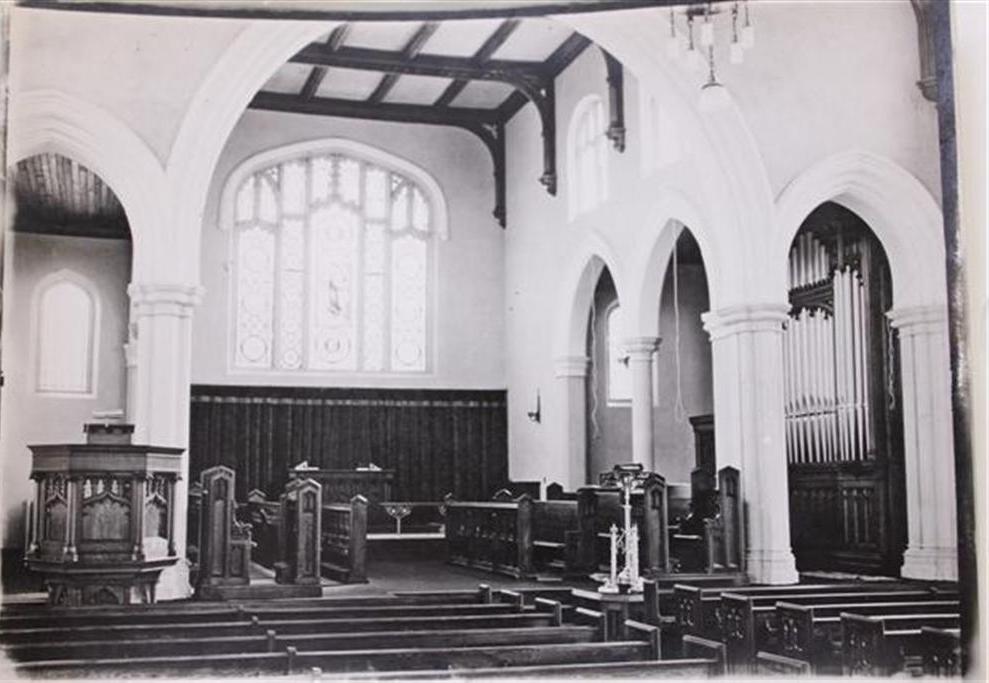
I am of an age which can still recite  sections of the Book of Common Prayer (sometimes known as 1662 from the year of its last revision).  This is because when I was a child it was the liturgy used in every parish church.  Of course, if you know anything about the C of E you will also know that the setting in which this liturgy was celebrated and belief about it varied enormously.  Here is the sort of church in which I was brought up and prepared for Confirmation.  You will notice that the Holy Table has books at either end.  This allows for the  custom (normal until the 19th century) of the priests kneeling for the Communion Service at the short end of the altar, which was known as the ‘north-end’ position.  There is neither cross nor candlesticks  on the altar. low church
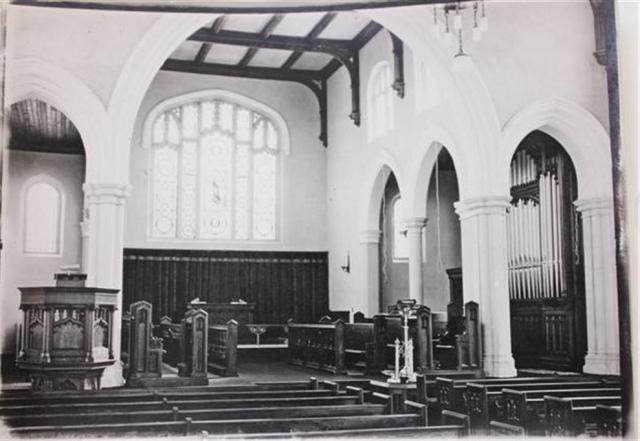
Yet every Sunday in this setting, the three Prayer Book Services of Holy Communion, Morning Prayer and Evening Prayer were celebrated, with little deviation from the permitted form except for the use of hymns at the two latter services.  Now it is my understanding that such Evangelical Anglicanism never really existed in the United States.  In England such churches were the inheritors of the Puritan tradition, who remained for various reasons within the National Church rather than forsaking it for “Dissent” in the 17th century.  In spite of the Evangelical Revival at the end of the 18th century, Anglican Evangelicals became ever weaker in the 19th century, although closely associated with the establishment and producing many of the bishops.  Their revival began after the Second World War and was boosted by the missions of Billy Graham and, somewhat paradoxically, by the decline of the mainline Free Churches in the second half of the 20th century.

The influence of the Liturgical Movement

So when at the age of 14 I moved to the neighbouring parish which was Anglo-Catholic, I found a huge difference in the ceremonial presentation of the services, but little difference (audibly at least) in the words.  What was noticeable was that the words of the Prayer Book had been re-arranged so that the Prayer Book Communion service now took on the shape of the Eucharist as it had been known since the first centuries of Christianity.  Of course, there were doctrinal issues at stake here, for Archbishop Cranmer had deliberately re-arranged the order in his Prayer Book of 1552 because he no longer believed in the Mass.  From the beginnings of the 1833 revival, the Anglo-Catholics had sought to restore Catholic belief in the Eucharist, and by the end of the 19th century were expressing this in the renewed ceremonial of the service.  They followed this in the 20th century with a call for changes in the rite to express what they saw as the primitive understanding of the Eucharist, beyond and behind the controversies of the Reformation. For some time Evangelical Anglicans  clung to Cranmer’s rite, as expressing their reformed theology.
english altar 2

The English Use

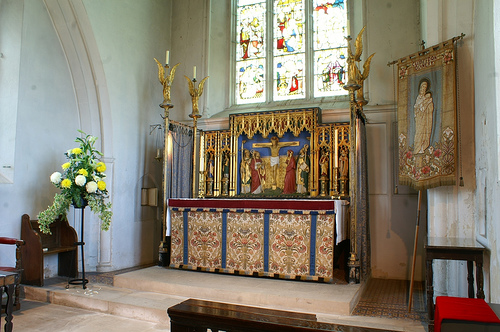
In their search for the recovery of the Catholic form of the Eucharist in the Church of England, Anglo-Catholics had moved along two paths, and these are usually distinguished as ‘English’ and ‘Roman’ (though the ‘Roman’ school often called themselves ‘Western’ to avoid ruffling too many feathers.) The protagonists of the ‘English Use’ contented themselves with the Prayer Book Service clothed with ceremonial which they had borrowed and adapted from pre-Reformation England. The sanctuary above with its long, low altar, gothic reredos, and two candles, shows the ideal of the ‘English Use’. The English Use was the liturigcal expressions, by and large, of  an eccesiology which understood the Church of England to be a legitimate (and independent) branch of the worldwide Church – a sort of ‘Catholicism without the Pope’ which came to be tagged ‘Prayer Book Catholicism’. (But I have become aware that those who held to the Prayer Book in the USA were doctrinally orthodox, and from among them were many who made the first moves to be received into the full communion of the Catholic Church) .

The Western Use

By contrast in the UK those who followed the ‘Western Use’ rejected the idea that the Church of England was some sort of independent expression of the Catholic Church, (with its own mind on ceremonial) standing on a par with the Roman Catholic and Orthodox Churches. (Such an ecclesiology had grown in the 19th century among some Anglicans, and was known as the ‘Branch Theory’). Rather, ‘West Use’ Anglicans believed the C of E to be two Provinces which had been cut off from the rest of the Western (Catholic) Church by the actions of King Henry VIII. They attempted to conform the English liturgy to the contemporary ceremonial of the (Roman) Catholic Church, thus looking forward to the day when the C of E would be restored to Communion with the Holy See.  (This last point would become more significant during the changes of the 1970’s and 80’s. )

Below is the side altar and Walsingham shrine at St Magnus, London Bridge: it represents the ideals of the Western Use in the first half of the 20th century. But it is worth noting that churches which were refurnished in this style rarely looked like contemporary English (Roman) Catholic churches, but rather more like the parish churches of France and Belgium. They are often geogeous but rather decadent looking, and designed to be both un-Anglican and un-English!
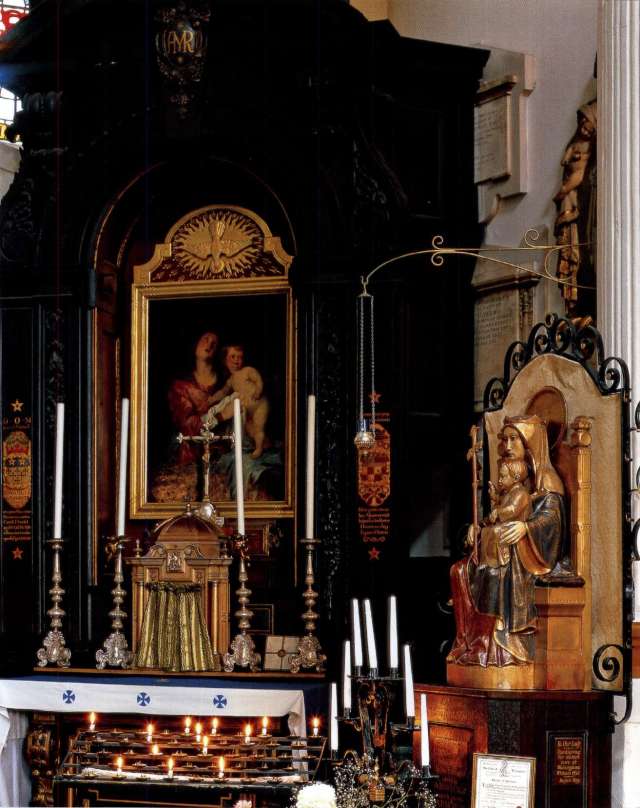
The papalist ideal: St Magnus, London Bridge

The papalist ideal: St Magnus, London Bridge

Anglicans across the Atlantic

As I understand it, the divisions among Anglicans in the United States were different, and expressed differently in worship.  There was no established Church, nor was there any history of the Catholic Church being the ‘original’ Church, as in Europe. Yet there was a great deal of church-going and a lot of money to be expended. The Episcopalians (as Anglicans are called in America) identified with the cultured, literate and  governing classes and built magnificent Gothic Revival churches, (like the Cathedral in Washington) with refined English music and furnishings. Thus they defined themselves over against the immigrant working class Catholics, and the revivalist Baptist and Pentecostal denominations. No significant tradition of ‘Anglican Papalism’ grew up, as far as I am aware.

Yet I wonder whether it was the lack of such (papalist) Anglo-Catholics, as well as their opposite numbers the conservative Evangelicals, which contributed, in part, to the growth of the most extreme Liberalism in what we must now call TEC – The Episcopal Church. Vestments and banners, candles and even incense, were widely used; but under this ‘front’ of outward Catholicism TEC was losing its grip – at first on moral issues like divorce and re-marriage, then on issues surrounding Holy Orders, and finally even on baptism and the doctrines of the Atonement and the Trinity.  Traditionalists in TEC took their stand over the liturgy, seeing the Book of Common Prayer as representing a norm of belief and practice which the Liberals were rapidly forsaking.  They clothed the celebration of the liturgy with a rich, traditional form of ceremonial which borrowed elements of both ‘English’ and pre-Council ‘Roman’ sources – but which identified them as definitely not belonging with the  new, liberal, TEC.  Thus Prayer Book language and the older forms of Anglo-Catholic ceremonial became associated with orthodox belief in the Episcopal Church: modern language rites, central altars and big modern vestments with liberal belief and the new moral agenda!
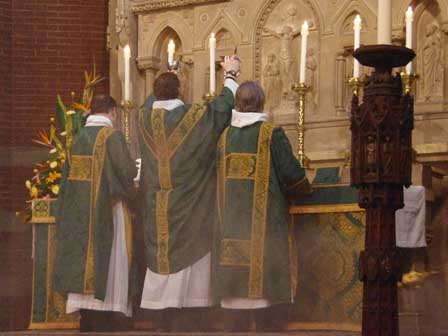
Church of the Advent, Boston, USA

Church of the Advent, Boston, USA

Meanwhile in England …The Vatican Council was widely welcomed by English Anglicans (although Evangelicals were cautious and even sceptical about whether ‘Rome’ had really changed), and there were hints of rapprochment, and even of re-union between the Communions.  The insights of the Liturgical Movement on the Continent now seemed to be coming to the fore, and the new English translation of the Roman Missal published in 1970 looked very much like the Eucharist which the C of E was moving towards. Admittedly, the Anglo-Catholic doctrine of the Mass had taken a knock when Colin Buchanan had persuaded his fellow Evangelicals (especially in the House of Laity) to vote down the use of the word ‘offer’ in the Eucharistic Prayer. And unlike 2012 and the Women Bishops Measure no-one seemed to be outraged by the laity ‘thwarting’ the ‘clear mind’ of the C of E on this issue.

But some Anglo-Catholics were unhappy about the liturgical changes now coming from the Catholic Church. The loyal papalists, of course, put away their folded chasubles (or converted them into concelebration vestments)  and began facing the people for Mass. But the days of the very grand and wealthy Anglo-Catholic priests whose word was law, these days were over, and the laity were more assertive.  The lack of curates had meant a generation of lay ‘sub-deacons’ at the High Mass, and these men were not going to give up their tunicles without a fight! Just at the point when the Area Bishop had been persuaded to wear gloves and read his part by the light of the bugia,  these things were being abolished.

Anglo-Catholicism goes ‘gritty’ – at least in the north!

My first curacy (1974-77) was served on a huge northern housing estate, with a staff of six, and living together in a Clergy House.  For my first Mass I asked the Vicar if  the choir might sing a motet.  He grudgingly allowed it, was gleeful when it went wrong, and told me afterwards: ‘You’ll never be any good as a priest, because you’re too Radio Three.’  (I have to tell you that I got two friends to sing the same motet for my 25th anniversary, and they too got into trouble in the middle of it!  Perhaps Fr Gibbs was right about me.) Liturgy had its place, but too much interest in it was suspect.  (The Kelham influence in clergy formation, of course.) Visiting, teaching and hearing confessions – as well as time spent socialising/evangelising in the Parish Club were all given high priority in terms of our daily routine.  It was a success story and we were proud of it.  And I’m afraid we were rather disdainful about what we regarded as the ‘all-fur-coat-and-no-drawers’ Anglo-Catholicism of London, especially.
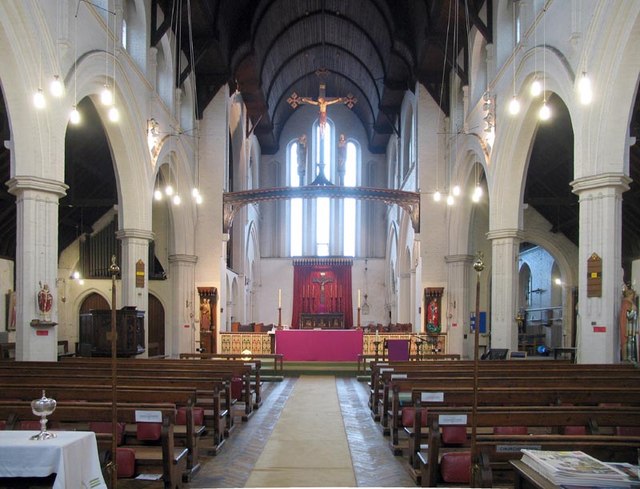
Lent in Leytonsone

Lent in Leytonsone

London Anglo-Catholicism catches up

My second curacy was in London, and it came as a shock.  The tiny congregation came to 11 am High Mass every Sunday, and there had been no changes, mainly because of pressure from the servers and choir (all three of them).  The next Vicar was having none of this, and had a large and spacious nnew sanctuary constructed in the nave,  (it was my late father’s first retirement project) introduced the Lectionary (younger clergy just cannot imagine what a joy it was to begin reading the Scriptures day by day through the year, and Sunday by Sunday over three years – in place of the Prayer Book readings repeated every day for a week!) and daily concelebrated Mass.  And what ‘proved’ that the changes were ‘right’ was that the congregation grew.  And when 30 years later the priest and most of the people joined the Ordinariate, Mgr Newton received twice as many people as I had known be at Sunday Mass in 1978.

A generation of ‘Vatican Two Anglicans’

Perhaps to the puzzlement of (Roman) Catholics, a generation grew up of Anglo-Catholics in England who were gladly swimming in the refreshing and sparkling waters, for so it seemed to us at the time, of the Council.  We convinced ourselves that we were winning over the C of E, and that re-union was around the corner.  We could see the resurgence of Evangelicalism, but we imagined that the Liberal/Establishment party was dying of dullness, and boring everyone else to death.  What we had not forseen was that the issue of ‘women priests’ would unite these two groups – both of them more deeply antagonistic to each other, than ever they were to us Anglo-Catholics.  Evangelicals convinced themselves that, after all the Bible did allow women to exercise leadership of the congregation, and united with the Liberals, who in turn saw this as just the issue to convince the people of England (well, Putney, Islington and the BBC) that the C of E was actually alive to the real concerns of ordinary people.  Both groups, voting in favour for entirely different reasons,  knew deep down  that this was the one issue which would prevent re-union with the Catholics and force the Anglo-Catholics to leave or conform.
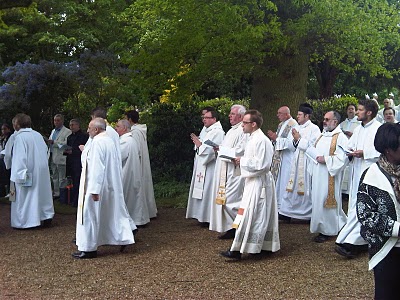
Anglican clergy concelebrate at Walsingham

Anglican clergy concelebrate at Walsingham

The growth of  ‘Modern Catholics’

In the aftermath of the Synod vote of 1992 to allow bishops to ordain women to the Anglican priesthood, orthodox Anglo-Catholics moved into ‘semi-detachment’.

And the result was that those  who defined themselves and their parishes as ‘Modern Catholic’ in the C of E were the ones who – beginning in 1994 and again from 2011 (the Ordinariate) – sought to enter the fullness of Communion with the See of Peter: they became Catholics.

The implications for the future

The Apostolic Constitution which set up the Ordinariates speaks of Anglicans bringing those parts of their Patrimony which are consistent with the Catholic faith with them into the Church.  No doubt the liturgical services which have been and are being produced will be loyally used by the priests of the Ordinariate, for they are Catholic priests: they will use them appropriately, as they would both the Ordinary and Extraordinary forms of Mass which they have and celebrate with their people at the moment.

Moreover, due acknowledgement must be given to the simple fact that – in England at least – it was the celebration of the renewal of mission, life and liturgy which came to us through the Second Vatican Council – that led many Anglo-Catholics to be reconciled to the Catholic Church.  It is the reason why, time and again, former Anglicans speak of ‘coming home’ and ‘feeling at home’ after their Reception.

The Anglican Patrimony then, is not something at odds with modern Catholicism, but is becoming part of the current faith and practice of the Catholic Church, which we have always seen through Anglican lenses, as it were, and now celebrate within our full Communion.

Posted in Uncategorized | Tagged , , , , , , , | 15 Comments

The governance of the parish: an Anglican perspective

Now there are varieties of gifts but the same Spirit; and there are varieties of service, but the same Lord; and there are varities of working, but it is the same God who inspires them all in every one.                                                                    I Corinthians 12:4  RSV


Last Sunday, at The Most Precious Blood, Borough (the first parish in the country to be placed in the care of the Ordinariate) we held an Annual Meeting after the Sung Mass. Those of us who come from Anglicanism into the Catholic Church will be very familiar with the Annual Meeting, or to give it the full title, Annual Parochial Church Meeting (APCM). A brief explanation might be useful for (life-long) Catholic readers.

Every parish in the C of E is required, by law, to hold a meeting of parishioners each year before the end of April. At this meeting two Churchwardens (senior lay people) are elected along with a Church Council. The priest and Council meet regularly during the year for the running of the parish. The priest has no vote in the lay elections, and the Council must authorise financial and building matters.

Our meeting at Precious Blood, attended by 48 parishioners, differed significantly, of course, from the Anglican model because the Canon Law of the Catholic Church places the governance of the parish in the hands of the Parish Priest. Many Catholic parishes now have a Pastoral Council which advises and collaborates with the priest in significant areas of parish life. On this provision we based our understanding of the purpose and aims of our meeting. First, in a series of (very) short reports we gave thanks to God (and took some satisfaction) on all that is going well and growing in our parish. The Treasurer reminded us (gently but firmly) of the need to make the parish financially secure. The Ordinariate group thanked the parish for its welcome, and the parish extended thanks to the Parish Priest – who then reminded us that we were not two separate groups, but united in the Catholic Faith and in our mission to our area. (Applause) The Pastoral Council is not elected, and so our priest asked us for written nominations, from which he will draw a balanced group of people best placed to work with him in all the areas of parish life.

I hear objections. The first is that this way of working gives the laity no real power, that it is too close to the old  autocratic clericalism.  True, it is dependent on a priest who wishes to work in collaboration with this people, who trusts them – and they him. It requires of the priest a confidence in his own ministry – to teach the faith, to preside at the Eucharist, to celebrate the other sacraments, to reconcile and to give spiritual counsel, to guide and even to rebuke – and to have the maturity to allow the laity to develop their God-given role and talents as the People of God. The leadership of the priest is not modelled on  the Chairman of the Board, but rather as the one ordained to preside at the Sunday Eucharist. He calls the community of faith together, he consecrates the Body and Blood of Christ; by his strong and humble presence at chair and altar he enables those who read and pray and take holy communion to the sick to do so effectively and for the good of the Church. He neither domineers, nor does he abdicate his responsibility.

This last point was brought home to me some years ago by a wise bishop. I had gone to him in desperation about a small group of people who seemed determined to undermine every plan I had for the parish. I could not get them to be open about this, (criticism was always behind my back) nor did they ever produce an alternative to solve the many difficulties we had over buildings and finance.  The bishop pointed out to me that, if I did not lead, there were people in the parish who certainly would! But the difference was that I was accountable to the Bishop, and they were not. If they led and got it wrong then they could walk away. On reflection I knew that there were many parishes like this; the Catholic Church may have its difficulties through clerical domination, but it is also true that many Anglican parishes have been blighted by domineering laity and infighting which has nothing to do with the Gospel. St Paul warned the Corinthian Christians, and his words warn us 2,000 years later.

So I am not uncomfortable with the way in which Canon Law places the governance of the parish in the hands of the Parish Priest. This ‘power’ is about responsibility and service and the priest exercises it wisely and humbly. I also know from experience that a community of people grows where each is valued – and used – for what each brings of him or herself for the common good.  If we truly know ourselves to be the Church whose life and work Christ has entrusted to all the faithful, and not just priests, then we shall demand much more of ourselves and each other than a  minimalist religion – in which duty is fulfilled but no more – and which takes us nowhere.

Posted in Uncategorized | 7 Comments

And very early in the morning, on the first day of the week …

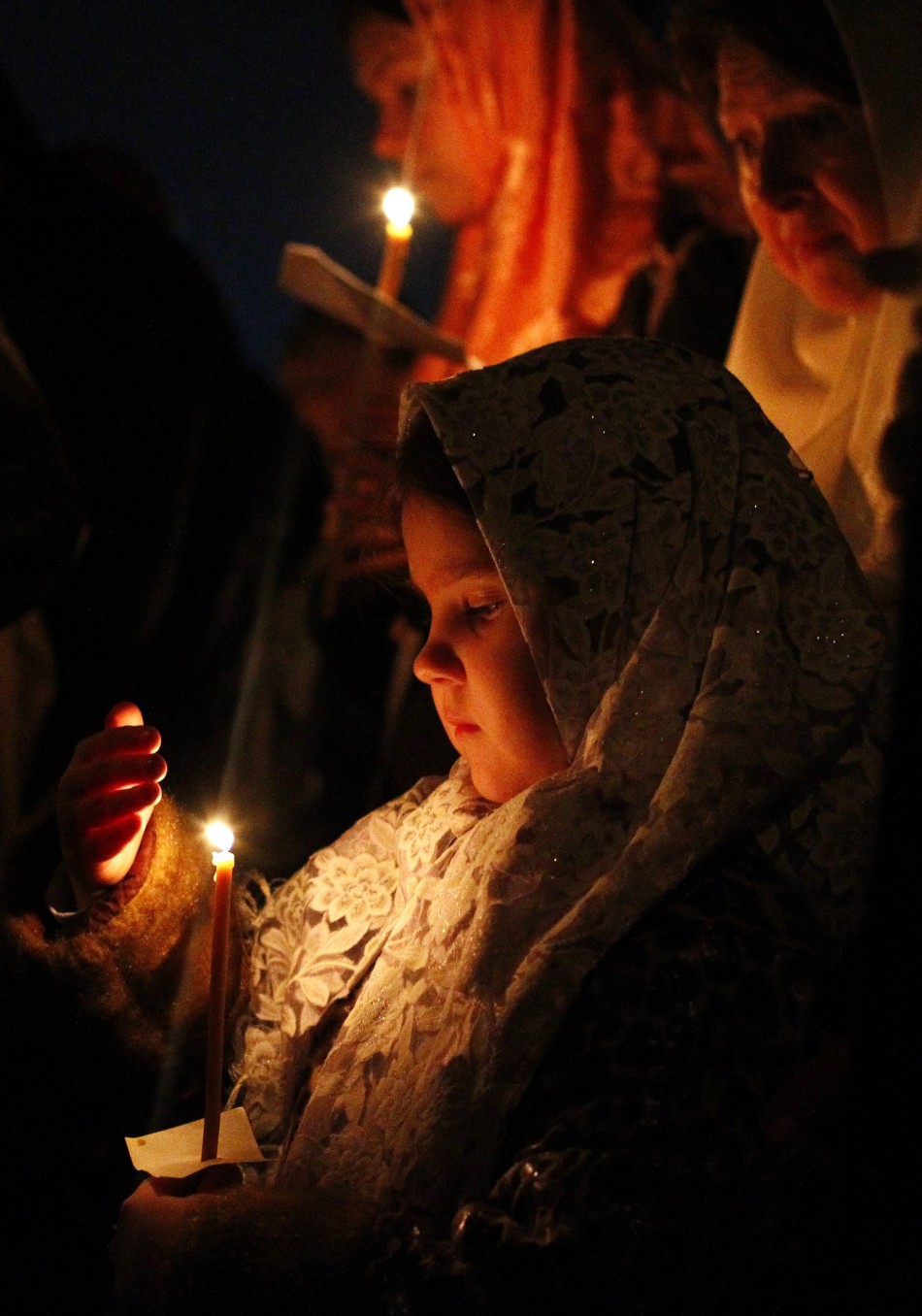
orthodox easter


Like many of you , I have just returned home from the Easter Vigil. Holy Week this year has been a great blessing to me, and I think to many in our congregation at Precious Blood. Here, then, is a little more from ‘A New Heaven’.


The New Testament positively trumpets with the heart-bursting realisation that Jesus is not dead but is alive for evermore! You can feel it as you study the pages: barely controllable grief, confronted with a truth that it dare not, cannot grasp. Then it is slowly invaded by light and certainty, peace and joy and that filling of the heart that sent them out to win everything for Christ. Jesus lives!

This is still the truth that Christians preach. I know he lives, for I, too, have met him. Like Peter, I have been unfaithful to him. Like Thomas, I have doubted him. Like the two who walked disconsolately to Emmaus, I have been foolish and slow of heart to believe. Yet I know he is alive, and he has come to me as he came to them. Like Peter, I have felt his eyes gazing with terrible and burning love into my heart and I have gone out and wept bitterly because of what I have done: I have known him in conscience. Like Thomas, I have felt his presence close to me as I have prayed, and I have reached out my hands and sought to surrender myself and all my doubts: I have known him in prayer. Like Cleopas and his companion at nightfall in Emmaus, I have felt him draw close to me at the breaking of bread in Church: I have known him in sacrament. Conscience, prayer, sacrament: these are but three ways in which he comes to us still, and there are many, many more.

Jesus lives! This is the first meaning of the Resurrection. He is not entombed on a Galilean hillside or between the pages of a book we long to but cannot believe; or in the experience of people holier than ourselves, but alive and accessible to us, if we will but seek after him. ….

Yes, this dust is bound for glory. Everything, every wounded child and every sparrow that falls to the ground in the cold of winter is, even now, being glorified. The Church exists to point men and women to the reality of what is happening now. As the old spiritual puts it: ‘We’re on our way to glory’. There is nothing else to say in Auschwitz or in the terminal ward of the cancer hospital or by the graveside on a dark Friday afternoon. There is only that. And if we felt it, if we knew it, it would bring back the whole world. Those who have been let in on the secret of the ages glow with the knowledge. The glory of that Kingdom, casts its brightness back into time and illumines the faces of those who look towards it. “For it is the God who said, ‘Let light shine out of darkness’ who has shone in our hearts to give the light of the knowledge of the glory of God in the face of Christ. ”  (2 Corinthians 4:6)

This then, is the final meaning of the Resurrection of Jesus Christ from the dead: it is the preview of the great future that awaits the whole of the created universe. This is why all the Easter hymns say that the Resurrection destroys death and sorrow, even ‘world-sorrow’ and bids our hearts rise with Christ.

” Can there be any day but this, / Though many suns to shine endeavour? / We count three hundred but we miss: / There is but one, and that one ever. ”          (George Herbert)

A New Heaven – Richard Holloway   p. 82

Posted in Uncategorized | 2 Comments

Holy Saturday, this day of waiting

entombment

No, Easter does not banish tragedy and suffering; it does not signal the end of all our striving, the drying of our tears. Instead it takes us and shows us deep down into the heart of things where Christ is working his endless work of love. It shows us the triumph, the resurrection, that is laid in store for us beyond tragedy. On this day of waiting, the day after the struggle is over, this day of brimming regret a sudden stillness falls on the battlefield, for an instant the smoke clears. We catch sight of the high eternal hills; then the urgent thrill of a trumpet call, and there is Christ going before us, walking on broken feet into the everlasting kingdom.

This death and its strange and glorious sequel do not banish tragedy. The world still suffers and grieves and regrets. But know that another thing is happening and this same tragedy, like Christ’s wounds, is being transformed into a glory that gives a meaning beyond all our meanings in a time beyond all the time we know.

So this is one moment, but we also know another, yet now another, for it is the same moment in its truer meaning. That moment is the moment of the Resurrection, which is the meaning of the death of Jesus from the side of God’s purpose.


A New Heaven p.83 – by Richard Holloway, former Bishop of Edinburgh, which book, published in 1978, I have read again each Easter Triduum for the past 30 years, and which never fails to move me.


Posted in Uncategorized | Tagged , , | Leave a comment

Am I just getting old?

This is really by way of a short follow-up to the last post. When I re-read it, I wondered if I was falling into that way of thinking which besets those of us over a certain age. We look back on the society of our younger days with a certain affection as a more innocent, responsible time; then we contrast it with the dissolute age in which we now are. Is this my problem? Well, here’s Clifford Longley writing in last week’s Tablet.

cliNone of this (the election of Pope Francis and the installation of Archbishop Justin Welby) is likely to make much lasting impression on British society and its obstinate pervasive secularity. The world may admire, but not change; there is no call to conversion. Both Churches (Catholic and Anglican) are on course to continue their slow decline in membership and influence, as British social and cultural life drifts even further away from anything recognisably  Christian .

Meanwhile along with churchgoing, and probably connected with it in a complicated way, there has been a collapse of values and virtues in institution after institution, from the health service to the finance industry, from politicians to the professions. By any measure people are more selfish and less honest, less faithful and less trustworthy. Indeed, it is because of the vacuum in values that administrators have tightened their regulations to try to rectify the decline. It hasn’t worked and instead has accelerated the process, for by their very nature rules crowd out virtues.

And although there will always be individuals who stand out, the secular claim that it is possible to have high ethical principles without religion is gradually, generation by generation, unravelling. The nation’s moral capital is being exhausted.

The Tablet   23rd March 2013  p.5

Posted in Uncategorized | 1 Comment

How does the parish evangelize?

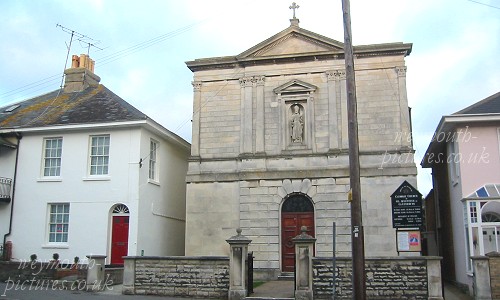
As a teenager, growing up in a sea-side town, I was aware of the (Roman) Catholic Church. We lived opposite the classical fronted, early nineteenth century building, which my grandmother still called ‘the Catholic Chapel’. It was extended in the early 60’s with a new sacntuary. Then there were two more parishes in the town, and I think at least two ‘mass centres’ for outlying estates. The town then was served by three Catholic parish priests and there were curates, too.

st augustine weymouthWithin the last year Catholic re-organization has been completed, the mass-centres closed some time ago, and there is now a single parish with one church, extended and beautifully re-modelled to hold 300. I attended the Vigil Mass of Christmas (advertised for parents and children) and had to stand at the back! The parish is served by one priest, together with several deacons and parish sisters.

But the pragmatic reorganisation and the enlarged building cannot hide the fact that the numbers of practising Catholics has dimished quite dramatically in the fifty years since I was a child. Even greater is the decline in the number of priests. And to its credit, this is not denied by the hierarchy. The annual mass figures are published as they stand. When I was an Anglican I used to write and speak with ever-growing exasperation at the spurious optimism at the centre of the C of E, and its constant changing of the criteria by which numbers were measured. The decline in religious practise across Europe is marked and worrying.

The phrase ‘The Death of Christian Britain’ comes from the title of a very persuasive book by Callum Brown.

It took several centuries (in what historians used to call the Dark Ages) to convert Britain to Christianity, but it has taken less than forty years for the country to forsake it. For a thousand years, Christianity penetrated deeply into the lives of the people, enduring Reformation, Enlightenment and industrial revolution by adapting to each new social and cultural context that arose. Then really quite suddenly in 1963, something very profound ruptured the character of the nation and its people, sending organised Christianity on a downward spiral to the margins of social significance. In unprecedented numbers, the British people since the 1960’s have stopped going to church, have allowed their church membership to lapse, have stopped marrying in church and have neglected to baptise their children.

The Death of Christian Britain – Callum Brown

Growth and decline in the UK

The Catholic Church in the UK grew from the nineteenth century through until the 1960’s. It grew while the Church of England and the Free Churches slowly declined. And then it too began to decline. Its growth had been principally what we call ‘biological growth’ i.e. when Catholic parents bring up their children in the faith, and they in turn come to adult commitment, which they pass on to their children, and so on and so on.

archbishop downey liverpoolBut throughout the period of growth there was also a steady stream of what were then called ‘converts’. Many of them had been brought up within other Christian communities (though some were high profile atheists/agnostics) and nowadays we would call this ‘transfer growth’ – for these people already knew God and had been baptised and lived the Christian life, while outside the Communion of Peter.

The attack on Christian life and values

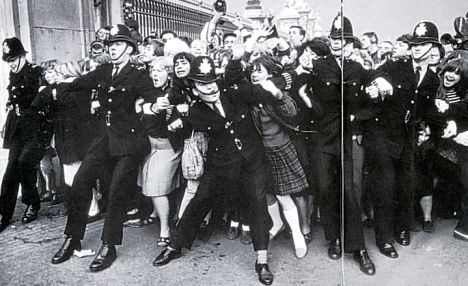
But by the 1980’s there had been what Callum Brown rightly calls, a ‘rupture’. The secular, materialist society was now strong enough to create a ‘generation gap’, and parents found it difficult, if not impossible, to pass their belief and value system on to their children. This generation gap was astutely nurtured by the great commercial forces, as they created a ‘youth world’ of constantly changing music, fashion and fads, all of which required young people to part with their money! The values this new world imparted had nothing to do with saying your prayers, going to Mass, loving God and building up your family.

beatlemania1It was ruthless and destructive of all that had gone before, and of many of the young people who were drawn by its passing glitter. The damage it did is only now being revealed, and those responsible are still deeply unwilling to admit their part in it. The mantra, ‘Lessons must be learnt’ means ‘by everyone else except us’.

The Church’s weakness

Christianity in Britain was caught unawares by the rapid secularisation of society in the 1960’s. The dramatic fall in the number of vocations to the priesthood, and the numbers of priests leaving their ministry, had a profound effect on the confidence of the Church, and its ability to organize dioceses and parishes for mission as it had done in the past.

The lay people – and the hope for the future

It is often claimed that the Second Vatican Council ‘re-invented’ the laity. But the following quote must surely show that the Council was responding to thinking at the highest level:

Lay believers are in the front line of Church life; for them the Church is the animating principle of human society. Therefore they in particular ought to have an ever-clearer consciousness not only of belonging to the Church, but of being the Church, that is to say, the community of the faithful on earth….. They are the Church.

Pope Pius XII quoted in CCC 899

southwark2011riteofelection02

Let the Church learn from Anglican experience (good and bad)

Groups of Anglicans coming into communion with the worldwide Church bring with them a tradition and way of working which involves the laity at every level. I know that this is a very mixed blessing: it was the assertion of lay control over the English Church by King Henry VIII which led to the devastating schism. The furious reaction from the (lay and secularised) Parliament when General Synod refused the pass legislation for ‘women bishops’, shows very clearly why the Establishment of the C of E has been so destructive of the National Church. Yet I also believe that the lay involvement which Anglo-Catholic parishes nurtured is part of our Patrimony. Rightly understood and developed within the structure of Catholic Canon Law, it could release and strengthen the Catholic Church in England and Wales for a new evangelisation of these islands.

After Easter the Ordinariate Parish to which I belong is going to have an Annual Meeting. These meetings were a legal requirement in our Anglican Parishes, and could (and did) sometimes become a forum for attacks on the Vicar, endless rounds of voting, and squabbles about the building. Such a meeting has no canonical status in a Catholic Parish, and so its agenda is freer and its aim, I suggest, is threefold. First, to thank God for his blessings on the parish, and to encourage all the parishioners in their share in its life. Secondly, to ask where the life of the parish is weak or failing, and what needs to be done about this. Thirdly, to support, advise and encourage the Parish Priest in his leadership of the parish and to enable him to collaborate wisely and effectively with his people.


The Lord added to their number

The Lord added to their number


10 signs for the renewal of parish life

These signs might provide a programme for parish renewal, and a check list for the Pastoral Council.

  1. The centrality of  the Eucharist in the life of the parish and every member of the congregation.
  2. The love of the  Scriptures so that the People of God listen attentively to them at Mass,  study them alone and in groups, and mould a new and radical way of living in society
  3. Common prayer, so that Catholics pray with the Church, whether alone or in groups, in homes or church building
  4. Consistent  teaching, (catechesis) so that we are committed to deepening our faith, not just as  children, but throughout our lives, and the laity expect the clergy to teach as an indispensable part of their ministry
  5. Effective witness, so that every Catholic welcomes the stranger and shares his or her personal faith, humbly but confidently.
  6. Able leadership,  (by which I mean leadership that en-ables, not dis-ables) from both clergy to the people, and the people to each other, so that the whole congregation is able to find and use the gifts God has given to each member.
  7. Responsible membership of all parishioners, so that all play their part in the life of the Church, and not just some.
  8. Pastoral charity extending within and beyond the congregation,  so that everyone is involved in giving and receiving of loving care in the name of Christ.
  9. Openness, both to continuity and change, so that  we are able to  discern where  God calls  us to remain faithful to the tradition, and where we must  make radical  changes in order to grow
  10. Sacrificial  giving, so that each parishioner is responsible for providing  what is needed by giving time, money and  ability to make the Church grow.


Posted in Uncategorized | 1 Comment

Night Litany for London

London

London

The Night Litany for London was published by the Church Literature Association with an introduction by the late Mgr Graham Leonard, then Anglican Bishop of London. It is believed to have been written by Fr H A Wilson of St Augustine, Haggerston. This is an amended and updated form and its use is by no means restricted to London: it is a litany for all of us who live in our great urban areas, across the world, with all their joys and sorrows.

God our Father, hear us. We plead before you the Sacred Heart of Jesus for all  in this great city of London who tonight need your merciful love and protection.

On all who work tonight                                                            have mercy

On the police, fire and ambulance services

On hospitals, doctors and nurses

On clergy and chaplains called out tonight

On all night nurses and social workers

On the homeless and destitute

On all young people

On the elderly

On abused children and battered parents

On loveless marriages and broken homes

On the sick and suffering

On the mentally ill

On those undergoing operations

On those with HIV and AIDS

On those who cannot sleep tonight

On the depressed and lonely

On the anxious and distressed

On those tempted to violence and crime

On all prisoners and prison staff

On those who are driving tonight

On all prostitutes and their clients

On those addicted to alcohol or drugs

On all who live in fear

On the victims of rape

On the victims of racial attacks

On all victims of crime

On all involved in accidents

On those who are bereaved tonight                                           have mercy

On those for whom tonight will be their last on earth

On those dying without the knowledge of your love for them

On those who are afraid to die

On those tempted to suicide

On the terminally ill

On all dying priests, religious and lay people

On ourselves at our last hour

On behalf of all Londoners who today have said no prayers, let us say

Our Father ….

Hail Mary …

Sacred Heart of Jesus, have mercy on us

Posted in Uncategorized | Tagged , , , | Leave a comment

A priest for the world

Once again, the world is surprised by the Catholic Church. We have a Pope, and there is a wonderful feeling of excitement. He asked us to pray for him and bowed quietly before us all – and then gave us his blessing. We must not fail to answer his request – every day – and undergird his papacy with the prayers of the People of God.

Pope Francis I

Pope Francis I

Posted in Uncategorized | Tagged , , | Leave a comment

Ancient & Modern: the music of the Ordinariate

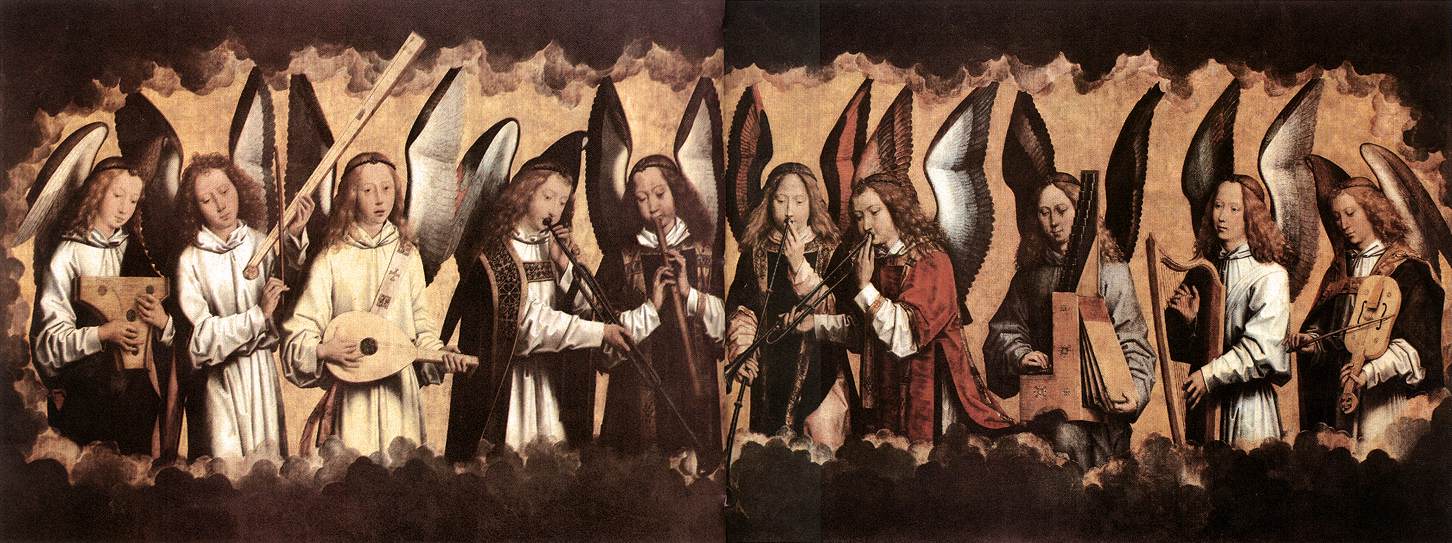
music of angelsSing psalms and hymns and spiritual songs with thankfulness in your hearts to God.      Colossians 3:16

We had been on a day pilgrimage to the Shrine at Walsingham, and it had been a wonderful and moving day.  But what my (cradle) Catholic friends talked about on the train home was the singing.  Certainly the congregation sang with enthusiasm a wide variety of hymns, and many were confident with the Latin Gloria sung to ‘De Angelis’.  A wide repertoire and congregational participation are what mark the approach to music in the worship of the Ordinariate.  Indeed, it seems that you are more likely to hear the words ‘Good hymns today’ after Mass, than ‘Good sermon today.’

Former Anglicans are sometimes  disappointed at the music at Catholic Masses, and the frequent choice of hymns and songs from the 1970’s and 80’s. But they need to understand the very different  background from which English Catholicism comes.  Emerging in the 19th century after centuries of persecution and obscurity the Catholic Church in England had clear priorities: the provision of priests for its growing congregations, schools for its children, and large (but often very basic) church buildings especially in the poorer urban areas.  It had none of the inherited money of the Established Church, and limited patronage from the middle and upper classes.  Sunday by Sunday the churches were filled at a string of Low Masses.  But most Catholics had no tradition of hymn singing, and where Mass was celebrated in the Solemn form, the rules allowed only the Latin Propers.

The Anglo-Catholics of the 19th century had rather more in the way of resources, and rather less in the way of rules!  They threw off very quickly the ‘High and Dry’ suspicion of hymns as tainted by Methodism, and joined enthusiastically in the torrent of hymn-writing.  And whereas Anglicans had previously turned their backs on anything before the Reformation, the Oxford Fathers plundered with abandon all the resources they could lay their hands on.  The fruits of their labours were  summed up in the publication of the English Hymnal, with its first edition in 1906 and a revised edition in 1933: this book became the mainstay of Anglican liturgical music until the 1980’s.

But what about today?  Much has happened in the field of church music since the English Hymnal held sway in our churches.  There has been an explosion of church music – just as there was in the 19th century – with much of it coming from America and principally for the use of Evangelical and Charismatic Christians.  How should Ordinariate Catholics respond to these innovations, and can they embrace more than they reject?  A full answer is way beyond the competence of this post, and so I will write about two rather different sources from which we might enrich the music we sing.  But first, let me pose a question: should a Mass ever be entirely without singing?  I always feel slightly let down when the reader or priest reads the Gospel acclamation.  The rigid distinction between ‘Low’ Mass and ‘Sung’ Mass has long since gone: but we need songs and chants, short and universally known, and congregations need the confidence and enthusiasm just to break into song.

Plainchant – music of the past and the future

The Oxford Movement rediscovered plainchant, the music of the liturgy par excellence.  Many of us admire it but are slightly nervous of it.  That’s in part because we always hear it, whether on TV to accompany pictures of the ruins of Fountains Abbey, or on ‘mood music CD’s, sung by the ‘professionals’.  Perfectly pure tone, and very high pitch can be really off-putting, but that’s not the only way to sing the chant, and I’ll bet it didn’t sound like that in the average parish church before the Reformation.  And chant sung robustly, at a pitch comfortable for the men,  by ordinary people, sounds magnificent!

Some years ago I was involved in planning an Induction (when, in the C of E, a new Vicar is publicly installed in his parish by the Bishop and Archdeacon).  The new man wanted to sing ‘Come Holy Ghost our souls inspire’  English Hymnal 153 to tune 154 (Mechlin) but we knew the organist would kill it stone dead, by playing in rigid time and all the stops out. So we told her that the new vicar wanted it ‘traditional style without organ.’  Without any practise the congregation just sang – one priest (a bit of a connoisseur) remarked afterwards that it was the best rendering he’d heard for years.  Here are the men and boys of St Paul’s Cathedral singing it: no accompaniment, free rhythm and quite fast.   http://www.youtube.com/watch?v=iHj6NR6H0tc

Now listen to what happens when you put accompaniment to it of the wrong sort.  I don’t mean band rather than organ, for many organists are capable of doing just the same: it’s rigidly sung in triple time and the light freshness of the melody line is being ruined by the soloist’s use of a quite inappropriate style.  It’s like a folk song being sung in the the style of Wagner with a huge orchestra – just wrong!   http://www.youtube.com/watch?v=R2Gog00cLdw

Chant is often better without  accompaniment.  If it is used then in most situations it should be very light and follow the voices.  Of course, there are exceptions.  Try this recording of the Te Deum being sung at Notre Dame de Paris: congregation singing robustly the  verses  with the organ alternating.  Hardly possible for your average Ordinariate group, but what about the end of our next Choral Evensong at Spanish Place? http://www.youtube.com/watch?v=iHj6NR6H0tc

But what about your average Ordinariate group?  Many of us know ‘Before the ending of the day’ and would happily sing it at Compline when a dozen of us are on retreat.  There are plenty of plainsong hymns like this: the Advent hymn which we know as ‘Creator of the stars of night’ at English Hymnal 1,  http://www.youtube.com/watch?v=wc2vV-v802s is a good example.  Single note per word, and none of those beautiful but tricky multiple notes (neums) which are so daunting when you first see them!  Sing it fast enough for one breath to cover two lines: and don’t let people drag it into modern strict rhythm.

So why do I think plainchant might be the music of the future?  Much modern music follows popular style with tricky rhythms, varied length of lines, and pauses for the instruments to come through: they demand accompaniment.  Many churches have difficulty in finding a single accompanist, let alone a band of instruments.  Even those churches in the evangelical/pentecostal tradition which have adopted this particular style for all their music have difficulty maintaining continuity: and what we see on ‘Songs of Praise’ in the above clip is the veritable ‘cathedral’ of worship song style.  Even to sing something as well known as ‘The Servant King’ would be difficult – and sounds curious – without at least a keyboard.  So what do you do at a weeknight Mass?  What do you sing when four of you have met in your front room to say the Rosary?  You sing – the ‘Salve Regina’ or ‘Come Holy Ghost ‘ or ‘Before the ending of the day’.  You sing plainchant.

Surprise yourself – give worship songs a go

Much as I love chant, I would be sorry if the church where I sing had no place for the music of the last fifty years, which has been coming out of Charismatic Renewal.  Over the years many of us have felt the need to express deeply and directly our emotional response to God’s love and greatness: we have become less embarassed about raising hands and voices in gratitude for the love of God in our lives.

‘There are furthermore special graces, also called charisms … such as the gift of miracles or of tongues…intended for the commmon good of the Church.  They are at the service of charity which builds up the Church.’                         Catechism of the Catholic Church 2003.

Some years ago a group planning a Diocesan liturgy were arguing over the ‘Time of Worship’ which some people wanted at the beginning.  ‘The whole service is worship – you really mean three choruses, each sung twice,’ said someone sharply.  Real risk of offence, until they decided to rename it ‘Time of Adoration’ – everyone (well nearly) happy!

There is a vast repertoire, of varying quality, just as there was in the 19th century.  Some groups and some congregations are afraid of repetition – the music must always be new, otherwise it gets ‘boring’.  Most of us like some familiarity and a corpus of well known music enables worship, rather than disables it.  Songs like ‘The Servant King’, ‘As the deer pants for the water’, ‘Shine Jesus shine’ have become worship classics.  Many others have drifted into obscurity and will be forgotten.

Here is an early Stuart Townend: ‘In Christ alone’. http://www.youtube.com/watch?v=ExnTlIM5QgE  It’s more like a hymn, and its theology, note, is massively orthodox: ‘fullness of God in helpless babe’ – you can’t get much more credal than that.  It reminds me of that wonderful phrase in Graham Kendrick’s ‘Servant King’  which says of Jesus Christ, ‘hands that flung stars into space/to cruel nails surrendered.’  Word of God, Logos, Wisdom, through whom the world was created, who took our flesh in the Incarnation – it’s all there.  I must admit that I do not like the almost universal custom of singing with American accents  but – as they say – “Get over it” and sing them in a more English style with your people, if that’s what you prefer!  If you can’t manage a band (and ask among your younger members, who may be dying to get out their  flute or clarinet) then a decent piano makes for wonderful accompaniment.  Indeed, its more percussive style may be better than the organ in persuading the congregation to sing.  Listen to pianist enjoying himself in ‘As the deer’   http://www.youtube.com/watch?v=VhlANjh7ybg

Another Stuart Townend favourite of mine is ‘How deep the Father’s love for us’.  Again it’s rather more like a hymn which makes it easier (for me) to sing.  I’m willing to enter into theological dispute over its understanding of the atonement, and the words, ‘The Father turns his face away’. http://www.youtube.com/watch?v=zSWC7XozVgY

A catholic choice of music

I think it was Monsignor Burnham in one of his articles who pointed to the ‘sophisticated’ use of hymnody which the Ordinariate brings to worship.  I understand him to be speaking among other things of its richness and variety: its catholicity, surely.  There are many other sources beyond just the two I have described in this post, containing incomparable treasures of music.  Let us use them to the praise of God and the edification of the faithful.  And if this is part of the Anglican Patrimony then let us offer it as a gift in small return for all that we have received from the Church.

Posted in Uncategorized | 4 Comments