Re-visiting the past so that the future may be renewed

The poet John Betjeman in his Collins Guide to English Parish Churches, published in 1958, writes a description of an urban church, the product of the Anglo-Catholic revival.
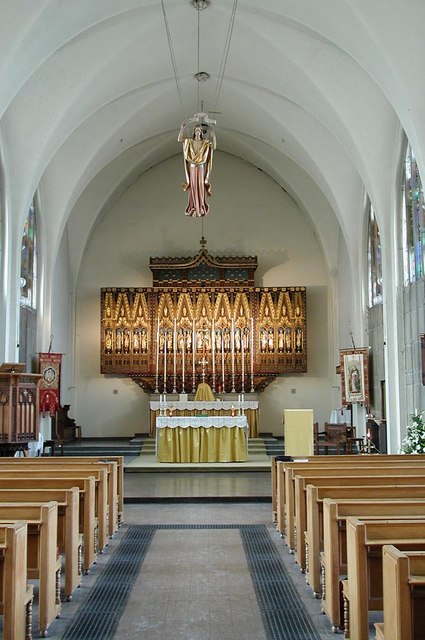
st agnes kennington‘Ting-ting’ the single bell calls to Sung Eucharist, because the tower, designed for a full peal of bells, was never completed. Rather gaunt without it, the church rises above the privet and forsythia and prunus of its little garden, for there is no churchyard to these churches; we have reached the era if municipal cemeteries, and it is in their marble acres that the dead of this new parish are to be found. Inside the church, the tall nave is filled with chairs, and the narrow aisles are not used on a Sunday, as they give a view only of side altars where the weekday Celebrations and the very early Sunday masses are said. The floor is of oak blocks, the walls are cream and clean, the woodwork of the thick Devonshire style chancel screen, carved by Harry Hems of Exeter, is unstained. In more recent times a coloured statue of Our Lady under a gilded canopy is seen against one of the eastern-most pillars of the nave. Throughthe screen we glimpse a huge reredos painted green and red and gold, with folding doors. The high altar has a purple frontal, because just now it is Lent. The floor of the sanctuary is paved with black-and-white marble. Riddel posts with gilt angels on them – the famous ‘English altar’ introduced by Sir Ninian Comper in the (eighteen) ‘eighties – hold curtains round the north, south and east of the side altars … The Sunday Eucharist is probably from the Prayer Book and with a crowd of acolytes at the altar. Blue incense rises to the golden reredos and the green Kempe window. The English Hymnal is used, and plainsong or more probably, Eyre in E flat or Tours in C. Candlelights twinkle in the mist. The purple Lenten chasuble of the priest is worn over amice, alb, stole and maniple, and there is discussion of these things after the service and before among the servers and the initiated. We are in a world which feels itself in touch with the Middle Ages and with today. This is English Catholicism. There is much talk of Percy Dearmer, correct furnishings and vestments, the Prayer Book and how far one is justified in departing from it. After church the acolytes in their Sunday suits hang round the porch, and the young curates too, and there is a good deal of backslapping and chaff. For months the Mothers’ Union and the women’s guilds of the church have been working on banners and a frontal to be ready for Easter. From these suburban parishes much of the Church life of England has sprung. They have trained their people in faith and the liturgy, they have produced many of the overseas missionaries and parish priests of today.

Those of us of my age can remember something of this world, something of this Church of England. It has gone now, with the curates and the women’s guilds, and the battered angels from the riddel posts  standing forlornly on a window sill. What Betjeman was not to know when he penned these words was that a very different world lay just round the corner, and it was a changed England and a changed Church which was to emerge at the end of the 1960’s.

But the Church did emerge, and the influence of the Second Vatican Council spread way beyond the Roman Catholic Church. It took Anglo-Catholics a little time to grasp what was happening, but many of the young clergy did – and they did it with hope and enthusiasm. I recently found this ‘update’ of Betjeman’s Introduction, which I guess from the type-face I must have written in the late ‘seventies.

Articulated lorries and family cars head for the coast; an old man reads his Sunday paper in the warm sunshine; and beyond the surging sea of demolition rises the red brick bulk of some suburban church. Built in the (18) 80’s and 90’s as the railways pushed out into Surrey, Essex and Herts, to serve the newly built estates where once had been only farms and fields, these churches rarely rate a mention in the guide-books. Local architects built schools in ‘Jacobean’ and churches in ‘Early English’ Gothic; no-nonsense buildings, leaving the furniture and fittings to some future generation. Then the money was spent on other things – the Parish Hall perhaps, to house the organisations and guilds. So there is about these churches an unfinished air. The buttresses which flank the porch are unnaturally thick to support the unbuilt tower; the staircase turret ending abruptly below the roofline; the altar backed by curtains instead of the great carved reredos, which exists now only in a faded water-colour in the vestry…

The congregation looks a little thin in the chair filled nave, even though several rows were removed when the present Vicar installed the nave altar. Older members of the congregation remember the 11 o’clock, with people sitting in the side aisles – High Mass, of course, for the parish had three priests then, and Sisters. Their contemporaries have moved to bungalows in the coast, or else have died. Their sons and daughters have ‘got on’ and gone to new estates in Bushey, or Harlow, or still further to Tonbridge Wells. Their small terraced houses have been bought and renovated by eager young couples, some of whom now worship at the Parish Mass, with their small children who race their toy cars up and down the aisles. The Mass is Series 3, and everyone joins in the singing. At the Peace the Vicar encourages them to shake hands, and nearly everyone goes to communion, though some have already been to the early mass, unable to break the habit of a lifetime.

Over coffee after Mass, there is much talk of house-groups and Renewal. The past is not forgotten, but the fear of the 60’s, the worry over ever-dwindling numbers, is being replaced by a new and deeper confidence, and an emphasis on commitment, the spiritual life, and lay ministry. No-one knows what the future holds for the parishes on England, but life goes on in the present with the growing certainty that it is in the hands of God.

This is the history of the Church of England over 50 years, described in the hey-day of Anglo-Catholic influence by John Betjeman, and then by a young curate (in pastiche Betjeman) confident of Catholic Renewal. It seemed to me then that the growing convergence in matters of doctrine, represented by the ARCIC reports, and in liturgy and worship, by the 1970 Missal and the Alternative Service Book in the C of E, would inevitably lead to reunion. But my generation did not foresee that there were others in the Church of England, who, though poles apart on virtually everything,  yet were united in their horror of ‘Rome’. Just when the Anglo-Catholics began to believe that their longing for One Church, One Faith, One Lord, might be fulfilled, so the ethos of the Church of England which captivated Betjeman and many of my generation, began rapidly to dissolve.

But what was that ethos, does it help us to understand what is meant by the ‘Anglican Patrimony’ and can it be renewed within the Ordinariate for the good of the whole Catholic Church in this country?  I have been greatly helped by several of the comments which readers of this blog are kind enough to leave: please continue to do so.

 

Posted in Uncategorized | Tagged , , , , | 1 Comment

Mother of the Incarnate Christ

A Thanksgiving for the Virgin’s Part in the Scheme of Redemption                                     from an Anglican priest & poet of the early 17th century

For that fair blessed Mother-maid,                                                                                           Whose flesh redeem’d us; That she-Cherubin,                                                                        Which unlock’d Paradise, and made                                                                                             One claim for innocence, and disseiz’d sin,                                                                             Whose womb was a strange heav’n, for there                                                                             God cloath’d Himself, and grew,                                                                                                       Our zealous thanks we pour.  As her deeds were                                                                          Our helps, so are her prayers; nor can she sue                                                                                In vain, who hath such titles unto you.

John Donne 1571-163

our lady

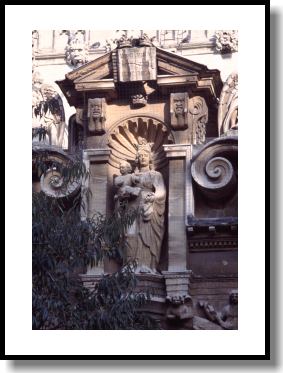
Statue of Our Lady & Child by Sir J N Comper

Posted in Uncategorized | Tagged , , , | Leave a comment

Fisher and King – saintly bishops

Jesus said to Simon Peter, “Simon, son of John, do you love me more than these?” He said to him, “Yes, Lord; you know that I love you.” He said to him, “Feed my lambs.” John 21:15   RSV

To the British public the name of Thomas More is much more familiar than that of John Fisher. But in the calendar of the Catholic Church they are celebrated together on 22nd June.

In 1504 Henry VII, King of England, appointed John Fisher to the vacant bishopric of Rochester. Writing to his mother he said, “I am well minded to promote Master Fisher … for the great and singular virtue that I see in him … and specially for his good and gracious living. And by the promotion of such a man I know well it should encourage many others to live virtuously and to take such ways as he doth.”  Fisher’s anonymous 16th century biographer wrote warmly of Bishop Fisher’s diligent care of his diocese. ” Many times it was his chance to come to such persons’ houses as for want of chimneys were very smoky, and thereby so noisome that scant any man could abide in them. Nevertheless himself would there sit by the sick patient many times the space of three or four hours together in the smoke … And in some other poor houses where stairs were wanting, he would never disdain to climb up by a ladder for such good purpose ”  (both passages quoted in ‘St John Fisher’  by Archbishop Vincent Nichols p. 91 & 92)

In 1885 The Crown appointed Edward King to the See of Lincoln. He is often remembered by Anglo-Catholics for his prosecution before the Privy Council for using candles on the altar and mixing water with the wine in the chalice when he celebrated the Eucharist. But his real saintliness of character rests on far more than this. One of the most moving stories about Bishop King concerns a young fisherman awaiting execution for murder. The chaplain could do nothing with this fierce and impenitent prisoner, and asked Bishop King if he would visit the convicted man. Nothing is known of what passed between King and the young criminal, but at the end of the visit the fisherman was utterly changed. Before his execution Bishop King heard his confession and gave him Holy Communion, saying, as he gave the Eucharistic Bread to him, “Let us consecrate the hand which did the deed.”

We in the Ordinariate who even now, in our great movement,  see the dawning of the reconciliation of the Anglican Communion with the See of Peter,  should have a special love for Bishop Fisher who gave his life in witness to the Roman Primacy. But as we do this we are to celebrate the grace of God in the heroic signs of Catholic life, recognisably lived even in those times when we were not in communion with Peter. Men and women of holiness and pastoral zeal – like Bishop Edward King – are the historical patrimony of Anglicans which we bring into the fulness of the Church.

The single Church of Christ, which we profess in the Creed as one, holy, catholic and apostolic  “subsists in the Catholic Church which is governed by the successor of Peter and by the bishops in communion with him. Nevertheless many elements of sanctification and of truth are found outside her visible confines. Since these are gifts properly belonging to the Church of Christ, they are forces impelling towards Catholic unity.”                                        

Lumen Gentium,  quoted in Anglicanorum Coetibus.


Posted in Uncategorized | Leave a comment

Parliament’s revenge or Henry VIII triumphant!

The announcement that, after all, churches would be able to celebrate ‘same-sex marriages’, has come in the past week. The Prime Minister, David Cameron, justified this move as something which forces no-one, but allows those churches who wish to celebrate such ‘marriages’ to do so.

The situation in the Church of England will be very similar to that of the re-marriage of divorcees. As soon as the State changed the law to permit second (and subsequent) marriages, every beneficed Anglican clergyman could celebrate them in his own church. Bishops might condemn such unions and the Church Assembly try to forbid them: no clergyman could be disciplined.

When the C of E tried to regulate an increasingly chaotic situation it was advised that  church legislation could not take away the right of a cleric to perform a ceremony which the law allowed. (One Bishop tried to tell his clergy that they must ask his ‘permission’, but no such permission was required from his Lordship!)

It seems that very much the same will be true for the Established Church once the state provides one-size-fits-all ‘marriage’. There are clergy queuing up to ‘marry’ same-sex couples. And they will have the legal right to do so. I imagine that General Synod will try to have a debate, and the House of Bishops may want to draw up regulations. But it suits them to be able to disclaim responsibility, breathing a sigh of relief that they will not have to come down on one side or the other.

Of course, it is the Evangelicals who will be most challenged over this issue; and the Liberals know it. They took on the Anglo-Catholics over women’s ordination and drove them into conformity or out of the C of E; now they are gearing up for the battle with the Evangelicals, and they will win it. A handful of big Evangelical parishes will raise millions of pounds to build new church premises down the road when they leave the C of E. With the conservative Evangelicals gone, most of the rest  will conform (telling themselves that the Bible does, after all, permit people of the same gender to marry).

After the loss of the conservative Evangelicals the complexion of the General Synod will change, and the Women Bishops legislation will sail through. Parliament will nod its approval, but might then decide to dis-establish the Church of England after all: just to put it in its place.

So what is it to me anyway? What right have I as a Catholic to comment on what the C of E is doing. Just this: the C of E is the Established Church in the country of which I am a citizen. Its bishops sit as part of the legislature which makes laws which affect me. Indeed, their current justification for remaining in the House of Lords is precisely that they represent me and all ‘people of faith’. Over and above that, I am deeply concerned for my Catholic-minded friends who have decided, for better or worse, to remain in the C of E. And that includes my women clergy friends. Here is the heart of the current crisis – not women in ministry, nor even gay relationships, but the subjection of the Church in England to the State.  Remember that the Oxford Movement (the Catholic Revival in the C of E) began in 1833 when John Keble challenged the Government over its decision to abolish bishoprics in Ireland.

So come on Anglo-Catholics, like me you know now that the Establishment is going to destroy the Church England’s claim to be, in any sense, a Church, let alone the Church in England. However we may have justified the Establishment as our opportunity to witness to the nation, we know now that the Government has no intention of any such role for the future C of E. What should you do? Join the Ordinariate, and find your future in the Catholic Church.


Since this post was written it has been announced that the Church of England will be specifically excluded from the right to celebrate ‘same-sex marriages’. My guess is that this will soon be challenged in the General Synod, leading to several years of controversy, debate and cliff-hanger votes. At the end of the process, will it fail in the House of Laity? And what will be the reaction of our MP’s? No prizes from this blog for foregone conclusions.

Posted in Uncategorized | 1 Comment

L J White and his music

I was coming back from the Ordinariate Pilgrimage to Walsingham with a couple of friends who have been Catholics for years. They had enjoyed the day greatly, and in particular the music and the hearty hymn singing. I would not disagree with those who believe that music from the Anglican tradition is one of the gifts that the Ordinariate might bring to the Catholic Church. So I use this as an excuse to do a short post about L. (Len) J. White. Some months ago I found a post on a Church Music website asking for details of him, but I was unable to raise anything from the Administrator when I tried to register. But Len White deserves to be remembered, as a devoted Anglo-Catholic who wrote some fine music within the English tradition – and perhaps some of his music might find its ways into our repertoire.

His best-known piece is the PRAYER OF ST RICHARD OF CHICHESTER which is to be heard still in English Cathedrals. You can hear it at

http://www.youtube.com/watch?v=5_kYVH_NSSo   and there is a choir version, too. As a curate at St Margaret’s Leytonstone, I was familiar with his Mass setting, White in E flat. It was a unison setting with organ accompaniment, and occasional harmony for the choir to show off. In the 90’s when I moved to St Andrew’s. Willesden Green, I was to find out far more about Len White, much of it from David Chellew (the then organist) who had known him well.

Len White was for many years Deputy Head of St Andrew’s School. He lived with his sister, within walking distance of the church, which had a fine musical tradition, and was Choirmaster until his death in the 1970’s. He had music published, including two masses and settings of A E Housman’s ‘A Shropshire Lad’. Among his unpublished music is a wonderful setting of the ICEL texts of the Mass, written in the last years of his life. It is amazing to me that it never became more widely known, for it is much better than the stuff which became the staple musical diet for forty years. Most of these settings are either boring, or embarassingly dated. By contrast, White’s setting is full of good tunes, singable by the people, and with a great organ accompaniment. My guess is that it would adapt to the new translation without much difficulty. Any offers?

I also have  a setting of ‘Jesus in thy dear Sacrament’ for soloist and (unaccompanied?) four part choir. I’ve never heard it sung, though on the piano it sounds wonderful. I have only a Banda machine copy!

Len White brought  a freshness and lightness – and an Englishness – to the music at Willesden Green, which is in contrast to the earlier choir books with their heavy adaptations of Gounod and Mozart to Cranmer’s words!

Although we can and do enjoy the great celebrations of the Ordinariate – the Walsingham Pilgrimage and Solemn Evening Prayer at Spanish Place – it is going to be in our groups and parishes that our contribution to music and worship is going to be of most effect. I argued in my last post for a truly Catholic (and catholic) approach to our music. We rule (almost) nothing out – from plainsong to Graham Kendrick – as we lift our hearts and voices, singing with the angels in praise of the Father, the Son and the Holy Spirit.

Posted in Uncategorized | Tagged , , , | 4 Comments

Sing we of the blessed Mother

Oxford: Archbishop Laud's Porch

Oxford: Archbishop Laud’s Porch

Many Anglicans know the hymn, ‘Her virgin eyes saw God incarnate born’. Some forty years ago I found and memorised this verse: I think that it is by Thomas Ken and belongs with that hymn. The verse  teaches both the immaculate conception of Mary, and the continuing tradition of her life free from sin.

The Holy Ghost his temple in her built, / Cleansed from congeni’al, kept from mortal guilt, / And from the moment that her blood was fired / Into her heart celestial love inspired.

Thomas Ken (1637-1711) was Bishop of Bath & Wells. He  is  the most famous of the ‘Non-Jurors’. He joined nine other bishops (including Sancroft, Archbishop of Canterbury) and 400 clergy who were deposed for their refusal to take the oath to William and Mary after the so-called ‘Glorious Revolution’ of 1688.

This verse does not appear in the English Hymnal which perhaps points to the need for an Ordinariate Supplementary Hymnal. Now what ought to be included in that? The word ‘included’ is the key one for Catholics (as opposed to a policy of ‘exclusion’). Have you ever noticed: Catholics will sing virtually anything proposed for a ‘Unity Service’ – but our fellow Christians have a long list of hymns they won’t sing. It leads us into some wonderful ironies, as, for example, the sound of a church full of Catholics singing ‘Be still, for the presence of the Lord’ before the Blessed Sacrament. It’s not quite what its author envisaged, I guess.

Go to  http://www.youtube.com/watch?v=uLd9n3DfGpw and just read those words and you will see why we sing it.

Posted in Uncategorized | Tagged , , , , | 1 Comment

How does the Ordinariate grow?

The People of God

The People of God

They praised God and were looked up to by everyone. Day by day the Lord added to their community those destined  be  saved.                                           Acts 2:47   NJB ________________________________________________________

The subtitle of this post is ‘Tall with glasses, sits near Jane.’ I’m not going to explain straightaway how it came to be called this, but anyway the post is about welcoming new people.

Everyone  agrees  that we want to welcome people.  We want people to hear the Good News about Jesus Christ and come to share our faith. We want to see our Ordinariate groups grow. At least we say we do. But too often what we say is not born out by what we do. I want to think through with you how you and I could make our groups and our churches more effective in welcoming people to worship, and helping them to stay welcome, as they find their way into the life of the Church – as once we did.

Now there’s something – as once we did. None of us is worshipping in the church where we were baptised, confirmed, and brought up. So at some point we made our first visit to the church where we now feel so at home. Can you remember what it was like? What happened? How long it took? Why you stayed? And whether you tried anywhere else? For, you see, if you could answer these questions it would be invaluable in helping you to be effective in getting your group to grow.

So let’s think first about what sort of people are coming for the first time to your church.

1.  TRANSFERS

These are people who have come from  another church. They may have moved house; they may have fallen out with people at the other church; or they may be like us in the Ordinariate. What sort of welcome did we receive when we came into full communion? They will appreciate a friendly welcome – they will be looking for and trying to find information – so a welcome pack with details of your group and church may well be useful – don’t push Mass cards at them during the service, for they may well know the Mass as well as you do. You may never see them again, of course, because they may find the worship at your church a complete turn off.

Do remember that people who start coming to you because they have had a disagreement at another church are not an unmixed blessing. We are a competitive lot, and hearing someone tell us that they just couldn’t stay at St X’s because the new vicar was ?? – and that’s why they’ve come to you – this can be very flattering. Just occasionally such people are real trouble and before you know it they are creating just the same trouble as they caused at St X’s – though of course it’s never their fault. It’s another reason for not asking people to take on anything until they have been with you for a while.

2.  VISITORS

You won’t see visitors again until perhaps next year. They may have dropped in because they saw your church as they drove to their hotel. So a big clear notice-board is vital for attracting visitors– and just as important these days, an up to date web-site. And remember, that they will talk about you when they get home. By the way, let me ask again why Catholic Churches often don’t advertise Christmas Masses on their outside board? It’s not enough just to assume that the regulars will read the Sunday Bulletin.

3.   RETURNERS

People lapse from the Church for all sorts of reasons – and then return. God touches them; there is a change in their life – and they come back. Treat them gently. Don’t rush their return and don’t immediately drag them back into jobs! If they left because of a falling out, that needs to be resolved. Priests, remember that making your way back via the Sacrament of Penance is not easy. Be sensitive and give people your time. There is joy in heaven over one sinner who repents!

4.   SEEKERS

You never know what draws someone over the doorstep, and you don’t know at what stage they are in their relationship with God. Be warm, but not pushy. Let them sit in the back row – which is why the regulars mustn’t be sitting there, they need to be up the front. If you are sitting next to someone new help them gently and discretely – no-one wants to be made to stand out as ignorant. Remember the times of awkwardness – like going to communion. If the person wants to stay where they are, that’s fine.

5.  THREE-WHEELERS

Not so many these days are the people coming for the ‘official occasions’ – a funeral, a baptism, a wedding. You might want to add those people who come just for Christmas. Make sure your Sunday Bulletin is up to scratch – and stewards, make sure they are taken home. And of course, the quality of the worship, the preaching and the sense of engagement by the people – remembering that you have an hour or so to touch these people, that’s all.

QUALITY OF THE WORSHIP

One Sunday, try to take part in the Mass at your church as if you were a new-comer. Can you hear the readings (why do people read without preparing and without understanding what they are saying?) Is the homily saying at least something to you? How do you know which of the three books and four pieces of paper you are supposed to be following? Why are people invited to coffee and then left to find the Hall which is 200 yards away round the corner?

Priests – why do you talk in that bored, sing-song voice? Why do you never smile? And I know that Fr Lacey Cotta never announced hymns, but could you not consider at least the first one? Not everyone these days realises that the board with a set of numbers on it refers to the green book with the funny title  ENGLISH HYMNAL.

AT THE DOOR

Coming through the door will have taken a huge amount of courage. The role of the welcomers is absolutely crucial – in fact they are the first people that the newcomer meets.  They need training. Learn to look people in the eye; smile; say, ‘Good morning, welcome to St Gloria’s.’  When you are on duty you may not spend time talking to your friends. That’s not what you are there for.

FOLLOW UP

Let’s assume that on this Sunday you noticed a couple sitting near the back, and half way down the nave a youngish man. Who were they? How do you find out? Did anyone speak to them? Does it matter, anyway? Perhaps they will come back next week – or perhaps they won’t? Anyway – Father will have shaken hands with them, won’t he … w – eee –l – no, he didn’t actually, because Marjorie had button-holed him about the flowers at the Sacred Heart, and you know how she goes on …

Yet, even if we have got the welcome bit right – what about some after-care?

GETTING TO KNOW YOU – ETHNIC, AGE AND CULTURAL DIVIDES

Follow-up is difficult if no-one really knows who the newcomers are! And even more difficult if the regulars do not know each other. In our groups of 25-30 that  ought not to be so difficult – if people really want to know each other. I know that these days people do not necessarily come to Mass every Sunday. For months and months our pastoral team, trying to keep a track of the ever changing congregation in our  parish, used to put a tick beside someone called, ‘Tall with glasses, sits near Jane.’ Devout, regular at Sunday Mass, with very little English and no desire to come to socials or teach the Junior Church, ‘Tall with glasses’ stayed with us for about nine months and then was never seen again. Yet perhaps this reaction was the same as the three young Polish women who came to us for a month, and told me that they were returning to Poland filled with hope that the Church could be renewed and come alive because of what they had experienced on the four Sundays they had worshipped with us. ‘Go with God’, I say – we had done our part in their spiritual journey.

Here are some suggestions.

Get everyone in the congregation to accept that, as soon as the last hymn is over, they will turn to the visitor or stranger next to them, and say how good it is to see them. If they won’t, then include it as part of the notices. (Once when I was in France, the elderly lady next to me, said nothing – I expect she felt awkward because I was English – but held my hand and patted it. I suddenly felt part of a church where I had been going to, once a year for 15 years, and no-one had spoken to me.  It doesn’t take much. But it does take something. And just a hello from the priest at the door is not it!

I suggest using a WELCOME CARD – if you have pews screw a couple of plastic holders to each one with a stock of cards and a couple of pencils – a bit like IKEA. If you have chairs, screw the holder on to the end chair. The WELCOME CARD asks for a name – and address – actual or e-mail. It asks whether the person would like to receive a WELCOME PACK or a HOME VISIT. You need a prominent collecting point just by the door. Early the following week a designated person – preferably the Parish Secretary or Administrator if you have one – goes through them – e-mails or posts WELCOME PACKS to those who have asked for them. And then gives the names and addresses to the VISITING TEAM to follow up within the next 10 days. These days it’s often a good idea to phone rather than just call. Even a card through the door to say, ‘Dave from St Gloria’s called to welcome you to the Parish’ is useful.

Notice that I haven’t mentioned the priest visiting these new people. New people need someone in the congregation to sit with when they come the second time. They can’t sit with the priest if he is their contact – so I advise lay-visiting of new-comers.

WELCOME GROUPS

My Catholic Parish holds  a WELCOME MASS and Refreshments every so often. In one central London church everyone filling out a card was then invited to the next WELCOME EVENING – coffee, light refreshments, a video and introductions. No-shows were invited a second time – but then their card was simply filed away – no further action. You can’t keep pushing people.

CONTINUING NURTURE

Many of our churches have started to realise that Christian nurture is a long and on-going process. Many of the people who come to us as SEEKERS will have little or no knowledge of the Christian Faith. And those who come as TRANSFERS (those who used to be called ‘converts’ but who may have been devout Baptists for many years)  may well be entirely new to Catholic worship, prayer and discipline. Does the parish run RCIA, and what about Catholic Alpha?  Could the Ordinariate group sponsor and help in the programme?

The growth of the Church can no longer be left to chance, the children in the Catholic School, and the vague hope that, even though people lapse, ‘I’m sure they’ll come back at some time.’ They won’t because they will have moved, and with every move away they become less likely to go to church. New people, welcoming and nurturing them into the life of the Parish ought to be high on the agenda of the Ordinariate and seen as something which everyone in the group does. Many of us don’t do it because we are afraid of people’s reaction. The technique is just to go for it. Jesus loves those new people – but they will only know that if the Lord, in you, smiles at them, takes their hand and invites them to sit next to you at the table of the Eucharist.

______________________________________________________________________

The “door of faith” (Acts 14:27) is always open for us, ushering us into
the life of communion with God and offering entry into his Church. It is
possible to cross that threshold when the word of God is proclaimed and the
heart allows itself to be shaped by transforming grace. To enter through that
door is to set out on a journey that lasts a lifetime. It begins with baptism
(cf. Rom 6:4), through which we can address God as Father, and it ends
with the passage through death to eternal life, fruit of the resurrection of the
Lord Jesus, whose will it was, by the gift of the Holy Spirit, to draw those who
believe in him into his own glory (cf. Jn 17:22). To profess faith in the
Trinity – Father, Son and Holy Spirit – is to believe in one God who is Love
(cf. 1 Jn 4:8): the Father, who in the fullness of time sent his Son for
our salvation; Jesus Christ, who in the mystery of his death and resurrection
redeemed the world; the Holy Spirit, who leads the Church across the centuries
as we await the Lord’s glorious return.

Porta Fidei (October 2011)    Pope Benedict XVI

Posted in Uncategorized | Leave a comment

Who are these, like stars appearing?

Eric Mascall 1905 – 1993


What is man, that thou art mindful of him? * and the son of man, that thou visitest him?    Psalm 8:4 (Book of Common Prayer)
What are human beings that you spare a thought for them, or the child of Adam that you care for him? (NJB)

As the life of the Ordinariate unfolds, so it becomes a little clearer what the ‘Anglican Patrimony’ might be; what it is that we bring from our Anglican heritage into the fullness of Catholic Communion. In this post I want to suggest that we have had some remarkable theologians, including those of recent times. Indeed, I think Fr Aidan Nichols OP has actually called Dr Eric Mascall a ‘separated Doctor of the Church’.

In 1940 Eric Mascall contributed to a series of paperbacks entitled ‘Signposts’. The purpose was described thus:

” This series consists of twelve books, written by young theologians and philosophers of the Church of England. It is the common conviction of the writers that only the authentic Christian tradition has the answer to the problems which beset the present age, and that only by a return to that tradition can disaster be avoided. Such a return is no mere reaction but rather the necessary prelude to progress, for Christian Theology is a signpost warning Homo Sapiens of the precipice that lies ahead and directing him back to the high road of human fulfilment. There is a widespread notion that Theology is irrelevant and out of date. In actual fact, Theology answers those very relevant questions about the origin and purpose of the world in which we live that come naturally to the lips of every child, and for lack of an answer to which modern civilisation stands today on the brink of suicide. What is out of date is not traditional Christian Theology, but the multitude of present-day attemts to ‘bring it up to date’. The reader of this series will find himself in regions beyond a Modernism which has already become outmoded. He will also find himself in the congenial and bracing climate of an ancient Faith. ”

Dr Mascall writes:

“At a time such as this it falls to the Christian Church to proclaim that man is made for God and for nothing less than God, and that, in consequence, because a man must pass through this earth on the way to heaven, all th things of this life, if they are used in accordance with the will of God, can play their part in getting him there. The words which a great Florentine Archbishop wrote 500 years ago still stand as the true expression of the place that the things of this world hold in the life of man: ‘The object of gain is that by its means man may provide for himself and others according to their state. The object of providing for himself and others is that they may be able to live virtuously. The object of a virtuous life is the attainment of everlasting glory.’ (St Antonino of Florence, Summa Moralis, I,i,3,iii.)  And this everlasting glory is nothing less than the Vision of God. ” (Man, his Origin and Destiny    p.40)

Dr Mascall is no less clear about the implications of the Doctrine of Man for modern life:

“It is perhaps in the realms of economics and international politics that the frustration of our civilisation is most clearly to be seen…. The purpose of the economic and financial organisation of a community – the thing that economics and finance are for – is to facilitate the production of the material goods that men and women need and to distribute them where they are wanted; and this without damage to the higher values of human life. It includes, for example, such things as getting potatoes grown and seeing that we are given them to eat. Now capitalism – by which is meant the economic order under which most of the world lives today and under which the primary purpose of any business concern is to produce money for the people who have invested in it – has never succeeded in doing this; ever since the Industrial Revolution, and even in the palmiest days of Victorianism, there have been vast masses of people who were producing things which, however much they needed them, they were not allowed to consume, and on the other hand a few captains of industry and finance who had things they did not really need…. Captitalism therefore never succeeded in fulfilling the proper function of an economic order, namely the production and distribution of goods (and, as it never set out to do so, we need hardly be surprised at this, though many people seem to be … for, whether capitalism is right or wrong the plain fact about it is that it simply is not working.  ”  ( Ibid. p.13 )

Is it too much to hope that the Ordinariate might raise up from among its priests and from its laity – both men and women – a group of young theologians and philosophers who might speak again with clarity of the origin and destiny of Man (Humanity, if you prefer)? Sucn theological underpinning is desperately needed, for without it we have no basis on which to discuss such pressing concerns as genetic research, the preservation and prolongation of life through medical intervention, and a host of other ethical imperatives.


What used to be the fertile European root of culture and progress appears to
have been forgotten ….                                                                                Pope Benedict XVI


Posted in Uncategorized | Leave a comment

An English Use for the Ordinariate?

The renewal of worship is central to the life of the whole Church and every individual Christian. In the service of worship the performance of the liturgy with care, devotion, reverence, fine ceremonial and good music – but equally with warmth, passion and loving-care for one’s fellow worshippers – is vital.

_______________________________________________________________________

Day and night they never stopped singing: Holy, Holy, Holy is the Lord God, the Alnighty, who was and is and is to come … the twenty-four elders prostrated themselves before him to worship the One who lives for ever and ever, and threw down their crowns in front of the throne.                                           Apocalypse (Revelation) of John 4:8f  (NJB)

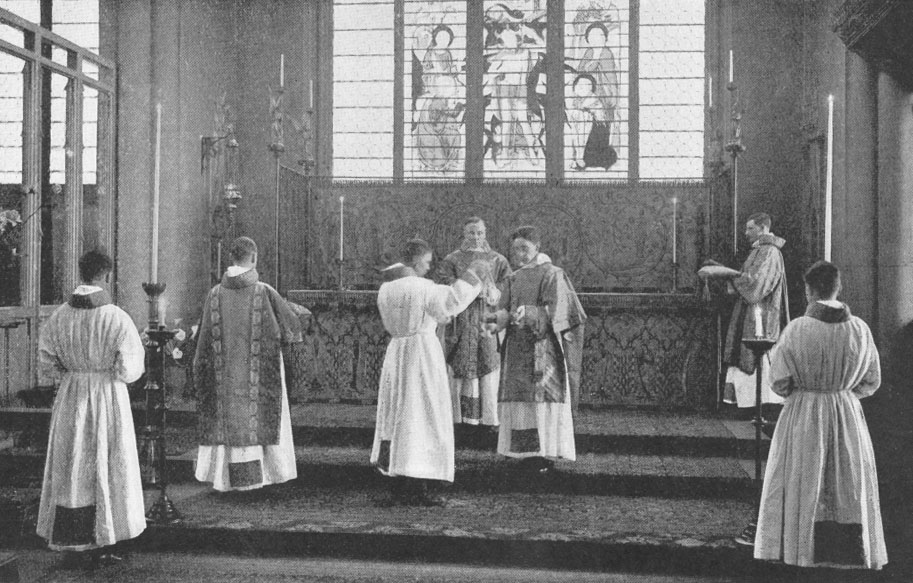
Leafing through my late father’s music copy of the English Hymnal, looking for a tune, I came across the hymn by T.A.Lacey which begins, ‘O faith of England taught of old/by faithful shepherds of the fold/the hallowing of our nation.’ The magnificent 16th century tune (which you can find on youtube at http://www.youtube.com/watch?v=v5L7Vpk1GpA is by Matthaus Greiter and called in English Hymnal  ‘Psalm 68’. In a moment I was back forty years, in the Great Chapel of the Kelham Fathers, in Nottinghamshire, taking part in the Procession at the end of first Evensong of Whitsunday (it seems a curious choice of hymn, but I think I’ve remembered the occasion rightly). Processions were always headed by the crucifer and acolytes, wearing albs and apparelled amices (the crucifer in a tunicle) and the thurifer and boat bearer followed, for Kelham followed the English Use.

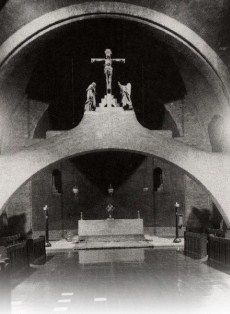
Great Chapel Kelham

Recently there has been some talk about an English Use in relation to the first ‘Prayer Book’ rites now authorised for the Ordinariate.  In the course of this post I want to ask two questions:  what is the English Use, and has it any place in the thinking and planning of the Ordinariate today?

Prior to King Henry VIII’s break with Rome, it was the latin rite of the Roman Church which was in use throughout England, and at the heart of the Mass was the Roman Canon or Eucharistic Prayer, symbolising the communion of the local diocese with the Bishop of Rome. The various Uses differed in things like liturgical colours and points of ceremonial during the celebrations.

The instructions for ceremonial in the Prayer Books of Edward VI and Elizabeth I are extremely meagre, and even under the Caroline Bishops there is little that could be said to constitute an English Use. The Holy Table was to be covered with a ‘carpet’ of silk or other material, and a white cloth when the Holy Communion was celebrated. The celebrating priest was to wear the surplice (with the cope retained for use in Cathedrals). True there was the Ornaments Rubric which referred to the second year of King Edward VI as the standard for what was (and was not) to be used in the services of the Church of England. But until the 19th century it was generally held that the Rubric had been superceded.

This was challenged by the Oxford Movement in the 19th century. This Catholic Revival held that the Ornaments Rubric must hold its face value: although it had never been implemented, now was the time to make sure that the Prayer Book liturgies were conducted with all the ceremonial permitted in 1548/9.  But while one group of 19th century Anglo-Catholics worked to try and devise an English Use, another thought it was a waste of time.  This latter group tried to fit the then current rules of the Sacred Congregation of Rites for the celebration of the Mass to the services of the Prayer Book.

In the late 19th century English Use churches were often rather exotic, spreading rushes and herbs on the sanctuary floor. Much work was done to research and sing mediaeval plainchant, and in the revived gothic architecture, stained glass and rich fabrics, to create an atmosphere of continuity with the Middle Ages. In the early work of (Sir) John Ninian Comper we have the most exquisite examples of the revived mediaeval style, seen perhaps most perfectly in his re-furnishing of the church at Cantley, near Doncaster. The altar provided the prototype for countless ‘English’ altars which were installed up and down the country subsequently. The altar is without shelves or ‘gradines’ and with its two candles and crucifix is low in profile to fit underneath the east window. Posts called ‘riddels’ stand at the four corners and are surmounted by candles. In the roof over the altar is a canopy or ‘tester’ from which hangs the pyx in which the Blessed Sacrament is reserved. (This method of Reservation of the Eucharist was universal in England until the Reformation)

The most significant  figure in the development of a characteristic English Use in the Church of England was the Revd Percy Dearmer, who became Vicar of St Mary’s, Primrose Hill, London in 1901. He had already written ‘The Parson’s Handbook’ which sought to clothe the services of the Book of Common Prayer in Catholic Ceremonial, derived from pre-Reformation England. Dearmer was a man of great taste, a poet and musician, with much common sense. (The Parson’s Handbook contains considerable practical wisdom about the design of churches and the care of liturgical furnishings and vestments.) He was also strongly ‘anti-Roman’, with little appreciation of the classical or the baroque in design or architecture, and a loathing for what he regarded as the commercialisation of church art.

The English Use?

Dearmer publicised what became the norms of the English Use: full and flowing vestments instead of the attenuated ‘latin’style; servers wearing albs with the distinctive ‘apparels’ at the neck, cuffs and skirt; long surplices instead of short cottas, and never a trimming of lace on anything or anyone! He lowered sanctuary levels, lengthened altars and would not allow any more than two candles, modest in height. (One of the obvious distinguishing features of a ‘Western Use’ church, was its row of six tall candlesticks often on a gradine, behind the High Altar.) In a reaction against the vivid coloured brickwork of the high Victorian architects, he advocated whitewashing church interiors, as a background for furnishing and richly coloured hangings.

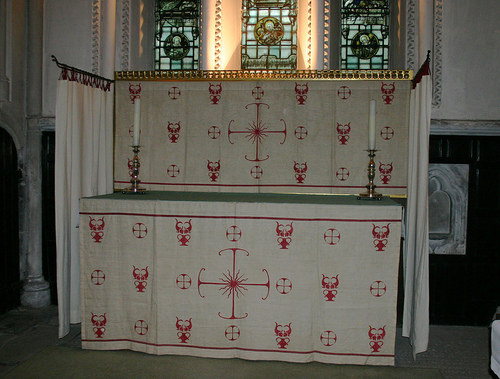
In a striking divergence from the Roman use, altar frontals and hangings in Lent were made of cream unbleached linen marked with the instruments of the Passion in red and black. Statues were covered throughout Lent in veils of the same colour. The practice in newly whitened churches was austere and effective, no doubt.

Dearmer argued his case that his English Use was entirely loyal to the Church of England and its Prayer Book. Thus the Use spread rapidly and was adopted by many of the Cathedrals. It was safe and it was defensible. But unlike Ninian Comper, Dr Dearmer was rather quiet about the place of the Blessed Sacrament which, in its pyx above the High Altar, had been such a centre of devotion in the Middle Ages. Anglican Bishops were at best nervous of, and at worst belligerently opposed to, reservation in Parish Churches.Dearmer would allow no place either for the Elevation of the Host in the Eucharistic Prayer.

To continue then, the authority for such an English Use was, in the end, just Percy Dearmer himself, and he was not averse to using some pretty tenuous arguments for what he liked. (Anglican clergy are good at that!) Later in life he was to become more and more liberal in his theology, advocating the ordination of women and intercommunion with the Free Churches.

In the early years of the 20th century the Liturgical Movement in the Catholic Church was growing in strength and influence. It had received a boost from the reforming papacy of Pope St Pius X, and reflected his concern that the laity should be able to participate in the Mass and other celebrations. Thus began the restoration of the altar as the place of sacrifice and communion, rescuing it from its position as a sideboard to support the tabernacle and Benediction throne.  The scholarship of Geoffrey Webb in his book, ‘The Liturgical Altar’ began to influence the design of Catholic sanctuaries in this country.

It is one of those curious paradoxes that, at about the same time, the Anglo-Catholics in England were deriding Dearmer’s work as ‘British Museum Religion’ and installing Baroque furnishings in their churches.

It would be easy to miss the significance of Ninian’s Comper’s developing thought on the altar in the churches he built in his long career as an architect, simply because he continued to use historical styles, Gothic and Classical, often blended with assured beauty.

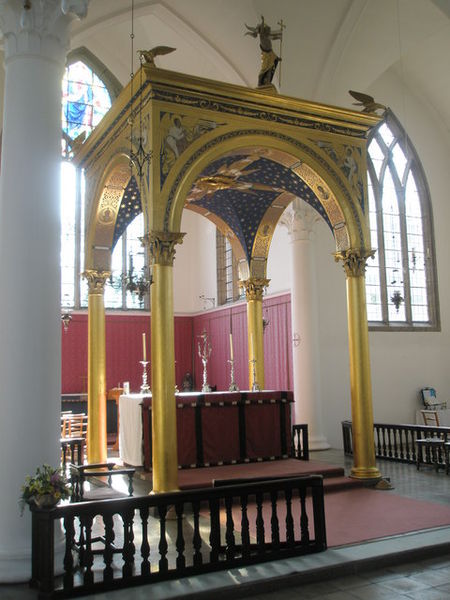
In this picture of St Philip’s Cosham, in Portsmouth, we see that Comper has left behind the English Altar. Now the altar standing stands almost in the centre of the church, and is given significance not by tall candlesticks or towering reredos, but by the use of a baldachino or canopy on pillars. Some believe it to be the most coherent modern church in England. (Compare and contrast the work of Basil Spence in the design of the Cathedral at Coventry.)

As the impact of the liturgical reforms of Vatican II became clear is seemed to many Anglicans the Catholic Church had now taken on board much of what the Reformers had argued for so many years earlier. The liturgy was now in the vernacular, with the full participation of the laity. Vestments were  cut in much fuller shape and cottas rivalled surplices in length.  With the changes in the Eucharistic rites of the Church of England there seemed to be a real convergence, and ‘Ritual Notes’, the handbook for the Western (Roman) Use was no longer needed: you simply read the introduction to the new (Roman) Missal and then celebrated Series 3 or the Alternative Service Book according to the rubrics.

The liturgical reforms were enthusiastically received by the majority of Anglo-Catholics, certainly by those who were working and praying for reunion with the Holy See. Indeed, it seemed as is attachment to the old ways was greater now among the more liberal elements. Perhaps just one example will suffice: it is quite common still to see in Anglican Cathedrals, the celebrant assisted by a ‘deacon’ and a ‘subdeacon’ . The ‘orthodox’ or ‘traditionalist’ Anglo-Catholics largely gave up this form. In any case priests would usually concelebrate rather than offering a ‘private’ Mass.

We come then to the question of whether an ‘English Use’ can now be devised for former Anglicans, now Catholics, in the Ordinariate (and indeed, whether it should be) . There are those who argue that Anglo-Catholics in England have celebrated the Eucharist perfectly happily for the last forty years according to the current rules and customs of the Roman Catholic Church, in what we now call the Ordinary Form. Perhaps they have done so in a rather more conservative way than among Catholics in England. High Altars have often remained intact, becoming the place of reservation; servers have retained the cassock and cotta, and incense is always used at the principal Mass on Sunday. It is surely this unobtrusive influence which might be valued in the Catholic parishes,  for it is, I think, the ‘noble simplicity’ desirable in liturgical worship today.

We are in a missionary situation in England, and we need to get on with evangelism, teaching, pastoral care of our groups, formation of the clergy – good liturgy, certainly, but on the whole we’ve got that and we’ve had it since we embraced cheerfully the liturgical work of the Second Vatican Council. That came to Anglicans like manna from heaven, and I believe we have interpreted it wisely. Please God we shall continue to do so within the full communion of the Church and with the deep assurance that such communion brings us in our life and work in the Ordinariate.

The liturgy involves universality, and this universal character must enter ever anew into everyone’s awareness. Christian liturgy is the worship of the universal temple, which is the Risen Christ. His arms are extended on the Cross in order to draw all men into the embrace of God’s eternal love. It is the worship of heaven opened wide. It is never merely the event of a single community, with its own position in time and space. It is important that every Christian feel and really be inserted into this universal “we”, which provides the foundation and refuge for the “I” in the Body of the Christ, which is the Church.

Pope Benedict XVI

I have tried not to use copyrighted images in this post. If I have please let me know and I will remove them.

Posted in Uncategorized | 5 Comments

We have a Gospel to proclaim

 For if I preach the gospel, that gives me no ground for boasting. For necessity is laid upon me. Woe to me if I do not preach the gospel!  I Corinthians 9:16   RSV

What is this ‘patrimony’ which Anglicans are being encouraged to bring with them into the Catholic Church?  High on my list would be good preaching. Anglicans have inherited this from the Reformation, when the preaching and teaching of scripture as the word of God were restored as belonging to the heart of  the minstry of the clergy. There is no conflict with Catholicism here, for the Council of Trent declared preaching to be praecipuum episcoporum munus   ‘the principal office of bishops’.  We should be glad that we have in Pope Benedict XVI a teaching Chief Bishop. The collections of his homilies and addresses on the Mass and on our Lady, are shot through with biblical teaching. He quotes scripture with insight and with clear love of God’s word. His expositions of the psalms in  A School of Prayer  bring freshness expecially for those who recite the psalms daily in the Divine Office, and are perhaps temped to rush through them.

Preaching then, flows from the reading of scripture; it aims to ‘break’ the word of God so that the people may be fed by the Lord Jesus himself, and that we may say with the dsiciples on the road to Emmaus:  ‘Did not our hearts burn within us  as he talked to us on the road and explained the scriptures to us?’  (Luke 24:32)  One of the worst sermons I have heard illustrates only too well what happens when the priest does not begin and end with the Bible. It was preached at a priestly anniversary, and consisted mainly of embarrassing reminiscences of the celebrating priest’s life, to which were attached some sentimental observations about priesthood. What a missed opportunity!

The homily or sermon is an integral part of the celebration of the Sunday Mass. The priest has an obligation to prepare his sermon with care, basing it firmly on the scriptures for the day, trying as best he may to make clear their meaning and to suggest ways in which we may put the teaching of the Lord into practice in the week ahead. Careful preparation is part of the respect due by the priest to his people for the trust that they put in him and the attention that they pay to his words. We should come with expectation and it will be a great encouragement to the priest to see us alert and listening. It may not be the custom everywhere in England for Catholics to shout ‘Yes, Jesus’ when the preacher makes an inspiring point – but it is a delight to see a congregation smile perhaps, or nod in agreement.

But if the preacher has a right to our attention and concentration, then he owes it to us his people to preach with care, with devotion and with inspiration. Very few clergy can preach these days without a text in front of them or at least very full notes. The magnificent speeches of Winston Churchill took hours of the great man’s time, and were crafted and then learnt by heart. We should be ready for a Sunday homily of about 12 – 15 minutes (we do not listen to long sermons as the Victorians did) and the priest must use every minute, speaking with clarity, with his quotes and authorities prepared. The delivery must be strong and authoritative, yet gentle and fatherly. Sometimes the priest will need to admonish, and his words will not always be popular. A wise and trusted priest will say these things without moaning or bullying, and everyone will recognise that the first person he is speaking to is himself!

The lectionary is a precious gift to God’s people. Over the three years of its Sunday cycle we hear all of the Gospels, most of the remainder of the New Testament, and a representative selection of the Old Testament. The preacher at Sunday Mass begins from the Scriptures for that day: he does not start with a theme or idea of his own, and then put in Bible references to make his point. The preacher is under the authority of the word of God and is humble before it.  Certainly the homily is the place in the Mass where the personality of the Celebrant will be most seen (and hopefully, most appreciated) but let the preacher beware of hobby horses: he must neither avoid difficult subjects not force them into every sermon he preaches.

It is the custom of some clergy to preach at the daily Mass, and this is both an inspiration for the people and a good discipline for the priest. The time is limited for people may be on their way to work or school in the morning, or tired after a day’s work. The priest therefore sets himself to preach on the Gospel in five sentences, no more. It is not easy, and you may make perhaps only one simple point. In the forty days between leaving the Church of England and being received into the Catholic Church, I went every day to Mass. I was, of course,  unable to go to Communion, but how much I appreciated  the daily homily, which fed me at the table of the word when I was unable to go to the table of the Eucharist.

I would like to ask you to benefit from the journey we shall be making in the forthcoming catecheses (0n prayer) by becoming more familiar with the Bible, which I hope you have in your homes. During the week, pause to read and meditate upon it in prayer, in order to know the marvelous history of the relationship between God and man, between God who communicates with us and man who responds.      

Pope Benedict XVI   Abraham’s Prayer  18th May 2011


Posted in Uncategorized | Tagged , , , | 4 Comments