Liturgical colours and the rhythm of the Christian year

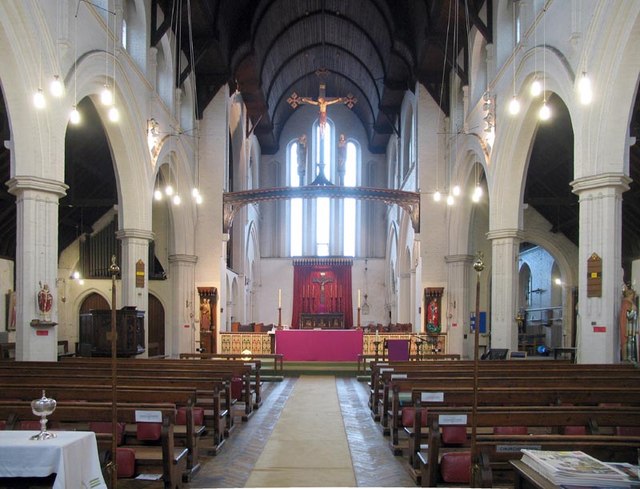
York Minster – the High Altar in Advent

One of my hopes for the Ordinariate in the UK is that it would introduce into the Catholic Church something of the Liturgical Revival which overtook the Church of England from the end of the 19th century until the 1960’s. This remarkable movement transformed English Cathedrals and many Parish Churches, but is now in danger of being swept away in the C of E. Although some of its protagonists delighted in reviving elaborate mediaeval ceremonial (thus rightly earning the mocking title ‘British Museum Religion’ from other Anglo-Catholics) many more confidently adapted the findings of liturgical researches to the liturgical needs of their day.

But there was more to it than that. Many of the leaders of the Movement were appalled by the poor quality and dowdiness of much that was placed in church buildings, and the fussy and thoughless ceremonial that was then current. They believed (as I think Pope Benedict did) that there was a moral quality to beauty. Ugliness was not “all just a matter of taste” but could be debilitating, and even soul-destroying. Believing that it is our duty and our joy to celebrate the sacraments – no matter how simply and in whatever humble circumstances – with reverence, care and beauty – I continue to offer these reflections.

The following of the Liturgical Year is one of the great joys of being a Catholic Christian. It enables us, through story, song and action (scripture, music and liturgy if you prefer) to proclaim and live out the wonder of our Redemption – God’s love for the human race in creating us, sending his beloved Son to live among us, teach us and to die and rise again, and to celebrate the gift of the Holy Spirit in every age of the Church. Through the Liturgical Year the action of God leaps out of the past, and becomes real in our generation.

The Second Vatican Council continued the renewal of the Liturgical Year as it had been begun by Pope Pius XII in his restoration of the liturgies of Holy Week and Easter. They greatly simplified the Calendar, reasserting the primacy of Sunday and abolishing the keeping of Octaves which tended to overlap and create confusion. Thus the seasons followed each other – Advent, Christmas – Winter Ordinary Time – Lent, Easter culminating with Pentecost, and then Summer Ordinary Time through to Christ the King and the end of the Liturgical Year.

The provision for the Ordinariates elaborated this scheme, re-introducing the time before Lent (the ‘gesima’s), the two weeks of Passiontide of which Holy Week is the second, and the Pentecost octave, as well as numbering ‘Sundays after Epiphany’ and ‘Sundays after Trinity’. Whether this was helpful is not within the scope of this article to comment! But what I do want to draw your attention to is the way in which the so-called ‘Roman’ liturgical scheme is unhelpful in the case of Lent, and a modification in an ‘English’ direction could be both clearer and more logical.
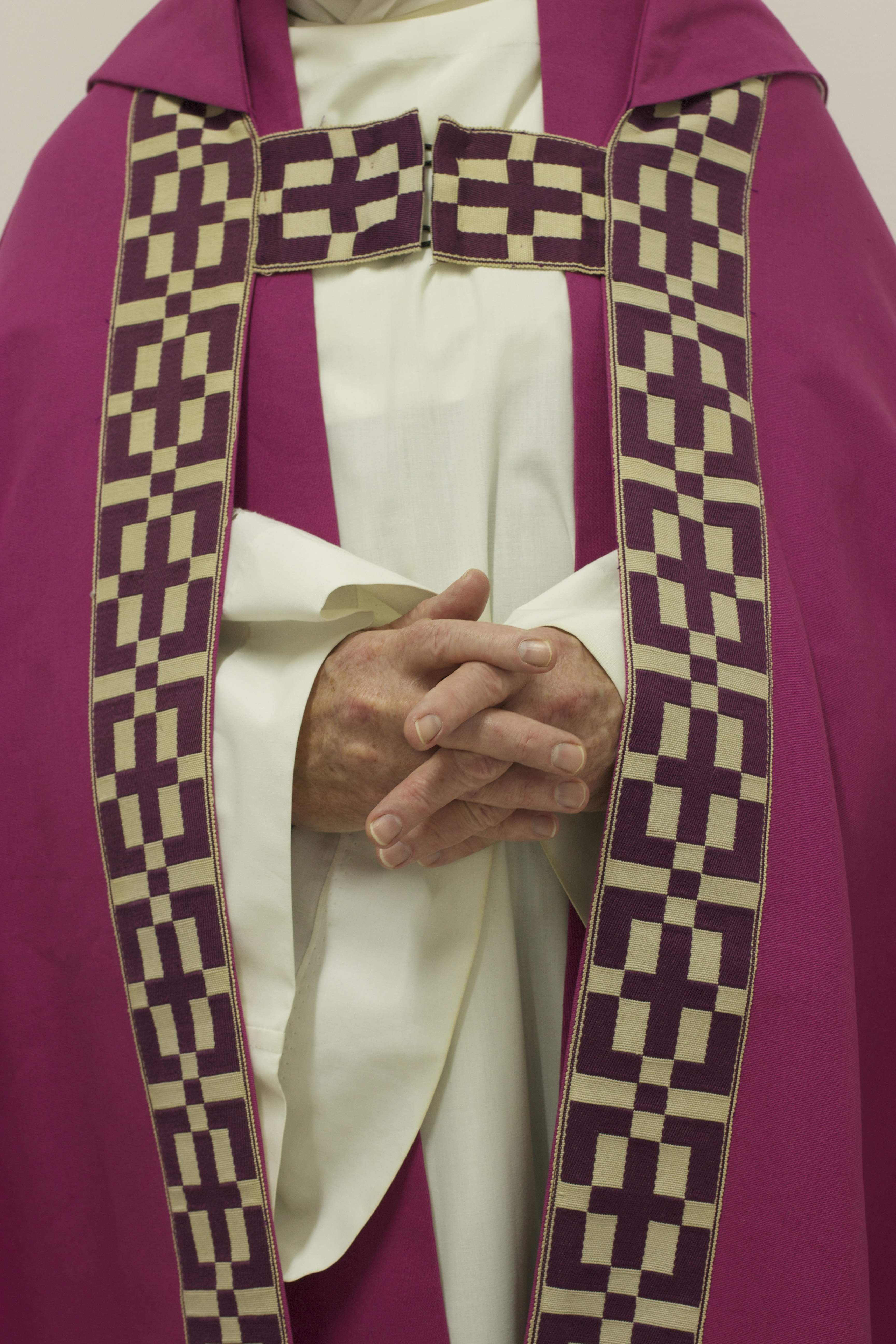
Purple – the ‘right’ colour for Advent and Lent and Passiontide?

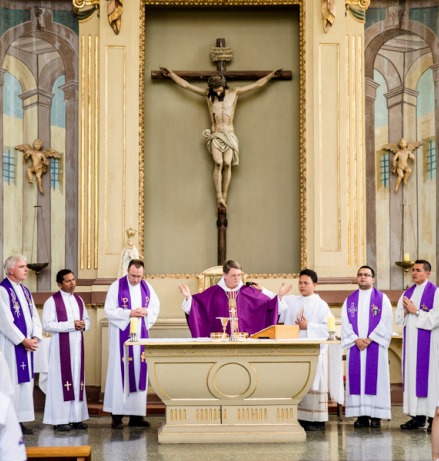
The colour purple is used in the basic ‘Roman’ scheme for Advent and Lent (including Holy Week), as well as for funerals. As a colour it is a mixture of blue and red – more blue and we usually call it ‘violet’, more red and we call it ‘Roman purple’. Although it can speak of preparation, mourning and sombre reflection, it also has notes of splendour and regal kingship. It is particularly associated with this last quality as the production of purple die was a costly business before the invention of chemical dyes. None of the shades though violet to purple is easy to match and contrast with other colours and it is not diffcult to make awful mistakes in church. Black, silver and grey are good for linings and orphreys – red and yellow are dreadful! Just be careful if you are buying a chasuble ‘off the peg’ , or getting an enthusiastic member of the congregation to make a frontal or banner.

So to Lent – and the Gesima Sundays of pre-Lent because you are an Ordinariate Parish. Ten weeks or so before Easter you go into purple; Ash Wednesday arrives – no change; Passiontide – no change; Holy Week – no change (I acknowledge that you might have the Palm Sunday Procession in red, and Good Friday too) But those parishes in the C of E which followed an English Use marked these changing seasons with a change of colour. The Gesima Sundays of pre-Lent were in violet or dark blue. (Whether blue was in fact faded violet is another question!)

A blue altar frontal

The blue altar frontal above is a splendid example. The contrast of the dark blue with the orange fringe is inspired. (Quite why the cross is veiled in white and the doors of the reredos closed – suggesting – Lent – I do not know. )

Please note that this blue is not – definitely not – the blue sometimes now sold by the Church Furnishers – as the appropriate colour for the Blessed Virgin Mary.
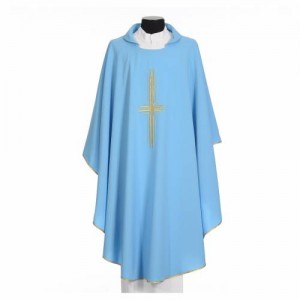
A ‘Marian’ chasuble in pale blue

Ash Wednesday arrives and the English Use takes the church into the Lenten Array. The use of unbleached linen to cover images, altars and reredoses was pretty universal across mediaeval Europe, though we cannot be sure that chasubles and other vestements were also made of off-white linen too. Maybe, at least in some places, the use of blue/violet continued through Lent . Simple decoration in red, black or blue was used.
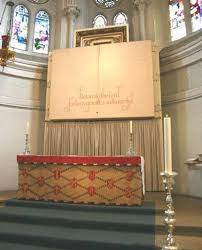
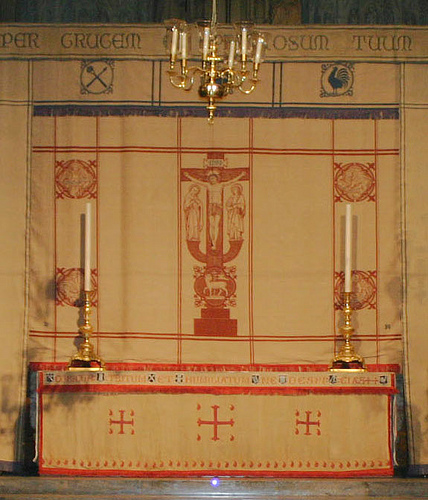
Lent at St Mary’s, Primrose Hill, London
High Altar, Westminster Abbey

And now to Passiontide, those two weeks from the Fifth Sunday of Lent through to Holy Saturday. The off white veiling remains in place but the altar frontal and vestments change to red – not the red of Pentecost, the bright red of fire, but blood-red perhaps decorated and lined with black …
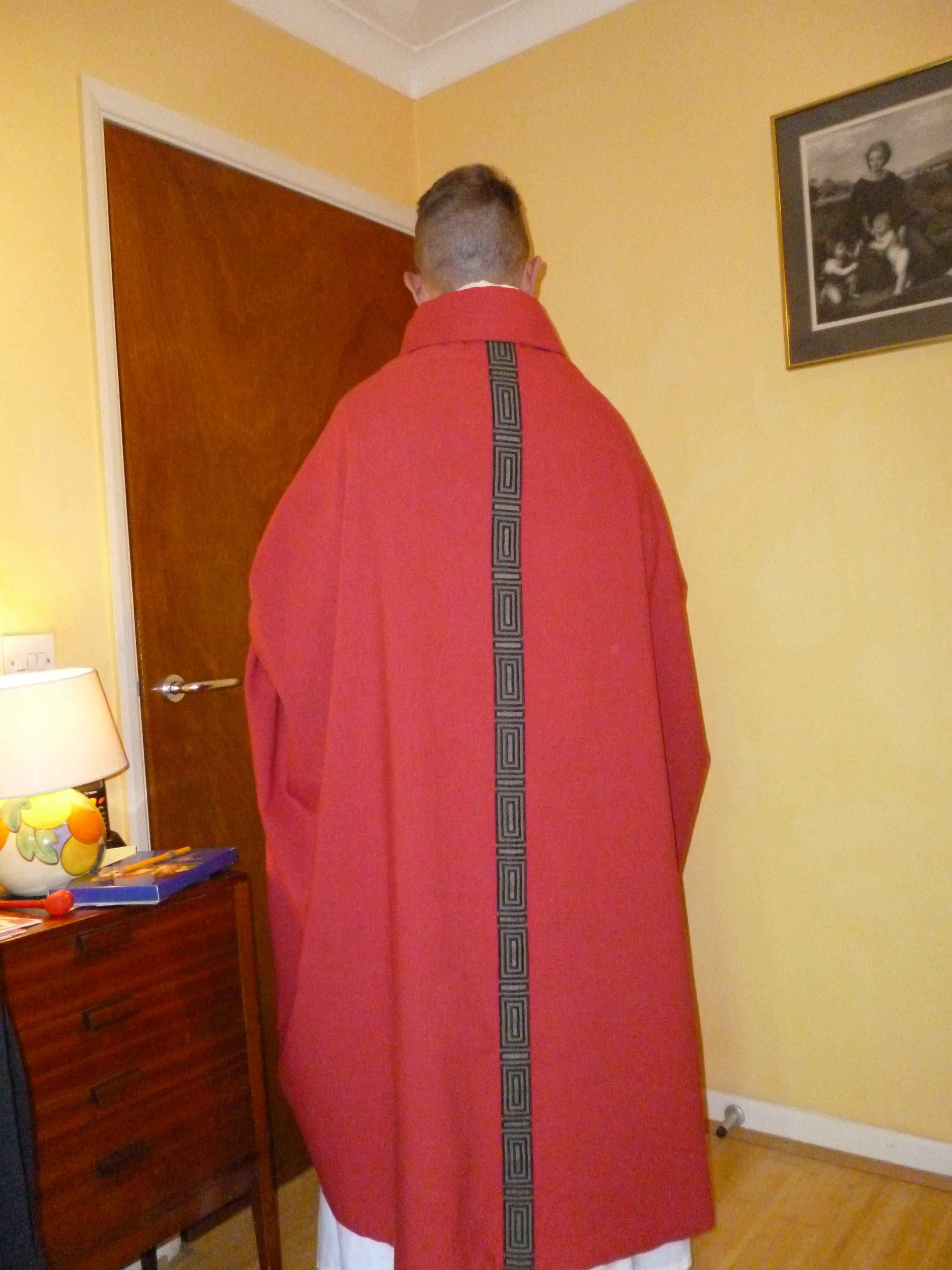
Red chasuble decorated in black and gold

Could any of this rich and evocative colour scheme be adapted for our use? Yes, I think so. Violet would be retained for the pre-Lent Sundays. If it is not thought correct to veil with the Lent Array, then try changing the hangings: here at Pont Rémy we take down the huge red altar curtains and go into off-white: the violet banners and vestments look very striking against it. Red for Passiontide – well Palm Sunday and Good Friday are red nowadays – but surely not scarlet with doves and flames!

Another chasuble in deep ‘Passiontide red’
Posted in Uncategorized | Tagged , , | Leave a comment

The Queen’s funeral: a lesson in reality

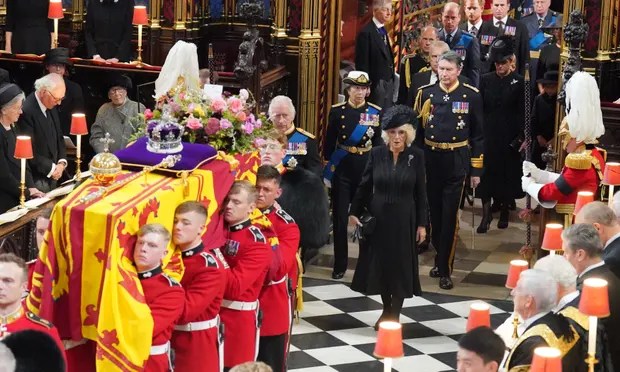
By happy chance I was back in the UK for the death and funeral of her late Majesty, Queen Elizabeth II. It was a moving and quietly emotional time. Since coming back to France I have had so many conversations with people here who followed those days intently. Indeed one of the parishioners here actually got an early ferry and travelled to London on the day of the funeral: a young woman in her 20’s! My own experience and the words of many French people lead me to question the remark on “The News Quiz” several days after the funeral: “The country has returned to reality after the funeral of Queen Elizabeth.” Where, I ask, lies the reality about the UK: is it in what we heard and saw in the days after the Queen’s death – or was this just a blip, a suspension of life as it really is, the reality as presented by the TV and the media day by day.

The funeral of Queen Elizabeth: entry into the choir of Westminster Abbey

Day after day we saw thousands of ordinary people queuing to walk quietly past the coffin at the Lying in State at Westminster Hall. In many interviews British people spoke with affection and respect of someone who had done her duty throughout her life. But it was more than duty. There was an understanding that the Queen had lived all her life as a public figure; that she had accepted her role without complaining; that she had tried to adapt and change and cope with the crises of life which came frequently in her long reign. Time and again one heard people speak of her as one who had upheld stability and tradition during a period of phenomenal change – one who had enabled the nation to change without some sort of national breakdown – or revolutiion.

I am not sure that the media ‘get’ this. Novelty has become their stock in trade. They present us with the latest fashion, the latest news – they tell us what we should be concerned about. Generally speaking, they have decided that “religion” in general and the Christian Faith in particular is to be ignored as irrelevant to the “modern age”. They were not at ease, I felt, with the frequent statements about the Queen’s personal and deeply held Christian Faith.

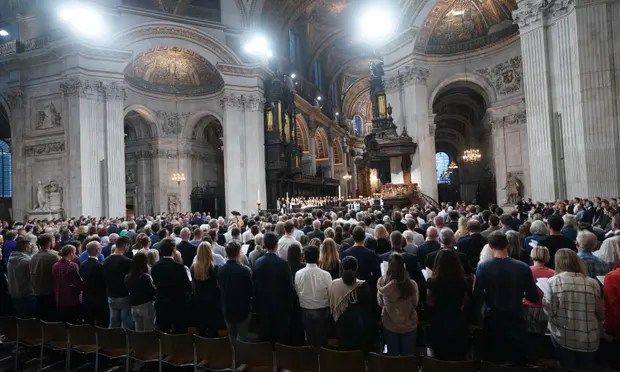
A huge crowd gathered in St Paul’s Cathedral. A handful were “the great and the good” but the vast majority of the 2,000 who entered that great building were ordinary people like you and me. The liturgy was deeply traditional (I wondered whether it was really necessary for the Cathedral clergy to do everything!) and the music magnificent – not a ‘worship song’ in sight; As far as I could see, no-one seemed bored or unengaged.

Now I wonder if this doesn’t give us a pause for reflection. For well on thirty years we have lived with the idea that traditional worship just puts people off. This idea is particularly established among evangelical Anglicans who are now the dominant voice in the Church of England. ‘Robes’ are boring and ’embarrassing’, any music written before yesterday ‘puts young people off’ and formal liturgy is ‘insincere’. Nor are Catholics exempt from this attitude. Ill-prepared Masses, trivial preaching and pathetic music are too much in evidence – nor is the answer to be found in polyester latin chasubles and the biretta!

Was there any embarrassment or awkwardness at the elaborate (one might even say antique) uniforms seen at every stage of the funeral? Not at all. And one imagines that those soldiers would have been back in their ordinary camos the next day without anyone thinking it odd. So what are we going to do ? Are we going to preserve the Cathedrals – Westminster Cathedral among them – so that we can roll out ‘traditional services’ for very special occasions ? Surely not, for that would create an impossible divide between the local communities and parishes which serve them, and the Cathedrals. Maybe we need to admit that we have just got it wrong. We have listened to the voices of media, the self-appointed opinion formers, the liberal élite – call them what you will – and we have believed them. ‘Success’ has replaced ‘faithfulness’ on the Christian agenda, and it looks from our recent experience that the people of our nation have shown their respect for tradition and those who uphold it.

Posted in Uncategorized | Tagged , | Leave a comment

Infant baptism, the Catechumenate – and Conversion to Christ

It was the seminary/theological college and the curacies which have informed, right through their lives, the attitudes and methods of many priests. Cartainly it’s true for me and for many (ex) Anglicans. So all my life I have struggled with the issue of baptism and how to prepare for it. My first vicar in the 1970’s had introduced a ‘baptism policy’, requiring parents to attend Mass for six months before the baptism of their child. The number of baptisms dropped, in one year, from around 145 to 9! The policy was regarded as draconian by many of our neighbours, but ‘indisciminate baptism’ continued to be an issue in the C of E and even made it into “Coronation Street” – a popular TV soap opera. In a remark which particularly challenged me, the late Fr Leslie Chadd, then vicar of St Peter & St Paul, Fareham, insisted that baptism was often ‘innoculation’ against the Faith. He explained that, just as in a vaccination we receive a tiny dose of the disease which then prevents us catching it for the rest of our lives, so baptism gives people a tiny dose of Christianity which means they can forget about it for the rest of our lives.

infant baptism

My guess is that I have officiated at more baptisms (of babies and small children) here in France in six years than in all the years I was an Anglican! But a huge question was posed three years ago when we contacted 60 families from our parish, with baptised children now at the age for Catechism. Even allowing for families moving house, we were shocked not to have a single response – let alone inscription for Caté.

Now the preparation for adult baptism – and there were around 4,000 last year in France – is strict: basically two years of Catechumenate, with interventions by the Diocese as well as preparation the the parishes, and Confirmation administered by the Bishop. ‘Conversion of life’ is deemed to be the number one priority, and not just instruction in the Catholic Faith.

TEAM RCIA, an American website with all sorts of resources for the Catechumenate says:

“The gospel story about the rich young man always amazes me. The man is a model of Jewish piety, having assured Jesus that he has followed all the rules Jesus lists. It almost seems he’s boasting a bit when he asks Jesus for more rules to follow.

He reminds me of some inquirers I’ve met. They just want to know what it takes to become Catholic. They’ll come to all the meetings, learn all the rules, check all the boxes. How do I tell them it takes more than that to be a disciple? “

Jesus’s answer to the rich young man is really a discernment question. He’s asking the young man where his heart is. What and who does he truly love? Inquirers come to us for a bunch of different reasons. But how do we know what is truly in their hearts? “

The author goes on the maintain that it is the responsibility of those who accompany the seeker, the Catechumen, to discern – and not to make the excuse that this is best left to to the Holy Spirit. He acknowledges that this discernment is often hard and may result in the Catechumen – like the rich young man – going away sad (or angry).

Fr Alexander Schmemann, the Orthox theologian, writes in a very different context. Nonetheless it seems to me that what he says about our encounter with Christ in the Sacraments is relevant:

The flaw of contemporary theology (including alas, Orthodox theology) and its obvious importance lies in the fact that it ceases to refer words to reality. It becomes “words about words”, definitions of a defenition. Either it endeavours, as in the contemporary West, to translate Christianity into the “language of today”, in which case, because this is not only a “fallen” language but truly a language of rejection of Christianity – theology is left with nothing to say and itself becomes apostasy ; or, as we often see among the Orthodox, it attemps to thrust on “contemporary man” its own abstract and in many respects “archaic” langauge, which to the degree that it refers neither to any reality nor to any “experience” for this “contemporary” man, remains alien and incomprehensible, and on which learned theologians, with the aid of all these definitions and interpretations, conduct experiments in artificial resuscitation.” ‘

‘The Eucharist’ – Alexander Schmemann – St Vladimir’s Seminary Press – New York 1987 (spelling anglicised)

Now if Fr Schmemann’s words are critical of Western Liberalism, they are also directed against those who would retreat behind interpretations of Canon Law, and who long for a previous age when, for example France could be called a ‘Catholic Country’ simply because the majority of its citizens were baptised!

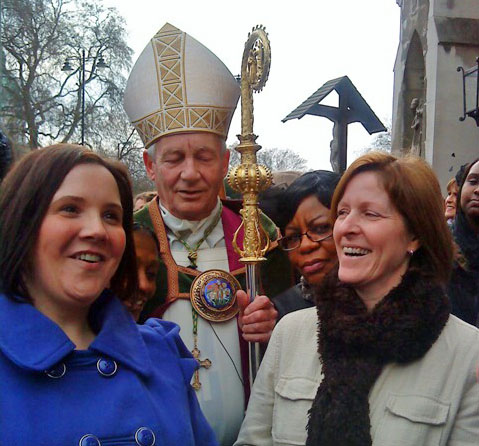
The late Archbishop Peter Smith at the Rite of Election of Cathechumens in Southwark Archdiocese

Yet among the strongest proponents of ‘indiscriminate baptism’ are those faithful Catholic lay-peoplewho insist that we must not erect any barriers to the Sacrament, on the grounds that ‘you never know what God might do.’ (Do they believe that God ceases to have anything to do with those not baptised as babies?) My own belief, is that many grandparents still have not come to terms with the wholesale rejection of the Catholic Faith by their children’s generation – and desperately hope that by getting their grand children baptised this will, in some way, make up for what they believe (wrongly, I think,) to be their “failure”.

Posted in Uncategorized | Tagged , | Leave a comment

Music in the liturgy – in France

One of my kind readers has asked me to continue the article I wrote last week by describing and comparing the music we use in the liturgy in France. Please realise that my observations are limited to this diocese and to my conversations those who accompany and animate our worship.

Before the Council there was no tradition of congregational hymn singing, though unlike England, most parishes would have sung de Angelis on Sunday. I have come across something called le plainchant picard but I know next to nothing about it, and must talk to my neighbouring curé who is interested and knowledgeable. The tunes gathered by the English Hymnal from the french breviaries on the 17th and 18th centuries and which were popularly sung at Evensong by Anglo-Catholics are quite unknown here. Only the Easter hymn Chrétiens, chantons, which we know as Ye sons and daughters of the King has survived in the popular memory.

As in the UK, so here in France, the vernacular liturgy promoted after the Second Vatican Council led to a great outburst of composing of music for use with the liturgy. Much of it is mediocre. The Mass settings are often paraphrases of the texts. The music is an attempt to keep up with the secular music boom from the 1960’s on, and always has the feel of being several years ‘out-of-date’.

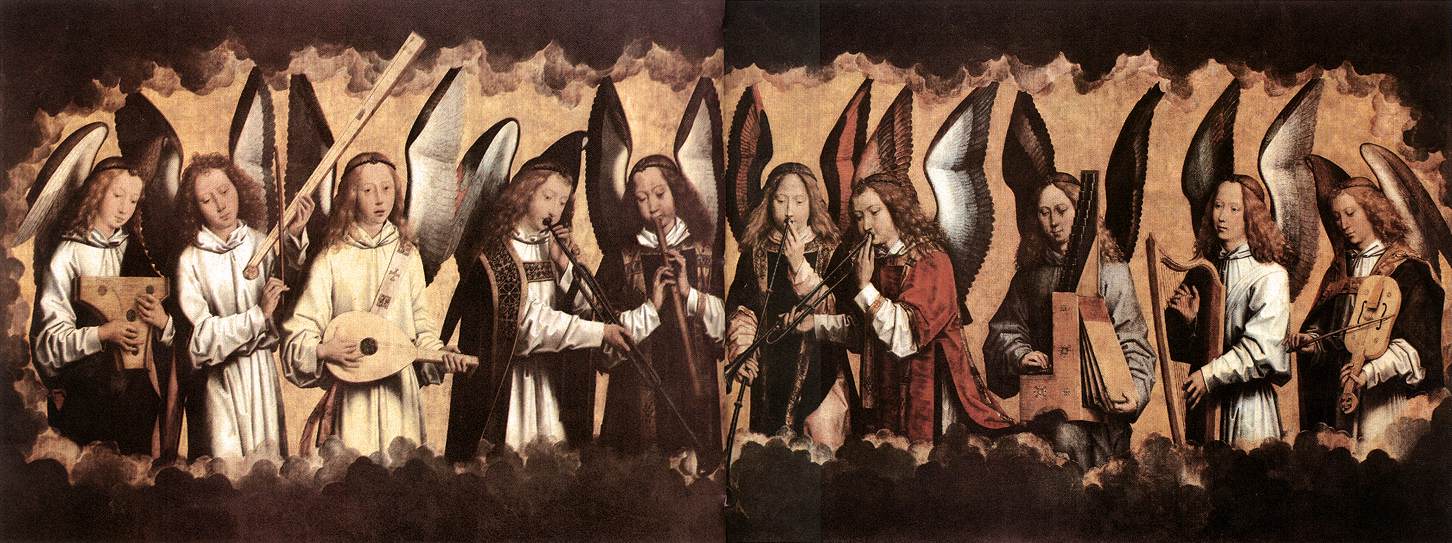
The music which came from the Community at Taizé apparently took some time to be accepted – “We can’t sing that, it’s Protestant”. But I wonder if it didn’t have some influence on the second generation of popular liturgical music in France. Much of the current stuff is being produced by the new Communities – Emmanuel, Chemin Neuf, Béatitudes … and is of rather better quality. There seems to me to be a real attempt to develop a style of music which is appropriate to Christian worship and is not a weak imitation of contemporary styles of popular music. Words are closer to biblical texts and reflect the new emphasis on worship and adoration often with time spent before the Blessed Sacrament.

Almost all French hymns are written with a rich, memorable, sometimes lively refrain to be sung by everyone together. The couplets or verses have a different feel and are to be rendered by a soloist or group of singers. I find the verses too high, and occasionally too difficult for the people,(if they try to join in) and therein lies the problem. In many parishes in this diocese the singing group, the chorale, has aged and dwindled in number. Accompanient on a cheap keyboard may be all that the parish can manage. What sounds splendid on You-Tube, cathedral accoutic, young voices, flute, clarinet, piano – may well sound less than beautiful in the village church at saint-roch-la-croix-blanche in deepest Picardie ….

I must admit that I miss the great tradition of English (and Welsh!) hymn singing, which over the centuries has been nourished too by the German hymn tradition, i.e. the chorales of JS Bach and others. The tunes are often rousing and lift hearts to praise and thanksgiving. The tradition of part singing with men’s voices supporting the tune inspires and lifts.

And what about the organ? Only one out of eleven of the churches in this little parish has a pipe organ – but what an organ. It was built by Aristide Cavaillé-Coll in the 19th century, and for two years a young Belgian enthusiast used to come once a month to accompany Satuday evening Mass. How I longed to sing ‘At the Lamb’s high feast’ or ‘How shall I sing thy majesty’ . But the Widor or Guilmant after the Mass was tremendous!

Let us remember too, that generations in the English-speaking world learned their theology through hymns. I think of something as simple as Mrs Alexander’s ‘There is a greenhill’ which contains at least three approaches to the doctrine of the Atonement!

So while singing remains important in our French churches, there is perhaps need for a further evolution. The tradition needs to be raided, especially for ‘teaching’ hymns, with much more music taken and adapted from the centuries before the Second Vatican Council. And congregations need to be encouraged and aided to sing, without always relying on the chorale and the animateur (without whose enthusiastic, but sometimes misguided arm-waving, it seems impossible to celebrate a Mass here in France.)

Posted in Uncategorized | Tagged , , , | Leave a comment

When did we stop kneeling?

My grandmother (born in 1891) was brought up as a Baptist though not baptised in adolescence. In fact she was baptised before her marriage to my grandfather, at St Mary’s Weymouth, a stronghold of low-church Anglicanism. But my grandmother knew that Anglicans knelt! She used to hiss at her cousin Jessie, whom she accused of ‘coopying’ – what we called in those far off and unecumenical days, the ‘Free Church Squat’. This meant that, when the Minister said, ‘Let us pray’ the congregation slipped forward in their pews, resting their foreheads on their clasped hands and leaning on the pew in front. Not so in the Church of England! Even in the ‘lowest’ of churches, kneelers or hassocks would be provided, so that people could pray on their knees.

Catholics knelt. They knelt a lot, because Mass was in latin and only the devout followed it in their missals. So for most of the twenty-five minutes on Sunday morning you were on your knees. You knelt, not on a hassock (which was C of E) but on a padded board which dropped down from the bench in front.

For Catholics all that began to change after the Vatican Council. The laity were expected to participate in the Mass which was now in the vernacular. They stood as the priest entered, sat for the readings, stood for the Gospel, kneeling only for the Eucharistic Prayer. Communion standing quickly caught on with the people going in procession to the altar. In France they even stood throughout the Eucharistic Prayer, though perhaps this was preferable to the immense clatter as congregations turned round those distinctive low-seated chairs to kneel on them!

The People of God

By the 1980’s Evangelicals in the C of E were increasingly rejecting the idea of anything distinctively Anglican. They looked towards the large and ‘successful’ Christian denominations of the United States, whose comfortable, carpeted church interiors resembled rather more an auditorium which was focussed on a stage, not an altar. This led to the curious situation in a neighbouring parish to me in London. As they prepared to open their new church building, the older ladies got together and embroidered several hundred kneelers. They were obsolete from the beginning!

Very soon the rubric ‘sit or kneel’ began to appear in printed service books, even at ordinations. The following rubric appears in a recent Sunday service booklet in one English Cathedral:

You may like to adopt a prayer posture such as sitting with your head bowed,
as we remember our brokenness and call to mind our sins.

Gosh! That’s a lot of words for what we would once have done instinctively.

And in France? Kneeling seems to be coming back in again and especially among young Catholics. (Maybe their knees are more up to it). I notice that many more young people kneel during the Eucharistic Prayer, and receive kneeling even though they are not at the rail. Good for them: it’s their choice and not for me to tell them that they must stand and must receive the Communion in the hands.

But sitting for prayer in church is not normal practice for Christians. In the early centuries the people stood, as they still do among the Orthodox. The English expression, ‘The weakest go to the wall’ comes from the days before pews when the only seating was the stone bench around the walls. Pews and Puritans go together when worship ceases to involve movement, senses, action – and is replaced by isolated and static individuals listening to a sermon or watching something on a stage.

Let’s free up worship, with kneeling, sitting and standing, and congregations confident enough to know when and how.

Posted in Uncategorized | Tagged , , , | Leave a comment

A memorial of Father Richard Rowe

I received news yesterday of the death of Father Richard Rowe. When he became Vicar of St Margaret’s, Leytonstone, in East London in 1979 he inherited me as the curate. I offered to move as soon as I was able (the usual thing to do in those days) but Richard wouldn’t hear of it. So began two tremendously happy years of parish ministry.

St Margaret’s Leytonstone had a long Anglo-Catholic history. The parish was not expecially large, long terraces of small late 19th century houses, the area bisected by the Barking-Gospel Oak line which ran on a viaduct … the church, large, brick, dull rather than ugly, built at the end of the 19th century. By the mid ’70’s parish life had become rather tired. The liturgy had not moved with the times and the 11am Sunday High Mass was still celebrated from the English Missal – as were the weekday Masses with a small band of faithful widows and spinsters who lived around the church. The previous vicar, Fr Christian Hilton, to whom I had come for my second curacy, died suddenly and we had an interregnum of a year. I was delighted at the news that Richard was to be the new incumbent, and that he wanted me to stay.

Richard began to assert himself immediately but in the most gracious way. I recall the first PCC meeting. There had been a lot of chit-chat in the ranks, and the first time this happened Richard said nothing but began tapping his fountain-pen on the table. Silence fell, and then he said ‘Thank you, ladies and gentlemen, through the chair, please.’

One evening we were due to welcome the local Guild of the Servants of the Sanctuary – the servers, in other words. Only one of the younger members came, but rather than go home Richard decided to demolish a rickety side altar. You have to realise that he himself only directed the demolition – standing there in his well-cut soutane, large red handkerchief just visible through the double cuffs and cuff links of his shirt. It suited us who were young and energetic! The altar went to the back of church under the huge painting of St Sebastian, the platform was broken up, the riddel posts went into store. Sunday arrived and so did the servers: shocked whispers in the sacristy.

More was to follow. Richard announced to the Church Council that the Bishop had indicated that he could not come to St Margaret’s unless something was done about the liturgical arrangements. (I think Richard was stretching the truth a little). He therefore proposed a new sanctuary be created in the nave. This was not to be done with a tiddly altar perched on a platform made from table-tennis tables! Oh no – Richard planned a ten foot altar and the restoration of six splendid baroque candlesticks he had found in a cupboard. My father, who had just retired, worked with Fred Hardy to construct a large platform; one of the ladies made a gold silk damask frontal, kneeling benches were obtained from a redundant church, a domed tabernacle was placed on the former High Altar, which now had as its reredos a fine copy of a Murillo Virgin and Child in a great gilded frame (which had been hidden away the the side chapel). The whole effect was very good and an example of what a sense of colour, proportion and sensitivity to tradition can do where there needs to be liturgical change.

the new sanctuary in Lent

It was a time of growth in numbers and in the quality of life. People were enthusiastic about their Christian life together, and proud to belong to St Margaret’s Leytonstone. Richard had his mother, who was crippled with arthritis, to live with him. I got on tremendously well with her and Richard did me the great honour of asking me to preach at her Funeral Mass.

Like so many priests of our generation, Richard entered into full Communion with the Catholic Church. I thank God for the years that he and I were colleagues. It was a good time to be in the Diocese of Chelmsford. We had a sympathetic Bishop in John Wayne and our enthusiasm was recognised and channelled into diocesan life. The Anglo-Catholic parishes were lively and forward looking led by a fine group of priests.

And now, Richard, may you rest in peace, assured of our prayers and affection.

Posted in Uncategorized | 1 Comment

Music in the liturgy – a new beginning or the end of an era?

I read with interest of the publication of a revised edition of the English Hymnal towards the end of this year. I shall certainly add it to my collection (of English Hymnals) with the 1906 & 1933 editions, the New English Hymnal of 1986 together with New English Praise 2006. But it is certainly a brave venture.

Brave because in many ways it is swimming against the tide in the Church of England. It may be bought by a handful of Catholic Cathedrals and churches, but not many I imagine. Yet from the beginning of the 20th century right through to the 1980’s its bright green cover was a sure sign that in this parish music and liturgy was taken seriously. Percy Dearmer as General Editor and Ralph Vaughan Williams as Musical Editor set high standards in both music and poetry. Many today would call them ‘élitist’ for their strong opinions. Popular Victorian hymns which they judged ‘poor quality’ or ‘sentimental’ or even ‘vulgar’ were banished to a section which Vaughan Williams apparently called the ‘Chamber of Horrors’.

The English Hymnal familiarised several generations of Anglicans with plainchant, fine tunes and words from the 17th and 18th century, and those delightful (and singable) little tunes from the French breviaries of so called Gallican period. My generation will remember these ‘modern’ tunes often sung to the Office Hymn at Evensong. It’s hard to remember that right through into the 1970’s most English Parish Churches had a choir of boys and men and an organist or two. Many people could sing a part. Indeed in my four years at Kelham I only remember one student who had to be coached because he found it difficult to sing in tune. Evensong was sung daily to Plainchant, together with the Sunday Mass and hymns harmonised (with the tune an octave lower!)

I suppose I became suddenly conscious of the rapid change that had taken place when I went to stay overnight at St John’s College, Nottingham in the mid 80’s. I joined the students for Evening Prayer which, I was told, was to be according to the Prayer Book. If my memory servies me right, modern songs were substituted for the Canticles and we sang a couple of worship songs for the time of free prayer at the end. Nothing of the service was chanted and the songs were accompanied on the guitar.

But what of the Catholics at this time? We have to remember that there had been no tradition of congregational singing up until the Second Vatican Council. Magnificent chant and polyphony was always sung at Westminster Cathedral and the Oratory, but outside London, very little. Sunday worship was Low Mass, with a handful of hymns like ‘Sweet Sacrament Divine’ and ‘O Sacred Heart’ sung at Benediction in the evening. The revisions proposed by the Council to the Liturgy envisaged the congregation participating by singing together. One might have imagined that the Catholics would have turned to the Anglicans with their tradition of liturgical singing but this did not happen. Music was provided by a new generation of composers much influenced by current trends in ‘popular’ music. Little of any lasting quality was written at this time, though it is interesting to note that Dom Gregory Murray’s New People’s Mass is in the Revised English Hymnal. The state of Catholic Church music remains pretty dire – a few singers, accompaniment on an electric keyboard …

In the Church of England, the Evangelical party were turning away from traditional music. They were propounding the theory that young people were ‘bored’ by ‘old-fashioned’ music. A new generation of composers (many of them American) were attempting to write in the popular idiom, and from time to time the press would run stories of ‘walk-outs’ (or ‘sackings’) of choirs and organists and their replacement with a ‘band’ or ‘music group’. Thousands of songs were produced – and still are – by a veritable music industry. A handful are memorable and some are beautiful. I am glad to see that ‘Be still for the presence of the Lord’ is in the new collection, and sorry to see that ‘The Servant King’ by Graham Kendrick isn’t. (A problem of copy-right surely, for its words are profound and majestic.) But after forty years of novelty the evangelistic hope of such music has not been fulfilled. American accents, the monotonous four-square rhythms and noisy accompaniments soon pall, I’m afraid, which is why there seems to be a constant need to sing something ‘new’ and ‘different’.

The publishers of the Revised English Hymnal are taking a great gamble, as the title of this post would suggest. The older generation of Catholics have been brought up on the music written soon after the Council. It lacks the strength of say, the chorale tunes of Bach or the lively ones of Handel. And the words too often are sentimental and repetitive. Yet the experience at Precious Blood, London Bridge, on the arrival of the Ordinariate, is worth reflecting on. A competent organist and a body of people (former Anglicans) who enjoyed singing, quickly inspired the existing congregation to participate in the Sunday Mass afresh.

And finally, the clergy. I recall a Deanery Chapter (Anglican) in the 1980’s where one of the more provocative young Anglo-Catholic clergy remarked that no man who could not sing should be ordained! It caused a stir at the time. But if we are to follow Pope Francis in his call for liturgical formation which goes way beyond learning the rubrics, then maybe doing something to encourage the clergy to sing, to sing well, and to enjoy worshipping in music and song, might help to renew Catholic worship.

Posted in Uncategorized | Tagged , , , , | 1 Comment

The living and the dead

“Now when the bells for Eucharist  / Sound in the Market Square, With sunshine struggling through the mist / And Sunday in the air. The veil between her and her dead / Dissolves and shows them clear. The Consecration / Prayer is said / And all of them are  near.” 

The Church’s offering for the living & the departed

John Betjeman

The Catholic beliefs of John Betjeman were often reflected in his poetry. He understood the importance of praying for the dead and, in particular, offering the Mass for the repose of their souls in a way that fewer and fewer people would think about today, including many Catholics. At a British funeral people are now much more keen to celebrate and give thanks for a life than to reflect upon the eternal world God has prepared for those who love Him, beyond the moment of physical death, and to commend their dead loved one to His love and mercy. Hence it was increasingly my experience as a parish priest that the eulogy (or eulogies) at a funeral took almost as long as the rest of the funeral; and that for many people the eulogy was the most important part of the funeral. 

Here in France (at least in this diocese) most funerals are taken by teams of lay people. This has been the custom for quite a few years, due to the shortage of priests. Most of the older generation expect their funeral to be in church and in the village where they have lived. The lay teams do a superb job. They arrange to visit the family before hand in order to prepare the liturgy, the music and the ‘Mot d’accueil’ – the tribute read out at the beginning of the funeral service. At the end it is French custom for the whole congregation to ‘bless the body’, walking round the coffin and sprinling it with holy water. Having done this, they place a donation in a basket held by one of the funeral directors. The Covid virus put an end to the blessing with hyly water, as we were not able to pass the sprinkler from hand to hand. The devout will make the sign of the cross; others will pass the basket by. Nor is it unknown to find buttons and foreign coins in the collection!

The close connection between the living and the dead unravelled very quickly at the English Reformation. The chantries closed and the reading of the names of the departed, Sunday by Sunday, ceased. The Reformers had the strange idea that praying for the dead was not known to the early Christians, and that the practice somehow lacked in trust for the saving death of Christ. One young evangelical explained to me some years ago, ‘When you die, you are dead, every bit of, and you have to wait for the resurrection; Ther’s nothing to pray for.’ So heaven is quite a lonely place. The dead are not there, and nor are the saints. ‘Mary is just a dead Christian’, I have heard it said. Very soon the chantries and tombs of mediaeval Christians were replaced by the pompous monuments of the 17th and 18th centures. The request to the passer-by to pray for the dead person was replaced by a list of his merits and good deeds in this world. So much for salvation by faith alone! The class system now stretched into eternity, for the mediaeval tombs of prelates and princes had often warned that ‘as I am now you will one day be.’

The replacement of the parish clergy by ‘funeral celebrants’ was a process favoured by the large funeral companies (increasingly American owned) which bought out local firms from the 90’s of the last century. The ‘celebrant’ was there to reflect back to the family their own beliefs. As the nation became secularised the lack of faith and hope for the dead accelerated. Now one only has to look into the eyes of most young people at a funeral to see the lack of comprehension of any Christian understanding of death – and life beyond death.

I think we are faced with two choices, those of use who lead funerals. We can either give in and offer the family what they want. It’s often not what they want but what they have been persuaded by an unbelieving world that they want. Or we can preach a full-throated belief in the resurrection of the dead because of the resurrection of Jesus Christ. And we can make sure that the funerals of the faithful are celebrated in the fulness of hope and prayer – and above all within the context of the Mass.

Remember St Monica’s words to her sons, ‘You are not to fret about where my body rests; this only I ask of you, that you remember me when you go to the altar of the Lord.’ The only truly Christian funeral is a Catholic one!

Posted in Uncategorized | Tagged | Leave a comment

Pope Francis and the Extraordinary Form

Like many Catholics I was at first taken aback by the Pope’s recent Motu Proprio, Traditionis Custodes – On the Use of the Roman Liturgy Prior to the Reform of 1970. I had been aware of problems around the use of the 1962 Missal, but this seemed like a sledge-hammer to crack a nut. Had not the permissions granted by Pope Benedict XVI been gladly received and led to greater harmony and understanding?

High Mass celebrated according to the 1962 missal

Yet in talking this through – both the Holy Father’s decisions and the subsequent reaction – I became more aware of the situation and why Pope Francis has felt the need to safeguard the unity and cohesion of the Catholic Church. In this post I want also to draw on my experience of Church Planting into parishes in the UK when I was an Anglican. This is now causing real concern in the C of E ; and there are at least some parallels with the Extraordinary Form Movement.

A friend who is more au fait with the social media than I am pointed out that more enthusiasm for the EF – and more opposition to the liturgical reforms of the Second Vatican Council – seems to come from America than from the UK and Europe. It has often been noted that people are more aggressive and rude on social media than ever they would be face to face, or even in print, and some Catholics have fallen into this way of expressing themselves. This has led a minority to write abusively about the Holy Father, and even to deny the legitimacy of the Council and the validity of the reformed Mass. Ironically, their freedom to do so and to remain Catholics is itself one of the results of the Council. Prior to Vatican 2 such sentiments would have led to excommunication!

What can one say?

Of course, it is possible to find Masses celebrated like this one above, but they are nothing like as widespread as some maintain. Moreover, those of us who are old enough to remember the liturgy before the Council will recall Mass rushed through in 20 minutes, congregations arriving late and leaving early, priests who seemed to take little care over what they were doing – and polyester vestments long before they became a bone of contention for the traditionalists. Peter Anson writes in Fashions in Church Furnishings that the average Catholic Mass must have been more of a penance than a joy for the discerning convert. I have myself taken part in Extraordinary Form High Mass beautifully organised and celebrated, with splendid music and a devout congregation – though the complicated ceremonial left me shaking – and at times puzzled. But let me assure you that it was not like that when I was a lad, apart from Westminster Cathedral!

So I begin to understand the Pope’s concern for the integrity and the unity of the Church. Moreover he has given back to the Bishops the ordering of liturgy and worship in their dioceses, which is part of what a Catholic bishop does. The attempts to by-pass Bishops and national Bishop’s Councils (with the perception that they are ‘liberal’ ) has not been good for the Church.

Let me turn now to the experience of those of us who are former Anglicans. In the 1970’s we became aware, particularly in London, of a resurgence in certain large churches. They began to draw middle-class professional people from all over the capital with a particular style of worship and life. As areas of London ‘gentrified’ in the 80’s young professionals moved into new housing built in areas previously occupied entirely by working-class families. The tension which this created socially was unfortunately mirrored in Church life. I recall one priest in such an area saying that if only three or four of these couples came locally to their parish church it would be enough to revivify his church. But alas, just as they commuted in to work from their gated communities Monday to Friday, so on Sunday they drove in to the West End to worship with their friends and people of their own class.

empty and ageing?

Church Growth and Church planting, imported from the States, began to grow in popularity as more and more Anglican parishes struggled with falling numbers. With little actual power residing with the Bishop to do anything about it, the house-groups began to hold Sunday services with no reference to the Parish in which they were situated (and with scant reference to anything looking like Anglican liturgy). For some years the parish clergy resisted this incursion into their parishes, until General Synod took away this right. There was a certain arrogance on the part of the Church Planters who sometimes (in private at least) doubted the commitment and even the Christianity of the clergy and people of the parish system. This “diocese within a diocese” spread out of London, south of the river and even to the south coast!

Sunday worship – but not at the Parish Church

Catholics in Europe see the Church organised into the parish system sometimes dating from well over 1,000 years. They are amazed when they drive down long American roads to see the Episcopal Methodists next door to the First Baptists and the Pentecostal Healing Ministry – and then the Catholic Church. Have Catholics in the States become accustomed to this “pick ‘n mix” Christianity – and have the “Extraordinary Formers” imported a free Protestant attitude (I go to what I like, where I like) into the Catholic Church? I know this is a tender area, but I know too, as a former Anglican, just what private and personal judgement can do to the unity of the Church. (Saint John Henry Newman understood it too.)

On the other hand, we (and I mean especially the priests and laity of my generation, for whom the Council came as such a breath of fresh air) need to reflect deeply on why groups of young people are so dissatisfied with the worship that they find in this parishes that they prefer to worship according to the old rite. We need to understand the very different world in which they live – a world which now lives without reference to God, and which regards Christianity in general, and Catholicism in particular, as irrelevant and even dangerous. And we need to do a lot about the quality of our liturgical worship and preaching. But that is another post.

It is believed that Pope Benedict looked forward to the two Forms nourishing each other; that a time would come when the latin west would once again celebrate a single form, clearly within the tradition of the ages yet refreshed and renewed by the insights of the Council. Has Pope Francis abolished the latin Mass? No! Has he stopped the use of the 1962 Missal? No!

Posted in Uncategorized | Tagged , | Leave a comment

Renewing the Catholic Parish

In 2009 a group of Anglo-Catholic clergy in the Diocese of London, encouraged by the then Bishop of Fulham, now Monsignor John Broadhurst, met to discuss a plan for parish renewal. I have kept the aide mémoire circulated after their meeting.

“Any evangelisation strategy among us seeks:

…. a new ardour in prayer and worship  (picking up the word from North/John Paul 2)

….. a new fluency in speaking to our friends about the Good News which is Jesus Christ in us

….a new dedication for both clergy and laity in the daily living of the Christian life

Towards the Conversion of England?

“We do not seek to promote a ‘Catholic Evangelism’ which is somehow different – we have serious doubts (outlined by Fr Philip North) about Mission Shaped Church – most notably its silence about the Church – which is central to God’s plan for the evangelisation of all people. I note that none of the current stuff is put out as ‘Evangelical Evangelism’, though the reason we are working on this is to produce something which is going to be attractive – and work with the Catholic parishes of the Diocese.

“In which case let it be unashamedly Catholic – it must centre on the Eucharist and on the Church as Body of Christ. It needs to ring Catholic bells – so that we place the initiative under the patronage of Our Lady of Willesden & St Mellitus! and wecommend for daily use a revised version of the ‘Night Litany for London’ .  We expect all participating parishes to have times of Exposition which are publicised across the Diocese in a chain of petitionary Prayer.

“The course, its aims and methods are devised by the small group, run in front of the London Bishops and the PEV’s – with comments invited: but we are going to do this ‘our way’ – and once launched it will be ‘taught’ – not given to clergy Chapters to be pawed over,  criticised and then forgotten.  Parishes will be asked to register and to accept its aims and methods. And then persevere in them!

“We recognise the diversity of Catholic Parishes (indeed, we revel in it, don’t we?) and give serious consideration to the needs of what I think are three types  (1) West End  (2) Urban Priority   (3) Suburban   …. the group needs one rep at least from these three types, if my analysis is right.

“The course(s) major on these aspects     A.  Sunday Worship    B. Welcome    C. friendship evangelism   D. identifying and enabling the small groups within our congregations  (which may include weekday mass congregations, existing groups & societies, )

 Catechesis – from pre-evangelism through preparation for baptism & confirmation and continuing nurture – stages of commitment, and RCIA type steps on the way. 

Identifying signs of and blocks to growth     

Lay ownership, lay leadership and the proper and healthy relationship between the Parish Priest and the people,.

The use of the new technology.”

The relationship between priest and people

From this rapidly evolved the “10 signs of growth” which were as follows:

TEN SIGNS OF GROWTH

The centrality of the Eucharist

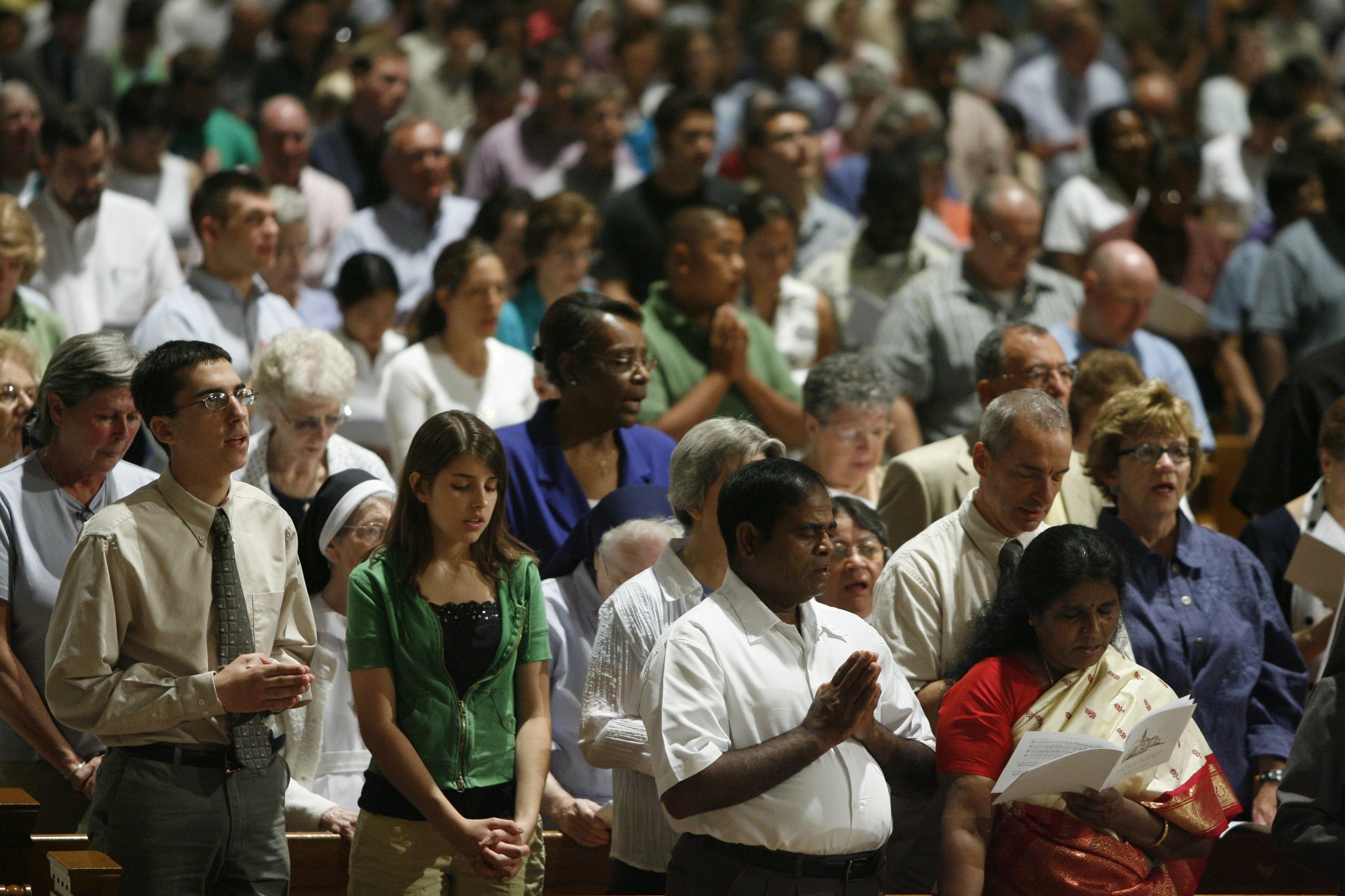
Sunday Mass is a devout and joyful celebration for all the People of God

Love of the Scriptures

The People of God listen attentively to the Scriptures at Mass, study them alone and in groups, and are trying to put them into practise

Effective welcome

It is the responsibility of everyone to welcome the visitor and the stranger as if the Lord himself had sat down next to us

Consistent Catechesis

We are committed to deepening our faith, not just as children, but throughout our lives, and we expect our clergy to teach

Daily Prayer   Common prayer

We pray daily, on our own and together, in our homes and in church

Able leadership

The leadership, both lay and ordained, enables all the People of God to find and use the gifts God has given them

Responsible Membership

All Church Members play their part in the life of the Church

Pastoral care of all

Everyone is involved in giving and receiving of loving-care

Openness to continuity and change

We try to discern where  God calls  us to remain faithful to the tradition and where we must  make radical changes in order to grow

Sacrificial giving

Each Church Member is responsible for providing  what is needed by giving time, money and ability to make the Church grow

This evangelistic strategy borrowed unashamedly from the work done by Evangelical Christians in the areas of evangelism and Church growth, both at home and abroad. But it recognised the major failing in all such work: its weak doctrine of the Church and its misunderstanding of the centrality of the Eucharist to the Christian life. These two failures of comprehension have seriously blunted the work of evangelisation and have lead to serious misgivings in the Church of England about its latest strategy (June 2021).

And now to France and to a remarkable series of coincidences in this little parish of Notre Dame des Etangs in the Diocese of Amiens. 2-3 years ago and after a period of consultation (a Synodal Year ) the then Bishop called for the establishment of “Fraternités Missionnaires de Proximité”, in the parishes. Drawing on my own experience in the UK, we were quick to establish these groups. In order to explain our motivation and purpose we identified four ‘pillars’ which supported our ‘building’ (i.e. our Church) together with the ‘arch’ of prayer which bound them all together. These five things we expected to see at every level of our life together.

The meeting of these groups of people had hardly begun when we were overtaken by the COVOD virus. This summer we have begun to think about meeting again. Then one of the group leaders read a book review in “Famille Chrétienne’ of a “Guide pour rebooster nos paroisses” ( I hardly think that needs translation!!) At our next Pastoral Group meeting I mentioned this book entitled “EZ 37” (the title refers to Ezekiel chapter 37 – the prophet’s vision of the Valley of Dry Bones) and one of our members produced the book – as he had been a member of the parish in Paris in which his story of renewal is based. Amazingly, we discovered that the “5 essentials” identified and emphasised throughout the book were precisely those which we had posited in the “4 pillars plus the overarch of prayer”.

So much in EZ 37 has come from visits to Holy Trinity Brompton, to Saddleback Church in the States – and the Alpha Course, already popular among Catholics here in France, is clearly an important part of their parish life. BUT – and for me it is the great BUT – all that they propose of do is set within the parish, as part of the diocese, under the authority of the Bishop and within the communion and teaching of the Catholic Church. To those of who who are already feeling panicky about such a “Protestant” approach to renewal, let me quote:

“This is why we proposed times of ” ‘missionary’ eucharistic adoration. This proposal has as its purpose not only life lived in close intimacy with Christ, but to allow ourselves to be filled with the longing of the heart of Christ to show his love to the world …. ” (EZ 37 p.104)

We have for several years in the Ordinariate been seeking to identify our ‘Anglican Patrimony: I think this is a truly important part of it. The fact is that it has been discovered and is being worked out in France!

The Ordinariate in the UK

And what about the English Ordinariate sponsoring a translation of this EZ37? And would the Catholic Bishops of England and Wales be ready to take it on board?

Posted in Uncategorized | Tagged , , , , , , , | Leave a comment