In 1995 I was having dinner with a group of (Roman) Catholic clergy, including one who had been recently received from the Church of England. He was still pretty angry and predicting the imminent collapse of the C of E. One of the older (and wiser?) priests counselled against such thoughts, warning that if that collapse happened, the Catholic Church would not be ready to take up the position of fronting Christianity in the UK. Twenty-five years later the C of E is much closer to collapse but I wonder whether the Catholic Church is any better prepared for the role which may well be thrust upon it. So in writing this post let it be clear that I take no delight whatsoever in the recent trends in my former home, the C of E, nor do I think that any sort of “Flaminian Gate” triumphalism is appropriate on our part.
In a recent article in the Church Times” Angela Tilby, Anglican cleric, and a thoughtful and interesting contributor on “Thought for the Day”, expressed many misgivings about the direction which the C of E was taking. She was thinking particularly of the recent target announced by the Archbishop of York for the establishment of 10,000 new churches, predominantly lay-led. This initiative is backed by New Wine and the Gregory Centre for Church Multiplication, and both organisations have a very different understanding and model of the Church from that which the C of E developed as it came out of the Reformation struggle and into the 17th century. In her article Canon Tilby quotes the Declaration of Assent: that the C of E is “part of the One, Holy, Catholic and Apostolic Church.” Which is precisely why the Anglo-Catholics in the 1990’s argued that the C of E could not change the ministry and ordain women to the priesthood and episcopate. Our concerns were rejected, often on the grounds that this was not really a fundamental change to what the C of E believed about priesthood – and in any case such a change would be subject to reception by the rest of the Christian world. At a service at St Paul’s Cathedral in 2004, Canon Tilby in her sermon still maintained that “Women priests have not unhinged the church.”
The Evangelicals in the C of E thought otherwise, which is why so many of them voted for the ordination of women, in spite of the evidence of Scripture. For they saw clearly that such ordination would distance the C of E from the Catholics and Orthodox, and complete the Reformation project. And with the Anglo-Catholics gone there has been little in the last 25 years to hold them back.
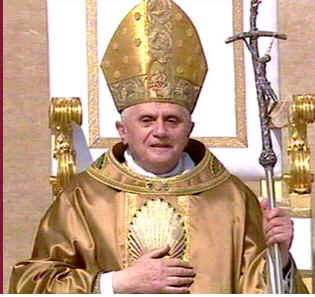
Canon Tilby is surely right when she says “These are hard times for the faith, fallow times for the C of E, with its cautious, grounded via media so needed, yet currently unwanted. ” Once again, time for careful, prayerful thinking, and difficult decisions. Pope Benedict understood the dilemma – not for dissatisfied Anglicans – but for those who saw the need for a deeper communion, real Christian unity, and above all the ministry of Peter.
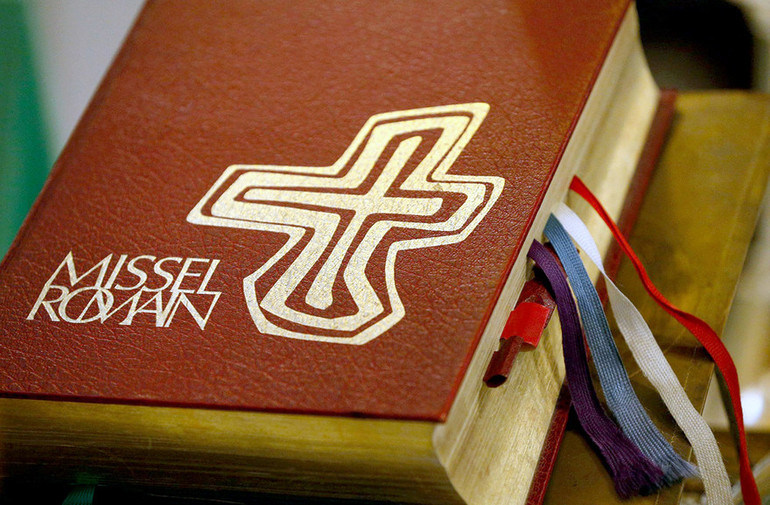
At long last the Catholic Church in France (and the other francophone countries) is to have its new translation of the Missal, which comes into use on Advent Sunday 2021. At last I shall not be the only priest in this diocese needing to use a card for the Eucharistic Prayer at concelebrations!
Mgr AUBERTIN, the Archbishop of Tours, explained the process lying behind this new Missal, which comes into force on Advent Sunday 2021, in book published recently, “Discover the new translation of the Roman Missal”. He explains that the Missal published in 1970 was the result of the Liturgical reform willed and initiated by the Second Vatican Council. An important Instruction Liturgiam authenticam appeared in 2001, modified by the motu proprio Magnum Principium issued by the present Pope. Three principles were established: faithfulness to the original (Latin) text; faithfulness to the language into which the Latin text is being translated; faithfulness to the sense of the original text so that its full meaning may be conveyed to the faithful as they pray it.
The new French Missal
If I have understood rightly, the process by which the new translation was developed involved 1. the preparation of the the new text under the guidance of the French-speaking Episcopal Conferences. 2. The submission of the text to Rome for verification of its conformity both to the original Latin and to the doctrinal norms of the universal Church, and finally (but crucially) 3. the concern of the French bishops that the translation would be good French, and not that of a Latin primer! In this process we see clearly all the principles of Liturgiam Authenticam and Magnum Principium at work.
The concern for their language is a particularly French thing, and they have tried to resist the importing of americanisms which they see as a sort of cultural colonialism. It is a lesson to which English-speaking Catholics might be more attentive. The English language has a beauty when written and spoken well. (I heard Ken Clarke when he was ‘Father of the House’ , and still an Member of Parliament, speaking- and more recently hearing Alec Guiness in “Smiley’s People” – both reminded me just how fine English can be.
Translating from a Latin original into a vernacular language is not easy. It requires a knowledge and fluency in Latin, and a fluency and appreciation of the beauty of the vernacular language. Few people these days have both skills. Thomas Cranmer, the compiler, translator and producer of the English Prayer Books of 1549 and 1552 was such a man. His ability to translate Latin into beautiful and memorable English is to be seen par excellence in the Collects. He is less sure with some of his own compositions, where his doctrinal concerns come to the fore: the Confessions at the beginning of the Office and in the Communion Service being obvious examples.
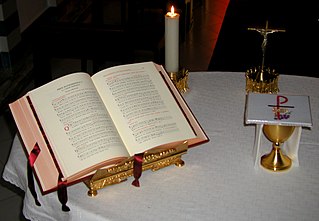
Divine Worship – the Missal of the English-speaking Ordinariates
The English-speaking Ordinariates, in the production of their Divine Worship Missal, tried to combine Cranmer with the translations from the Latin made for the various Anglican Missals at the beginning of the 20th century. The success of these later translations is questionable. These Missals (the Anglican Missal in particular) had remained in use in the United States, while being largely abandoned in the UK, where the adoption of current English was not seen as a threat to orthodoxy (as it was by many American Episcopalians). The English were less than enthusiastic about having to re-learn a liturgical language remembered only by those over a certain age!
Remaining close to the Latin was said to be one of the key aims of the new Missal produced for English speaking Catholics in 2011. It came out at a time of the so-called “Liturgy Wars” when there was suspicion among “conservatives” that the 1970 translation was “liberal” – or at least being used by the “liberals” to play-down the traditional understanding of the Mass. Its attempt to introduce “latinate” words into the English liturgical vocabulary has not been entirely successful. Where the previous translation could be characterised as “bland”, the 2011 translation is, in places, “lumpy”. It only shows the difficulties for the Universal Church of a single Eucharistic Rite in many languages!
The French, it seems to me, have been right in insisting that French language experts should have the last say over the language, just as doctrinal experts (theologians) have the final say over the theology which is being expressed in the liturgy: not either-or but both-and. Nothing less will do.
Last Sunday I was confronted at the moment of Holy Communion by a young woman insisting on receiving the consecrated host on the tongue. Currently this is not permitted in France, as part of the COVID precautions.
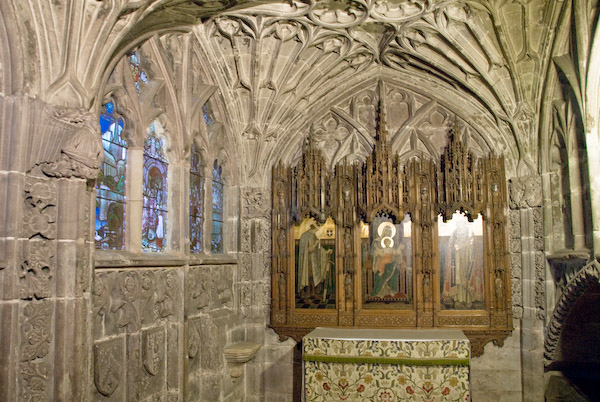
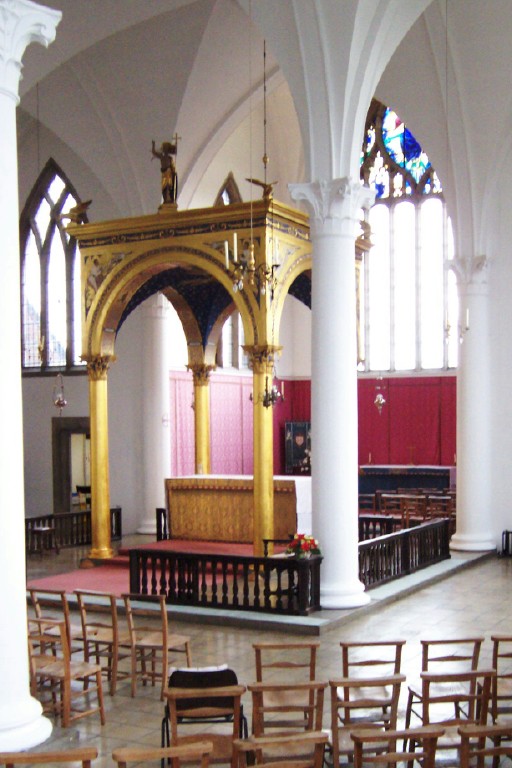
Interior of the Stanbury Chantry Chapel
In the liturgical changes which came through in the aftermath of Vatican 2, the laity were given the choice of receiving Communion in the hand (the practice of the Church for the first 1,000years of her history) or of receiving on the tongue (the later custom which came in the Middle Ages).
Some while ago, to circumvent stories going around that priests were refusing to give Communion to those who knelt and/or wished to receive on the tongue, I made it clear that these decisions were for the individual communicant. As the Catholic Church validated both practices I, as a priest, was duty bound to respect that freedom.
Until, of course, COVID arrived among us. In order to maintain the celebration of the Mass, the Bishops’ Conference announced a number of restrictions, among them the insistence that concelebrating priests must communicate from the chalice by intinction (dipping the fragment of consecrated host into the chalice and carefully take both species to the mouth) and for the laity communion in one kind only, with the priest or extraordinary minister placing the Body of Christ into the palm of the hand, and not on the tongue.
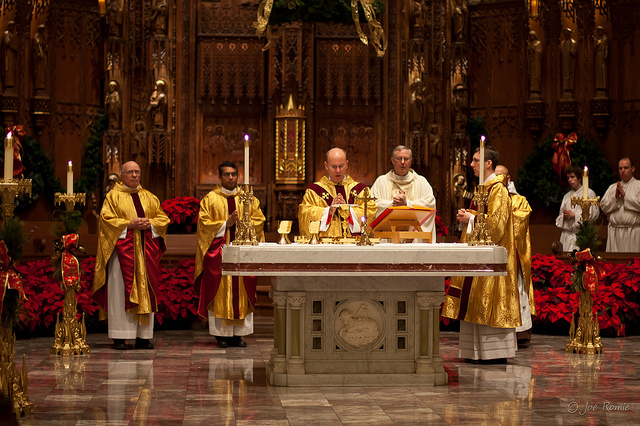
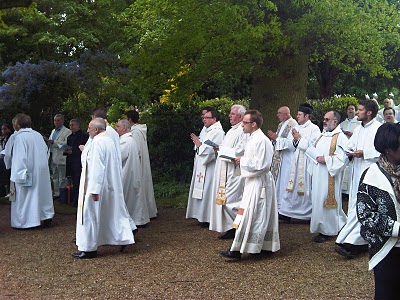
A concelebrated Mass
I am aware of the controversy which has been stirred up and I have read articles and comments on the internet. Some of it is rude and inaccurate : at times I have been shocked by the language used by people claiming to be Catholic Christians, language offending against the law of charity which binds us. But I had not expected to enter into this controversy until last Sunday. I very much doubt if the young woman concerned will read my English language blog ; she left before the end of Mass so I did not have the chance to speak with her. The irony is that we are among the more trad parishes of the diocese – the chasuble is worn for all masses, the Missal followed – indeed, last Sunday I used Eucharistic Prayer 1, the Roman Canon. I was upset and I felt deeply that her behaviour towards me was unjust.
Two questions arise in my mind. The first concerns the way in which holy communion is received. It really cannot be maintained that the older custom (into the hands) is in any way lacking in reverence: it was the custom of Catholic Christians for hundreds of years, and only gave way to the later practice when regular Communion at Mass was on the decline. One might ask why placing the host on the tongue – with all that the Letter of St James has to say concerning the sinfulness of this member – is to be preferred to the hands!
The second question which arises is that of authority in the Church. As a former Anglican I rejoice that I do not have to make controversial decisions on the own authority: that it the responsibility of the Pope and the Bishops. I feel myself to be part of a body, a family, in which decisions are taken corporately. I may not end up on the “winning” side of the argument, but that is neither here nor there. I accept the Church’s decision because I am a Catholic and that’s what Catholics do. It’s part of Jesus Christ’s plan by which the Holy Spirit leads us into all truth. I can argue that principle with Protestants, with Anglicans, (within myself as I once had to) – but I cannot argue it with people who claim to be Catholics but seem to be at odds all the time with the Church.
Over the weekend 19/20 June there were reports that the CEO of Stonewall, Nancy Kelley, had made a startling comparison. She asserted that those who held the view that gender is biologically fixed and cannot be altered, were akin to those who hold anti-Semitic prejudices.
On Monday I listened to part of a programme on Radio 4 entitled ‘Arctic Dreams’. It expressed deep concerns about the exploitation of the Arctic region (mainly by the Western and/or industrialised nations) which were bringing about irreversible changes to the nature of the planet. The presenter ended by telling us that the Eskimos call us ‘The people who change nature’.
I found it interesting to reflect on these two stories.
Between the end of the 19th century until the 1970’s English music enjoyed a period of greatness perhaps not seen since the time of Purcell, maybe even since the flowering of English music under the Tudors. Composers such as Elgar, Parry and Stanford, Vaughan Williams, Gustav Holst, Ethel Smythe, Gerald Finzi, Eric Coates and William Walton, reached deep into the long heritage of English music. They brought forth music which was fresh and innovative yet rooted in the tradition: music which was evolutionary not revolutionary.
Rooted in the tradition because they had been part of the revival of folk music, the music of generations who sang and played instruments. These were ordinary people who, before the invention of the record, CD and music-streaming, ‘made music’ for every sort of gathering. The folk songs are simple without being banal, and memorable without being trite or boring. They are melodious and expressive of joy and sadness – indeed of all the emotions and occasions of human life.
Ralph Vaughan Williams 1872 – 1958
In rediscovering this deep-rooted tradition of music our English composers added elements like superb orchestration which was original and capable of carrying deep emotion. (A good example might be in the contrast between Elgar’s ‘Pomp and Circumstance Marches’ and the ‘Cello Concerto). Some of the music is exquisitely beautiful (‘The lark ascending’ by Ralph Vaughan Willams) without being in the least ‘saccharine’. Much of it is popular and accessible – ‘The Young Person’s Guide to the Orchestra’ by Benjamin Britten, or the war-time music of Eric Coates and his ‘The three Elizabeths’ Suite.
After the Second World War popular music took a new turn in looking towards America for inspiration. A whole genre of music, at first called ‘Rock and Roll’ flooded into the UK, assiduously marketed by the promoters who saw money to be made from a generation of young people now called ‘youth’. Exploiting their desire to distance themselves from their parent’s generation, the ‘music industry’ characterised all earlier music as ‘boring’ and lacking in ‘cool’. Classical music in reaction became increasingly experimental and inaccessible to many people: although rejecting cries of ‘elitism’ it became more and more elitist!
The same period was one of growth and development within the Church of England of a peculiarly ‘English’ style in the ordering of its worship. Increasingly conscious of its Catholic roots the movement reached behind the controversies of the Reformation to the mediaeval period. The beautiful creations of Ninian Comper (the ‘English altar’ at Cantley and the church of St Cyprian, Clarence Gate in London) in his early period are typical examples.
St Cyprian Clarence Gate West London – High Altar
During this period many English Cathedrals were re-ordered, and the heavy Victorian Gothic Revival furnishings removed. Side chapels were re-instated, nearly always with ‘English’ altars. The total effect was fresh and lively with colour, due to the fashion for whitewashed interiors. This was hardly mediaeval, for the churches of that era would have been painted and decorated all over. One gets some idea of the original effect from St Giles’ Cheadle (by AWN Pugin) or Comper’s Crypt Chapel at St Mary Paddington. Yet the instinct was a right one – and the effect of a large, well-lit church, like the parish church at Thaxted, its spacious white interior cleared of pews, its shrines, altars and flower displays creating splashes of colour, is spectacular. If the early designs of Comper, rich and luxuriant, evoke the music if Elgar and Parry, then perhaps the church at Thaxted brings to mind Vaughan Williams – or indeed, Gustav Holst who was musical director there!
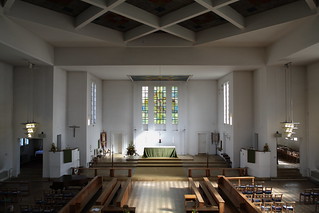
John Keble Memorial Church, Mill Hill, London
The church built at Mill Hill to honour the saintly John Keeble, instigator of the Oxford Movement (the 19th century Catholic Revival in the C of E) shows that this ‘English’ Movement was no pseudo-mediaevalism. The same elements are there: the white interior, the long High Altar (as originally built the altar was longer and surrounded in three sides by curtains, the east window coming down to within a matter of a few feet of the altar, the splashes of colour at the altar and ambos. Liturgical renewal has clearly affected the design, for the church is wider than it is long, there are no pillars, and the choir of singers is placed in the midst of the congregation. In the 1960’s, as I can testify, the Parish Eucharist was both serenely beautiful celebrated with three sacred ministers, and with full participation by a lively and welcoming congregation.
St Philip’ Cosham (1938) – by Sir John Ninian Comper
Sir Ninian Comper began to question his earlier assumptions about church planning. His researches in North Africa led him to develop a much more open plan with the altar separated from the nave only by low rails, and the congregation able to gather around the sanctuary. His theory of unity-by-inclusion enabled him to draw together design elements from classical and gothic architecture. The photograph of St Philip’s Cosham in Hampshire shows a church, totally in line with current liturgical thinking, glowing with colour especially around the altar which is the heart of the building, and drawing on a building tradition 2,000 years old. A remarkable achievement! And one which is surely in line with the musical developments – drawing on a long tradition to evolve and grow – of this fascinating period.
A trip down memory lane to a period now almost beyond living memory? Or a source of inspiration for a generation just beginning to understand the importance of beauty and tradition in worship – and indeed all of life. An English tradition surely dear to the hearts of Catholic Christians in the Ordinariates? A guide perhaps for those clergy and laity (with limited numbers and money) wondering what on earth to do with their grim concrete box of a church built in the 1960’s, asking themselves whether it can ever be beautiful, welcoming and worthy of the worship of heaven celebrated in the Mass?
The Revd Paul Benfield, writing in the Ordinariate Portal magazine, comments thus on the current reorganisation of the Anglican diocese of Sheffield:
” … the Diocese of Sheffield is to have four further Associate Archdeacon Transition Enablers to work with two existing ones. The diocesan website informs us that: These are innovative and transformational roles aimed at leading and supporting … twinned Deaneries through a period of transition. The intention is to create a collaborative context that enables Deaneries, Parishes and Mission Areas to embrace significant change. Full-time Associate Archdeacons will work with flexibility, ingenuity and imagination to grow teams of lay and ordained leaders in shaping a mission-focused church. The role of the Associate Archdeacon is to work in partnership with the Bishops, Archdeacons, Parish Support Team, Area Deans, Oversight Ministers, Focal Ministry Teams, Lay Leaders, and all the baptised members of the diocese of Sheffield, to help realise the Diocesan strategy to be a flourishing and generous Diocese of Sheffield by 2025: Renewed, Released and Rejuvenated!
This is of particular interest to me, since I was ordained as an Anglican in 1974 to a parish in Sheffield Diocese. The parish of Parson Cross became something of a cause célèbre for its successful evangelistic strategy in an area not before or since associated with such success in the C of E. Moreover, I have recently been in touch with some Sheffield Anglicans who are becoming concerned about what is happening there. It had been my intention for some time to write about the experience of Anglo-Catholic evangelism in the 70’s, and perhaps some comparison with the current experiments might not go amiss.
The parish of Parson Cross on the north edge of the city of Sheffield had been established when the estate was built between the wars. With a population of 42,000 it was reckoned to be the largest conventional parish in England. The parish had been staffed by the Kelham Fathers, but after their withdrawal, a married vicar and curate had struggled with this colossal parish and its three churches. In the late 1960’s a team of five clergy and one lay member of the Company of Mission Priests established itself in the rambling clergy house (the former Kelham priory) under the leadership of the late Fr Derek Gibbs (himself an old student of Kelham). The evangelistic thrust of parish life was clear right from the beginning with a simple but demanding commitment expected of Church members. Every year in preparation for the Patronal Feast of St Cecilia the clergy visited those on the electoral roll to renew his or her Rule of Life. During this time the large majority of people made their Confession.
The numbers rose steadily: I was there as a curate from 1974 – 1977 and on a average Sunday 200 people made their Communion. There was a noticeably high proportion of men – indeed at the weekday masses the congregation might consist entirely of men who had come straight from work in the steel mills. A great feature of the parish was the Social Club. Several years of hard fund-raising (no grants to my knowledge) provided a modern hall, bar and lounge, open every night of the week with social events at the weekend. Here the Church met the Parish – in a place familiar to the local people, clergy and church members socialised with their friends – a began to explore the deeper questions which began to arise. The annual Confirmation provided an opportunity for witness and commitment: local people were proud of the parish and belonging to it. Fr Gibbs prepared a large adult class with teaching which was deeply biblical and made real demands.
What was the role of the Bishop in all this? In terms of policy I guess he had little input: he was a pragmatist in believing that if it worked, if people were being brought to Christ, he would support it. But it was essentially a local initiative, and it went against the grain for its neighbours. And yes, there was a good deal of disapproval from the diocese at large. Our practice of Mass attendance and Confession annoyed both the liberals and evangelicals: our opposition to the Anglican Methodist Reunion Scheme and the growing feminist movement in the C of E meant that we were not supposed to grow the way we did. Today the Parish Church of St Cecilia is closed and demolished, the parish left with one daughter church and combined with its neighbour. No Anglican clergy live on the estate.
Faced with tiny congregations, worried laity and indifferent parishioners, the Anglican diocese of Sheffield is certainly working at its plan to reverse this trend. Here is a quote from its website,
The role of the Associate Archdeacon is to work in partnership with the Bishops, Archdeacons, Parish Support Team, Area Deans, Oversight Ministers, Focal Ministry Teams, Lay Leaders, and all the baptised members of the diocese of Sheffield, to help realise the Diocesan strategy to be a flourishing and generous Diocese of Sheffield by 2025: Renewed, Released and Rejuvenated!
The contrast with what we did at Parson Cross is obvious: this is a top-down plan, the initiative of the Diocesan Bishop and staff, a plan to appoint many more people at management level while cutting posts at the parish level, eye-watering amounts of money spent on re-organisation. What is going on at a deeper level? Well, what’s in a name? It’s easy to dismiss the title of “Associate Archdeacon Transition Enablers” with a giggle about what the word ‘transitioning’ means today, but I was struck by “Oversight Ministers” – who would seem to be Team Rectors by a new name. “Oversight”, that’s what bishops do, isn’t it? And “ministers” is what the Protestants call their clergy; it’s “priests” in the C of E, or used to be. The diocese of Sheffield, at least some people in it, created a stink about the nomination of Bishop Philip North, on the grounds that he couldn’t accept women as priests. It would be ironic if now they were working towards the abolition of priests of either gender!
There will be those who argue that my concern about an Anglican diocese is impertinent: when I became a Roman Catholic I ‘deserted’ the C of E and left it to go its own way. I do not agree with them. The greatest boost to evangelism in England would be the re-union of the C of E with the worldwide Catholic Church. From its inception the Oxford Movement sought to demonstrate that the National Church stood in a peculiar and particular relationship to Catholicism. It claimed that it had not rejected hallmarks like the episcopacy, ordained priesthood, sacraments and liturgy. The formation of ARCIC and the pronouncements of Archbishops and Popes all seemed to be pointing the C of E in the direction of re-union (something even our secularised press would have found it difficult to ignore). The worry that this process has now gone into reverse must be of deep concern to all Christians. 150 years of progress towards unity and the possibility of the transformation of the religious scene in England should not be lightly set aside.
A friend of mine has been reading ‘Catholics in Crisis’ by Francis Penhale. Written in 1986 it was part of a Mowbray’s series on the Church of England. (At one time I had another book in the same series, ‘Evangelicals on the move’ by Michael Saward). My friend had been struck by the author’s portrayal of a movement on the decline and fearful about its future. ‘But I don’t remember it being like that in the 1980’s!’
Neither do I, which is why in this post I want to reminisce a little about the two Conferences held at Loughborough University in 1978 and 1983; and then the Caister Conferences, held annually (with some exceptions) between 1996 and 2008.
I was not at the first Loughborough Conference: my vicar at the time went, and brought me back copies of the addresses. I remember being deeply moved by one entitled ‘Consecration’, delivered by Richard Holloway. I recall his remark that priests usually make lousy prophets: they cannot see the wood because they are too busy caring for the trees. The second Loughborough Conference I did go to, though I remember little of it, except the evening hour of adoration led by the Charismatic Group (and presided over by a Bishop) – the first time I had experienced open prayer and the tongues in front of the Blessed Sacrament. A powerful combination I thought at the time – and still do.
The Caister Conferences (held at a holiday camp in Norfolk) were the initiative of the then Bishop of Horsham, Lindsay Urwin. He had felt the need for something that combined the elements of a Conference, teaching and fellowship, with a Retreat, worship and times of prayer. The Conferences were received with acclaim: with the daily centrepiece being an hour of prayer in silence before Jesus in the Blessed Sacrament. There was much getting-together and much laughter, as you would expect of Anglo-Catholics. (I am reminded that the first night of the first Conference the bar ran out! They had had a well-known Evangelical Parish there the previous week – bar closed – and were stunned to discover that it was back to normal consumption with this group of Anglicans!) Attendance at the Conferences varied between 500 and 1,000. Not bad for a Movement judged from outside to be on its last legs.
Good modern liturgy, hymns and songs from Gregorian chant to Graham Kendrick, orthodox teaching and lively presentation – all stuff which one could take back to the parish. The current obsessions of the C of E were far away. It felt as if we were on the move – and perhaps we were, though not in the direction that we imagined. For a time it seemed as if the promises made by the C of E about ‘mutual flourishing’ would be honoured. Twenty years later I am inclined to agree with another friend who remarked, “It wasn’t so much that Anglo-Catholicism was dying, but rather that it wasn’t being given the space to breathe.”
Many of us now find ourselves swimming in the much larger sea of the Catholic Church. In the early days of formation for reception we were wisely advised to try to put behind us the controversies which had filled our time as Anglicans and I hope that posts like these do not reveal an obsession with the past. But I do want to give thanks for all the blessings heaped on us during difficult times, and for the joy and hope which I myself shared with many others. And I hope that the patrimony represented in the liturgy, prayer, teaching of fellowship of Caister is something which we can bring into the Catholic Church.
I have been reminded of the great gathering of Anglo-Catholics in East London to welcome and celebrate the Millennium in 2000, “Christ our Future”. The Mass filled the 10,000-capacity London Arena, and was concelebrated by the Archbishop of York, David Hope, with more than 35 other bishops and 750 priests, and the preacher was the Bishop of London, Richard Chartres. So many clergy (visible in those days by the collar and often, the cassock) crowded on to the trains and tubes approaching the Arena that people stopped to ask what was going on. It was said to be the largest gathering of Anglicans to celebrate the Millennium. Significantly, it received little publicity in the Church or secular press. In spite of this, gatherings like this are of great value at the ‘celebration’ level (‘the more the merrier’ the books say) and Anglo-Catholics have been good at organising them).
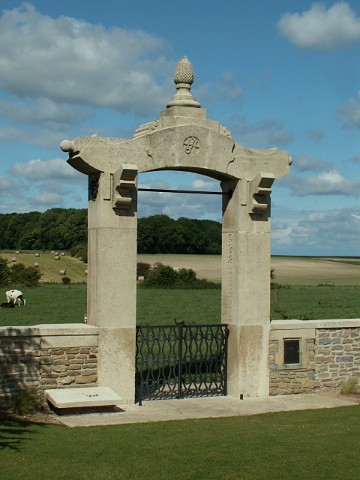
My great uncle, Frank Anderson, died of his wounds in the Great War. His body is buried in the Commonwealth War Graves Cemetery at Aubigny-sur-Artois in the Nord departement in France. Here in the Somme is the Chinese Cemetery at Noyelles-sur-Mer, on the way to the coast. The entrance gate, the design of Sir Edwin Lutyens, is shown in the photograph above.
In this cemetery are the graves of those Chinese who came from far away to join the Chinese Labour Corps. Many of them stayed on after 1918 and died in the Spanish Influenza epidemic. The cemetery is poignant and deeply moving.
It is sad to hear the reports from Africa of the bodies of black soldiers not treated with the respect that was undoubtedly their due, alongside their white colleagues. One hopes that this will soon be rectified.
The little cemetery at Noyelles shows the intention (apparently not always fulfilled) of the Commonwealth War Graves Commission that there should be no distinctions among the dead of race or class.
The title of this post indicates the three ways in which people become Catholic Christians. But there is a lack of coherence, a mismatch, if you like, between the three.
Research has shown that a substantial of people become Catholics who are already believing Christians; they have practised their faith as Anglicans, Methodists, Pentecostals … A much smaller number are converted to Christ; they have not been baptised or brought up in the Christian Faith, and are therefore called Catechumens. Then there are the infants of Catholic parents brought to baptism. The commitment of these families will vary from those who are regular at the Sunday Eucharist and manifest a clear understanding of the Faith, right through to those who are there for social reasons – grand-parental pressure or the party afterwards.
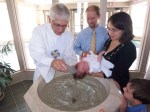
Infant Baptism
The preparation of people in these different groups varies enormously, and the link between what is basically the same process – men women and children entering the Catholic Church – is not at all clear.
The preparation of those who are already believing Christians has become much more sensitive and understanding in recent years. These are people who have been living the Christian Faith for many years. They have come to realise that for the fullness of Christian life they need to embrace the unity and truth of Peter. If they come from the C of E and its Anglo-Catholic tradition they may well have a grasp of the Eucharist, a devotion to Mary, and an adherence to the Sacrament of Penance deeper than some cradle Catholics! In the past this has not always been understood by Catholic laity and even some Catholic clergy. Nonetheless, they do not want to ‘slip in by the back door’. They want to prepare seriously for a profound moment in their Christian journey and they want to mark that moment liturgically within the Catholic Community.
The preparation for adult baptism lasts normally two years. Various rites presided over by the Bishop in his Cathedral Church mark the decisive process of becoming a Catholic Christian. The newly baptised are anointed in Confirmation and receive the Eucharist, thus restoring the traditional order of Initiation. The process is profound and absorbing, though it needs to be animated effectively and imaginatively by those who accompany and teach the Catechumens.
Sunday by Sunday, often in the afternoon fitted in between the morning and evening gatherings for the Mass, infants will be baptised. Here in this rural diocese in France the huge majority will be of families who rarely, if ever, go to Mass. More and more parents in this group defer the baptism until they can afford the obligatory party (which they have arranged before approaching the parish) The Baptism preparation team does its best in a couple of sessions, but its suggestion that the families might want to continue their connection with the parish community after the baptism is greeted with blank looks. Of course, this attitude is not universal, but I believe it is widespread. Even among the faithful there is a belief that baptising a child – without any sign of commitment from the family – might somehow do some good; and that refusal or even conditions somehow “puts off” parishioners. The evidence suggests otherwise.
I am not for one moment suggesting the abolition of infants baptism – such a position would be unscriptural! I am proposing that the gap between baptism of adults and of babies (and questions concerning preparation, celebration of the baptismal liturgy, and discipline) be acknowledged and tackled.
On Good Friday a special intercession was added to the Solemn Prayers of the Liturgy. Here is the prayer for use with the Ordinary Form:
Let us pray also for all those who suffer the consequences of the current pandemic, that God the Father may grant health to the sick, strength to those who care for them, comfort to families and salvation to all the victims who have died.
Almighty ever-living God, only support of our human weakness, look with compassion upon the sorrowful condition of your children who suffer because of this pandemic; relieve the pain of the sick, give strength to those who care for them, welcome into your peace those who have died and, throughout this time of tribulation, grant that we may all find comfort in your merciful love. Through …
In the Ordinariate this prayer, based on one found in the Anglican 1662 Book of Common Prayer, was said by those using the Divine Worship Missal:
Let us pray likewise for all who suffer through plague or sickness: that God the Father Almighty may bestow on us the healing of his grace.
V. Let us bow the knee. R. Arise.
O Almighty God, who in thy wrath didst send a plague upon thine own people in the wilderness for their obstinate rebellion against Moses and Aaron; and also in the time of King David, didst slay with the plague of pestilence threescore and ten thousand, 3and yet remembering thy mercy didst save the rest; Have pity upon us miserable sinners, who now are visited with great sickness and mortality; that like as thou didst then accept of an atonement, and didst command the destroying Angel to cease from punishing, so it may now please thee to withdraw from us this plague and grievous sickness; through Jesus Christ thy Son our Lord, who liveth and reigneth with thee, in the unity of the Holy Spirit, ever one God, world without end. Amen.




 Ordinariate Pilgrim