
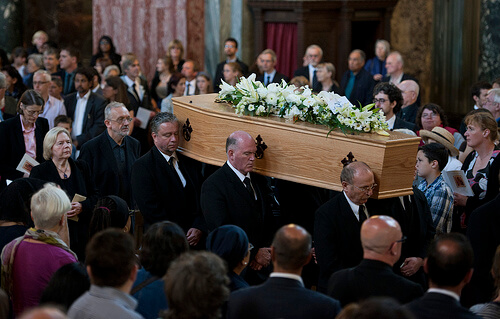
It has been pointed out to me that my last post – a tongue-in-cheek proposal for marriage celebrations not attended by the couple – might have puzzled readers from outside the UK. Let me try and explain.
Fifty years ago the normal pattern for a funeral in this country had the Funeral Directors contacting the local priest or minister, depending of the stated faith of the deceased (or his or her family.) It was my practice and that of many clergy to contact the bereaved family and if possible to see them at home. Here we encouraged them to talk about their memories and their love (or occasionally lack of it) for their departed relative. Some Funeral Directors, seeking to exercise control over the process, would contact a preferred cleric, often one who was retired. Some of these retired clergy took the need for pastoral care seriously, just as some parish clergy did not! But a feeling grew up that funeral services were ‘rushed’ and ‘impersonal’.
As more and more local firms were taken over by large companies so the link with the local clergy was lost. And as ‘no religion’ supplanted ‘C of E’, so ‘Funeral Celebrants’ began to officiate at services. Being employed by (or at least dependant on) the Funeral Directors, these officiants crafted their ‘services’ to suit their employers – and the bereaved family. Out went any attempt at liturgy or prayers, and in came those lengthy tributes to the accompaniment of Frank Sinatra singing ‘My way’.
At this stage there was still often considerable public display, with horse-drawn hearses, numerous black limousines, and banks of flowers.
Recently there has been a shift in the opposite direction. Public concern about the cost of funerals (together with several scandals surrounding their conduct) has led to a number of large companies offering a minimalist funeral at basic cost. This is being aggressively marketed as anyone who watches television in the UK will know. Under this system the body of the departed person is collected soon after death from hospital or home; and taken directly to a crematorium. There is no service and no-one attends the crematorium. The cremated remains, or ashes, are then returned to the next of kin to do with as they see fit. And basically that is it.
The advertisements for this form (or rather lack) of funeral attempt to soften the edges. First of all the great god Choice is invoked. The lady in the advert assures us that she wants to do it ‘my way’. A couple of actors tell us that they don’t want their children worrying when ‘the time comes’. There will be time to organise a ‘send off”. One of the adverts does mention a ‘church service’ but lying in the bath and talking about sausage rolls, or coming in from the garden carrying a large bowl of trifle, seems to be the norm of such ‘send-offs’.
You would expect me as a Christian and a priest to be saddened by the erosion of belief in this country of faith in Eternal Life. Protestantism must take some share of blame here, with its unreasonable and unchristian rejection of prayer for the dead. But I also believe that we are now living in an age which is so fearful of death that it refuses to even acknowledge it. Moreover, the process of grieving cannot be simply shut off without real psychological harm.
Hence my post, where I contrasted the huge amounts of money spent on tasteless display when it comes to marriage with the mean and penny-pinching funerals which are proposed daily on our television screens.


I think you are absolutely right about the influence of Protestantism (if you can’t/won’t pray for the departed all you’re left with is a “celebration”, so why not do it “your way”?) and the psychological and spiritual harm caused by denying the grief process its proper course.
What worries me most about those adverts is the depiction of happy, smiling, partying spouses and children. Grief is messy, raw and disabling and to imply that not acknowledging it ritually or seeking God’s help in it will make it somehow less painful is a scandalous and dangerous lie.